
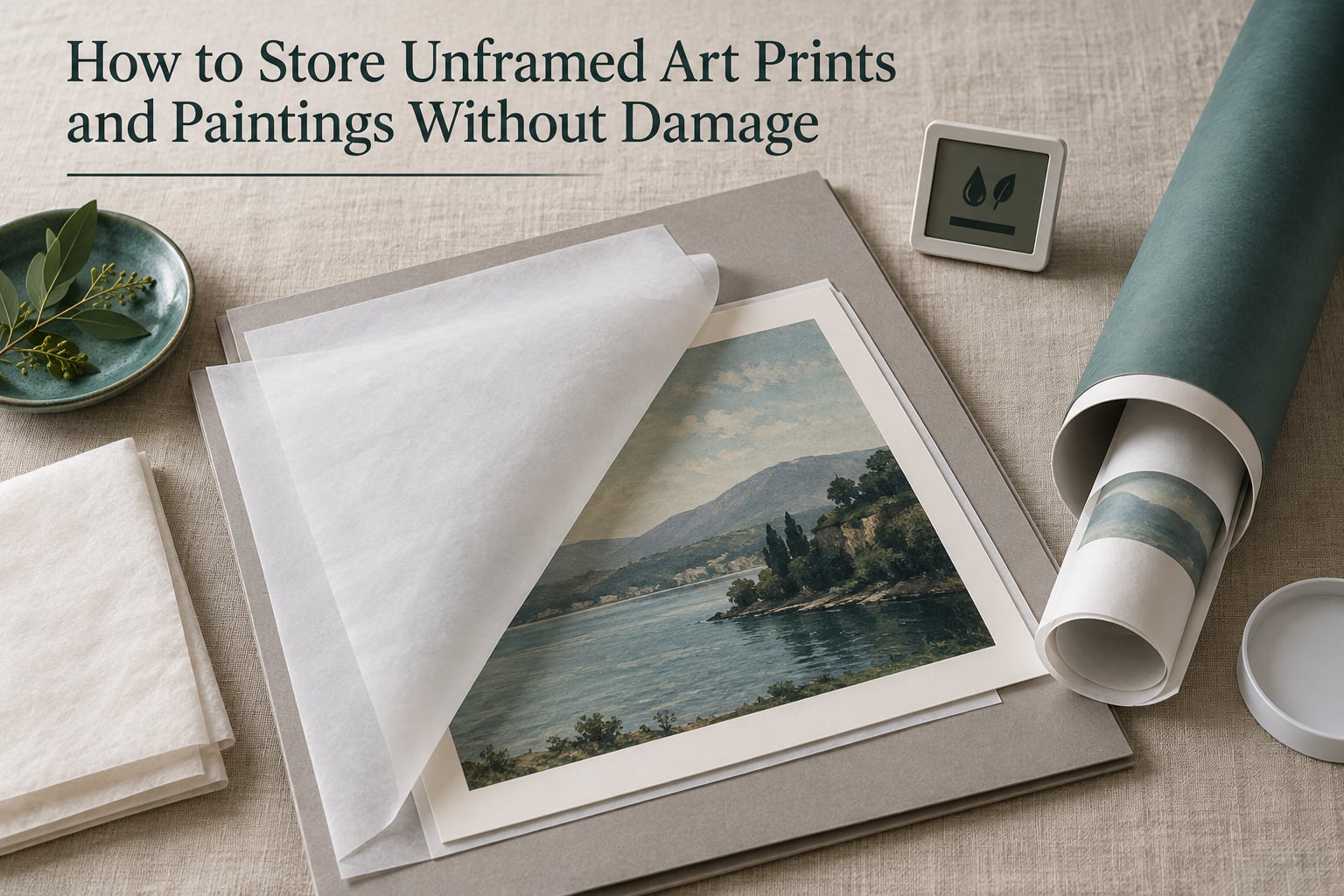
Store unframed art prints and paintings flat, interleaved with acid-free tissue, inside a rigid-backed board, in a dark room held at roughly 40-50% relative humidity and 60-70°F. Rolling is a second choice, not a first, and only works for flexible, fully dry media on a tube at least 3-4 inches wide.
That is the whole method. Almost every storage mistake I have seen comes from skipping one of those four variables: a rigid contact surface, a dark enclosure, a stable climate, and enough space that nothing is pressing on anything else.
I have spent years sorting collections for family members and for a small gallery, and the pieces that survive are almost never the most valuable ones. They are the ones that got boring, correct storage. Light fades pigment and dye permanently. Humidity warps stretcher bars and grows mould along paper edges. Pressure creases paper and cracks paint that has gone brittle. None of it reverses.
This guide covers the four storage methods, the numbers behind them, what you can and cannot roll, what to buy first when money is tight, and what to do with a print that has spent two years in a tube. I have kept it 2026-current as new damage mechanisms and better archival materials have come into use.
Table of Contents
- Quick answers to the three questions people search most
- Flat vs rolled vs upright: the decision table
- What damages unframed art, and why storage works in layers
- How to store unframed art prints and paintings without damage: flat storage
- Method 2: how to roll a canvas print and store it in a tube
- Method 3: upright storage for stretched and gallery-wrapped canvas
- The storage environment: temperature, humidity, light, and locations to avoid
- Supplies checklist: what to buy first on a budget
- Inventory and condition notes before you store anything
- Packing and moving unframed art safely
- Handling rules that prevent most accidental damage
- How to de-curl a print after long-term storage
- Common mistakes and how to fix damage that has already happened
- Special cases: heirloom prints, children’s artwork, and oversized works
- Display rotation and the 70/30 rule
- When storage is the wrong answer
- Frequently Asked Questions
- What is the best way to store art prints?
- Is it better to store art flat or in a folder?
- Is it better to store posters flat or rolled?
- Can canvas painting be rolled?
- What is the best way to store canvas prints?
- What to do with unframed canvas prints?
- What is the best way to store old paintings for long-term storage?
- How do you keep art from fading in storage?
- How to hang art prints without damaging them?
- Is it okay to hang an unframed canvas painting?
- What do you do with old family canvas prints?
- How do you flatten a rolled art print?
- What is the 70/30 rule in art?
- Conclusion
Quick answers to the three questions people search most
What to do with unframed canvas prints? Sandwich the canvas between two rigid foam-core or archival boards, tape the boards together with gummed paper tape, and store the package flat in a dark cupboard. If the piece is already stretched, store it upright on a shelf with dividers and nothing leaning against it.
Is it better to store art flat or in a folder? Flat wins for anything printed on paper. A rigid sandwich of two boards with acid-free tissue between the layers prevents flex, abrasion, and curling, and it protects against the small scuffs that happen in a shared cupboard. Rolling is only reasonable when floor space runs out and the print is flexible and dry.
Can canvas painting be rolled? A dry, flexible canvas print can be rolled, but never tightly and never small. Use an archival tube at least 3-4 inches in diameter, roll with the image on the outside, and interleave with glassine. Never roll a freshly painted oil or acrylic surface, thick impasto, an aged brittle varnish, or a mounted panel.
Flat vs rolled vs upright: the decision table
Choose flat for paper and anything fragile, rolled for flexible media when space is the constraint, and upright for stretched canvas. The deciding variable is not size. It is how much the surface flexes, and whether you have dark, dry, rigid space to put it in.
| Method | Best for | Space used | Main risk |
|---|---|---|---|
| Flat in a rigid sandwich | Paper prints, posters, giclee and pigment work, anything valuable | High, floor or shelf area | Warping if the board is not rigid enough |
| Rolled in an archival tube | Flexible canvas prints, large posters, works in transit | Low | Curl memory and a crease along the leading edge |
| Upright on a shelf | Stretched and gallery-wrapped canvas, board-mounted pieces | Medium | Abrasion and stretcher-bar bowing if packed tight |
| Flat in a portfolio | Works on paper, prints with matt surfaces, small collections | High | Creases at corners if the portfolio flexes |
A poster that will be shown for a few years and then discarded is a fine candidate for a tube. A family print that is meant to outlast you is not. Treat the storage method as a decision about how long you intend to keep the piece, not about how awkward the piece feels in your hands.
What damages unframed art, and why storage works in layers
Unframed work has no glass, no mat, and no backing, so nothing stands between it and the room. Storage is simply a stack of barriers, and each one blocks a specific mechanism.
- Light and UV. Pigment inks, dye sublimation, photographic dyes, and paper all fade under ambient light, and fading is cumulative and irreversible. Even indirect daylight through a window is enough over years.
- Humidity swings. Above roughly 60% relative humidity, paper cockles and mould finds the sheet edges. Below about 35%, paper dries out and becomes brittle at the folds. A room that swings daily is worse than one that is simply warm.
- Abrasion. Every contact is a scuff. Two prints stored face to face without a tissue sheet between them will both end up with a matte area in the middle.
- Flex and pressure. Paper creases where it bends, and oil paint cracks where the support moved. A board that is too thin, or a stack with too much weight on top, causes both.
- Pests. Silverfish, booklice, and fire ants are drawn to warm, damp, dark storage spaces with organic paper and glue. Insect frass on a sheet edge is the first sign.
- Acidic contact. Ordinary paper, cardboard, and some plastics release lignin acids that brown the sheet they touch. This is why pH-neutral interleaving matters more than the box the art sits in.
The four layers that neutralise those six mechanisms are a pH-neutral contact surface, a rigid support that stops flex, a dark enclosure that stops light, and a stable environment that stops mould. A setup that does all four will hold for decades. A setup that does three will usually be fine. A setup that does one is a box of paper in a hot cupboard.
How to store unframed art prints and paintings without damage: flat storage
Flat storage is the safest option for anything printed on paper, and the only correct answer for a valuable work. The whole point is that the print never bends.
- Interleave first. Lay the print on a sheet of acid-free tissue, then another sheet over the top. Interleaving is the sheet of material placed between two artworks to stop them touching, and it is what prevents the scuff marks and the acidic transfer.
- Add a rigid backing. Place the sandwiched print on a piece of archival foam-core board or two-ply museum board, cut two inches larger than the print on every side. Rigid board is what stops flex; tissue alone will not.
- Cap it. Put a second board on top and tape the two boards together at the edges. Use gummed paper tape, not ordinary tape, so nothing acidic touches the art.
- Keep stacks shallow. Aim for no more than about two inches of stacked weight inside a package. More than that and the lower sheets take a set from the weight above them.
- Store flat, not on edge. Put the packages in a flat file, a drawer, or a portfolio. A sheet leaning on a shelf edge is slowly creasing itself.
- Label the outside. Write the title, size, medium, and date on the board edge with a soft pencil. A label you cannot read without unpacking is a label you will curse later.
A user on statueforum described a home made portfolio built from two sheets of acid-free foam core taped with duct tape, and it is a sound idea with one swap. Replace the duct tape with gummed paper tape on the outside edges only, and it becomes archival because nothing acidic is touching the paper.
If you have no foam core, a rigid picture frame with the glazing and backing removed works as a shell around the sandwich, again with tissue on every contact surface.
Method 2: how to roll a canvas print and store it in a tube
Rolling is a compromise that buys floor space. It works when the media is flexible, fully dry, and free of thick texture, and it fails when the roll is too tight or the tube is too narrow.
- Choose a wide tube. The roll should sit on a tube at least 3-4 inches in diameter. A narrow tube sets a permanent curl that no amount of weighting will fully remove.
- Lay the print image-side up. Put a sheet of glassine or acid-free tissue over the printed face before you move it at all.
- Roll from the bottom, image out. The painted or printed side goes on the outside of the roll. Cracking and abrasion happen on the compressed inner surface, so the image stays on the convex side.
- Keep pressure even. Use one hand at the leading edge and one at the tube, moving them together. Never let the leading edge lag behind, because that is where a diagonal crease starts.
- Interleave the loose end. Place a sheet of glassine on top of the roll so it cannot touch itself, then slide it into the tube.
- Seal and store upright. Cap both ends and stand the tube in a dark cupboard, off the floor, out of any direct light.
Here is what you should never roll. Freshly applied oil or acrylic that has not cured, because the surface is still soft and will crack the moment it flexes. Thick impasto, where the paint layer physically cannot bend without breaking. Aged or brittle varnish, which flakes under stress. Mounted or pre-stretched panels, which crease at the mount line. Anything of real value that you can store flat.
The roll to leave in its tube is a print that just arrived that way and is not going on a wall for a while. A photography forum summary of the prevailing advice is simply to keep prints in the dark at relatively low humidity, and that is the correct instinct for anything in a tube.
Method 3: upright storage for stretched and gallery-wrapped canvas
Stretched and gallery-wrapped canvas should never lie flat. The weight of the stretcher bars and the stretcher-bar tension underneath create slack in the middle of the canvas, and slack becomes a sag, and a sag becomes a permanent deformation.
- Use a deep shelf or a canvas rack. The piece must stand upright with the stretcher bar edges fully supported.
- Add separators. Place foam-core sheets or archival foam between each canvas so no two painted surfaces ever touch. Face to face storage is the single most common way unframed canvas gets marked.
- Keep it off the floor. Concrete and slab edges wick moisture, and the bottom of a canvas is where mould and pests start.
- Do not lean stacks. A row of canvases tilting against one another puts lateral pressure on the front faces, and that is what causes stretcher-bar bowing and permanent wrinkles.
- Cover the whole group. A breathable dust cover or a dark cabinet keeps out the lint and the silverfish that a fabric surface attracts.
Someone on r/ArtistLounge pointed out that ink prints can be stretched on bars and later unstretched for storage or transport, which means removing the stretchers is a legitimate option when you need flat storage. If you unstretch, release the corner staples fully and pad the stretcher bars, because the edges of a stretched canvas are the first place a dent appears.
The storage environment: temperature, humidity, light, and locations to avoid
Target a stable 60-70°F and 40-50% relative humidity, in a room that is dark and ventilated. Stability matters more than the exact number. A room that holds 55% all year is better storage than one that sits at 45% in winter and 70% in July.
Keep art out of direct sunlight and out of rooms lit by ordinary bulbs for long periods. If a print has to live in a room with lighting, a closed cabinet door is a better answer than a UV filter that adds cost and glare.
| Location | Verdict | Reason |
|---|---|---|
| Interior closet or cabinet | Good | Dark, stable, no light exposure, air movement |
| Interior wall of a conditioned room | Good | Holds temperature and humidity close to living conditions |
| Climate-controlled self-storage unit | Acceptable | Works if you use sealed tubs, not cardboard boxes |
| Basement, dry and finished | Risky | Damp, pests, flooding risk. Needs a dehumidifier and sealed tubs |
| Garage or shed | Avoid | Extreme heat swings, damp, pests, no climate control |
| Attic | Avoid | Hundreds of degrees in summer, condensation in winter, and freezing paper becomes brittle |
| Damp closet or enclosed porch | Avoid | Standing humidity drives mould and silverfish within months |
| Wall directly on an exterior surface | Avoid | Condensation behind the sheet, temperature swings you cannot control |
| Unheated self-storage unit | Avoid | No temperature control, shared damp, and a real risk of condensation on the box |
A hygrometer clipped inside the cabinet answers the confidence gap that people hit most often. If it reads 40-50% and the needle barely moves over a week, your setup is good enough and you can stop worrying about it.
Humidity above 60% brings mould and silverfish. Humidity below 35% makes paper and paint film brittle, so do not chase an artificially dry room in winter.
Supplies checklist: what to buy first on a budget
Spend in this order and the expensive items can wait. Each item below maps to a specific damage mechanism, and the priority column is what I would buy first if money were tight.
| Supply | Prevents | Budget priority |
|---|---|---|
| Acid-free tissue or glassine sheets | Acidic transfer, scuffing, face-to-face abrasion | Buy first, always |
| Rigid foam-core or museum board | Flex, creasing, corner dents, stack set | Buy second |
| Gummed paper tape | Acidic contact from ordinary tape and duct tape | Buy second |
| Archival tube, 3-4 inch diameter or wider | Curl memory, creases, edge abrasion on rolled work | Buy third, only if you must roll |
| Sealed plastic tub with gasket | Mould, pests, and moisture in basements and units | Buy third for damp locations |
| Hygrometer | Unknowable humidity, the confidence gap | Buy third, high value for the money |
| Cotton gloves or nitrile gloves | Fingerprints, oils, abrasion during handling | Nice to have, clean hands are the real requirement |
| Lint-free cloth | Dust and grit dragged across an ink surface | Nice to have |
Archival materials are described with three terms you will see constantly. Acid-free means the paper will not release acids. pH-neutral means it is neither acidic nor alkaline, so it will not shift the pH of the sheet it touches. Buffered means it contains a reserve compound that neutralises acid, which suits works on paper but is a poor choice for photographs and some works on metal, where the buffer can cause a colour shift over time.
The word archival on a retail print is a marketing phrase more than a standard. The useful questions are what the ink is, whether the paper is certified pH-neutral, and whether the surface is matt or gloss, because gloss and semi-gloss ink surfaces show scratches that a matt surface hides.
Inventory and condition notes before you store anything
Photograph every piece before it goes into storage, and photograph the storage location itself. Two years in a portfolio, you will not remember which of four similar prints was the one with the water stain.
- Number each piece and write the number on the outside of its package in pencil.
- Record the essentials: title, artist if known, size, medium, date of the work, and the date you stored it.
- Note existing condition, including any foxing, tears, dents, or prior repairs. A photograph taken now is your baseline for arguing about damage later.
- Keep the list off the storage unit. A written inventory in a separate file, or a phone photo of it, survives a flood or fire that the art may not.
This takes about ten minutes per piece and it is the only part of storage that gets harder to reconstruct the longer you wait. Nobody remembers what a box contained after four summers.
Packing and moving unframed art safely
Most art damage happens during a move, not during storage. The vulnerable moment is not the drive, it is the three days after the boxes are opened when everything is being decided at once.
- Use rigid sandwich packs for anything on paper. Board, tissue, art, tissue, board, taped at the edges. Never a poster sandwiched between two soft cardboard shipping boxes.
- Stand boxes upright and pad them. Stack them like books in a padded vehicle corner, with nothing heavy resting on any art surface.
- Roll only what has to be rolled, and label the tube with the piece inside. A tube arrives on the other end of a move and nobody knows what is in it.
- Keep art out of the car during a warm drive. A parked vehicle in summer reaches temperatures that will curl a print flat in a box within a couple of hours, which is why a forum user mailing unframed prints in a hot climate asks about this so often.
- Never use bubble wrap directly on a print face. It traps grit and prints its texture into the surface. Wrap the board sandwich, then the bubble wrap, with tissue at the contact surface.
- On arrival, unpack into the final room first. Let pieces acclimatise for 24 to 48 hours before flattening or hanging anything, and do not stack fresh arrivals against a wall.
If you are storing art for a few months during a renovation, the habitable-room cupboard is genuinely fine. A conditioned interior room at 40-50% relative humidity beats a dry garage every time.
Handling rules that prevent most accidental damage
Most marks on unframed art happen while it is being moved, not while it sits still. These are the rules I follow without exception.
- Wash and dry your hands, or wear clean cotton gloves. Bare hands on clean skin are fine. Gloves are for skin that is not, because skin oil and lotion transfer a fingerprint that is hard to lift later. On a fresh ink surface, nitrile gloves are better than cotton because cotton fibres can snag.
- Lift by the edges, always. A print is held at its corners or edges, never across the middle, because pressure in the centre is what creates a bow that becomes a crease.
- Never put tape on a painted or printed face. No masking tape, no sticky notes, no tape used as a bookmark. Even low-tack tape pulls the varnish or ink layer when it is removed.
- Never stack face to face without tissue. Interleaving is the whole reason a stack survives contact.
- Work on a clean, padded surface. A dining table with grit on it will emboss a sheet with that grit.
- Keep pets and food out of the storage space. A dog in the room where a portfolio is open is a real and common cause of paw prints and edge chew.
- Log every move. Write where the piece went and when. Storage damage is usually discovered months later, and the date narrows down the cause.
How to de-curl a print after long-term storage
A print that comes out of a tube after two years will not lie flat on its own, and the goal is to relax it slowly rather than force it. Rushing this is what turns a curl into a crease.
- Open the tube and check the surface first. Look for a visible crease, a whitening line, or a dull scuffed band. If the crease is there, de-rolling will not remove it.
- Lay the print image-side up on a clean, flat surface larger than the sheet.
- Place a sheet of glassine over the image and leave the leading edge slightly proud so you can feel it.
- Anchor the corners with clean, heavy books or weights. Four books on the corners, weighted gradually, is the standard approach and it works because the curl relaxes in stages rather than all at once.
- Wait 24 to 48 hours before judging it. Add weight if it is still lifting at the leading edge.
- Do not use heat, steam, or a hair dryer. Accelerating a curl with heat sets the memory more permanently than the original roll did.
If the curl will not relax under weights, sandwich the print between two damp-but-not-wet sheets of paper inside a plastic bag for several hours, then press it flat under boards. This is a last resort for watercolour or works that tolerate moisture, and it is not appropriate for anything with a gloss or lamination layer.
For canvas that has gone slack, there is no home fix. A canvas with a new slack area has usually lost stretcher-bar tension, and the correction is a re-stretch by a conservator, not a roller and a hammer.
Common mistakes and how to fix damage that has already happened
Some storage damage is reversible and some is not. Knowing which is which saves you from trying to fix something that will only get worse.
- Edge curl and mild wave. Usually reversible. Interleave and weight for 24 to 48 hours as described above.
- Corner crease. Difficult. Laying the sheet over a rounded form under weights can soften it, but the line usually remains visible under raking light.
- Matte scuff ring from face-to-face contact. Not reversible. A faint matte patch on a gloss print stays.
- Foxing, the small brown spots from humidity. Only stoppable, never removed. Isolate the piece, lower the humidity, and keep it separate from everything else.
- Fading. Permanent. This is why the dark enclosure is the layer people most often skip and most often regret.
- Insect silk or frass. Clean the area with a soft brush, isolate the piece in a sealed tub for a few weeks, and treat the whole storage space, not just the affected piece.
- Slack or bellied canvas. Conservator work. Rolling it back up to fix it makes the deformation worse.
One real failure we saw involved a family collection stored in a self-storage unit in a coastal town. The cardboard boxes held fine, but the tube of rolled prints inside them was attacked by insects along the tape seam, and the outer print was speckled within one season. Sealed plastic tubs with gasket lids are the fix, and they cost very little.
Special cases: heirloom prints, children’s artwork, and oversized works
Heirloom and family prints. Treat these as the highest-value category because they are irreplaceable, not just expensive. Flat storage, interleaved, buffered tissue suitable for the paper, and never a self-storage unit. A fireproof document box in an interior closet gives you flood and theft protection at the same time.
Children’s artwork. Crayon, marker, paint, and glue stick create uneven, absorbent, sometimes sticky surfaces. Store flat in a rigid sandwich and never roll it. Mount the good pieces and display or frame them, because the drawings that get damaged are the ones that sat in a box untouched for years.
Mixed media with glitter, thick paint, or raised texture. This cannot be rolled. Flat only, with rigid boards on both sides so nothing presses into the texture.
Oversized works. Anything wider than your largest board and longer than your widest tube needs a plan. Options in order of preference: mount it, frame it, store it flat in a dedicated portfolio with a second sheet of board as a lid, or store it upright between two full sheets of rigid board with tissue on both faces. Never improvise with a rolled tube on a work larger than the tube, because the fold becomes a permanent crease.
Display rotation and the 70/30 rule
The 70/30 rule comes from display practice: the same work is displayed for 70% of a rotation period and put away for 30%, which spreads light exposure across the collection instead of destroying the one piece on the wall. A single piece on a south wall in full sun can lose a visible share of its colour in a few years.
Applied to storage, the rule is a reason to rotate rather than store. Every month a work spends flat and dark in a cabinet is a month it is not fading, not collecting dust, and not getting touched by someone with greasy hands. Storage is not a permanent state; the pieces you rotate out get their turn, and the ones in the cabinet are resting.
When storage is the wrong answer
If a piece is going to be on a wall within a year, storage is an unnecessary risk and an unnecessary expense. Frame it, glaze it with acrylic rather than glass if the surface is fragile, and hang it out of direct sunlight. An unframed canvas can be hung safely as long as you hang a proper hanging hardware on the stretcher bar, keep it off a wall that gets damp, and keep pets off it.
Storage earns its cost for pieces you will not see for a while, for work that arrives rolled and has no plan yet, for anything inherited and not yet catalogued, and for the overflow of a collection larger than your walls. Everything else is better framed and displayed.
Frequently Asked Questions
What is the best way to store art prints?
The best way to store art prints is flat, in a rigid sandwich of two boards larger than the print, with acid-free tissue between every contact surface, in a dark room kept at roughly 40-50% relative humidity and 60-70°F. Interleaving stops scuffing and acidic transfer, and the rigid board stops flex and creasing. Keep stacks under about two inches of weight and label the outside of each board.
Is it better to store art flat or in a folder?
Flat is better for anything printed on paper. A flat folder or portfolio only protects against dust, while a rigid sandwich of two boards with acid-free tissue between the layers also prevents flex, abrasion, and curling. Rolling is reasonable only when floor space runs out and the print is flexible and fully dry. Large flexible canvas prints can go in an archival tube.
Is it better to store posters flat or rolled?
Store a poster flat if you plan to keep it for more than a couple of years, because rolling sets curl memory. A rolled poster in a 3-4 inch archival tube is fine for short-term storage, transport, or a work you will discard. If you do roll it, keep the image on the outside of the roll and interleave the loose end with glassine.
Can canvas painting be rolled?
A dry, flexible canvas print can be rolled, but never tightly and never on a narrow tube. Use an archival tube at least 3-4 inches in diameter, roll with the image on the outside, and interleave the leading edge. Never roll freshly applied oil or acrylic, thick impasto, an aged brittle varnish, or a mounted panel, because each will crack or crease permanently.
What is the best way to store canvas prints?
The best way to store a stretched or gallery-wrapped canvas is upright on a shelf or in a canvas rack, with foam-core separators between each piece, nothing leaning against the front faces, and the whole group off the floor and out of direct light. Never store stretched canvas flat, because the weight causes slack that becomes permanent sag. Never store two painted surfaces touching.
What to do with unframed canvas prints?
Sandwich the canvas between two rigid foam-core boards with acid-free tissue on the painted face, tape the boards together with gummed paper tape, and store the package flat in a dark cupboard. If the piece is already stretched, store it upright with separators instead. Do not leave unframed canvas leaning against a wall or stacked without interleaving.
What is the best way to store old paintings for long-term storage?
Store old paintings in a dark, conditioned interior room kept at 60-70°F and 40-50% relative humidity, with a stable climate over time. Use a flat rigid sandwich for work on paper and upright dividers for stretched canvas. Avoid attics, garages, sheds, exterior walls, damp closets, and unheated self-storage units, where temperature swings, condensation, and pests do the damage.
How do you keep art from fading in storage?
Keep art in a closed, dark cabinet or a portfolio inside a closed drawer, not in an open room. Fading is caused by cumulative exposure to light, and even indirect daylight through a window is enough over years. Darkness also prevents the paper discolouration that comes with heat. For work that must live in a lit room, keep it enclosed whenever it is not on the wall.
How to hang art prints without damaging them?
To hang art prints without damaging them, use proper hanging hardware rated for the weight, attach it to the frame or stretcher bar rather than the print surface, and keep the piece out of direct sunlight and away from damp walls. Clean your hands or wear cotton gloves before lifting, lift by the edges, and never put tape on the printed face. Avoid exterior walls, which condense behind the sheet.
Is it okay to hang an unframed canvas painting?
Yes, hanging an unframed canvas painting is fine, provided the paint is fully dry and cured, usually at least a few weeks for acrylic and longer for oil. Hang hardware goes on the stretcher bar, the painted surface is never touched, and the piece stays off a damp or exterior wall. A varnish or glaze adds protection once the surface has cured enough to accept it.
What do you do with old family canvas prints?
Treat old family prints as your highest-value category because they cannot be replaced. Photograph and number each one, record the condition, then store flat in rigid board sandwiches with buffered acid-free tissue, inside a fire-resistant document box in an interior closet. Display or frame the pieces your family actually wants to see rather than storing everything in the dark.
How do you flatten a rolled art print?
Lay the print image-side up on a clean flat surface, cover it with glassine, and anchor the corners with heavy books or weights. Wait 24 to 48 hours before judging it, adding weight if the leading edge still lifts. Do not use heat, steam, or a hair dryer, which set the curl memory more permanently than the original roll did.
What is the 70/30 rule in art?
The 70/30 rule in art display means a work is shown for 70% of a rotation period and put away for 30%, spreading light exposure across a collection rather than fading the single piece on the wall. Used alongside storage, it means the pieces in your cabinet are resting while the ones on the wall rotate out, so no one work absorbs all the light damage.
Conclusion
How to store unframed art prints and paintings without damage comes down to four things: a pH-neutral, acid-free contact surface, a rigid backing that prevents flex, a dark enclosure that blocks light, and a stable room at 40-50% relative humidity and 60-70°F. Get those right and the method matters less than you think, because flat, rolled, and upright storage all work in a good room.
Start with the pieces you have already damaged by handling them without gloves, and give those the rigid sandwich first. Buy acid-free tissue and rigid board before anything else, skip the tube unless you are actually short on space, and keep a hygrometer inside the cabinet so you stop guessing. Everything else in this guide is detail on top of those four numbers.