
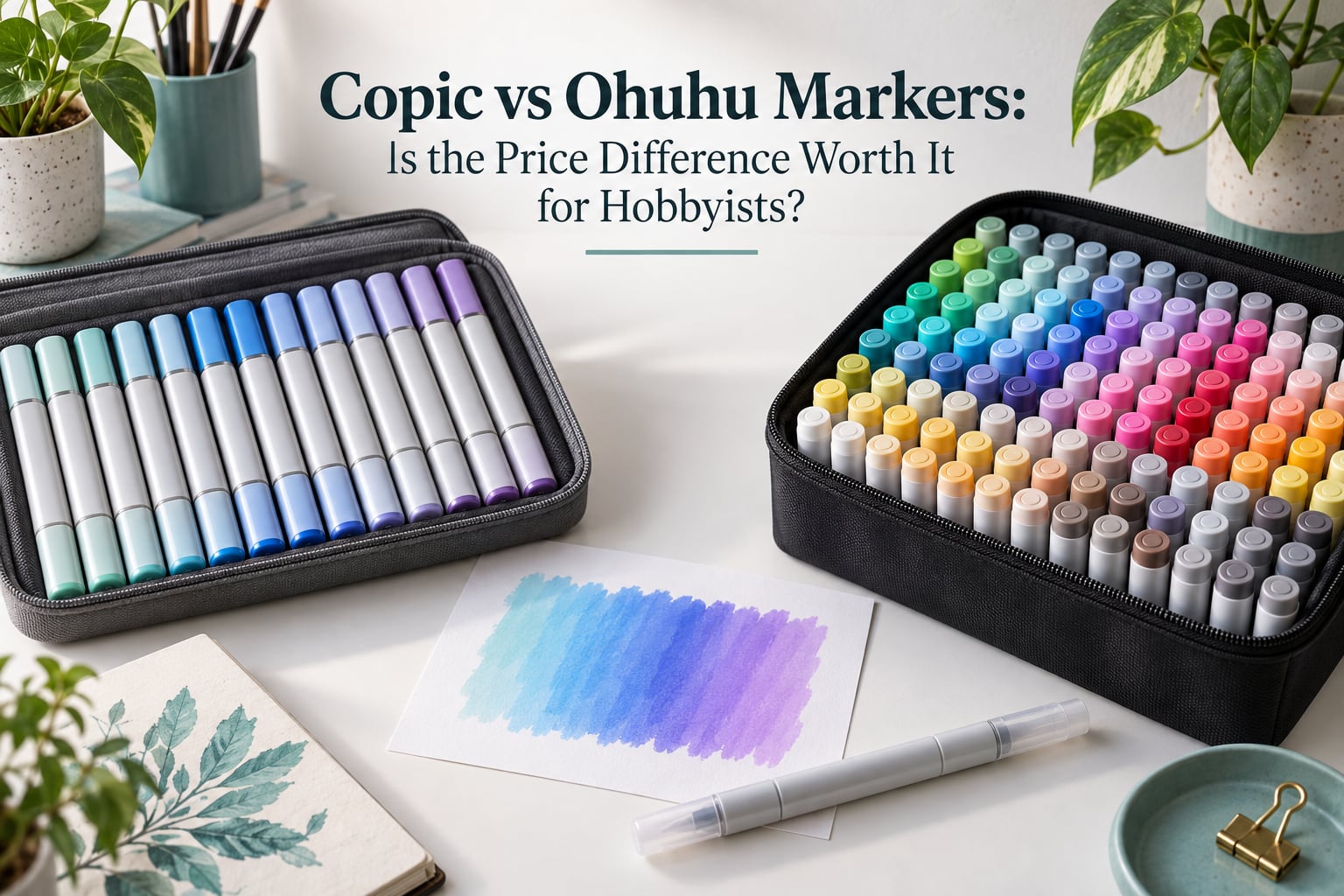
The short answer on Copic vs Ohuhu markers: the real difference is cost per marker, and the gap is roughly ten to fifteen times. Both are dual-tip alcohol markers that blend by reactivating ink already on the paper. For most hobbyists, Ohuhu is the sensible starting point. Copic earns its premium through refillability, tip precision, and a color library you can grow one pen at a time.
That is the whole argument, and most of the noise around it comes from people answering a different question. Retailer pages argue about which brand is better. Forum threads argue about which brand they already own. Neither answers the question a hobbyist actually has, which is whether the price difference is worth paying for the way you use markers.
We spent time with both brands, swatched the same gradients on the same paper, and ran the cost math a serious coloring hobbyist would run over twelve months. What follows is the version that ignores brand loyalty and looks at hours of use instead. Prices shift constantly, so we frame every figure here as a ratio or a cost tier rather than a fixed number, and we tell you which side of the tier a given marker sits on.
Quick verdict: Ohuhu for hobbyists who color a few pages a week and want the widest palette for the least money. Copic for anyone who renders regularly, teaches with markers, or wants a refillable system that stops costing money after the first purchase.
Table of Contents
- Copic vs Ohuhu Markers at a Glance
- How Much Does the Price Difference Actually Cost?
- Is Copic Overpriced?
- Are Ohuhu Markers as Good as Copics for Blending?
- Ink Longevity and Total Cost of Ownership
- Paper Matters More Than the Brand
- Tips, Ink Behavior, and the Colorless Blender
- Color Range and Swatching
- Middle-Tier Markers Between Ohuhu and Copic
- Who Should Buy Which?
- What Most Copic vs Ohuhu Comparisons Get Wrong
- Storage and Marker Care
- Frequently Asked Questions
- Final Verdict: Is the Price Difference Worth It for Hobbyists?
Copic vs Ohuhu Markers at a Glance
The fastest way to see the trade-off is a side-by-side table. Copic is the premium, refillable system with a library of roughly 350 colors. Ohuhu is the budget system that sells the same category of alcohol ink in much larger sets for a small fraction of the cost per marker.
| Factor | Copic | Ohuhu |
|---|---|---|
| Cost per marker | Premium tier | Budget tier |
| Relative price per marker | Baseline (1x) | Roughly 1/10th to 1/15th of Copic |
| Typical set sizes | Built one color at a time, or sets of 24, 48, 72, 96, 120, 216 | Sets of 48, 72, 96, 120, 216 and larger bundles |
| Refillable | Yes, with matching ink refills | Generally no |
| Tip options | Brush, bullet, chisel, fine, plus specialty tips | Dual tip, usually broad chisel and fine bullet |
| Color library | Roughly 350 colors | Depends on set size, from 48 upward |
| Blending on good marker paper | Smooth, controllable gradients | Adequate for most hobby work, less consistent |
| Bleeding on ordinary paper | Low | Noticeably higher, ink runs thicker |
| Ink consumption | Moderate, refills top the pen back up | Higher per session, reported as thirsty in hobbyist communities |
| Best suited to | Regular rendering, teaching, long-term collection building | Casual coloring, adult coloring books, learning the medium |
One row deserves emphasis. Refillability is the only structural difference between the two brands that changes the math over time rather than the result on the page. Everything else in that table is a performance or palette trade-off you can live with.
How Much Does the Price Difference Actually Cost?
Competitor pages quote wildly different numbers for the same markers, which is why search results for this query contradict each other. One reseller blog puts a single Copic Sketch marker near the high single digits and a comparable Ohuhu near two dollars. Another puts Ohuhu at well under a dollar per marker. Another quotes Copic per marker at a figure that only makes sense when you divide a set price by a set size.
None of those are wrong, and that is exactly the problem. The gap closes as set size grows, and it changes again when you compare a single pen to a full set. Here is the honest version, expressed as ratios so it stays true when prices move.
- A single Copic marker sits in the premium tier. A single Ohuhu marker sits in the budget tier, roughly one-tenth to one-fifteenth of the price.
- A 72-color set from either brand flips the comparison in your favor as the set grows, because set pricing drops the per-marker figure for both.
- Large Ohuhu bundles push the per-marker cost down further still, which is where the headline savings come from.
- Building a Copic collection one color at a time keeps each addition expensive, but every refill after that is a small fraction of a new pen.
So the price difference is real and it is large. What the per-marker number does not tell you is how often you will spend it.
Is Copic Overpriced?
Copic is priced at the premium tier, and by sticker price alone it looks hard to defend next to a marker that costs a fraction as much. Account for refills and the picture changes, because a Copic pen is a body you fill rather than a sealed unit you throw away.
Three factors make the premium defensible. First, refills: the ink is cheaper than the housing by a wide margin, so the second, third, and tenth fill of a color cost a fraction of the first. Second, color control: a library built one pen at a time means no wasted duplicates and no gaps in mid-tones, unlike a large budget set that hands you three near-identical browns. Third, tip precision, which is where hobbyists who upgrade usually notice the change first.
There is a version of this question where Copic is overpriced, and it is worth naming. If you color two pages a month and never touch a brush tip, you are paying for refill economics you will never use, and for a tip range you will never use. The honest answer is that Copic is not overpriced for a working artist and is overpriced for a casual user.
Are Ohuhu Markers as Good as Copics for Blending?
For most hobby work, yes, and for rendered illustration, no. The mechanism is identical in both brands, and understanding it explains the gap better than any brand label.
Alcohol markers blend because a new layer of alcohol-based pigment reactivates ink already sitting on the paper. It dissolves the boundary between two colors and lets them settle into each other. The formula is the same, the paper is often the same, so the difference in results comes down to ink thickness, tip quality, and how consistently each pen lays down the same amount of ink.
Copic ink runs thinner and more evenly. That gives you control: a light pass, a second pass, a third, and the gradient moves in small increments. Ohuhu ink is thicker, which means fewer passes produce a stronger blend but with less steering. Thick ink also bleeds more on thinner paper, which is why the same gradient that looks smooth on marker paper can look fuzzy on a standard coloring book page.
Three recurring weak points come up in hobbyist communities. Ohuhu ink is described as thirsty, meaning pens empty faster than you would expect. Brush tips splay and go soft under heavy use, which costs you fine detail. And pastels reportedly do not hold up as well as the rest of the range, a complaint raised by colorers testing large bundles.
None of that makes Ohuhu bad. It makes Ohuhu a tool with a different ceiling.
Ink Longevity and Total Cost of Ownership
This is where the price difference actually resolves, and no competitor we reviewed does this math. The question is not what a marker costs. It is what twelve months of drawing costs you under each system.
Copic is refillable. Ohuhu is generally not. A Copic pen is a housing plus an ink reservoir. When it runs dry you buy a refill, which costs a fraction of a new pen. An Ohuhu pen is a sealed unit, and once it dries or runs out it is finished, regardless of how much ink the housing still physically contains.
Run the break-even in steps:
- Estimate how many coloring sessions you do in a year. For a casual hobbyist that is roughly two to four per month. For a regular renderer it is far higher.
- Estimate how many pens you lose per year to drying out or empty ink, based on how tightly you cap and how you store them.
- Multiply that by the budget-tier per-marker cost. That is your annual Ohuhu replacement bill.
- For Copic, count the first purchase of each pen plus the refills you buy across the year. Early years are heavy. Later years are not.
- Compare the two totals. Copic crosses over once the colors you own start needing a second or third fill.
| Cost of ownership | Copic | Ohuhu |
|---|---|---|
| First purchase of each color | Premium tier, one pen at a time or by set | Budget tier per pen, cheap in bundles |
| Refill or replace | Refill at a small fraction of a new pen | New pen at full budget-tier price |
| Cost after the first year | Falls sharply, since refills dominate | Stays flat, since every empty pen is a full price |
| Cost of unused colors in a big set | None, you never buy a color you do not want | Real, if the set has duplicates or gaps |
| Best case for this brand | Regular use across many sessions over years | Occasional use, or a hobby that may stop |
That table is the answer to the title question. If your marker use might quietly stop in a few months, the budget brand wins on every measure. If this is a ten-year habit, the refillable system wins on every measure after the ramp-up period.
Paper Matters More Than the Brand
A large share of the perceived blending gap is not the markers. It is the surface. On proper marker paper, budget alcohol markers blend well enough for most hobby work. On ordinary sketchbook or coloring book stock, the same markers streak, bleed, and feather through the fibers.
Coloring books are usually printed on thin, uncoated stock with a sizing agent that fights alcohol ink. That sizing is why a Copic can look merely good and an Ohuhu can look broken on the same page. If blending is what frustrates you, change the paper before you change the brand.
Two habits help on any surface. Work on a backing sheet to stop ink bleeding through onto the next page. And test a swatch of your own two favorite colors on your own paper before you judge either brand.
Tips, Ink Behavior, and the Colorless Blender
Both brands are dual tip, and the tip is where you feel the difference most often.
- Chisel tip: broad, angled, good for fills, edges, and wide strokes. The workhorse tip on both brands.
- Bullet tip: round and medium-fine, good for line work, borders, and small fills. Ohuhu sets usually pair this with the chisel.
- Fine tip: a small detail tip for texture and tiny areas.
- Brush tip: a flexible bristle tip that tapers with pressure, ideal for shading and organic shapes. Copic sells these as separate pens; budget sets sometimes include one, and hobbyists report those brush tips splaying and softening with heavy use.
Ink dries fast on both, which is convenient on paper you care about and annoying if you want to keep blending for a long time. Work in small sections and come back to them rather than trying to blend a whole page at once.
The colorless blender is a pen filled with clear solvent and no pigment. Touching it to the edge of a color pulls that color outward and softens the transition, which is how you get a gradient to fade to nothing rather than stop at a hard line. Ohuhu sets commonly include one, and for a beginner it is the single most useful pen in the box.
Color Range and Swatching
Copic’s library runs to roughly 350 colors, assembled one pen at a time or through sets. Ohuhu sells sets from about 48 colors up through 96, 120, and 216, so the largest Ohuhu bundle can hold more pens than a mid-size Copic set while costing a small fraction as much.
More pens in a set is not automatically more useful. Budget sets tend to include near-duplicate colors and leave gaps in useful mid-tones, and the palette is designed for broad coverage rather than tight control. A smaller set of colors you can name and reach for is worth more than a large set you have to sort through.
Whichever brand you pick, swatch the whole set on your own paper and keep the chart somewhere you can see it. Real swatch photos on your own surface tell you far more than any brand reputation, and it takes an afternoon.
Middle-Tier Markers Between Ohuhu and Copic
Not every hobbyist wants a straight choice between the cheapest and the premium tier. Several brands sit in between and are worth a look.
- Spectrum Noir is refillable, which puts it on Copic’s side of the refill argument at a middle price.
- Arrtx is priced above Ohuhu and well below Copic, and is frequently recommended in hobbyist threads as a step up.
- Arteza, Shuttle Art, and Bianyo are budget-adjacent options that show up in beginner recommendations for broad set value.
For a hobbyist who colors weekly but does not want to think about replacement costs, a refillable middle-tier brand often makes more sense than either extreme.
Who Should Buy Which?
Use frequency and project type decide this more reliably than preference does.
| If you are… | Start with | Because |
|---|---|---|
| Coloring a few pages a week, no plans to render seriously | Ohuhu | Lowest entry cost, widest palette per outlay, nothing to regret |
| Working through adult coloring books, mostly flat fills | Ohuhu | Large sets cover many books; blending is not the priority |
| Learning markers, unsure you will stick with it | Ohuhu | The cheaper mistake is the cheaper one |
| Coloring weekly and blending is the point | Middle tier, or Copic | Blending control is the real upgrade, not color count |
| Rendering art regularly, character work, anime-style illustration | Copic | Tip precision, thinner ink, refillable over years |
| Teaching with markers or running workshops | Copic | Consistency across batches and a system you can expand |
| Willing to buy one color at a time over years | Copic | No duplicate waste, and refills make the second year cheap |
The progression pattern that shows up again and again in hobbyist threads is the same one most of us follow with any tool. Start on Ohuhu, and graduate to Copic only when marker art becomes a regular habit rather than a weekend activity.
What Most Copic vs Ohuhu Comparisons Get Wrong
Four errors keep showing up in articles ranking for this query.
The first is ignoring paper. Plenty of the reported blending gap disappears on decent marker stock, and plenty of reported Copic underperformance comes from cheap paper.
The second is hiding refillability in the footnotes. Without it, Copic looks like a luxury and the comparison ends there. With it, the answer changes for anyone who sticks with markers for more than a year.
The third is treating set quality as uniform. Hobbyists report that budget sets bought through marketplace warehouses sometimes arrive partly dried out, which turns a brand comparison into a storage-condition comparison. The same people often find that sets bought directly from the brand behave much better.
The fourth is repeating the claim that the two brands are nearly identical. Plenty of hobbyists who own both say there is barely any practical difference in everyday coloring. That is fair for flat fills and small areas. It stops being fair the moment you build a gradient that takes three passes.
Storage and Marker Care
Storage decides how long either brand lasts, and it costs nothing to get right.
- Store markers horizontally, not tip-down, so ink settles at the base and does not dry in the nib.
- Cap tightly. A loose cap is the fastest route to a dried-out pen.
- Keep them away from direct heat and out of parked cars in summer.
- Use a case or pouch so a pen does not roll away uncapped on a desk.
- For large budget sets, original packaging or a divided case makes finding the color you need much easier.
None of this is brand specific. It just matters more for a sealed pen, because a sealed pen that dries out is finished, while a refillable one just needs an ink refill.
Frequently Asked Questions
Should I get Copic or Ohuhu markers?
Start with Ohuhu if you are new, color a few pages a week, or mainly fill in adult coloring books. Move to Copic once blending and rendering become the point of your work, or if you want a refillable system you can grow one color at a time. The progression most hobbyists follow is Ohuhu first, Copic later.
Is Copic overpriced?
Priced alone, Copic sits in the premium tier and looks hard to justify next to a budget marker. Add the refill program and the picture changes, because refills cost a fraction of a new pen and a pen is a housing you refill rather than a unit you discard. Copic is not overpriced for a regular renderer; it is overpriced for a casual user.
Why is Copic so expensive?
Three things sit behind the price. The ink system is engineered for thin, even flow and low bleed rather than raw pigment volume. The color library is standardized across batches so a color you buy this year matches one you bought years ago. And the housing is built to be refilled many times instead of discarded after one fill.
Are Ohuhu markers as good as Copics?
For flat fills, coloring books, and casual hobby work, Ohuhu is genuinely as good and costs roughly a tenth to a fifteenth as much per marker. For multi-pass gradients, fine detail work, and consistent color across a large illustration, Copic’s thinner ink and better tips win. Paper choice changes the gap more than most comparisons admit.
Can you refill Ohuhu markers?
Generally no. Ohuhu pens are sealed units, so when one runs dry or dries out it is finished even if the housing still looks full. Copic is refillable, which is the single structural difference that changes the cost math over time. Some middle-tier brands are also refillable if that matters to you.
What markers are like Copic but cheaper?
Spectrum Noir is refillable at a middle price and is the closest structural match. Arrtx sits above Ohuhu and well below Copic and is frequently recommended in hobbyist threads. Arteza, Shuttle Art, and Bianyo are budget-adjacent options with broad sets. None matches Copic’s tip precision, but any of them beats the budget tier on refill economics.
How many Ohuhu markers do I need to start coloring?
A 48 to 72 color set covers most coloring books and gives you a workable skin and neutral range. Add a colorless blender, which most sets include, and you have everything a beginner needs. Buy larger bundles only if you already know which colors you reach for, since budget sets often repeat shades and leave gaps in mid-tones.
Final Verdict: Is the Price Difference Worth It for Hobbyists?
For most hobbyists, the Copic vs Ohuhu price difference is not worth paying. The budget brand puts roughly ten to fifteen times more colors in your hands for the same outlay, and for flat fills, coloring books, and learning the medium, the visible difference is small. The gap is worth paying only in one situation: you render regularly and want refillable ink, thinner flow, and better tips over a multi-year habit.
Here is the next step. Buy a mid-size Ohuhu set, work on decent marker paper, and count how many sessions you actually color over a couple of months. If the number is high and you are chasing gradients rather than fills, upgrade to Copic one color at a time. That way you are never betting on a brand before your own habits have told you which one you are.
Updated for October 2026.