
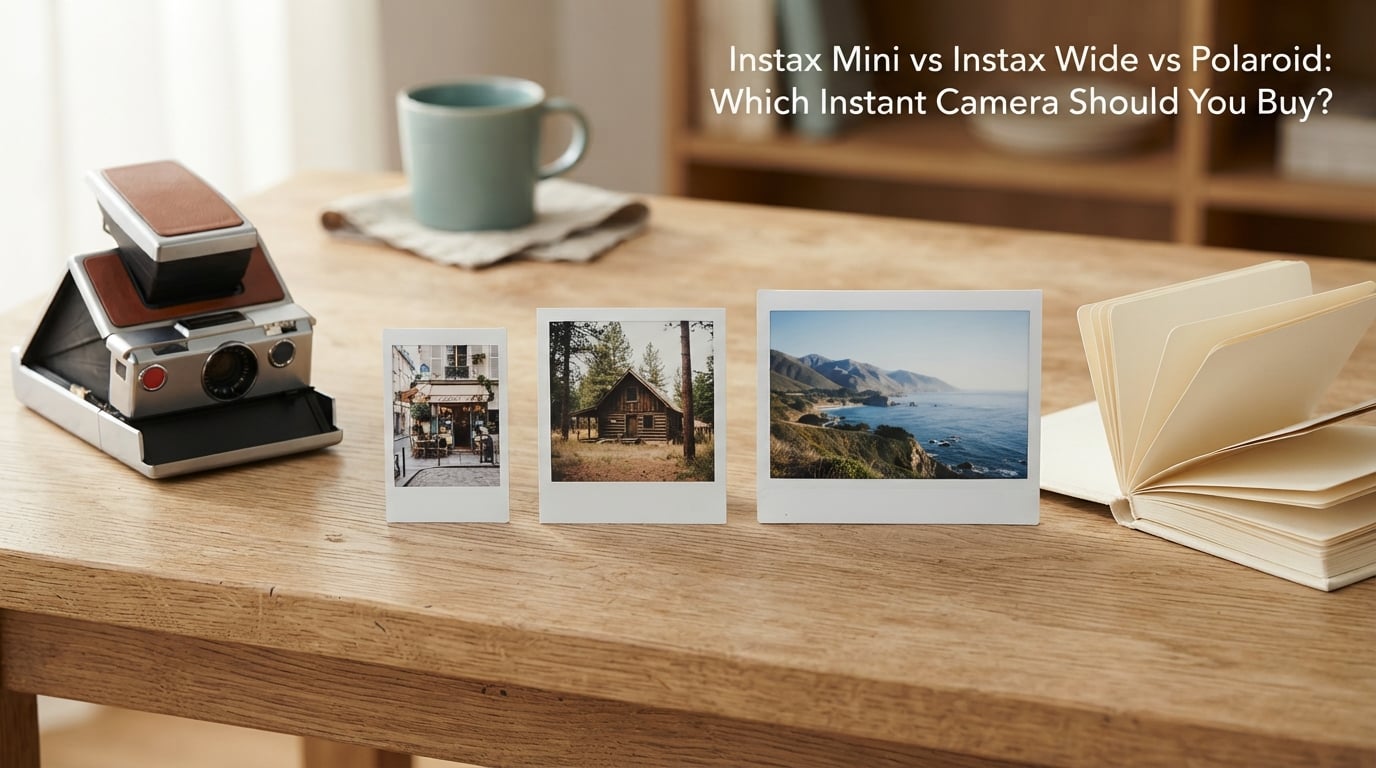
Pick Instax Mini if you want a camera that fits in a jacket pocket and cheap film you can shoot in bulk. Pick Instax Wide if the print is the point and you want something you can hang on a wall. Pick Polaroid if you specifically want that thick, soft, retro look and you are willing to pay more for every frame.
That is the whole decision behind Instax Mini vs Instax Wide vs Polaroid. These three formats are not competing on camera quality, because none of them has a serious sensor or a manual control ring worth arguing about. They compete on the physical print that comes out of the front: how big it is, what shape it is, what it costs, and how long it will last on a wall.
I have shot all three formats over the same subjects, packed the same prints into the same albums, and watched people pick them up for the first time. The gap between them is much wider than the camera bodies suggest, and it shows up everywhere except on the spec sheet. This guide breaks the three formats down side by side, covers the fourth format most people forget (Instax Square), explains where hybrid cameras fit, and puts a realistic running cost on each one so you can decide with a number instead of a vibe.
Last thing before we start: the format you choose is close to permanent. Film, albums, frames, wallets, phone cases and guest books are all format-specific. Getting it wrong means repurchasing an ecosystem, not just a camera.
Table of Contents
- Instax Mini vs Instax Wide vs Polaroid: The Quick Answer
- The Three-Way Comparison at a Glance
- Film Size and Format
- Film Cost and Portability
- Instax Mini: Best for Everyday Carrying
- Instax Wide: Best for Big Wall Displays
- Polaroid: Best for That Signature Instant Look
- Instax Square: The Format in Between
- Hybrid Cameras: The Middle Path
- Film Cost: What You Actually Spend Per Photo
- Image Quality and Colour: What to Expect
- Printers vs Cameras: Do You Actually Need a Camera?
- How Long Do the Prints Last?
- Which Is Better for Gifts, Parties and Guest Books?
- Before You Buy: Five Decisions to Make
- Frequently Asked Questions
- Is the Instax Mini better than the Instax Wide?
- Which instant camera is better, Polaroid or Instax?
- Why is Instax so much cheaper than Polaroid?
- Why is the Instax Mini so popular?
- What are the pros and cons of Instax Wide cameras?
- Is a Polaroid camera better than Instax?
- Which instant film is better, Instax or Polaroid?
- What is the best instant camera for a beginner?
- Conclusion
Instax Mini vs Instax Wide vs Polaroid: The Quick Answer
Here is the short version. If you only read one section, read this one.
Pick Instax Mini when:
- You want a camera small enough to carry every day
- You plan to shoot in volume and want the lowest running cost per photo
- Your prints go into wallets, phone cases, small albums or a bullet journal
- You are buying for a teenager or anyone who will lose the camera in a bag
Pick Instax Wide when:
- The print is the main event, not the taking of the photo
- You want landscape and group shots to have room to breathe
- You are doing a wedding guest book, a party, or a display wall
- You mind spending a little more per pack for roughly double the image area
Pick Polaroid when:
- You want the specific Polaroid colour rendering and the vintage look
- The thick, glossy, white-bordered print is the aesthetic you are after
- You are buying for someone who is sentimental about the medium
- You shoot far less often, so the higher per-shot cost adds up slowly
My own rule after comparing all three: if you are undecided, start with Instax Mini. It is the least risky commitment, the film is the easiest to find, and a credit-card-sized print is genuinely useful rather than decorative. You can always move up to Wide later, but you cannot move a Mini print into a Wide album.
The Three-Way Comparison at a Glance
This is the table I wish existed when I was deciding. Every row is a real decision factor, not a spec-sheet filler line.
| Factor | Instax Mini | Instax Wide | Polaroid |
|---|---|---|---|
| Total frame size | 86mm x 54mm | 108mm x 85mm | Roughly 3.4 x 4.2 inch body, larger image window |
| Image area | 62mm x 46mm | 99mm x 62mm | Largest of the three, close to 4.25 x 3.3 inch usable window on standard packs |
| Orientation | Vertical, portrait | Horizontal, landscape by default | Square, nearly symmetrical |
| Inches (rough) | 3.4 x 2.1 inch | 4.25 x 3.3 inch | Bigger than Wide in overall area |
| Shots per pack | 10 | 10 | 8 on most standard packs |
| Relative film cost per shot | Lowest of the three | About 15% more per pack than Mini | Several times the Instax per shot |
| Print shape | Credit-card rectangle | Landscape rectangle | Square with a wide white border |
| Default use case | Pocket carry, scrapbooking, wallets | Events, guest books, display walls | Sending a physical photo to someone |
| Best first camera for | Beginners, teens, everyday carry | Event hosts, big wall displays | Gift buyers chasing the retro look |
Two things jump out. First, the image area difference between Mini and Wide is bigger than the frame dimensions suggest, because Mini wastes a lot of its tiny frame on the border. Second, Polaroid still wins on sheer image area, which is exactly why it costs what it costs.
Film Size and Format
These are the physical facts, and they explain almost every other difference you will run into.
- Instax Mini measures 86mm x 54mm with a 62mm x 46mm image area. The vertical, portrait layout is the reason it feels like a photograph rather than a receipt, and the 62mm x 46mm window is the single most useful number on this page. It is small enough to slot into a wallet, a phone case or a bullet journal without folding.
- Instax Wide measures 108mm x 85mm with a 99mm x 62mm image area. The horizontal, landscape layout exists so that groups, dinner tables and scenery actually fit inside the frame. That 99mm x 62mm window is roughly 2.2 times the Mini image area, which is why a Wide print feels like a picture and a Mini print feels like a memento.
- Polaroid produces a near-square print with a wide white border. The classic packs carry a large image window, close to 4.25 x 3.3 inch on the standard format, and the border is part of the design language rather than wasted film. It is the biggest image area of the three formats and the smallest number of shots per pack.
One clarification that confuses almost everyone: frame size and image area are different numbers. The frame is the whole physical piece of film. The image area is the part the camera actually exposes. Polaroid wastes the most on the border and Instax Wide wastes proportionally the least, which is why the frame dimensions alone will mislead you.
Film Cost and Portability
Cost and size are the two factors that decide most purchases, and they push in opposite directions.
- Instax Mini is the cheapest per shot and the easiest film to buy in bulk. A ten-shot pack is small, light and the easiest film of the three to find, which is why the running cost is the lowest of any format here. Cameras like the Mini 12, Mini 13 and Mini LiPlay also fit in a coat pocket, so the camera and the film both stay out of your way.
- Instax Wide costs slightly more per exposure and gives you roughly twice the photo area. The Instax Wide 400 and the Lomo Wide are noticeably bigger bodies, and the ten-shot pack is larger and heavier too. The Wide Evo is the exception that proves the rule: it is a hybrid with a fixed lens and a small sensor, but it prints Wide film.
- Polaroid is the most expensive per shot and the least compact. Most standard packs hold 8 shots, and the film is priced well above both Instax lines. The benefit is real though: the near-square print is the largest of the three, the white border means you never have to crop, and the developing colour shift is the signature look people are buying.
The r/instax community consensus, cited repeatedly in search results for this query, is straightforward: Mini film is cheaper and easier to buy in bulk, and Wide film costs slightly more per exposure while yielding roughly twice the photo area. That is the correct summary and I have not found a reason to disagree with it.
Instax Mini: Best for Everyday Carrying
Instax Mini is the format you buy when the camera should disappear into your day. The print is credit-card sized at 3.4 x 2.1 inch, and the bodies are genuinely pocketable, which is the whole point.
The current generation worth looking at is the Instax Mini 12, with the Mini 13 sitting alongside it. Both are point-and-shoot bodies with a close-up mode, a selfie mirror and a flash that fires automatically and can be switched off. If you want more control, the Mini 99 adds manual exposure compensation and a real flash, and the Mini Evo is the hybrid version that prints from a small digital sensor instead of film chemistry.
Why the Mini is so popular comes down to three things. Film is cheap enough that you stop thinking about every frame, the print fits into a wallet or a phone case so people actually keep it, and the camera is forgiving enough that a complete beginner gets a usable photo on the first try.
The catch is format lock-in. A Mini print will not fit a Wide album, a Polaroid album or a square-frame frame. Accessories are format-specific, and if you fall in love with the medium you will eventually want more than one format anyway. But as a first commitment, Mini is the least painful one.
Instax Wide: Best for Big Wall Displays
Instax Wide is the answer when the photograph has to say something at a distance. The 99mm x 62mm image area is the largest usable window on any Fujifilm film, and the horizontal layout means a group shot finally fits without someone being cropped off.
The bodies to consider are the Instax Wide 400, which is the straightforward analog point-and-shoot, the Lomo Wide, which adds manual-ish controls and a different lens character, and the Instax Wide Evo, the hybrid that prints from a digital sensor. The Wide 400 is still the default recommendation because it is simple, reliable and does exactly one job.
The pros of Wide are obvious: the biggest Fujifilm image area, a landscape frame that suits events and scenery, and prints that fill a wall without needing three of them side by side. r/instax and largeformatphotography.info both describe Wide as ideal for small events and ice-breaking, which is a good description of the format in one sentence.
The cons are equally obvious. The body is bulkier, the film costs roughly 15% more per pack than Mini, and if your main use is small keepsake prints going into a wallet or a journal, you are buying a large frame to fill a small space. The number of shots per pack is also the same 10 as Mini, so you pay that premium for fewer, bigger photos.
Polaroid: Best for That Signature Instant Look
Polaroid is the only one of the three where the look itself is the product. The near-square print with the wide white border, the slightly milky blacks, the colour that settles into place over about ten minutes, and the soft, low-contrast rendering are all things you cannot get from Instax.
The decision usually comes down to one of three bodies. The Polaroid Now and the Now+ are the mainstream analog point-and-shoots. The Polaroid OneStep 2 is the simplest possible entry point, with one button and a fixed exposure. The Polaroid I-2, sometimes called Polaroid Originals, is the enthusiast film camera with a real lens, manual exposure and a flash you can control. If you want a hybrid, the Polaroid Go prints from a digital sensor into the same film shape, and it is the cheapest route into the Polaroid look.
Where Polaroid wins is unmistakable. It is the largest image area of the three formats. The square frame is the most balanced for a face or a still life. The white border means prints frame cleanly without matting. And for sending a physical photo to someone who is not in the room, a Polaroid in an envelope is still the most convincing gesture in the medium.
Where it does not win is running cost and predictability. Standard packs hold 8 shots, the film is several times the per-shot cost of Instax, and users on photography forums consistently report that blacks and whites are weak. Exposure is also less forgiving, which is the main reason the format feels harder to beginners.
Instax Square: The Format in Between
Almost every comparison you will find online skips the format that actually solves the size gap, so let me add it.
Instax Square, shot on bodies like the SQ1, the SQ40 and the SQ-Evo, produces a square print with a much larger image window than Mini. It is the closest Fujifilm comes to the Polaroid shape, and it costs roughly the same money per pack as Wide.
This is the answer to a complaint I read repeatedly in r/instax threads: there is a fun point-and-shoot tier and a serious film camera tier, and nothing useful in between. Square is the in-between. It is the format for someone who finds Mini prints too small to display but thinks Polaroid running costs are a step too far. If the size gap between the two poles of the decision is what has been stopping you, this is where the answer lives.
The honest downside is how easy the film is to get hold of. Square film works for most buyers, but it is still far easier to find in bulk than it is to find on the day you need it, and a lot of the accessory ecosystem is built around Mini and Wide instead.
Hybrid Cameras: The Middle Path
Hybrid instant cameras sit between the analog and digital worlds. They use a small digital sensor, let you review the shot on a small screen, and print onto the same instant film format as their analog siblings. Nothing is exposed twice and nothing is thrown away, which means far fewer wasted packs.
The Instax Mini Evo and the Instax Square SQ-Evo print Mini and Square. The Instax Wide Evo prints Wide. The Polaroid Go prints Polaroid, and a current-generation version of it is the cheapest way to get Polaroid-format prints.
Where hybrids genuinely win is control. Creative modes, double exposure, selective colour and print effects are on the camera rather than in a darkroom of guesswork. If you have ever been frustrated by a fully automatic point-and-shoot producing a flat, badly exposed frame, a hybrid is the format that lets you intervene without leaving the point-and-shoot experience.
Where they lose is the honest part: you are shooting a tiny sensor with a plastic lens, so image quality sits below what a phone camera can do. You gain the ritual and the print, not the picture quality. That is a perfectly good trade for most people, and a disappointing one for a few.
Film Cost: What You Actually Spend Per Photo
Pack price alone is a bad way to compare formats, because the packs do not hold the same number of shots. Cost per shot is the only number worth arguing about, and the only one that matters over a year of use.
| Format | Shots per pack | Packs for 100 shots | Relative spend for 100 shots |
|---|---|---|---|
| Instax Mini | 10 | 10 | Baseline, lowest of the three |
| Instax Square | 10 | 10 | Close to Wide |
| Instax Wide | 10 | 10 | About 15% more per pack than Mini |
| Polaroid (standard pack) | 8 | 13 | Several times the Instax baseline per pack |
Multiply that out and the picture gets clearer. A hundred Mini shots is ten packs and a manageable spend. A hundred Wide shots is also ten packs, slightly more expensive each. A hundred Polaroid shots means thirteen packs at several times the per-pack cost, which is the number that shocks people who thought Polaroid was merely a bit pricier.
Now the question everyone asks: why is Instax so much cheaper than Polaroid?
There are two structural reasons. The first is manufacturing. Fujifilm makes its own instant film as an integrated product, with the emulsion and the chemistry designed and produced under one roof. Polaroid’s film depends on a separate cartridge and chemistry supply chain with more steps in it, and that complexity shows up in the pack price.
The second is shots per pack. Polaroid’s standard packs hold 8, not 10, so every exchange divides a higher price across fewer photos. Neither brand is gouging you; you are looking at two genuinely different supply chains and two different pack sizes.
The practical advice I give everyone: buy Mini film in bundles of five or ten packs, and never run a format down to the last two frames. Film that sits for months in a warm car is the fastest way to waste the money you just saved.
Image Quality and Colour: What to Expect
Set your expectations honestly, because this is where instant photography gets judged against the wrong benchmark. These are not medium format cameras. They are fixed-focus point-and-shoots with a single element of glass.
Sharpness and colour: Fujifilm film is the sharper of the two big formats. On photography forums, the recurring verdict is that Instax is far sharper with truer colours than an SX-70, which is a camera Polaroid people often compare it to. That is a real and consistent edge.
Blacks and whites: the same forum threads raise the same complaint in the same breath. Instax struggles to hold true blacks and clean whites, and low light produces a flat, grey-looking frame rather than a rich dark one. If you shoot indoors at an evening party, this is the single most likely thing to disappoint you.
Polaroid colour is warmer, softer and more saturated, and it shifts visibly as the print develops. Some people find that shift charming and others find it distracting, but either way it is consistent and it is the reason the format has survived. Polaroid’s real weakness is exposure unpredictability, which is why the OneStep 2 and the Now+ outperform older folding cameras for beginners.
There is a side-by-side colour and performance test worth watching if you are still torn. The video carousel on this query is dominated by head-to-head film tests, and seeing the same subject on Mini, Wide and Polaroid in one video settles the question faster than a paragraph of description.
Printers vs Cameras: Do You Actually Need a Camera?
The fourth option, and the one that quietly wins for a lot of people, is a printer. The Fujifilm Instax Link series prints from your phone, and the Polaroid printers work the same way in the Polaroid format.
A printer makes sense if you already take good photos on your phone and the physical print is the only thing you care about. You get the best image quality available in the format, because the source is a modern phone sensor rather than a plastic lens. You also waste nothing on blurred shots.
A camera makes sense if the experience of taking the photo matters to you. The reason people buy instant cameras is the framing, the limitation, the single unrepeatable shot. A printer removes all of that. If you are buying an instant camera and find yourself annoyed by the quality, stop and consider whether you actually wanted a camera or a printer.
That distinction is worth making before you spend anything, because the two categories have completely different ongoing costs and completely different reasons to own them.
How Long Do the Prints Last?
This is the question I get asked most, and it is the one most guides skip. Print longevity depends far more on how you treat the print than on which brand made it.
The useful data point comes from r/instax, where users switching from Polaroid report that Instax film packs hold up against degrading for much longer, as long as the prints were not exposed to high heat or direct light. Users migrating the other direction tend to say the opposite about older Polaroid packs that have already begun shifting.
The practical rules are the same for every format. Keep developed prints out of hot cars, out of direct afternoon sun through a window, and out of damp basements. Store them flat in an album rather than loose in a drawer, because the emulsion scuffs and the surface picks up scratches. Album sleeves and interleaving pages help more than any spray or archival frame.
For most people the honest answer is that a well-kept Polaroid print and a well-kept Instax print will both still look good years later. The difference is that Polaroid prints are worth protecting, because people hand them to other people.
Which Is Better for Gifts, Parties and Guest Books?
The format that wins depends entirely on what the print is for, and the occasions pull in different directions.
Birthdays and Christmas gifts for a teenager: Instax Mini, without much debate. The camera survives a school bag, the film is cheap enough that a teenager will shoot a hundred of them, and the prints slot into a phone case. dpreview forum users asking this exact question about 16 to 22 year olds consistently land in the same place.
Weddings: Instax Wide for the guest book, no contest. Guests need to see the result immediately, the horizontal frame suits a table of people, and the larger print is legible from across the room. A wedding guest book full of Mini prints reads as a small detail; the same book full of Wide prints reads as a gift. If you are buying a Polaroid for a wedding, buy it for yourself, because the per-shot cost adds up fast with a hundred guests.
Parties and gatherings: Wide again, for the same reason. r/instax users describe it as ideal for small events and ice-breaking, and that is accurate. A print that gets handed across a room has to be big enough to pass around without being folded.
Long-distance or sentimental gifting: Polaroid. The white border, the square shape and the fact that it is physically a card means it can go straight into an envelope. It is the format that still surprises people.
Scrapbooking and bullet journals: Mini. Nothing else fits the page, and a credit-card-sized print is the size scrapbookers designed this format for.
One gift note. If you are buying an instant camera as a present, buy the camera plus two packs of film. A camera with no film is a very common gift, and it is a disappointing one.
Before You Buy: Five Decisions to Make
Run through these five before spending anything. They take two minutes and they eliminate almost every regret I have seen from first-time buyers.
1. Decide where the photos are going. Wallet, journal and phone case means Mini. Wall, guest book and fridge means Wide. Envelope to someone across the country means Polaroid. The destination of the print determines the format more reliably than anything else.
2. Decide how often you will actually shoot. Occasional shooting makes Polaroid costs irrelevant. Heavy shooting makes per-shot cost the dominant factor and Mini is the clear winner. Be honest about the second one, because people overestimate how much film they will burn.
3. Decide whether the camera or the print is the point. Camera means analog point-and-shoot and the joy of the constraint. Print means a hybrid or a printer, and you should stop buying analog bodies to chase better image quality that they cannot deliver.
4. Check the accessory ecosystem before you commit. Albums, frames, wallets, guest books and phone cases are all format-specific. If you already own a Mini album, that is a strong argument for staying with Mini. If you want the Polaroid square look, budget for square-frame albums from day one.
5. Plan for film, not just the camera. Decide where you will buy it, because finding the right film is the number one recurring forum complaint. Supermarkets and pharmacy chains carry Mini most reliably. Wide and Square are easier online or in camera shops. Polaroid is available nearly everywhere, but popular packs have historically attracted resellers and price spikes. Bulk buying is the fix for every format.
Two mistakes worth naming outright, because I have watched both happen. The first is buying a Wide camera, loving it for a month, then realising the running cost is beyond your habit, and the film sits unused. The second is buying a Mini, loving it, and then trying to enlarge or mat the prints for wall framing, which does not work at that size.
There is also a niche third path. Enthusiasts have modified an Instax Wide 210 to shoot both Wide and Mini film in one body, which solves the ecosystem problem but is a weekend project rather than a buying decision. Worth knowing about, not worth doing first.
Frequently Asked Questions
Is the Instax Mini better than the Instax Wide?
Neither is better, they are built for different jobs. Mini is better if you want a pocketable camera, the lowest cost per shot and prints that fit a wallet, phone case or journal. Wide is better if the print is the point, because its 99mm x 62mm image area is roughly 2.2 times the Mini 62mm x 46mm window, and it shoots in a horizontal frame that suits groups and scenery. Mini film is cheaper and easier to buy in bulk; Wide film costs about 15% more per pack.
Which instant camera is better, Polaroid or Instax?
Instax is better for cost, sharpness and film availability. Its film is cheaper per shot, it holds 10 shots per pack instead of 8, it is easier to buy in bulk, and forum users consistently report it is sharper with truer colours than Polaroid film. Polaroid is better if you specifically want the near-square white-bordered print, the developing colour shift and the retro look, and if you shoot often enough that the higher per-shot cost does not matter.
Why is Instax so much cheaper than Polaroid?
Two structural reasons. Fujifilm manufactures its instant film as an integrated product, with the emulsion and chemistry made under one roof, while Polaroid’s film runs through a separate cartridge and chemistry supply chain with more steps. And Polaroid’s standard packs hold 8 shots against Instax’s 10, so the higher pack price is spread across fewer photos. Neither brand is overcharging, you are comparing two different supply chains and two different pack sizes.
Why is the Instax Mini so popular?
Because it removes three friction points at once. The camera fits in a pocket so you actually carry it, the film is cheap enough that you stop counting frames, and the credit-card-sized print fits into a wallet or phone case so people keep it instead of losing it. On top of that, point-and-shoot bodies like the Mini 12 and Mini 13 are forgiving enough that a complete beginner gets a usable photo on the first attempt.
What are the pros and cons of Instax Wide cameras?
Pros: the largest Fujifilm image area at 99mm x 62mm, a horizontal frame that fits groups and landscapes, and prints that display well on a wall or in a guest book without needing several side by side. Cons: the bodies and film packs are bulkier, the film costs roughly 15% more per pack than Mini, and the large frame is wasted if you only wanted small keepsakes for a wallet or journal.
Is a Polaroid camera better than Instax?
Only for a specific reason. Polaroid gives you the near-square print with the wide white border, the soft warm rendering, and the visible colour shift that happens as the print develops. That look cannot be reproduced on Instax film. If image quality, sharpness or running cost matter more to you than the aesthetic, Instax is the better camera, and users consistently report it is sharper with truer colours.
Which instant film is better, Instax or Polaroid?
Instax film is the better all-round film. It is sharper with truer colours, it costs several times less per shot, it comes 10 shots to a pack instead of 8, and r/instax users switching across report that Instax prints hold up against degrading for longer when kept away from heat and light. Polaroid film wins on image area and on the look, not on price, sharpness or availability.
What is the best instant camera for a beginner?
An Instax Mini point-and-shoot, specifically the current-generation Mini 12 or Mini 13. Both are fully automatic with a close-up mode, a selfie mirror and a flash you can switch off, which means a complete beginner gets a usable photo on the first try. The film is the cheapest of the three formats, so a mistake costs less, and the prints fit in an album without any special frame. If you want the print to be bigger than a credit card, step up to Instax Square or Instax Wide instead.
Conclusion
Instax Mini vs Instax Wide vs Polaroid comes down to one question: what happens to the photo after it comes out? If it goes in a wallet, a phone case or a journal, Mini. If it goes on a wall, in a guest book or across a table, Wide. If it goes in an envelope to someone who is not in the room, Polaroid.
Beyond that, Instax Square is worth a look when the size gap between Mini and Wide is the thing blocking you, and a hybrid or a printer is the right answer if you care more about the print than about taking the photo.
Whichever you pick, buy two packs of film on day one, keep the prints out of hot cars, and expect your first ten shots to be worse than your fiftieth. That is not a flaw in the format, it is just how point-and-shoot instant cameras work. Updated for 2026.