
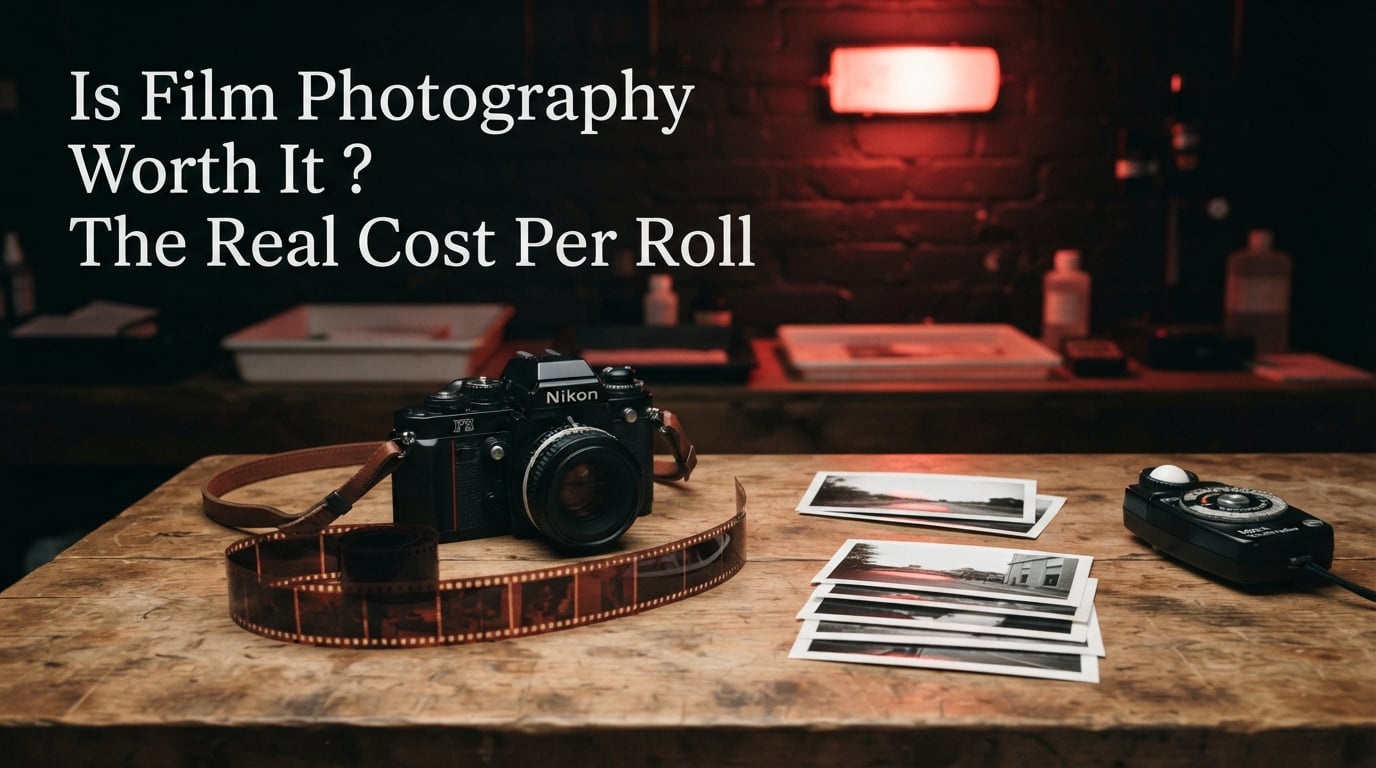
Is film photography worth it in 2026? Yes, conditionally, and the condition is arithmetic rather than artistic. A finished 35mm roll costs roughly 30 to 45 dollars end to end once you add development and scanning, so it pays off when you value the constraint itself and shoot deliberately. Below is where the money actually goes, what a roll costs per usable photograph, and who should skip the whole thing.
I have tracked film spending and digital spending side by side for this site across thousands of frames, and the number that decides the question is almost never the price of a roll. It is the price of a roll divided by the number of photographs you would actually keep from it. That single division changes the answer more than any other variable, including the camera.
Three numbers to know before you buy anything:
Cost per roll is the emulsion plus the lab’s development fee plus scanning, plus an optional share of the camera you bought to shoot it.
Cost per frame is cost per roll divided by exposures, which is 36 or 24 for 35mm and 8 to 16 for 120 roll film.
Cost per usable keeper frame is cost per roll divided by the frames you would print or publish, after you subtract loading mistakes, metering errors, fogged frames and duplicates. This is the honest number.
All figures below are benchmarked as of October 2026 and reflect price bands observed across specialist retailers, marketplace listings and mail-in lab rate cards.
Table of Contents
- Is Film Photography Worth It? The Short Answer
- What a Roll of Film Costs in 2026 – Emulsion, Development, Scanning
- The Real Number: Cost Per Usable Frame
- The Full First-Year Cost of Shooting Film
- Hidden Costs Most Beginners Never Budget For
- Home Development vs Mail-In Lab: Where the Crossover Is
- How to Cut Your Per-Roll Cost by 40 to 60 Percent
- What Film Costs in 2026: The Supply Reality
- Used Film Camera Price Bands and What to Check Before Buying
- Film vs Digital: Total Cost of Ownership Over Three Years
- Why People Shoot Film Anyway
- Who Film Photography Is Worth It For – and Who It Is Not
- Frequently Asked Questions
- How much should a roll of film cost?
- How much does it cost to develop and scan a roll of film?
- Is film photography more expensive than digital?
- Why is film photography so expensive now?
- How many photos can you take on a roll of film?
- Is film photography worth the money for a beginner?
- Is film photography coming back in 2026?
- What is the cheapest way to shoot film?
- The Verdict: Where Film Photography Breaks Even
Is Film Photography Worth It? The Short Answer
Film photography is worth it if you shoot on purpose and hold onto what you make. It is not worth it if you need instant feedback, high volume, or a predictable frame count for paid work.
Here is the break-even in one line. If a 36-exposure roll costs you 38 dollars all in and you keep 18 frames, your real cost is 2.11 dollars per usable photograph. A digital shooter with a mid-range body and a normal zoom spends less than that in the first year of batteries, card storage and screen insurance, then spends nothing per frame forever after.
So the honest answer is a conditional yes. Film costs money per frame that digital never charges again. What you buy with that money is deliberate limitation, a physical object at the end of the process, and a slower relationship with taking photographs.
Two conditions decide it. First, you must be willing to lose frames, because a beginner miss rate of 30 to 50 percent is normal and it inflates every number in this article. Second, you must actually want physical prints, or a slow process, because the money buys nothing you can replicate with a screen.
There is a third consideration people miss. TalkPhotography regulars have pointed out for years that shooting less is a feedback loop: film gets expensive, people shoot fewer rolls, fewer rolls keep small-scale labs open, and thinner lab networks push prices higher again. The hobby is partly priced by how few people are in it right now.
What a Roll of Film Costs in 2026 – Emulsion, Development, Scanning
A roll costs three separate things, and the third is the one people forget. You buy the emulsion, you pay a lab to run chemistry and machine time, and you pay again to turn the developed negatives into files you can look at.
What a 35mm roll costs to shoot
| Item | Budget tier | Mid tier | Premium tier |
|---|---|---|---|
| Emulsion (36 exposures) | 8 to 11 dollars (Gold 200, Superia X-TRA 400, CineStill 400D) | 12 to 18 dollars (Portra 400, ColorPlus) | 22 to 30 dollars (CineStill 800T, Ektachrome slide) |
| Development, C-41 | 8 to 10 dollars | 9 to 12 dollars | 12 to 15 dollars |
| Scanning to JPEG | Included | 5 to 8 dollars | 9 to 14 dollars (flatbed or drum, high dpi) |
| Total, 36 exposures | 16 to 21 dollars | 26 to 38 dollars | 43 to 59 dollars |
| Total per frame | 0.44 to 0.58 dollars | 0.72 to 1.06 dollars | 1.19 to 1.64 dollars |
Slide film costs more because E-6 is a smaller, older process with fewer labs running it. One TalkPhotography poster reported Provia 100F in 120 format at 127 pounds for a box of five, which works out past two pounds a frame in emulsion cost alone at 6×6, before any processing. That is the medium format reality in one number.
What other formats cost
| Format | Film cost | Development | Scanning | Total per roll or sheet | Frames per unit |
|---|---|---|---|---|---|
| 35mm, 36 exposures | 8 to 30 dollars | 8 to 15 dollars | 0 to 14 dollars | 16 to 59 dollars | 36 |
| 35mm disposable | 12 to 20 dollars | 8 to 12 dollars | 5 to 9 dollars | 25 to 41 dollars | 27 |
| 120 medium format, 6×6 | 20 to 40 dollars | 8 to 14 dollars | 5 to 10 dollars | 33 to 64 dollars | 8 to 12 |
| 120, 6×7 or 6×9 | 20 to 40 dollars | 8 to 14 dollars | 5 to 10 dollars | 33 to 64 dollars | 6 to 10 |
| 4×5 large format | 3 to 9 dollars per sheet | 4 to 8 dollars per sheet | 2 to 5 dollars per sheet | 9 to 22 dollars per sheet | 1 |
| Paper negatives | under 1 dollar per sheet used, about 2 dollars new | 2 to 4 dollars per sheet in home chemistry | 1 to 3 dollars per sheet | 3 to 9 dollars per sheet | 1 |
Two numbers worth memorising. A 120 roll at 6×6 is 8 to 12 frames, so a 45 dollar roll is 4 to 5 dollars a frame before you account for anything you missed. Large format is the inverse: cheap per sheet, brutal per usable image because a single sheet is one exposure.
Black and white is the budget route. Development chemistry costs a few dollars for dozens of rolls, and HP5 Plus plus Kentmere Pan 400 or Fomapan 100 let you build a year of black-and-white shooting without touching premium colour emulsions. Forum regulars consistently name those Kentmere and Fomapan rolls as the cost-saving substitution for expensive colour emulsions.
The Real Number: Cost Per Usable Frame
Cost per usable frame is cost per roll divided by the frames you keep. Beginners keep 12 to 18 of 36 on a first roll. Experienced shooters on a metered camera with a film plane and a light meter they trust keep 24 to 30.
| Format and tier | All-in cost per roll | Low miss rate (25 kept) | Typical miss rate (18 kept) | High miss rate (12 kept) |
|---|---|---|---|---|
| 35mm budget, 36 exposures | 18 dollars | 0.72 dollars | 1.00 dollar | 1.50 dollars |
| 35mm mid, 36 exposures | 32 dollars | 1.28 dollars | 1.78 dollars | 2.67 dollars |
| 35mm premium, 36 exposures | 50 dollars | 2.00 dollars | 2.78 dollars | 4.17 dollars |
| 120 medium format at 6×6, 10 frames | 48 dollars | n/a | 4.80 dollars for 10 kept | 8.00 dollars for 6 kept |
| 4×5 large format per sheet | 15 dollars | n/a | 15.00 dollars per sheet | 30.00 dollars per sheet if half are keepers |
Read the 120 row carefully, because that is where the hobby quietly gets expensive. A 10 frame roll at 6×6 that yields 6 keepers is 8 dollars a photograph. No amount of careful shooting moves that below about 5 dollars unless you change emulsions or shoot larger.
Counter that with the same discipline applied to digital. A body and a lens is a fixed cost. Storage pennies, no chemistry, no postage, no drying, and unlimited frames. The analogue case is not that film is cheaper per photograph. It is that each photograph carries more of your attention.
The Full First-Year Cost of Shooting Film
The first year is where film surprises people, because the camera is only part of it. Here is a realistic itemised budget for someone starting from nothing with 35mm only.
- Camera body and lens. 100 to 250 dollars for a Pentax K1000, Canon AE-1 Program, Minolta X-700, Nikon FM or Olympus OM-1 in working order. Add 40 to 150 dollars for a fast 50mm f/1.8 if the kit lens is slow.
- Fifty rolls of film. 500 to 900 dollars at a mix of budget and mid-tier emulsions, which is roughly one roll a week for a year.
- Development. 400 to 600 dollars for 50 rolls through a mail-in lab at 8 to 12 dollars a roll.
- Scanning. 0 to 400 dollars. Choose a lab that includes a scan, or scan at home on a flatbed.
- Postage and consumables. 60 to 150 dollars for prepaid mailers, sleeves, tanks for home black-and-white work and chemistry.
- Servicing and batteries. 0 to 250 dollars. A CLA service plus light meter calibration is common in the first two years, and a meter needs a battery before it reads at all.
| Scenario | Year one | Year two | Year three | Three-year total |
|---|---|---|---|---|
| Casual, 1 roll a month | About 560 dollars | About 400 dollars | About 400 dollars | About 1360 dollars |
| Regular, 4 rolls a month | About 1560 dollars | About 1400 dollars | About 1400 dollars | About 4360 dollars |
| Medium format, 4 rolls a month | About 2900 dollars | About 2400 dollars | About 2400 dollars | About 7700 dollars |
Year two drops only by the amortised camera cost. Everything else repeats, which is the structural point: film is a recurring cost, digital is a one-time cost with a small tail.
Hidden Costs Most Beginners Never Budget For
Five line items escape almost every cost article, and together they add 15 to 25 percent to a realistic annual budget.
CLA servicing. Clean, lubricate and adjust is not optional on a 40-year-old camera. A benchmarked comparison of the used film camera market found untested bodies at 65 to 95 dollars against tested bodies at 120 to 220 dollars, with roughly 38 percent of untested units needing service within three months. That gap is the service cost, priced in advance.
Light meter batteries. A stopped meter means shooting blind at guessed shutter speeds, which is the single biggest driver of blown or fogged rolls. Silver oxide cells are pennies. Skipping them is expensive.
Re-shoots. A fogged roll from a hot car is a lost 20 to 40 dollars plus the roll’s frames. Cold storage exists to prevent exactly this, and it costs a freezer drawer.
Mail-in postage. Prepaid mailers exist because photographers discovered the round-trip cost eats the savings from cheaper processing. Budget roughly 1.50 to 3 dollars each way per roll including the padded return.
Home development gear. A changing bag, reels, tanks, a thermometer, a timer and a safelight run 150 to 400 dollars new, plus chemistry per session. The gear only pays for itself at volume, which is the next section.
Home Development vs Mail-In Lab: Where the Crossover Is
Home development is cheaper per roll only after a break-even volume, and that volume is reachable for a serious hobbyist. It is not reachable for someone shooting one roll a month.
| Annual volume | Mail-in lab, dev plus scan | Home black-and-white, dev only plus home scan | Difference |
|---|---|---|---|
| 12 rolls | About 216 dollars | About 180 dollars of chemistry and consumables | Break-even zone, gear not yet recovered |
| 36 rolls | About 648 dollars | About 250 dollars, plus 300 dollars of gear in year one | Clear saving from year one |
| 72 rolls | About 1296 dollars | About 400 dollars | About 900 dollars a year |
The crossover sits around 24 to 36 rolls a year for black-and-white, which is two or three rolls a month. Below that, lab chemistry is cheaper than your own chemistry once you count wasted test rolls and mistakes.
Home colour development is a different story. C-41 chemistry, a rotary or stand development kit, temperature control and accurate scanning push setup cost several hundred dollars, and getting temperature wrong ruins the batch. A mail-in lab does it for 9 to 15 dollars a roll with no equipment, no chemistry handling and no ruined batches.
For scanning, forum users report wet-mounting developed negatives on an Epson V850 and scanning by hand produces very high resolution output at low running cost. That is the best value in home processing, and it is also where the results are most repeatable.
One practical warning. Home developing is a chemistry hobby that happens to save money. If you do not enjoy measuring temperature and timing steps, buy the lab service and spend the saved time on photographs.
How to Cut Your Per-Roll Cost by 40 to 60 Percent
Six moves, ranked by how much they save on a standard 35mm C-41 workflow that started at 32 dollars a roll.
- Choose cheaper emulsions for practice. Gold 200, ColorPlus, Superia X-TRA 400 and CineStill 400D run 8 to 11 dollars against 12 to 18 for Portra 400. Shooting your learning rolls on budget film and your keepers-on-a-good-day rolls on Portra saves roughly 6 dollars a roll.
- Buy a lab rate that includes scanning. Paying 9 to 12 dollars for development plus a basic scan beats 12 to 15 for development alone plus 5 to 8 for scanning. Worth about 5 dollars a roll.
- Buy film in quantity from specialist retailers. Forum comparisons of the same boxes across marketplaces and specialist shops showed consistent gaps, with CineStill 800T at 25 pounds on a general marketplace against 18 pounds at a specialist seller. That is roughly a 5 dollar saving per roll at volume. Buying in bulk is a hedge against further price rises and against emulsions that become hard to find.
- Freeze film you are not using. Users report that freezing slows chemical deterioration to a near stop, making use-by dates close to irrelevant, and they see no quality difference against in-date film. Film bought in tens and frozen converts a consumable into inventory.
- Scan once, not twice. A negative scanned for screen viewing and a negative scanned for a 20 inch print are different jobs. Decide per roll which one you need and pay for that, not both.
- Push your black and white instead of buying a faster emulsion. One development fee covers the film, so a single-stop push on a mid-speed emulsion is cheaper than buying the next speed up and re-learning the exposure.
Applied together those bring a 32 dollar roll down to roughly 14 to 19 dollars, which is the 40 to 55 percent reduction most shooters report. A pool shooter who is comfortable metering and mostly shoots 6×7 can push closer to 60 percent by staying on 120 with a mid-tier colour emulsion and developing at home.
What Film Costs in 2026: The Supply Reality
Film pricing in 2026 is a supply story as much as a demand story, and the practical effect reaches your budget directly. Kodak manufactured around 25 billion frames in the US in 1999, went bankrupt in 2012, and the plants that were not sold are now gone. Capacity, not desire, sets the price.
Tier one: budget colour negative runs from Gold 200, ColorPlus and the Fujifilm and CineStill value lines at 8 to 11 dollars a roll. Tier two: Portra 400 and consumer 400-speed colour at 12 to 18 dollars. Tier three: CineStill 800T and E-6 slide film at 22 to 30 dollars, with slide processing in the highest bracket and the fewest labs offering it.
Two practical consequences. The emulsions your lab carries change by region and by season, so the one you planned your year around may not be on the shelf when you come for it, and E-6 in particular has lost local lab coverage in some cities. Buyers who lost a local lab’s slide service are the people most exposed to this.
The other consequence is expiry. Colour negative degrades fastest above about 24 degrees Celsius and 40 percent relative humidity, which is exactly the condition inside a parked car in summer. Expired film remains usable, especially black and white kept refrigerated, but exposure compensation and unpredictable shift become part of the roll rather than an exception.
Buying in advance and freezing is the direct response to all of this, and it is the strategy forum users converge on. A roll bought and frozen today costs what a roll costs today, whatever it costs later.
Used Film Camera Price Bands and What to Check Before Buying
Used film camera prices have firmed, and the useful move is separating tested bodies from untested ones, because the same model appears at two very different numbers.
| Band | Typical price | Examples | What you get |
|---|---|---|---|
| Student mechanical SLR | 100 to 200 dollars | Pentax K1000 | Fully manual, dependable, fixed aperture lens |
| Entry aperture-priority | 150 to 250 dollars | Canon AE-1 Program, Canon AE-1 | Metered, shutter-priority, wide lens choice |
| Advanced mechanical | 200 to 400 dollars | Minolta X-700, Nikon FM2, Nikon FE | Program and manual, robust bodies |
| Compact rangefinder | 250 to 600 dollars | Olympus OM-1, Olympus XA, Contax T2 | Pocketable, quiet, meter-dependent |
| Medium format | 500 to 2500 dollars | Mamiya 7, Hasselblad 500C/M | 6×7 and 6×6, 120 film, per-frame cost jumps |
Five checks before you pay. First, fire the shutter at every speed and listen for a consistent, mechanical sound; a slow or sticky second curtain is a service item. Second, put a fresh battery in and confirm the meter needle moves. Third, open the back and look for haze, orange fog or a stuck film gate. Fourth, check the lens glass for haze, fungus and separation, and test the aperture blades. Fifth, confirm the film advance completes fully and the rewind releases.
Buy tested over untested even when the price difference is 50 dollars. The gap between an untested body at 65 to 95 dollars and a tested one at 120 to 220 dollars is a service bill you have simply moved to someone else’s bench.
One more check for anyone buying used bodies to collect: a listing that has not sold in months at an ambitious number is worth less than the number. Market the body by its weakest recent comparable, not by its best.
Film vs Digital: Total Cost of Ownership Over Three Years
Over three years, the comparison is not close on price, and pretending otherwise wastes the reader’s time. Film wins on attention, digital wins on arithmetic.
| Scenario | Initial outlay | Year one | Year two | Year three | Three-year total |
|---|---|---|---|---|---|
| Film, 1 roll a month, used body | 200 dollars | 560 dollars | 400 dollars | 400 dollars | 1560 dollars |
| Digital, mirrorless body plus normal zoom | 900 dollars | 60 dollars | 30 dollars | 30 dollars | 1020 dollars |
| Digital, phone plus used body | 0 dollars | 40 dollars | 40 dollars | 40 dollars | 120 dollars |
| Hybrid, film for weekends, digital for volume | 1400 dollars | 700 dollars | 450 dollars | 450 dollars | 3000 dollars |
Digital annual costs are batteries, storage and occasional service. Film annual costs are the entire operating model, and they never stop.
The hybrid row is what most working photographers actually land on, and forum consensus agrees. Film covers deliberate work where the constraint helps, digital covers volume, travel where coverage matters and any client deadline.
There is one non-financial column that belongs here. Film hands you a physical object. A print in a box survives a lost account, a failed hard drive and a device you no longer own. For parents shooting milestones, that object is the entire point and no digital saving touches it.
Why People Shoot Film Anyway
People shoot film for reasons that are not financial, and every one of them is real. The cost question only decides whether those reasons justify the money.
Deliberate limitation. Twenty-four or 36 exposures turns each frame into a decision. The constraint removes the option of taking eleven versions, and what remains is composition, light and timing.
No instant feedback. You cannot check the screen, so you commit to what you saw through the viewfinder. That single change fixes habits, including a sharper reading of light and a more honest shutter-speed choice, and it is why film teaches exposure faster than any tutorial.
A physical keepsake. Prints, contact sheets and negatives last longer than accounts. Grain and colour rendition are the aesthetic side of the same trade.
Community and darkroom culture. Local labs and mail-in labs have quietly reopened in many cities, and sharing rolls of results is a real part of why people stay in the hobby.
Intergenerational continuity. Loading a camera for a child, handing over a camera that belonged to someone else, and scanning a roll the family shot fifty years ago are experiences with no digital equivalent.
The adjacent question about young photographers picking up old digital cameras rather than film is worth answering honestly. Those cameras are cheap, silent, give unlimited frames and need no chemistry, which is why they spread. Film adoption by the same generation is smaller and slower because it costs money every time the shutter fires.
Who Film Photography Is Worth It For – and Who It Is Not
The right answer depends on your situation, and the situations are different enough that one verdict would be useless.
Film is worth it for a beginner who wants to learn exposure. The forced limit and the delayed review are an unusually effective teacher, and the mistake cost is low enough to survive early errors.
Film is worth it for a parent recording milestones. The physical artefact carries the value, and the higher per-frame cost is irrelevant against prints that survive.
Film is worth it for a deliberate shooter who plans a session and prints. A planned 36 frame roll with a meter and one 50mm lens is a different proposition from a point-and-shoot carried all day.
Film is worth it for a collector of cameras and a student of photography history. Mechanical bodies teach how an exposure actually works.
Film is not worth it for a working photographer on deadline. Per-frame cost, turnaround and no instant review make it a liability, and hybrid is the answer.
Film is not worth it for a high-volume shooter. Events, sports and stock imagery break the model completely.
Film is not worth it in a tight budget. If the camera and 50 rolls would strain the budget, digital delivers the same learning at a fraction of the annual cost.
Film is not worth it for anyone who wants to see the result immediately. The delay is the feature for some people and the dealbreaker for others, and no amount of good photography changes that.
Frequently Asked Questions
How much should a roll of film cost?
A 36-exposure 35mm roll should cost 16 to 21 dollars at the budget tier and 26 to 38 dollars at the mid tier, including development. That figure is the emulsion plus the lab’s development fee plus scanning, so it is higher than the box price alone. Premium slide film and CineStill 800T push the total to 43 to 59 dollars. Add postage if you use a mail-in lab, and expect the first few rolls of your life to cost extra because of metering errors.
How much does it cost to develop and scan a roll of film?
Development alone is 8 to 15 dollars per 35mm roll depending on process, and scanning adds 0 to 14 dollars on top. C-41 colour negative is the cheapest common option at 8 to 12 dollars, while E-6 slide costs more because fewer labs still run it. Many mail-in labs bundle a basic JPEG scan into the development price, which is the cheapest way to get both jobs done.
Is film photography more expensive than digital?
Yes, on a per-frame basis film is always more expensive after the first year. A digital body and lens is a one-time cost of several hundred to several thousand dollars, and frames after that are free. Film repeats its full cost every single roll, forever. Over three years, a regular film shooter spending 4 rolls a month runs well ahead of the digital total, and the gap widens every year after that.
Why is film photography so expensive now?
Supply is the main reason, not demand. Kodak manufactured around 25 billion frames in the US in 1999 and went bankrupt in 2012, and the un-sold plants are closed. Smaller remaining production runs, fewer labs competing for each process, and higher freight and chemical costs all feed into the price. Cold storage and buying in quantity are the practical response, since frozen film effectively fixes today’s price.
How many photos can you take on a roll of film?
A standard 35mm roll gives 36 exposures, and a cheaper 24-exposure roll gives 24. 120 roll film gives 8 to 12 frames at 6×6 and 6 to 10 frames at 6×7 or 6×9. Large format gives one exposure per 4×5 sheet. You can reload a partly finished 35mm camera in changing light, but daylight reloads lose frames, so most people pay for the whole roll and develop it all at once.
Is film photography worth the money for a beginner?
It can be, if you treat the cost as tuition rather than consumable spending. A used mechanical body with a normal lens runs 100 to 250 dollars, and budget emulsions run 8 to 11 dollars a roll. Shooting one roll a month for a year costs a few hundred dollars after the camera. What that buys is a forced practice in reading light, and many photographers credit it with the fastest exposure training they got.
Is film photography coming back in 2026?
Partly, and the growth is concentrated in processing rather than shooting. Local photo labs and mail-in labs have reopened in many cities after two decades of closures, and film camera prices on the used market have held firm. The limitation is that every roll still costs money, so growth is limited to people with disposable income. Most working photographers now shoot hybrid, using film for deliberate work and digital for volume.
What is the cheapest way to shoot film?
Shoot 35mm rather than medium format, use budget colour negatives or black and white emulsions, and pick a mail-in lab rate that includes scanning. Add film bought in quantity from a specialist retailer, frozen for storage, and a home flatbed scan rather than a per-roll scan charge. Starting from 32 dollars a roll, that combination typically lands between 14 and 19 dollars, a 40 to 55 percent reduction.
The Verdict: Where Film Photography Breaks Even
So, is film photography worth it in 2026? The arithmetic says a 35mm roll costs 26 to 38 dollars all in at the mid tier, which is 0.72 to 1.06 dollars a frame, and closer to 1.78 to 2.67 dollars once you count the frames you do not keep.
That number never gets cheaper, and it never competes with digital on price. The break-even test is therefore not financial. It is whether the things the money buys are worth something to you.
They are worth a lot if you want a slower, more deliberate practice, a physical object that outlives your accounts, and a reason to learn light properly. They are worth nothing if you need volume, immediate review, or a predictable result under deadline.
If you are undecided, do the cheapest version of this test: one used mechanical body, one normal lens, three rolls of budget colour negative and one of black and white, all sent to the same lab with scanning included. That is roughly 200 dollars and one month, and it will answer the question faster than any article, including this one.