
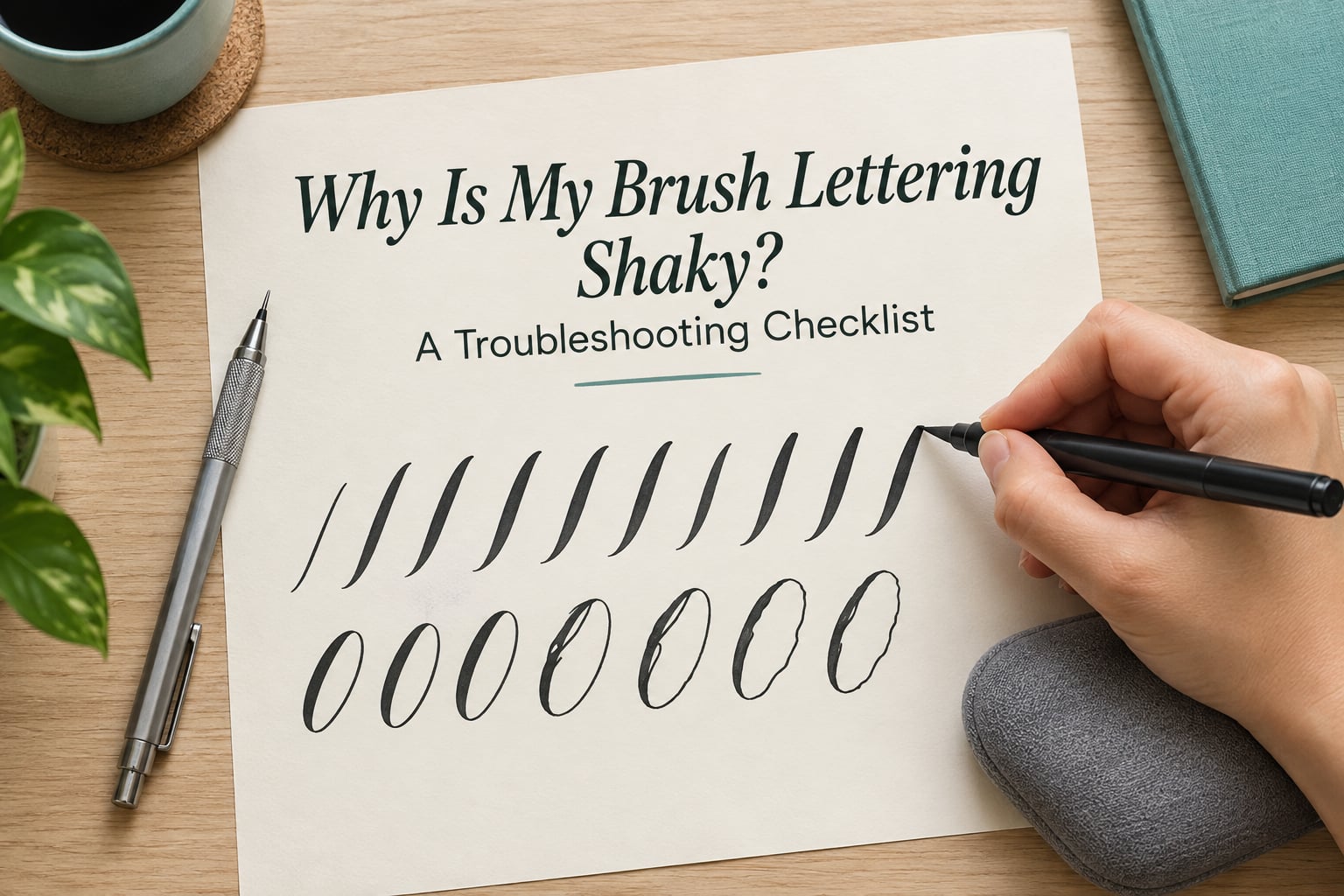
Shaky brush lettering is nearly always caused by four things: stroke speed that is too fast or too slow, a grip that is too tight, movement coming from the fingers instead of the arm, or a tool and paper combination that fights you. Shaky lines are a control problem, not a talent problem, and they usually come from one or two causes rather than everything at once.
Last updated: October 2026
I have watched hundreds of beginners hit the same wall. They practice for weeks, letter a page, look at the wobbly upstrokes, and conclude they do not have the hand for it. Almost every one of them had a fixable cause they never checked.
So this article is built as a diagnostic checklist rather than a pep talk. You will work from the free, instant tests to the involved ones, changing exactly one variable at a time. If you can name the cause, you can fix it in a single session. If you cannot, you will just practise for months and hope.
Table of Contents
- The 60-Second Shaky Lettering Checklist
- Step 0 – Check the Physical Stuff First
- Step 1 – Is It Your Speed?
- Step 2 – Is It Your Grip?
- Step 3 – Is It Your Arm Movement?
- Step 4 – Is It Your Tools?
- Step 5 – Is It Your Pressure on Upstrokes?
- Step 6 – Is It Practice and Muscle Memory?
- Symptom-to-Cause Lookup Table
- When Shaky Hands Are Physical, Not a Technique Problem
- The 5-Minute Warm-Up Routine
- Weekly Practice Protocol
- Frequently Asked Questions
- Is shaky brush lettering normal for beginners?
- Why does going too slow make my lines shaky?
- How to fix shaky handwriting?
- Why does my hand tighten when I write?
- How to stabilize hands when drawing?
- What health conditions could cause shaky handwriting?
- Should I rest my wrist when brush lettering?
- How can I improve my hand lettering skills faster?
- Final Thoughts
The 60-Second Shaky Lettering Checklist
Run through this list in order before you change anything. Each item is symptom, cause, then fix.
- Lines wobble most on thin upstrokes. Cause: light pressure. Fix: press slightly more and prioritise evenness over thinness.
- Lines wobble evenly on every stroke. Cause: hand tremor from fatigue or tension. Fix: rest the forearm and shake out your hand.
- Your hand cramps and tightens mid-letter. Cause: death grip. Fix: hold the pen higher on the barrel, breathe out as you stroke.
- Strokes are short and cramped. Cause: finger-driven movement. Fix: rest the forearm on the table and move from the elbow.
- Lines improve the longer you keep going. Cause: muscle memory still forming. Fix: keep practicing, it resolves.
- Lines got shaky suddenly with the same pen. Cause: dried or skipping tip. Fix: test on scrap paper, replace the pen.
- Downstrokes wobble, upstrokes are fine. Cause: too much finger pressure on the flex. Fix: let the nib flex do the work.
- Everything wobbles on rough paper only. Cause: paper tooth catching the tip. Fix: move to smooth marker paper.
- Your hand tightened as you got frustrated. Cause: adrenaline and stress. Fix: stop, reset, return after a break.
- Shakiness appears on any writing, not just lettering. Cause: a physical factor. Fix: check sleep, caffeine, blood sugar, and see the health section.
Step 0 – Check the Physical Stuff First
Check the physical stuff first because it costs nothing and takes two minutes. Grip, pen and paper feel like the problem, so most people start there and never think to look at the body doing the lettering.
Sleep is the big one. A night of four hours or five hours is enough to make fine motor control noticeably worse the next day. If your lines are shaky after a late night and fine after a full one, you have your answer, and no amount of technique work will outrun it.
Caffeine cuts both ways here. A little sharpens focus; a lot ramps up fine tremor in your fingers. If your lettering is worse on days you have had three or more coffees, try matching your intake to your sleep and see whether the wobble moves with it.
Stress and adrenaline tighten the hand without you noticing. Feeling rushed or frustrated mid-page is often the moment the letters start to go wrong, which is why beginners blame their letterforms when the real trigger was emotion.
Hydration, blood sugar and cold hands complete the list. A skipped meal or a chilled room produces a faint, unsteady tremor that beginners write off as a bad session. Warm your hands before you start and eat something if you have not.
Step 1 – Is It Your Speed?
Speed causes shakiness in both directions, and the slow direction is the one most people never consider.
Too fast is obvious. You have not given your hand time to start a stroke smoothly, so the line jumps into motion instead of easing into it. Everything looks like a small spike or hook where a stroke begins.
Too slow is counter-intuitive, and it is the most common hidden cause. When you crawl through a stroke, your hand has more time to drift and micro-correct. The longer the stroke lasts, the more chances your muscles have to wander off the path, so the wobble accumulates over distance.
| Speed | What your line looks like | What to do |
|---|---|---|
| Too fast | Spikes, hooks and overshoot at stroke starts, abrupt ends | Slow down roughly one third and keep it there |
| Goldilocks | Even line that starts and stops softly | Repeat at the same pace, every stroke |
| Too slow | Wobble that builds along the length of the stroke | Speed up and use longer, more confident strokes |
Consistency matters more than the exact pace. The real target is a steady rhythm you can repeat, not a particular speed. Pick a pace that feels easy, letter a full row, and check whether the wobble is distributed evenly or piling up at the end of each stroke. Piling up at the end means you are going too slow.
One test takes a minute. Letter the same letter twenty times, then letter it twenty more at a noticeably quicker pace. If the fast set looks steadier despite being less controlled letter by letter, speed was your variable.
Step 2 – Is It Your Grip?
Your grip is the second thing to check, and tightening it is the most common reaction to shaky lines. That reaction makes everything worse.
A death grip is squeezing the pen harder than the stroke needs. It tires the small muscles in your fingers, and tired muscles shake. It also locks the wrist, so the arm cannot take over the movement, which forces the fingers to do work they are not built for.
Hold the pen higher on the barrel, near the top rather than near the tip. The extra distance gives your fingers more leverage and reduces the pressure needed to control the stroke. Three points of contact with the pen, not a closed fist.
The top answer on the r/Handwriting thread for shaky hands goes further and suggests controlling your breath. It works because exhaling slows your heart rate and softens the hand at the same time. Try a slow exhale that lasts the length of a stroke.
Check your shoulders while you work. Raised shoulders mean tension has already travelled up the arm, and no amount of finger awareness will undo it. Drop them deliberately, rest your forearm, and shake your hand out every two minutes or so.
Step 3 – Is It Your Arm Movement?
Where your movement comes from decides how long your strokes can be, and beginners almost always start by moving their fingers.
Finger-driven movement produces short, cramped strokes. Your fingers can only travel a few centimetres, so long strokes become a chain of tiny joined movements. Every joint in that chain is a place the line can drift, so the result looks wobbly and cramped at the same time.
Arm-driven movement produces long, smooth strokes. Rest your forearm on the table so the elbow is supported, and let the forearm travel while the wrist stays relaxed. The pen follows the arm rather than the fingers.
A floating wrist works if you have a surface to rest on. A tripod or palm-down grip works better if you are lettering on a small surface or on paper without a table edge to lean into. Neither is wrong; the problem is mixing them mid-session.
Use your non-dominant hand. Resting the heel of it on the paper, or lightly holding the edge of the sheet, removes a surprising amount of movement from the writing hand. Many letterers find this one change alone halves the wobble.
A rest pad is a small foam or fabric mound you place under the wrist. If you work on a hard desk and your hand is tired by the second row, this is a five-minute fix that lasts the whole session.
Step 4 – Is It Your Tools?
Tools cause shakiness more often than beginners expect, and the symptom looks identical to a shaky hand. This is the step most guides skip.
Test the pen on scrap paper first. Draw twenty short downstrokes and twenty upstrokes. If you see broken ink, gaps or tiny skips that were not there last week, the tip is dried, depleted or worn and no amount of technique will fix it. A new pen of the same type is the fastest diagnostic in this entire article.
Tip size changes how forgiving a pen is. A small tip has a narrow, firm contact point and gives you a narrow line with very little wobble tolerance, but it is far easier to keep steady. A large flexible tip produces beautiful thick downstrokes and demands a steady hand on every one, because the whole nib splays.
Nib flexibility is the part beginners underestimate. With a very flexible brush, your downstroke thicks and your upstroke thins entirely from pressure, so any variation in hand pressure shows up directly as a change in line width. If your lines vary in width as much as they vary in smoothness, switch to a firmer pen for a while.
| Pen type | What it is best for | Effect on wobble |
|---|---|---|
| Small-tip firm brush pen | Learning control, small letters, consistent practice | Most forgiving; hides beginner shakiness best |
| Large flexible brush pen | Thick downstrokes, large display lettering | Amplifies every pressure wobble into visible width change |
| Bristle brush with ink | Thick, textured, sign-painting styles | Hardest of all to keep steady; not a learning tool |
| Dried, depleted or skipping pen | Nothing | Mimics a shaky hand exactly; replace before diagnosing yourself |
Paper surface is the other half. On toothy, textured or recycled paper the tip catches on fibres, so the line skips and looks shaky even when your hand is perfectly still. Move the same stroke onto smooth marker paper and compare. If the smooth sheet is clean, the paper was the cause.
Paper grain and direction matter less than most people think, but they are free to change. Turning the sheet so the grain runs with your longest strokes reduces drag slightly. If your downstrokes feel heavier going left to right than right to left, that drag is real and rotating the sheet helps.
Pen angle is worth checking too. Around 45 degrees to the paper keeps the nib contacting the surface evenly as you move through a curve. Rolling the pen flatter as you curve increases the contact patch and introduces drag you will fight for the whole stroke.
Ink flow changes with age and storage. A pen left uncapped dries at the tip, and a warm room thins ink so it flows fast and overshoots. If your lines are flooding rather than wobbling, the pen is doing it, not you.
Step 5 – Is It Your Pressure on Upstrokes?
Too-light pressure on upstrokes is the cause most guides leave out, and it produces the most frustrating wobbly lines of all.
When an upstroke is barely touching the paper, the tip skips across the surface instead of dragging along it. The result is a thin, broken, extra-wobbly line with visible dry patches, and beginners almost always read it as a hand control problem.
The fix is to stop chasing the thinnest possible line. Lift slightly before the baseline, press to full contact through the curve, then release before you reach the top. Prioritise an even line over a hairline-thin one, and the skipping disappears.
Test it: letter ten full-height upstrokes with a deliberate, confident press. If those ten are cleaner than the fifty before them, pressure was your variable.
Step 6 – Is It Practice and Muscle Memory?
If you have worked through every step above and the wobble is milder rather than gone, this may simply be where you are.
Brush control is a motor skill, and motor skills consolidate through repetition, not through understanding them. Knowing the right pen angle does not build the movement; two hundred repeated upstrokes do. There is no shortcut to that stage and no reason to be discouraged by it.
Beginners usually see visible change within a few focused weeks. Consistency across a page comes later, and smoothness under time pressure comes later still. Judge progress over a week, never over a single page.
Symptom-to-Cause Lookup Table
This table is the fast version. Find the symptom that matches your page and go straight to the first fix.
| Symptom you see | Likely cause | First fix to try |
|---|---|---|
| Wobbly thin upstrokes, clean downstrokes | Upstroke pressure too light, pen tip too flexible | Press through upstrokes, test a firmer small tip |
| Wobbly downstrokes too | Finger-driven movement, death grip | Rest forearm, move from the elbow, loosen grip |
| Shaky with any pen, any surface | Tremor, fatigue, stress, caffeine, low blood sugar | Rest, hydrate, eat, sleep, then re-test |
| Fine and clean for 30 seconds, then degrades | Fatigue building in the grip | Hold pen higher, shake out hand, shorten sessions |
| Worse on rough paper only | Paper tooth catching the tip | Move to smooth marker paper |
| Suddenly shaky after many good pages | Dried, depleted or worn pen tip | Retire the pen, test a new one |
| Line width varies as much as smoothness | Over-flexible nib, inconsistent pressure | Firmer pen, practise pressure transitions |
| Strokes start with hooks or spikes | Going too fast | Slow down and start each stroke deliberately |
| Wobble grows along the stroke | Going too slow | Speed up, use longer strokes |
| Fine at a desk, worse on a lap or standing | No forearm support, tripod grip too tight | Use a rest pad or stabilising hand |
| Worse in the evening than the morning | Fatigue, low blood sugar, late caffeine | Move practice earlier or break it into short sessions |
| Hand shakes even when not writing | Physiological tremor, not technique | See the health section below |
When Shaky Hands Are Physical, Not a Technique Problem
Some shakiness is not a technique problem, and no drill will touch it. This section exists because almost every guide in this space assumes a healthy hand, which leaves a real group of readers with no help at all.
The clearest signal is that the shakiness follows you. If your hand shakes holding a cup, resting it on a table, or writing a shopping list, the wobble in your lettering is not about your pen grip. If the tremor only appears under a pen, technique is worth working on.
| Physical factor | What it feels like | What helps |
|---|---|---|
| Sleep deprivation | Broad unfocused tremor, worse in the morning after a bad night | Consistent sleep, practice when rested |
| Caffeine | Fine rapid tremor in the fingers, worse after several cups | Reduce intake and compare across a week |
| Stress or anxiety | Tremor that spikes with frustration or time pressure | Slow exhales, shorter sessions, break away on frustration |
| Low blood sugar | Shaky, weak and light-headed, often mid-session | Eat before practising, take breaks |
| Dehydration | Dryness with general unsteadiness | Water before and during practice |
| Cold hands | Finger stiffness and slow, jerky strokes | Warm hands first, work in a warmer room |
| Essential tremor | Tremor with movement or posture, often hands and head | Medical assessment; stabilising aids and adaptative tools |
| Medication side effects | Tremor that appeared after a medication change | Speak to a pharmacist or prescriber before changing anything
Fixing a physical factor takes minutes, which is why it is worth testing first. Fixing a technique cause takes a session. That order alone tells you which is cheaper.
See a doctor if the tremor is new, worsening, happens at rest, affects one side, comes with weakness, changes in speech or balance, or appears alongside other symptoms. A GP or neurologist can rule out causes that no amount of practice will touch, and having that ruled out removes a lot of anxiety from practice.
Adaptive tools genuinely work and are worth knowing about. Pen grips add barrel thickness for hands that close too tightly. Wrist rests and palm pads remove the load that causes fatigue. A stabilised stylus turns a physical tremor into a smooth digital line. A hand can be unsteady and still produce excellent lettering, particularly at large sizes where the stroke length hides small movement.
If you letter digitally, a software stabilisation slider does the equivalent work instantly. It samples your stroke and smooths it, which lets you build shape and path knowledge on shaky days and keeps practice from becoming frustrating.
Letterers with genuine tremor conditions have asked in communities what they should use to steady their hands, and the honest answer is that no tool removes the tremor. What the tools do is reduce fatigue, remove surface drag, and let you work longer before quality drops. That is enough to keep making work.
The 5-Minute Warm-Up Routine
A five-minute warm-up does more for shaky lines than twenty minutes of lettering cold, because your hand is a physical system and it needs blood moving through it first.
- Minute 1 – Shoulder rolls and arm swings. Ten slow backward circles each way, then ten forward. This releases the tension that travels from the shoulder down to the fingers.
- Minute 2 – Finger and wrist release. Spread your fingers wide, hold, relax. Shake each hand out for fifteen seconds. Open and close the pen hand gently around the pen to feel the difference between gripping and holding.
- Minute 3 – Baseline lines. Long horizontal lines, filling a page, at a consistent medium speed. These are the most direct warm-up for hand steadiness and they are where you check your speed.
- Minute 4 – Ovals and compound curves. Underturn and overturn ovals in both directions, large, with no pressure change. This warms the wrist through the movement your letters need.
- Minute 5 – Pressure transitions. Thick to thin in one continuous stroke, in both directions. This is where the pen learns to change width without your hand jolting.
Do the routine before every session, not only before the good ones. It takes five minutes and it changes the first ten minutes of your practice more than those ten minutes change anything else.
Weekly Practice Protocol
Progress in brush lettering is invisible from inside a single session, so you need an external measure or you will convince yourself you are getting worse.
- Five minutes, every day. The warm-up, then one drill type. Daily short sessions build control far faster than occasional long ones.
- One drill per day. Monday baselines, Tuesday overturns, Wednesday underturns, Thursday compound curves, Friday pressure transitions. One variable at a time builds the muscle memory you are actually after.
- One measured page per week. Pick the same word and letter it twenty times on a single sheet. Circle your three smoothest. That is your baseline for next week.
- Change one thing at a time. If you adjust grip and pen and paper in one session and the lines improve, you have learned nothing about which change did it. This is the single most useful habit in the whole protocol.
- Log the symptom. Write one line about what was shaky and when. After two weeks your own notes will usually name your cause faster than any article can.
Give it three focused weeks before you judge technique changes. Motor control responds on a lag, and a fix that feels useless on day two often looks obvious by day fifteen.
Frequently Asked Questions
Is shaky brush lettering normal for beginners?
Yes. Shaky lines are the most common stage in brush lettering, and almost every beginner produces them. Your hand is learning a new motor pattern and control comes from repetition, not from understanding. The difference between normal beginner shakiness and a fixable problem is whether the wobble stays the same across a whole page or grows as you fatigue. If it is even and mild, keep practicing. If it changes as you go, work through the checklist above.
Why does going too slow make my lines shaky?
Because a longer stroke gives your hand more time to drift and micro-correct. When you crawl, every small muscle correction becomes visible on the paper, and the wobble accumulates along the length of the stroke. A slightly quicker, confident pace usually produces a steadier line than a careful crawl. Aim for a consistent medium rhythm you can repeat on every stroke rather than the slowest pace you can manage.
How to fix shaky handwriting?
Start with the free checks: sleep, caffeine, stress, hydration and blood sugar. Then check your grip, hold the pen higher on the barrel and keep it loose. Rest your forearm on the table and move the pen with your arm rather than your fingers. Slow your speed by about one third and keep it consistent. If the tremor also shows up when you are not writing, the cause is physical rather than technical.
Why does my hand tighten when I write?
Most often it is a feedback loop: you notice a shaky line, grip harder to control the next one, and the added tension tires the small finger muscles, which shake more. Fatigue, stress and cold hands all accelerate it. Break the loop by holding the pen near the top of the barrel, breathing out slowly through each stroke, dropping your shoulders deliberately, and shaking your hand out every couple of minutes.
How to stabilize hands when drawing?
Rest the forearm on the table so the elbow is supported, and use your non-dominant hand to hold the edge of the paper. If your surface is hard and high, place a small foam or fabric rest pad under your wrist. Keep the pen high on the barrel so less finger force is needed. If you work digitally, use the stabilisation slider while your technique is still forming.
What health conditions could cause shaky handwriting?
Common contributors include an essential tremor, which affects the hands during movement or while holding a posture, and side effects of medications, including some inhalers, stimulants and thyroid treatments. Caffeine, poor sleep, low blood sugar, dehydration, anxiety and cold hands all produce tremor as well, and those are the easiest to test and fix yourself. A tremor that is new, worsening, present at rest, or accompanied by weakness, speech or balance changes is a reason to see a doctor.
Should I rest my wrist when brush lettering?
Yes, if you are working at a table with your forearm supported. Resting the forearm takes the weight off the wrist and lets your arm move the pen in longer, smoother strokes. If no surface is available, a floating wrist is fine, but keep it relaxed rather than locked. Either way, avoid a tripod or palm-down grip unless you are lettering on a small surface, and do not switch between grips mid-session.
How can I improve my hand lettering skills faster?
Short daily sessions beat long occasional ones, because control is built by repetition. Warm up for five minutes, drill one stroke type per day, and measure progress once a week on the same word rather than on finished pieces. Change only one variable at a time so you know what worked. Practise a stroke in the largest size first and scale down later, since the movement is easier to see and correct when it is big.
Final Thoughts
Why is my brush lettering shaky? Almost always because of speed, grip, finger-driven movement, or a tool that is skipping or too flexible. Those four account for nearly every case, and each has a test you can run in under a minute.
Work the steps in order and change one thing at a time. Physical factors first because they are free, then speed, then grip, then arm movement, then tools, then upstroke pressure. If everything checks out, the shakiness is a stage rather than a defect, and the answer is a warm-up and daily short practice.
Finally, separate the hand problem from the letterform problem. Slightly uneven handmade letters are part of the medium, not a mistake to correct. If you have checked every box on this list and your lines are still unsteady but your work is improving week to week, you are exactly where a beginner should be.