
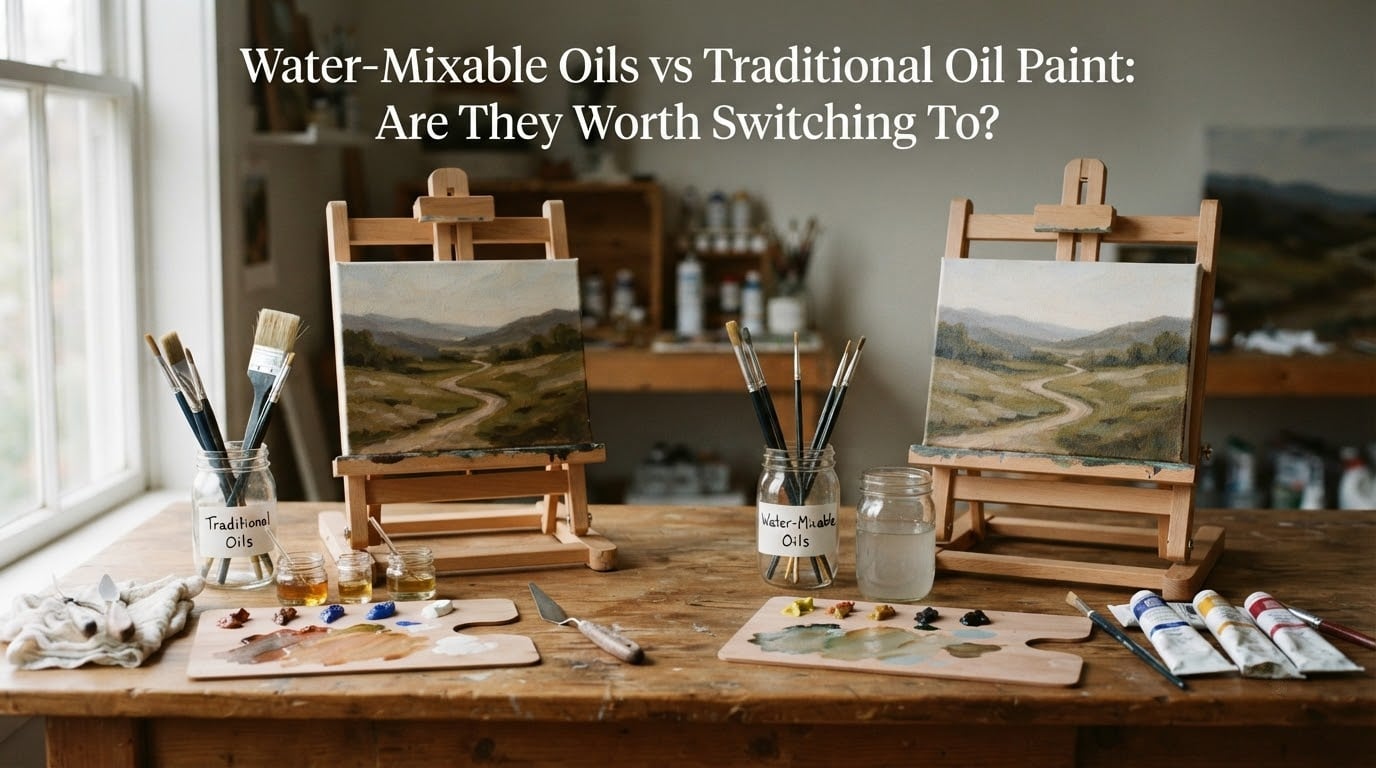
Water-mixable oils are real oil paints with a modified binder that lets you thin them and clean your brushes with water instead of turpentine or mineral spirits. After comparing them side-by-side with traditional oils for several months, I can tell you the difference comes down to handling, drying time, and how much you value a solvent-free studio. This guide walks through how each medium actually works, where water-mixable oils shine, where traditional oils still win, and how to decide if switching is worth it for your painting setup.
Table of Contents
- Quick Comparison: Water-Mixable Oils vs Traditional Oil Paint
- What Are Water-Mixable Oils and How Do They Work?
- Drying Time and Curing: How They Compare
- Cleanup, Solvents, and Safety Compared
- Can You Mix Water-Mixable Oils With Traditional Oils?
- Pros and Cons of Water-Mixable Oils
- Archival Quality and Longevity: The Honest Truth
- Top Brands and Recommended Mediums
- Who Should Switch vs Who Should Stay With Traditional Oils
- Frequently Asked Questions
- The Final Verdict: Are Water-Mixable Oils Worth Switching To?
Quick Comparison: Water-Mixable Oils vs Traditional Oil Paint
| Feature | Water-Mixable Oils | Traditional Oil Paint |
|---|---|---|
| Cleanup | Soap and water | Turpentine, mineral spirits, or Gamsol |
| Odor | Low to none | Strong solvent smell |
| Toxic fumes | Minimal | Significant in poorly ventilated spaces |
| Drying time (surface) | 2 to 7 days | 3 to 14 days depending on pigment |
| Full curing | 6 to 12 months | 6 months to 1 year |
| Working time | Long, similar to traditional | Long |
| Opacity and pigment load | Slightly lower in some brands | Generally higher |
| Archival quality | Good, but less long-term data | Centuries of proven durability |
| Cost per tube | Usually higher than student-grade | Wide range, student to professional |
| Brush compatibility | Synthetic brushes recommended | Natural or synthetic both work |
| Varnishing | Standard Gamvar or equivalent | Standard Gamvar or equivalent |
| Best for | Asthma, allergies, small spaces, plein air, classrooms | Traditional studios, large-scale work, maximum color depth |
What Are Water-Mixable Oils and How Do They Work?
Water-mixable oils are genuine oil paints chemically engineered to behave like traditional oils during painting, but to mix with water during thinning and cleanup. The trick is in the binder.
The modified binder and emulsifier explained
Traditional oil paint uses linseed oil, walnut oil, or safflower oil as its binder. Water-mixable oils add an emulsifier to that same oil binder. An emulsifier is a molecule with one end that bonds to oil and one end that bonds to water, so it bridges the two and keeps them mixed. This is the same basic chemistry that lets soap lift grease off a plate.
Because the emulsifier is built into the binder, the paint still dries through oxidation. It does not dry by water evaporation like acrylics. The water you add during painting eventually leaves the film, and the oil cross-links with oxygen in the air, just like traditional oils.
Are water-mixable oils real oils?
Yes. The pigment is bound in oil, the film cures by oxidation, and once cured the painting behaves exactly like a traditional oil painting. You can varnish it the same way, frame it the same way, and the surface has the same buttery feel when you load your brush.
The chemistry is more modified linseed oil or modified safflower oil than a fundamentally different medium. What changes is how you handle it during the painting session.
The drying process: oxidation, not evaporation
Both paints cure the same way at a molecular level. Oil molecules react with oxygen and link into long polymer chains. That is why an oil painting can take six to twelve months to fully harden even though the surface feels dry in days.
If you add water to water-mixable oils, the water does eventually leave the film, but the oil still needs oxygen to cure. Adding too much water can slow drying and leave a weaker film, which is why most manufacturers recommend limiting water content to roughly 30 percent and switching to a proper medium for anything beyond that.
Drying Time and Curing: How They Compare
Drying time is the comparison most artists want first, and the honest answer is that water-mixable oils dry at a similar pace to traditional oils, with one important exception.
Surface dry vs fully cured
Most water-mixable oils are surface dry to the touch in 2 to 7 days, comparable to a fast traditional oil like a cobalt drier. Full curing, meaning the paint film has oxidized all the way through, still takes 6 to 12 months for most colors.
The chemistry is the same oxidation process, so the curing curve is similar. You can varnish water-mixable oils on the same timeline as traditional oils, usually after the surface has cured for 6 to 12 months.
Why water-mixable whites dry slower
Water-mixable whites, especially Titanium White, often dry noticeably slower than their traditional counterparts. The reason is the binder: many water-mixable whites use safflower oil because it accepts the emulsifier more easily, and safflower oil yellows less but dries more slowly than linseed oil.
If fast-drying whites are critical for your layering approach, choose a water-mixable brand that uses linseed oil binders, or add a small amount of alkyd medium to speed things up.
Curing timeline differences
In practice, most painters find the curing timeline close enough that they can follow traditional oil painting rules. Let thick impasto dry for several days before glazing over it. Wait a week before varnishing. Avoid stacking paintings face-to-face until the surface is truly dry.
The one situation where water-mixable oils behave differently is when too much water is left in the film. If you over-thin with water and paint on a non-absorbent surface, the water can get trapped and slow drying significantly.
Cleanup, Solvents, and Safety Compared
This is where water-mixable oils earn their reputation. Cleanup is dramatically easier, and the safety profile is genuinely different.
Soap and water cleanup
During the painting session, you can clean your brushes with plain soap and water, the same way you would clean acrylic brushes. Murphys Oil Soap or Masters Brush Cleaner both work well. The brush comes clean in under a minute, with no solvent smell in the studio.
Once the paint dries on the brush, cleanup takes a bit more work, but it is still doable with soap and water. This is one reason many artists with asthma or solvent sensitivities finally feel comfortable painting in oils.
When solvents are still needed
For the painting session itself, you can often avoid solvents entirely. For final brush cleaning after a long session, or for cleaning dried paint out of brushes you forgot to wash, a small amount of solvent or brush cleaner is still helpful.
Many artists keep one small jar of Gamsol or Turpenoid Natural for tough jobs, but the daily routine is mostly water-based.
Toxic fume reduction
Traditional oil painting solvents like turpentine and mineral spirits release volatile organic compounds that can irritate eyes, lungs, and skin. In a small apartment or shared studio space, the fumes are a real concern.
Water-mixable oils cut that exposure to near zero for everyday painting. This is why teachers in classroom settings often choose water-mixable oils, and why artists with chemical sensitivities frequently switch and never go back.
Can You Mix Water-Mixable Oils With Traditional Oils?
This is the question I get asked the most, and the answer is more nuanced than a simple yes or no.
Why you should never mix them wet-on-wet
If you mix water-mixable oils with traditional oils on the palette while both are wet, the emulsifier in the water-mixable paint will try to bond with the water in the water-based paint and the solvent in the traditional paint at the same time. The result is unpredictable: poor adhesion, weak film, and possible separation over time.
The chemistry does not play nicely when both types are fresh. Stick to one or the other for any single painting session, especially in the early layers.
Using them in the same studio
You can absolutely keep both water-mixable and traditional oils in the same studio. Use separate brushes, separate palettes, and separate medium cups. Apply traditional oils in one session and water-mixable in another, or use them for entirely different paintings.
Many working artists do this. They keep traditional oils for studio work where ventilation is good and color depth matters, and water-mixable oils for plein air trips, classes, or quick studies.
Fat over lean rule still applies
The traditional fat over lean rule applies to water-mixable oils just as much as to traditional oils. Start with lean layers (less medium, more solvent or water) and finish with fat layers (more medium, more oil).
The same modified linseed oil mediums that work for traditional oils work for water-mixable oils, as long as you stay within the water-mixable product line during any single painting.
Pros and Cons of Water-Mixable Oils
Here is the honest list after months of side-by-side testing.
What water-mixable oils do better
- Cleanup with soap and water in under a minute
- Almost no solvent smell in the studio
- Safer for artists with asthma, allergies, or chemical sensitivities
- Lower odor makes plein air work more pleasant outdoors
- Great for classrooms and shared studio spaces
- Real oil paint feel with acrylic-like cleanup convenience
- Easier to introduce beginners to oil painting without solvent fear
What traditional oils still do better
- Highest pigment load and color saturation in professional lines
- Centuries of proven archival performance
- Wider range of historical and professional brands
- Natural hog bristle brushes work well, not just synthetics
- More forgiving with extreme impasto and palette knife work
- Generally lower cost per tube at the student-grade level
- Longer track record for museum-quality conservation
The trade-off is mostly about convenience versus maximum pigment performance. For most hobbyists and many professionals, water-mixable oils are more than enough.
Archival Quality and Longevity: The Honest Truth
This is the section where I have to be most careful, because the long-term data on water-mixable oils is still being gathered.
What scientific research shows
The available research, including NMR and GCMS studies cited by conservation specialists, suggests that fully cured water-mixable oil films behave very similarly to traditional oil films. The oxidation process is the same, and the final polymer network is comparable.
One concern some researchers raise is that the emulsifier residue may affect long-term stability in ways that are still being studied. The chemistry is newer, so we simply have less data on paintings made in the 1970s and 1980s compared to traditional oils with centuries of history.
Museum and conservation perspectives
Major museums like the Getty and Smithsonian have studied modern oil paint formulations, and the consensus is that properly made modern oil paints, including water-mixable versions, should perform well if applied correctly.
The key phrase is “if applied correctly.” Water-mixable oils require the same care as traditional oils: proper fat over lean ratios, adequate drying between layers, and varnishing only after full curing.
Cross-linking and binder differences
The cross-linking process, where oil molecules bond into long chains, is identical for both types. What differs is the modified binder and the residual emulsifier.
If you paint within the manufacturer’s guidelines, do not over-thin with water, and follow traditional oil painting techniques, the archival performance should be excellent. The risk comes from cutting corners, not from the medium itself.
Top Brands and Recommended Mediums
A few brands have built strong reputations in the water-mixable category.
Cobra, Holbein Duo, Winsor & Newton Artisan
Royal Talens Cobra is widely considered the gold standard for professional water-mixable oils. Excellent pigment load, good consistency, and a wide color range. Long-term users on r/oilpainting report satisfaction after ten or more years.
Holbein Duo Aqua is the Japanese counterpart, known for refined handling and a buttery consistency that many artists compare favorably to traditional oils. Winsor & Newton Artisan is the most widely available option in many art stores, with solid quality and a beginner-friendly price point.
LUKAS Berlin is another strong option, particularly known for good coverage and color intensity.
Modified linseed oil and walnut oil mediums
For mediums, stick with the water-mixable product line from your paint manufacturer. Cobra has its own water-mixable linseed oil medium. Holbein offers a Duo Aqua medium. Winsor & Newton Artisan has matching mediums designed to work with their paint.
Walnut oil based mediums are popular for artists who want minimal yellowing. They are available in water-mixable formulations and work well for glazing and fat layers.
Choosing the right starter set
For beginners, I recommend starting with a small set from Cobra or Winsor & Newton Artisan. Get the basics: Titanium White, Cadmium Yellow Light, Cadmium Red, Ultramarine Blue, Burnt Umber, and Yellow Ochre.
Buy the matching water-mixable medium and a set of synthetic brushes. Total investment is modest and lets you decide if the switch is right for you before committing to a full studio overhaul.
Who Should Switch vs Who Should Stay With Traditional Oils
The honest answer depends entirely on your situation.
Artists who benefit most from switching
If you have asthma, allergies, or chemical sensitivities, water-mixable oils can be life-changing. The elimination of daily solvent exposure is a real health upgrade.
If you paint in a small apartment, shared studio, or classroom, the lack of fumes makes the workflow dramatically easier. Teachers especially appreciate that students can clean up without strong-smelling solvents.
If you do plein air work or paint while traveling, water-mixable oils simplify your kit. No solvent containers, no special disposal, no smell complaints from travel companions.
Artists who should stay with traditional
If you paint at the professional level where maximum pigment load and color depth matter most, traditional oils still have the edge. The professional lines from brands like Michael Harding, Rublev, and Gamblin offer pigment loads that are hard to match.
If you have a well-ventilated studio and enjoy the traditional painting process, the solvent smell is part of the ritual for many artists. There is no reason to give that up if it works for you.
If you use natural hog bristle brushes heavily, traditional oils are more forgiving. Water-mixable oils work fine with synthetics, but the brush care is different.
A decision framework by use case
Ask yourself three questions: Do I have ventilation concerns? Do I have health sensitivities? Do I need maximum pigment performance?
If the first two are yes, switch. If the third is yes and the first two are no, stay with traditional. If you answered yes to all three, consider using both: traditional for major studio work and water-mixable for everything else.
Frequently Asked Questions
What are the disadvantages of water-mixable oil paint?
The main disadvantages are slightly lower pigment load in some brands, slower drying whites (especially safflower-based Titanium White), higher per-tube cost than student-grade traditional oils, and the fact that long-term archival data is still being gathered. Brush care also requires synthetic brushes or careful cleaning to avoid damaging natural bristles.
Can you use water-mixable oil paint with regular oil paint?
You can keep both in the same studio, but you should never mix them wet-on-wet on the palette. The emulsifier in water-mixable paint reacts unpredictably with traditional oils when both are fresh. Use separate brushes, separate palettes, and apply each type in separate sessions or on separate paintings.
Is water-mixable oil paint any good?
Yes, water-mixable oil paint is real oil paint and produces real oil paintings. Brands like Royal Talens Cobra, Holbein Duo Aqua, and Winsor u0026amp; Newton Artisan offer professional quality with pigment loads suitable for most work. The main difference from traditional oils is handling during the session, not the final result.
What is the difference between water-mixable oil paint and normal oil paint?
Water-mixable oil paint contains an emulsifier added to the oil binder, which lets you thin and clean it with water instead of solvents like turpentine or mineral spirits. Traditional oil paint uses only oil as the binder and requires solvents for thinning and cleanup. Both dry through oxidation and produce the same type of cured oil film.
Do water-mixable oils dry faster than traditional oils?
Water-mixable oils dry at a similar pace to traditional oils, with surface drying in 2 to 7 days and full curing in 6 to 12 months. One exception is whites, which often use safflower oil binders and dry more slowly than their traditional linseed-oil counterparts. Adding a small amount of alkyd medium can speed drying if needed.
The Final Verdict: Are Water-Mixable Oils Worth Switching To?
Yes, water-mixable oils are worth switching to if you have any concerns about solvents, ventilation, or health. The cleanup is dramatically easier, the smell is essentially gone, and the finished painting is the same real oil film you would get with traditional oils. For most hobbyists, plein air painters, classroom teachers, and artists with chemical sensitivities, the switch is a clear win.
If you are a professional artist working at the highest pigment loads in a well-ventilated studio and you love the traditional process, traditional oils still have a slight edge in color depth. Many artists end up using both: water-mixable for travel, studies, and quick work, traditional oils for major studio pieces.
Start with a small set from Cobra or Winsor & Newton Artisan. Paint with it for a few weeks. If the handling feels right and the cleanup makes your studio more pleasant, you have your answer.