
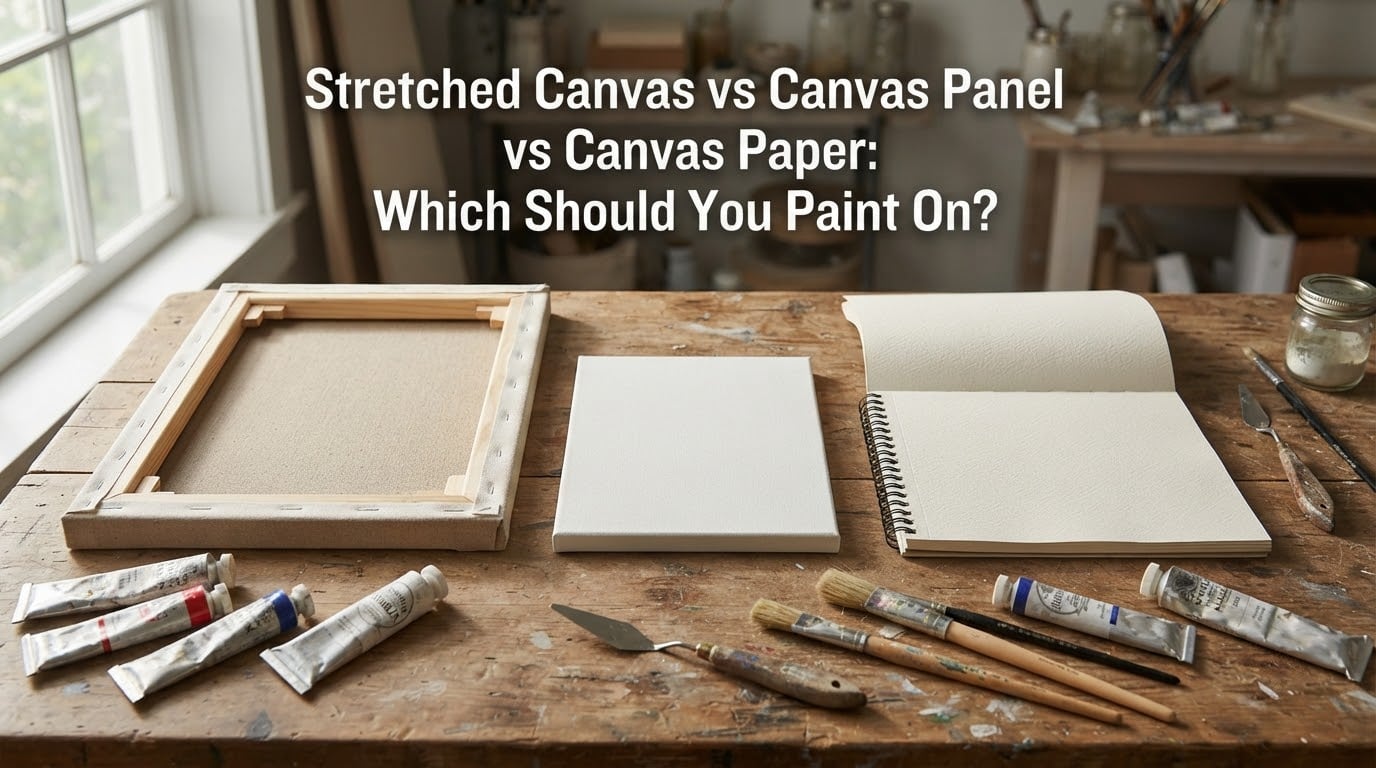
Pick stretched canvas when you want a professional, gallery-ready surface with bounce under the brush. Pick a canvas panel when you want rigid support, easy storage, and quick framing. Pick canvas paper when you want an inexpensive, portable surface for studies, travel, and quick acrylic or oil sketches. That is the short answer, and the rest of this guide unpacks the why behind it.
The painting surface you choose changes how your paint feels, how it dries, how much framing it needs, and how long the artwork lasts. I have painted on all three over the years, and the differences are real. Whether you are a first-time acrylic painter or a working oil artist, this guide walks you through stretched canvas vs canvas panel vs canvas paper so you can stop guessing and start painting on the right surface.
Table of Contents
- What Is Stretched Canvas? Definition and Core Features
- What Is a Canvas Panel? Rigid Support for Stable Painting
- What Is Canvas Paper? The Portable Practice Surface
- Stretched Canvas vs Canvas Panel vs Canvas Paper: Full Comparison
- Which One Should You Choose? Decision Guide by Medium and Skill Level
- Common Painting Surface Mistakes (and How to Avoid Them)
- Sustainability and Archival Quality Across Canvas Surfaces
- Frequently Asked Questions
- Final Verdict: Which Painting Surface Should You Buy?
What Is Stretched Canvas? Definition and Core Features
Stretched canvas is fabric (cotton or linen) pulled tight over a wooden frame and usually pre-primed with gesso. The fabric does the actual holding of the paint. The wooden frame, called stretcher bars, keeps the fabric drum-tight and slightly under tension so the surface feels alive when you load it with brushstrokes.
Classic construction starts with a frame made of four stretcher bars mitred at the corners. Most frames include small wooden wedges, called canvas keys or canvas wedges, that you tap into the inner corners. That is what lets you re-tighten a stretched canvas if it starts to sag over time. Pre-stretched canvases from art supply stores arrive already tight and primed.
Two fabrics dominate the market. Cotton duck is the standard, affordable choice for students and hobbyists. Linen is the professional favorite for oil painting because of its smoother weave, stronger fibers, and lower stretch over decades. Both work for acrylics, oils, and mixed media once they have been primed with two or three coats of gesso.
One feature worth knowing is gallery wrap. A gallery-wrapped canvas has the fabric continued around the edges and stapled on the back. That means you can hang it without a frame and the edges look clean. Traditional wrap leaves the staples visible and almost always needs a frame.
Stretched Canvas: Pros and Cons
Pros: Authentic professional look, paint adheres beautifully to textured weave, accepts impasto and palette knife work, re-stretchable if it loosens, available in many sizes including very large formats for murals and statement pieces.
Cons: Heavier and bulkier than panels, can sag in humid storage, needs occasional re-tensioning, harder to ship without dents, light can pass through thin fabric during plein air painting.
Who Picks Stretched Canvas
Stretched canvas is the default choice for finished studio work sold or exhibited, large oil or acrylic paintings, and anyone who wants the traditional painting feel under the brush.
What Is a Canvas Panel? Rigid Support for Stable Painting
A canvas panel (also called a canvas board) is a rigid support with canvas glued or mounted on top. You get the canvas tooth without any wooden frame, stretcher bars, or canvas wedges. The back is solid, so the surface does not bounce, flex, or sag.
Most canvas panels use a medium-density fiberboard (MDF) or hardboard core. Higher-end options use Gatorfoam or Dibond for very large works. Some makers use heavy paperboard, which is cheaper but more prone to warping in damp studios. Professional painters often mount linen on their own cradled wood panels for the best of both worlds.
Quick note on terminology: canvas panel and canvas board mean the same thing in most stores. The phrase stretched canvas panel usually refers to a finished painting that has been mounted in a floater frame or shadow box, not a different product.
Panels come pre-primed and ready to paint on. You can also buy unprimed boards and apply your own gesso if you want to control the surface tooth.
Canvas Panels: Pros and Cons
Pros: Rigid, no bounce under the brush, easy to store stacked, light to transport, simpler to frame or display as-is, less expensive than stretched canvas of the same size.
Cons: Limited very-large sizes, lower-quality cardboard cores can warp in humidity, cannot be re-tightened, less of the traditional gallery feel, can dent or chip along edges if dropped.
Who Picks Canvas Panels
Plein air painters love panels because they travel well. Oil painters who mount linen to board favor them for stability. Beginners and students use them for studies and class work. Professional artists often use them for small to mid-size final pieces and reproductions.
What Is Canvas Paper? The Portable Practice Surface
Canvas paper is not actually canvas. It is heavy paper that has been embossed with a canvas-like texture, so it looks and feels a little like woven fabric. It usually comes as a glued pad (similar to a watercolor block), as loose sheets, or as a roll.
You can paint on canvas paper with acrylics, oils, gouache, and mixed media. Many makers also sell dedicated oil paper and acrylic paper so the sizing and primer are tuned to one medium. Look for acid-free and lignin-free labels when you care about archival longevity.
One question comes up constantly. Which side of canvas paper should you paint on? Always use the textured, embossed side. The back is usually smoother and designed to resist moisture so the pad stays flat.
Canvas paper is essentially a sketchbook for oil and acrylic. It gives you the tooth of canvas without the weight, the wooden frame, or the cost. The trade-off is that thin paper can buckle under heavy washes, and finished pieces almost always need framing behind glass or acrylic glazing to keep them flat.
Canvas Paper: Pros and Cons
Pros: Very inexpensive per sheet, lightweight for travel and classes, no priming required for most pads, easy to store flat, great for studies, color studies, and teachable moments.
Cons: Buckles under heavy wet paint, less durable than real canvas, papers need glass or acrylic glazing to frame, smaller practical sizes, can yellow over decades if not acid-free.
Who Picks Canvas Paper
Canvas paper is for beginners practicing before committing to real canvas, travel sketches, plein air thumbnails, classroom work, and gift-worthy studies that will live behind glass in a frame.
Stretched Canvas vs Canvas Panel vs Canvas Paper: Full Comparison
Below is a quick side-by-side comparison. Use it to scan the key trade-offs at a glance before we get into the recommendations.
| Feature | Stretched Canvas | Canvas Panel | Canvas Paper |
|---|---|---|---|
| Core structure | Fabric over wooden stretcher bars | Canvas glued to rigid board | Embossed heavyweight paper |
| Surface feel | Bouncy, textured | Rigid, stable | Textured, slightly flexible |
| Portability | Bulky, can dent | Easy to stack and carry | Lightest, fits in a bag |
| Framing needed | Often hung as-is (gallery wrap) | Often framed or floater-framed | Always needs glass or glazing |
| Best sizes | Any size, including very large | Small to medium most common | Small to medium sheets and pads |
| Skill level | Beginner to professional | Beginner to professional | Beginner, students, travel |
| Durability | Decades with re-tensioning | Decades, can warp if low quality | Years behind glass |
Medium Compatibility Matrix
Different media behave differently on each surface. This matrix shows the practical combinations.
| Medium | Stretched Canvas | Canvas Panel | Canvas Paper |
|---|---|---|---|
| Acrylic paint | Excellent | Excellent | Excellent |
| Oil paint | Excellent | Excellent | Good (oil paper pads) |
| Watercolor | Possible (heavy gesso) | Possible (heavy gesso) | Excellent (canvas-textured paper) |
| Gouache | Good | Good | Excellent |
| Mixed media collage | Excellent | Excellent | Good |
| Soft pastel | Good (with fixative) | Good | Good |
| Ink drawing | Good (sized surface) | Good | Excellent |
Which One Should You Choose? Decision Guide by Medium and Skill Level
Let us translate the comparison into actual buying decisions. Pick by medium first, then by your skill level and use case.
If You Paint With Acrylics
Acrylics dry fast and play nicely with all three surfaces. Beginners thrive on stretched canvas because the bounce helps loosen the brush. Working artists making final pieces also stick with stretched canvas, often the gallery-wrap kind, for sale-ready work. For practice and travel, canvas paper pads are unbeatable on price.
If You Paint With Oils
Oil painters commonly debate panels vs stretched canvas, and the forums have plenty to say. The common thread: pro oil painters often mount linen on rigid panels for the rigid surface, while stretched canvas remains the favorite for large, dramatic oil pieces. Canvas paper marketed as oil paper is a clean, lightweight choice for plein air and color studies. Make sure it is sized for oils.
If You Paint With Watercolors or Gouache
Watercolorists lean toward canvas-textured paper because the embossed surface grips washes beautifully. Real canvas needs multiple coats of gesso to keep watercolor from soaking in too quickly. If you want the canvas look in watercolor, dedicated watercolor canvas pads are the easy way.
If You Are a Complete Beginner
Start with pre-primed stretched canvas in the 8×10 to 16×20 range. Pre-stretched and pre-primed takes the prep work off your plate. Add a canvas paper pad for daily practice. You will not lose money if you decide the hobby is not for you.
If You Are Plein Air Painting Outdoors
Panels and canvas paper dominate plein air. Lightweight, rigid, and easy to transport. Stretched canvas is tricky outdoors because it can catch the breeze, the back of the canvas can let light leak through, and wet painting can dry unevenly when wind hits the surface.
If You Want to Sell or Exhibit Work
Go with stretched canvas in classic sizes or mounted panels in floater frames. Galleries expect either of those formats. Canvas paper almost always gets framed behind glass, which competes with the artwork and limits size.
Common Painting Surface Mistakes (and How to Avoid Them)
Across forums, these are the mistakes I see most often. None of them are fatal, but each one costs time or money if you do not know to look out.
Sagging Stretched Canvas
If the canvas starts to ripple or sag, you can almost always fix it. Tap the corner keys deeper with a mallet or a heavy spoon. The fabric re-tensions and the surface tightens. If keys do not solve it, the canvas needs re-stretching on a new frame.
Warping in Cheap Panels
Low-end panels with cardboard cores warp in humid conditions. If you live somewhere damp, look for MDF, hardboard, Gatorfoam, or cradled wood panels instead. Store panels flat and dry between coats.
Painting on the Wrong Side of Canvas Paper
The textured side is the painting side. The smooth back of the sheet is sized to be water-resistant. Flip the sheet over and your paint will slide off.
Skipping the Gesso
Pre-primed surfaces are usually fine for two or three coats of acrylic or a single layer of oil. For thick, archival oil paintings, most artists add one more layer of gesso and let it cure fully. Unprimed canvas paper is rare, but if you grab a raw sheet, prime it before painting.
Forgetting Glazing on Paper Art
Canvas paper and watercolor paper need UV-protective glass or acrylic glazing to survive years on a wall. Skipping that step is the fastest way to fade or yellow a paper-based painting.
Sustainability and Archival Quality Across Canvas Surfaces
Archival quality is not a marketing buzzword in painting. It is the difference between a piece that survives for grandchildren and one that yellows in five years. Here is how the three surfaces compare.
Linen outlasts cotton by decades when stored well. Cotton duck is fine for most uses, but linen has tighter fibers and is more resistant to humidity changes. Acid-free, lignin-free paper keeps the same brightness over time. Look for those two phrases on the packaging. Lightfast pigments matter as much as the surface, so pair an archival surface with lightfast paint.
On the eco-friendly side, several makers now offer cotton and linen from sustainable farming, boards with FSC-certified wood cores, and paper made from cotton rag or post-consumer fiber. None of the three categories is inherently greener than the others. What matters is the source of the raw fiber or pulp, the primer chemistry, and how the product is shipped.
Frequently Asked Questions
Should I paint on canvas or paper?
Pick canvas for finished artwork you plan to keep, frame, or sell. Pick paper for studies, travel, practice, and quick sketches. Canvas is more durable and handles thicker paint, while canvas paper is cheaper, lighter, and easier to store.
Which side of canvas paper is used for painting?
Always paint on the textured, embossed side of canvas paper. The smoother back of the sheet is sized to resist water so the pad stays flat. Painting on the smooth side causes paint to slide off and the paper to cockle.
What is the difference between canvas panels and stretched canvas panels?
Canvas panels are rigid boards with canvas glued on top, so they are flat, lightweight, and stackable. Stretched canvas is fabric pulled over a wooden frame with stretcher bars, so it has slight bounce and needs occasional re-tensioning with corner keys. Panels win on portability, stretched canvas wins on traditional gallery feel.
What type of canvas is best to paint on?
Stretched linen canvas is widely considered the best surface for finished oil paintings because of its strong fibers and smooth weave. Pre-primed cotton stretched canvas is the best all-around value for acrylics. Canvas paper is best for practice and travel rather than archival finished work.
Final Verdict: Which Painting Surface Should You Buy?
If you only buy one surface, buy a stretched canvas. It is the most versatile and the most forgiving. Add a stack of canvas panels for plein air and small studies when your budget allows. Keep a canvas paper pad in your bag for warm-ups, sketches, and the moments when inspiration shows up but the wooden frame does not.
The right surface is the one that gets out of your way and lets the painting happen. Test each one with the same thumbnail subject and see how your brush and your paint respond. The differences are small on paper and huge in practice. Once you feel each surface, the choice will be obvious.