
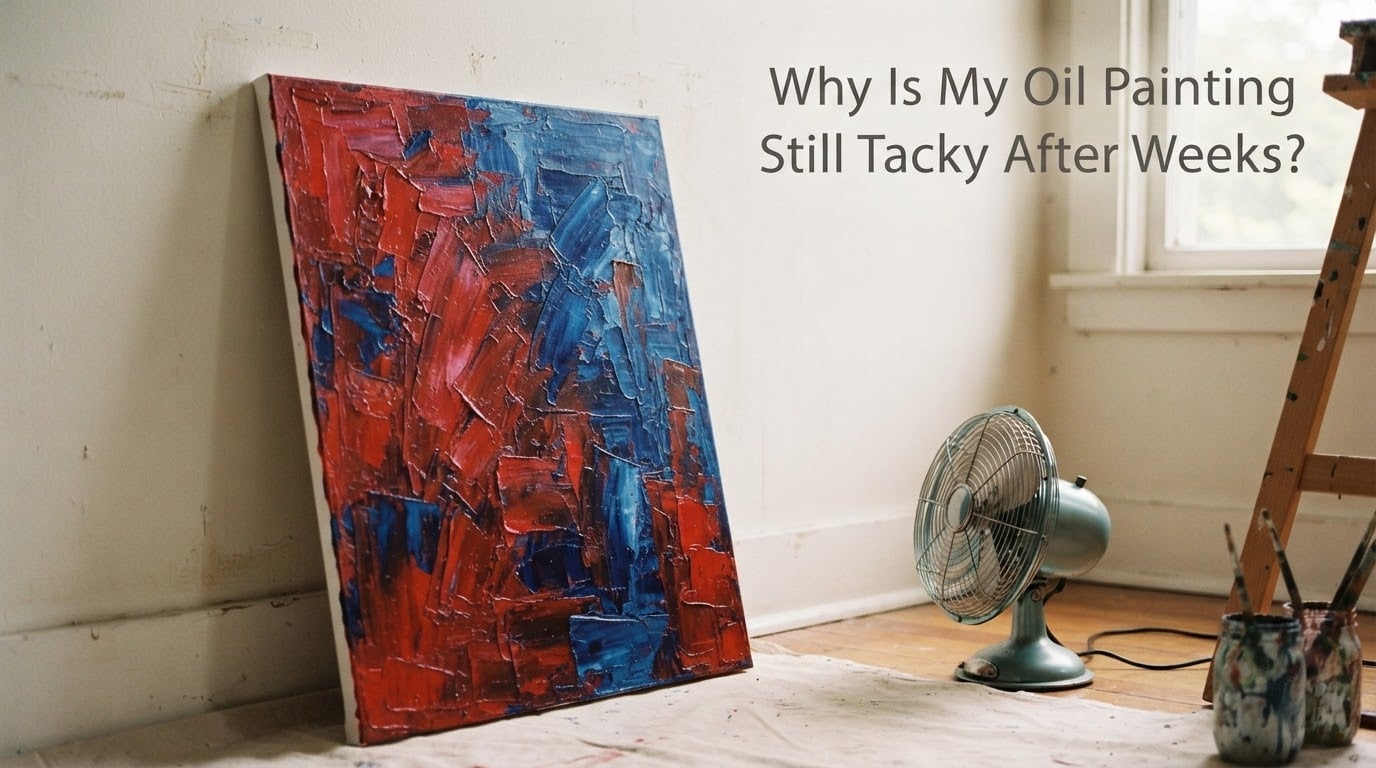
I have stared at a perfectly dry-looking oil painting that still felt sticky to the touch three weeks in. It is one of the most frustrating moments in oil painting, especially when you have done everything by the book.
If you are asking “why is my oil painting still tacky after weeks,” you are not alone. Artists post this exact question on r/oilpainting every week, and the honest answer is usually reassuring. Most of the time, your painting is fine. Oil paint simply behaves differently from acrylics or watercolors, and what feels like a problem is often just the medium doing its slow, deliberate work.
In this guide, I will walk you through what is actually happening on your canvas, the seven most common reasons a painting stays tacky, the environment factors that secretly control your drying time, and a step-by-step rescue protocol you can use today. By the end, you will know whether your painting is curing normally or whether something genuinely needs fixing.
Table of Contents
- Quick Answer: Why Your Oil Painting Is Still Tacky
- How Oil Paint Actually Dries: Oxidation, Polymerization, and Curing
- The 7 Most Common Causes of Tacky Oil Paint
- How Environment Controls Your Oil Paint Drying Time
- Pigment-by-Pigment: Which Colors Stay Tacky the Longest
- How to Fix a Tacky Oil Painting: A Step-by-Step Rescue Protocol
- How to Test Whether Your Oil Paint Is Truly Dry
- How to Prevent Tacky Oil Paintings in Future Work
- Frequently Asked Questions
- Final Thoughts: Patience Is Part of the Medium
Quick Answer: Why Your Oil Painting Is Still Tacky
Your oil painting is still tacky because oil paint does not dry by evaporation. It cures through oxidation, a chemical reaction where the binder absorbs oxygen and slowly polymerizes into a solid film. Depending on the pigment, the thickness, and your studio conditions, full curing can take anywhere from a few weeks for thin layers to over a year for thick impasto.
If your painting is only a few weeks old and still feels tacky, the most likely causes are:
- Thick paint application, especially impasto or palette-knife work
- Slow-drying pigments such as cadmiums, quinacridones, or blacks
- Too much oil or medium in the upper layers (violating the fat-over-lean rule)
- Cool, humid, or still-air studio conditions
- Recent glazing or varnish over an underlayer that was not fully cured
- Using non-drying oils such as mineral oil by accident
- A painting stored facing a wall with no airflow
None of these are usually a disaster. They are almost all fixable. Let me show you how to tell which one you are dealing with, and what to do next.
How Oil Paint Actually Dries: Oxidation, Polymerization, and Curing
Oil paint is fundamentally different from acrylic, gouache, or watercolor. It does not “dry” in the everyday sense of water leaving a film behind. Instead, it cures.
Curing happens in three overlapping stages. First, the thinner and any solvent evaporate, leaving the oil binder behind. This is the “touch-dry” stage you can feel within hours or days. Second, oxygen begins reacting with the unsaturated fatty acids in the drying oil, typically linseed, walnut, or safflower. Third, those oxidized molecules link together, a process called polymerization, into a tough, flexible film.
That third stage is the slow one. Polymerization can take weeks for thin films and many months for thick ones. Even a painting that feels solid to a light touch may still be polymerizing internally for a year or more. This is why conservators talk about “fully cured” paint as a long-term state, not a day-of-the-week event.
Touch-Dry vs Fully Cured
Touch-dry means the surface no longer transfers paint to your finger. Fully cured means the entire film has polymerized through its depth. Most paintings are touch-dry within days but only fully cured after months. Varnishing too early, before the lower layers cure, traps solvents and unreacted oil and is one of the most common reasons a painting stays tacky for what feels like forever.
The Role of the Binder
The binder is the oil, usually linseed. Pigments vary widely in how they interact with that binder. Some, like lead white and the earth tones, actually speed oxidation. Others, like cadmiums and many modern organic pigments, slow it down because the pigment particles physically block oxygen from reaching the oil. This is one of the cleanest explanations for why your painting is still tacky after weeks.
The 7 Most Common Causes of Tacky Oil Paint
Now that you understand the science, here are the seven causes I see most often in studio practice and on forums like r/oilpainting and r/ArtistLounge. Any one of them can stretch your drying time from days into weeks.
1. Thick Paint Application (Impasto)
Thick paint dries from the outside in. The surface skin forms, sealing off oxygen from the layers below. A 5 mm impasto stroke can take months to cure all the way through. If your painting is mostly thick brushwork or palette-knife work, tackiness after weeks is completely normal.
2. Slow-Drying Pigments
Cadmium red, cadmium yellow, quinacridone magenta, and most blacks (especially ivory black and lamp black) are notorious for staying tacky. If your painting is built around these colors, expect weeks of waiting regardless of how thin you applied them.
3. Too Much Oil or Medium in the Top Layers
The fat-over-lean rule exists for exactly this reason. Each upper layer should contain more oil than the one beneath it, so the whole painting dries evenly. When you load the top layers with linseed oil, stand oil, or alkyd medium, you create a soft skin over a leaner, faster-drying underlayer. The bottom dries first, and the top stays tacky for weeks or longer.
4. Cool, Humid, or Stale-Air Studios
Oxidation needs warmth and moving air. Studios below about 60 F (15 C) slow the reaction dramatically. Humidity above about 70 percent can stall it entirely. A still-air room traps solvent vapors around the painting, slowing surface cure.
5. Painting Over a Still-Wet Underlayer
Wet-on-wet is a legitimate technique, but if you keep adding oil-rich layers to a layer that has not even become touch-dry, you essentially have one thick layer of uncured paint. This is a common trap for beginners working alla prima.
6. Non-Drying Additives
Mineral oil, baby oil, and some “oily” mediums contain no reactive fatty acids and will never cure. If a medium feels greasy or has no smell of linseed, it is probably non-drying. A painting made with non-drying oil will stay tacky indefinitely. This is one of the few situations where the painting genuinely will not fix itself with time.
7. Varnishing or Framing Too Early
Applying varnish before the lower layers cure traps solvent and oxygen-deprived oil. Framing behind glass with no air gap does the same thing. Many paintings I have seen stay tacky for months were simply sealed too early.
How Environment Controls Your Oil Paint Drying Time
You can do almost everything right in your painting and still end up with a tacky surface if your studio environment is working against you. Environment is the silent variable most artists underestimate.
Temperature
Oxidation roughly doubles in speed for every 10 C (18 F) increase in temperature, up to a point. A studio at 24 C (75 F) will cure noticeably faster than one at 15 C (59 F). Below about 10 C (50 F), some pigments stop curing entirely. If you paint in a cold garage in winter, tackiness is almost guaranteed.
Humidity
High humidity slows drying because water vapor competes with oxygen at the film surface. The sweet spot is 40 to 60 percent relative humidity. Above 70 percent, expect prolonged tackiness. Below 30 percent, paint can skin over too quickly on top while staying soft underneath.
Airflow
Moving air carries fresh oxygen to the surface and sweeps away solvent vapors. A still-air room is the worst case. A simple fan set on low, not pointed directly at the canvas, can cut drying time meaningfully.
Light
Indirect daylight accelerates oxidation. Paintings stored in dark closets cure slower than those in well-lit studios. This is why I keep work-in-progress on an easel near a north-facing window whenever I can.
Pigment-by-Pigment: Which Colors Stay Tacky the Longest
Not all pigments behave the same way. Here is a quick reference based on what artists report and what pigment chemistry suggests.
| Pigment Family | Relative Drying Speed | Typical Touch-Dry Time |
|---|---|---|
| Earth tones (raw/burnt umber, sienna, ochre) | Fast | 1 to 3 days |
| Lead white (when available) | Fast | 2 to 4 days |
| Titanium white | Medium | 4 to 7 days |
| Phthalo blues and greens | Medium | 5 to 10 days |
| Ultramarine blue | Medium to slow | 1 to 2 weeks |
| Cadmium red, yellow, orange | Slow | 2 to 6 weeks |
| Quinacridone magenta, violet | Slow | 2 to 4 weeks |
| Ivory black, lamp black | Very slow | 4 to 12 weeks |
These are rough ranges for thin layers at 21 C (70 F) and 50 percent humidity. Thick applications add weeks to every row above.
How to Fix a Tacky Oil Painting: A Step-by-Step Rescue Protocol
Before you do anything drastic, walk through this protocol in order. Most of the time, steps one through three are all you need.
Step 1: Diagnose the Cause
Press a clean, dry fingertip to a low-visibility area. If paint transfers, you are still in the touch-dry window. If it feels tacky but nothing transfers, you are polymerizing normally and just need more time. If paint smears, the layer is genuinely wet and may be too thick or too oily.
Step 2: Improve the Environment
Move the painting to a warm (21 to 24 C / 70 to 75 F), low-humidity (40 to 60 percent), well-ventilated room. Set up a small fan for gentle airflow. Make sure the painting gets indirect daylight. These three changes alone can cut weeks off the curing time.
Step 3: Give It More Time
If your diagnosis in step one says “polymerizing normally,” the fix is patience. Six to twelve weeks in a good environment will resolve most cases. Track the date on the back of the canvas so you are not guessing.
Step 4: Use a Retouching Varnish (When You Must Varnish Early)
If you absolutely need to varnish for transport or exhibition before the painting is fully cured, use a retouching varnish. It is designed for touch-dry but not-fully-cured work and lets the painting continue to oxidize underneath. Final varnish goes on after full cure, usually six to twelve months later.
Step 5: Address the Fat-Over-Lean Mistake
If you suspect the top layer has too much oil, you have two options. Let it cure as-is (it will, eventually) and accept a longer timeline. Or, in extreme cases, a conservator can remove the oily top layer and replace it. Do not try to wipe oil out of a cured skin at home.
Step 6: Check for Non-Drying Oils
If the painting has stayed tacky for many months with no improvement, suspect a non-drying additive. This is the one situation that requires professional intervention. A conservator can identify the contaminant and recommend solvent removal.
How to Test Whether Your Oil Paint Is Truly Dry
There is no perfect home test, but a few reliable checks will tell you most of what you need to know before varnishing or framing.
The Touch Test
Press a clean fingertip firmly to the painting in a low-visibility area for three seconds. Lift straight up. If nothing transfers and the surface feels cool rather than tacky, you are at least touch-dry. Repeat across multiple colors, since slow pigments will lag.
The Vent Test
Hold the painting up to your nose and gently exhale on the surface. If you smell strong solvent, the paint is still off-gassing and not ready to seal. This is surprisingly reliable and what many conservators use in the studio.
The Press Test
For thick impasto, press a clean thumbnail gently into the highest point of a stroke. Any visible indentation means the lower layers are not cured. A slight surface scuff with no deformation means the film has good integrity.
When in Doubt, Wait
Conservative timelines before varnishing are six months for thin work and twelve months for thick or impasto work. If you cannot wait that long, retouching varnish is your friend.
How to Prevent Tacky Oil Paintings in Future Work
Most causes of tackiness are easy to prevent once you know what to watch for. These are the habits I lean on now after years of frustrated waiting.
Apply Paint Thinly Where You Can
Thin films cure faster through their full depth. Save thick impasto for highlights and accents rather than whole passages. A painting with thin underlayers and selective thick highlights dries more evenly than one thick layer everywhere.
Follow Fat-Over-Lean Strictly
Each successive layer should contain slightly more oil or medium than the one beneath it. A common routine: lean underpainting (turpentine-thinned paint), mid layers (paint plus a little linseed), and final layers (paint plus more medium or stand oil). This keeps the whole stack drying at compatible rates.
Choose Your Mediums Deliberately
Alkyd mediums speed drying dramatically and are my go-to when I want a painting touch-dry within a day. Linseed and stand oil slow drying and add gloss. Walnut and safflower oils yellow less but cure even slower than linseed. Poppy oil barely cures at all and is best avoided as a top-layer medium.
Control Your Studio
Aim for 21 to 24 C (70 to 75 F), 40 to 60 percent relative humidity, gentle airflow, and good indirect light. A basic thermometer-hygrometer costs almost nothing and removes the guessing.
Let Each Layer Cure Before Adding the Next
You do not need each layer fully cured, but you do need each layer touch-dry before adding oil-rich paint on top. This single habit prevents more tacky paintings than any other change you can make.
Wait Before Varnishing
Six months for thin work, twelve months for thick. Use retouching varnish in between if needed. Varnishing too early is the single most common cause of permanently soft surfaces in finished work.
Frequently Asked Questions
Why is my paint still tacky after a week?
Your paint is likely still touch-drying or in the early stages of oxidation. Thin oil films can take one to two weeks to feel fully dry, while thick passages or slow pigments like cadmiums and blacks can stay tacky much longer. Check temperature, humidity, and airflow before assuming something is wrong.
Why is my oil paint still tacky after weeks?
Oil paint cures through oxidation and polymerization, which can take weeks to months depending on thickness, pigment, and environment. Thick impasto, slow-drying pigments such as cadmiums and blacks, and cool or humid studios all extend the timeline. In most cases the painting is curing normally and just needs more time in warm, dry, well-ventilated conditions.
Is tacky oil paint ruined?
In almost all cases, no. Tacky oil paint is usually still curing, not ruined. The exceptions are paintings made with non-drying oils like mineral oil, which never cure and require professional removal. Otherwise, give the painting weeks to months in good conditions and it will firm up.
Can I varnish over tacky oil paint?
You should not apply a final varnish over tacky oil paint because it traps solvents and stops the curing process. If you must varnish early for transport or exhibition, use a retouching varnish designed for touch-dry but not-fully-cured work, then apply the final varnish six to twelve months later.
How long does oil paint take to fully cure?
Thin oil paint films typically cure in three to six months. Thick impasto can take a year or longer. Full cure means the oil has polymerized through the entire depth of the film, which is much slower than the surface becoming touch-dry.
How to harden tacky paint?
Move the painting to a warm (21 to 24 C), low-humidity (40 to 60 percent) room with gentle airflow and indirect daylight. Avoid varnishing, framing behind glass without an air gap, or adding more oil-rich layers on top. For genuinely stubborn cases, a conservator can identify non-drying additives.
Final Thoughts: Patience Is Part of the Medium
If you are still asking “why is my oil painting still tacky after weeks,” the most important thing I can tell you is this: in nearly every case, your painting is fine. Oil paint is a slow medium by design. What feels like failure is usually chemistry doing exactly what it should, just on a longer timeline than our impatient brains prefer.
Set up a warm, dry, well-ventilated spot for the painting, give it a few more weeks, and resist the urge to varnish or frame too early. If months pass with no improvement, reach out to a professional conservator. Otherwise, trust the medium, plan your studio conditions for future work, and let the oil do what oil does.