
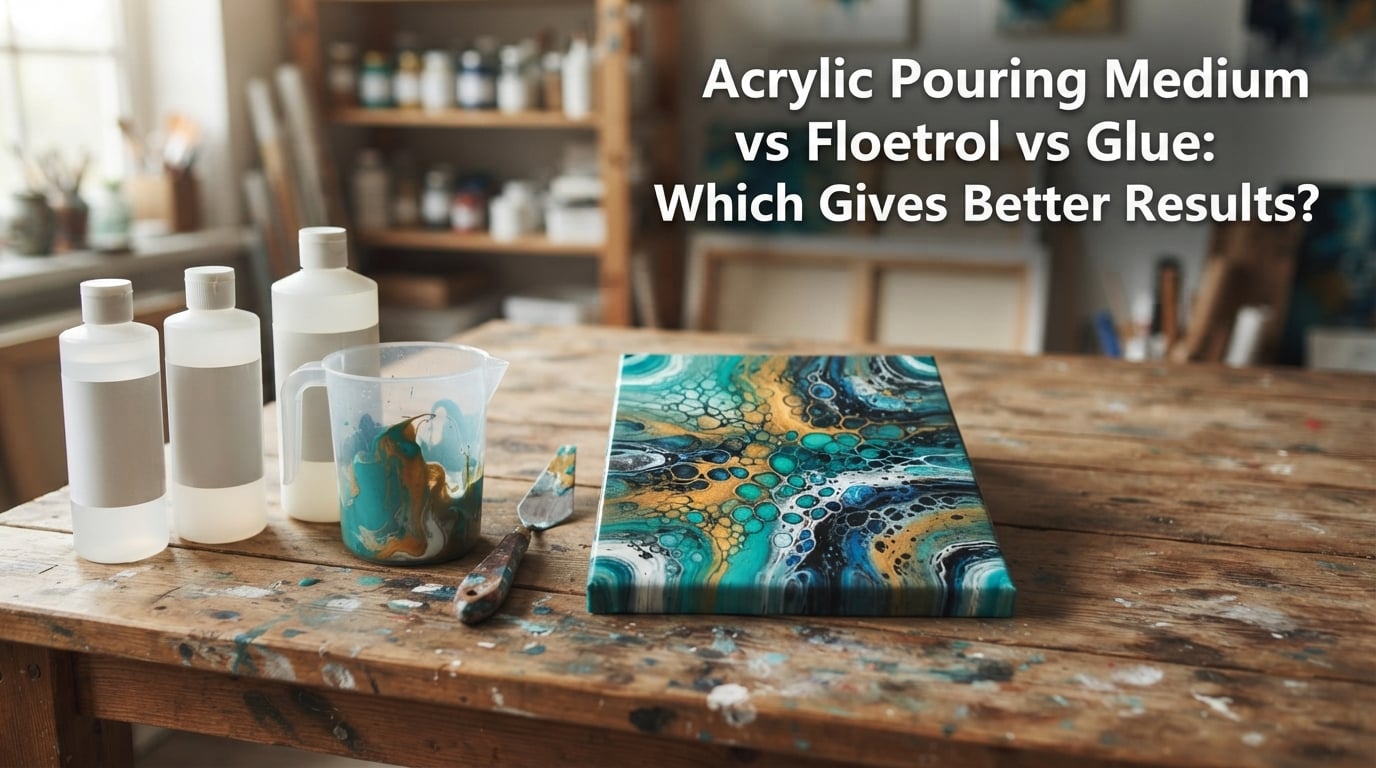
Acrylic pouring medium vs Floetrol vs glue produces genuinely different results, and the artist community is split for a reason that most explanations miss. Artist-grade pouring medium thins paint and keeps the binder intact. Floetrol improves flow but contains no binder at all. PVA glue is itself a binder, which is why it adds body and adhesion. Once you understand that one distinction, the arguments stop being confusing.
I have poured with all three across the same paint brand, the same canvases, and the same flip-cup and swipe techniques, and I have watched beginner classes split into camps that are both partly right. The honest answer is that there is no single winner. There is a best option for cells, a best option for stability, a best option for a first pour on a tight budget, and a best option for a canvas you intend to sell.
This guide covers what each additive really is, the ratios that work, what each one costs you per finished pour, and which failure mode to expect when something goes wrong. Updated for 2026.
Table of Contents
- Which One Wins, and For What
- Acrylic Pouring Medium vs Floetrol vs Glue: The Head-to-Head Comparison
- What Each Additive Actually Is (and Why the Internet Argues)
- Acrylic Pouring Medium: Strengths and Weaknesses
- Floetrol: Strengths and Weaknesses
- PVA Glue: Strengths and Weaknesses
- Mixing Ratios and Recipes for Each Option
- Which Medium for Which Pouring Technique
- Cost Per Finished Pour
- Can You Mix Floetrol and Glue Together?
- The Water-Only Myth: Why Water Is Not a Medium
- Regional Floetrol Differences
- Troubleshooting: Cracking, Crazing, Muddy Colors, Tacky Surfaces
- Testing Small Batches: A Controlled Experiment
- When Premium Mediums Are Worth It
- Frequently Asked Questions
- What is the best pouring medium for acrylic pouring?
- Can I use PVA glue instead of Floetrol?
- Is Liquitex pouring medium the same as Floetrol?
- What happens if you use too much Floetrol?
- Will PVA glue stick to acrylic paint?
- What is the best Floetrol to use for acrylic pouring?
- Why is my acrylic pour cracking after drying?
- What are the common mistakes in acrylic pouring?
- Conclusion
Which One Wins, and For What
Here is the short version. Read this block and you can stop before the rest if you just need a decision.
- Best overall result: artist-grade pouring medium. It is the only one of the three that is formulated to thin paint without weakening the binder, which is why pours made with it crack least often and level smoothest.
- Best for cells and lacing: PVA glue mixed thin. The extra body slows the paint down and holds density differences in place so the cells keep their edges as the paint moves.
- Best pour stability: PVA glue. A widely linked r/PourPainting thread is titled “I switched from floetrol to glue – much more stable!” and that reaction matches what we see in the tray.
- Best value: Floetrol, or Floetrol with a small amount of water. It costs very little per pour and keeps colours moving, though it leaves the film matte.
- Best finish: artist-grade pouring medium, or any of the three finished with a gloss varnish. Colour vibrancy after curing is where the difference shows most.
- Best first pour for a beginner: a mid-priced artist pouring medium at 2 parts medium to 1 part paint. Forgiving, predictable, and the least likely to end in a cracked canvas.
Acrylic Pouring Medium vs Floetrol vs Glue: The Head-to-Head Comparison
No competitor page we studied publishes a real side-by-side table, so here is one. This is the fastest way to see which column your project needs.
| Attribute | Artist pouring medium | Floetrol plus water | PVA glue plus water |
|---|---|---|---|
| What it actually is | Formulated binder emulsion and flow improver | House-paint conditioner and flow improver | Polyvinyl acetate adhesive, a true binder |
| Binder content | Yes, high | None | Yes, the main ingredient |
| Flow | Smooth, slow, self-levelling | Very smooth, keeps colours moving | Controlled, more resistance |
| Cells and lacing | Clean, well-defined | Active but softer edged | Small, tight, well-defined |
| Finish when dry | Matte to satin | Matte | Matte, sometimes slightly glossy |
| Drying time | Longer | Longest of the three | Long, and can stay tacky if thick |
| Colour vibrancy | Highest | Slightly dulled, matte film | Good, can dull if over-mixed |
| Cracking risk | Lowest | Low if the paint already has binder | Low, but thick pours can stay tacky |
| Yellowing risk | Low | Low | Present, varies by glue type |
| Typical ratio to paint | 2 parts medium to 1 part paint | 1 part 91:9 Floetrol-and-water mix to 2 parts paint | 1 part 60:40 glue-and-water mix to 2 parts paint |
| Best techniques | Flip cup, dirty pour, ring pour, Dutch pour | Flip cup, swipes, open pours | Dirty pour, swipes, ring pour |
| Best for | Commissions, gallery work, large canvases | Practising, budget pours, high flow | Cell work, stability, cellars without heat |
What Each Additive Actually Is (and Why the Internet Argues)
The reason two camps argue past each other online is that they are describing different things as if they were the same thing. Nearly every heated thread in r/PourPainting comes down to the binder.
Acrylic pouring medium: a binder-containing additive
A pouring medium is an emulsion that carries extra acrylic binder alongside flow-improving ingredients. When you add it, the paint particles stay suspended in a stable film instead of separating. That is why pours made with medium level out, take a scraper well, and resist the crazing that ruins cheap pours.
Floetrol: a paint conditioner, not a medium
Floetrol is a flow improver sold for extending the open time of interior latex house paint so brush and roller marks disappear. It is water-based, it smooths flow, and it slows drying. It contains no acrylic binder, so it cannot replace the binder a pour needs in order to form a durable film. Beginners find this confusing because they assume every product that thins paint belongs to the same family.
PVA glue: a binder in its own right
Polyvinyl acetate is the adhesive in school glue and in wood glue. Added to paint it does two jobs at once: it thins the paint the way a medium does, and it supplies the film-forming binder that a medium supplies. That is the single reason glue and medium produce different results even at the same ratio.
Why both opinions about Floetrol are partly correct
The anti-Floetrol argument in r/PourPainting holds that Floetrol is a house-paint conditioner with a matting component, that it dulls colour, and that it should never pass roughly 20 percent of a latex mix. The pro-Floetrol counter is that it is “an excellent media for pour. The best that I’ve personally used.”
Both are describing real behaviour. The matte film is exactly what a matting component does, and it does mute colour slightly. At low ratios, that cost is worth paying for the flow you get. Past roughly 20 percent in the mix, the coating starts to lose cohesion, colours turn muddy, and cells get soft and sloppy.
Acrylic Pouring Medium: Strengths and Weaknesses
Artist-grade pouring medium gives the best result of the three and costs the most per pour. It is the only option here that adds binder rather than borrowing it from the paint you already bought.
Strengths:
- Keeps the paint film strong, so pours crack far less often.
- Levels on its own, which is what makes flip cups and trowel work behave predictably.
- Colour stays vibrant because the pigment particles stay evenly dispersed.
- Scrapes, swipes, and pulls cleanly without tearing.
Weaknesses:
- The highest cost per pour of the three options.
- Slower flow than Floetrol, so open pours do not travel as far.
- Still dries matte on most formulations until you varnish.
Floetrol: Strengths and Weaknesses
Floetrol is the flow champion and the cheapest way to keep paint moving for a long time. It is not a substitute for a medium, and treating it like one is the most common beginner mistake in this whole hobby.
Strengths:
- Longest open working time of the three, so slow flip cups are forgiving.
- Smooths flow and levels surface tension differences, which helps lacing.
- Very low cost per pour, which is why it suits practice canvases.
Weaknesses:
- No binder, so the pour relies entirely on the binder already in the paint.
- The matte component dulls colour compared with medium or glue.
- Over 20 percent in the mix leaves paint drippy with poor coverage and sloppy cells.
- Needs added water in many recipes, which thins the binder a further step.
Using poor-quality paint with Floetrol is where cracks show up. A commenter in r/PourPainting notes that with water alone you must use more paint than with a Floetrol-and-water or glue mix, and the same holds true for weak paint: the additive cannot supply structure the paint does not have.
PVA Glue: Strengths and Weaknesses
Can I use PVA glue instead of Floetrol? Yes, and for many styles it is the better choice. Glue thins paint, adds body, slows the pour, and supplies a real binder, so colours hold their shape instead of spreading flat.
Strengths:
- Adds body and structure, which is what stabilises a pour.
- Produces small, tight, well-defined cells and crisp lacing.
- Improves adhesion to the canvas, reducing lift and cracking.
- Costs very little per pour.
Weaknesses:
- Yellows over time, and the amount varies by glue type.
- Very thick dirty pours can stay tacky for days rather than curing hard.
- Too much glue makes paint resistant to flow, so colours stop travelling.
On the yellowing question, glue type is what matters. Wood glue and Elmer’s Glue-All are formulated for strength and are less prone to visible yellowing than cheap school glue, which is why most experienced pourers reach for Glue-All. A r/PourPainting discussion comparing English, American, and Australian Floetrol also put PVA glue and water in the same test batch, and the glue mixes consistently produced the most stable, tightest cell structures.
Will PVA glue stick to acrylic paint? Yes. It bonds to acrylic readily, which is the upside for adhesion and the reason thick glue layers can stay tacky if they are not given time and airflow to cure.
Mixing Ratios and Recipes for Each Option
Numbers are what people repeat, so here are the three ratios that cover almost every pour. Measure by volume from the same container so the ratios mean the same thing every time.
Artist pouring medium: 2 parts medium to 1 part paint
This is the standard starting ratio for flip cups and dirty pours. Thin with a splash of water only if the paint sits too heavy on the palette. Pour slowly and let the medium do the levelling.
Floetrol: 91 parts Floetrol to 9 parts water, then 1 mix to 2 paint
Make the 91:9 blend first, then use one part of that blend to two parts paint. This keeps the Floetrol in the final mix well under the point where it starts to leave the film matte and weak. Add a further splash of water only if your paint is thick-bodied.
PVA glue: 60 parts glue to 40 parts water, then 1 mix to 2 paint
Mix the 60:40 glue-and-water solution, then combine one part of it with two parts paint. The solution is thin enough to flow and thick enough to add body. Going heavier on the glue is the quickest way to kill your cells.
Whichever route you take, mix gently. Vigorous stirring is a leading cause of muddy colour.
Which Medium for Which Pouring Technique
Technique matters as much as the additive. Some moves need thin, fast paint and some need paint that holds a line.
- Flip cup: artist medium or the 91:9 Floetrol blend. Both give the long, slow flow a flip cup relies on.
- Dirty pour: glue works well here because the body keeps the colours from blending into mud before you tilt.
- Swipes: Floetrol is the traditional choice for smooth movement, and glue gives cleaner edges if you want definition over flow.
- Ring pour: artist medium. The even, non-drippy flow makes concentric rings land where you planned them.
- Dutch pour: artist medium with a small amount of water. Thick glue resists the controlled stream a Dutch pour needs.
- Colander pour: the Floetrol blend, thinned a touch more than usual, since the cells here come from the pour itself rather than from silicone.
Cost Per Finished Pour
Cost per pour is easier to work out than most people realise, because it depends on how much medium ends up in the paint rather than on what you paid per bottle.
Start with a 16-ounce acrylic pour on a standard 11 by 14 inch canvas. At 2 parts paint to 1 part medium, you need roughly 8 ounces of paint and 4 ounces of medium. The same pour using the Floetrol or glue blend needs the same paint volume plus 4 ounces of a home-mixed solution you made yourself from a product that costs a fraction as much per ounce.
The other lever is paint consumption. Water-only pours need noticeably more paint, as a r/PourPainting commenter pointed out. A thin pour that splatters off the edge of a tilted canvas has not saved anything, because you have simply moved the waste from the bottle to the table.
Put plainly: artist medium costs the most per pour and is the only one of these three that is a finished product rather than something you mix yourself. Floetrol and glue both require a mixing step and a few minutes of measuring, which is the trade you make for the lower cost.
Can You Mix Floetrol and Glue Together?
Yes, and the combination is a real recipe rather than a contradiction. The two additives do different jobs in the same mix.
Glue contributes binder, body, and adhesion. Floetrol contributes flow and extended open time, and nothing else. Together, a typical starting point is one part Floetrol, one part glue solution, and two parts paint, adjusted until the paint ribbons off the palette and falls slowly.
Watch the ratio. Each one has a threshold past which it hurts you, and combining them means you are managing two thresholds at once. Add the glue first, confirm the body is right, then add Floetrol a little at a time.
This hybrid suits artists who want the cell structure of glue with the movement of Floetrol, and it is a common answer to the question of which to buy first when you only plan to buy one bottle for now.
The Water-Only Myth: Why Water Is Not a Medium
Water thins paint without adding anything, so it looks like the simplest option on the shelf. It is the weakest of the four choices, because acrylic binder is not designed to survive dilution.
When you add water, the polymer chains that hold the pigment together spread out. Past a modest amount of water per part of paint, the film is left under-built, and the result cures chalky, cracks, or peels from the canvas. Keep water below roughly 0.5 parts per part of paint and you will usually stay safe; many pourers go further than that and get away with it, which is how the myth survives.
Water is fine as a last-minute adjustment on a mixed pour. It is a poor substitute for a medium across an entire painting.
Regional Floetrol Differences
Floetrol is not one formula worldwide, and the version you can buy affects your results. English, American, and Australian variants behave differently, and the Australian Owatal version is genuinely hard to source outside Australia. Artists in the United States have reported not knowing which version they were purchasing.
The practical consequence is in the cells. Thinner regional formulas move further and open more lace; heavier formulas hold tighter, rounder cells. If a tutorial calls for a specific behaviour, check which version the artist actually used before you tune your own ratio to chase it.
Troubleshooting: Cracking, Crazing, Muddy Colors, Tacky Surfaces
Each of the three has a characteristic failure mode. Matching the symptom to the additive saves you from rewriting a recipe that was not the problem.
Cracks and crazing after drying come from too much water, too fast a dry, or too little binder. Fix them in this order:
- Cut the water in your recipe, and keep total water below 0.5 parts per part of paint.
- Add more binder by moving to artist medium or adding glue, rather than adding more thin mix.
- Dry between 18 and 24C, away from direct sun, drafts, and heating vents.
- Tent the canvas so air moves across the surface without hitting it directly.
- Level the surface so one edge does not dry faster than the rest.
Muddy colour usually means over-stirring, over-thinning, or too much Floetrol stretching the paint past its cohesion. Stir with a gentle folding motion from the bottom, and pull the Floetrol share of the mix back under 20 percent.
A permanently tacky surface points at glue in a thick layer, or at a pour sitting in humid conditions. Glue needs airflow and time; move the canvas somewhere with movement of air, and avoid stacking pieces while they cure.
Dull, chalky colour that no varnish fixes is a sign the binder broke. That is a water or low-quality-paint problem, and gloss varnish will not restore pigment that has lost its binder.
Cells that will not form in a glue mix usually mean the glue ratio is too high. Back off toward 1 part of 60:40 glue mix to 2 parts paint.
Testing Small Batches: A Controlled Experiment
You do not need a shelf of mediums to answer this for your own paint. Run one controlled test and you will know more than any video.
- Pick one paint brand and one colour, and use it for every sample. Paint brand and pigment load change results more than the additive does.
- Prepare three small cups in 4-ounce amounts: one at 2:1 medium to paint, one at 2 parts paint to 1 part 91:9 Floetrol blend, one at 2 parts paint to 1 part 60:40 glue blend.
- Use identical canvases, or identical primed panels cut to the same size.
- Run the same technique on all three: the same flip cup motion, or the same number of swipes.
- Record time to touch, time to fully cure, cell behaviour, and colour under the same light.
- Photograph all three at day one and again at day seven, then decide.
Keep the untouched drips from the edge of each pour. The side that runs off the canvas tells you more about flow and coverage than the neat centre does.
When Premium Mediums Are Worth It
Budget mixtures are the right call for practice, for large volumes of experimental work, and for pours you are happy to call a learning piece. The arithmetic changes when the work has to hold up to scrutiny.
For commissions, gallery sales, and any canvas above about 16 by 20 inches, artist pouring medium earns its cost. It cuts cracking risk on the large surfaces where a crack is most visible, it levels cleanly enough to present professionally, and it keeps colour vibrancy, which is what a buyer is actually looking at. In our experience the premium is cheapest per hour once you stop redoing failed pours.
Frequently Asked Questions
What is the best pouring medium for acrylic pouring?
An artist-grade pouring medium gives the best overall result, because it thins paint while adding acrylic binder, so the film stays strong, levels smoothly, and resists cracking. PVA glue wins for cell definition and stability, and Floetrol wins for open working time and cost. Pick the option that matches your technique rather than the one that is universally best.
Can I use PVA glue instead of Floetrol?
Yes. PVA glue thins paint, adds body, and supplies a real binder, so it produces tighter, better-defined cells and a more stable pour than Floetrol. The trade is slower movement and a tacky surface if the layer is thick. Mix 60 parts glue with 40 parts water, then use one part of that to two parts paint.
Is Liquitex pouring medium the same as Floetrol?
No. A pouring medium contains acrylic binder and is formulated to keep the paint film strong. Floetrol is a house-paint conditioner with no binder, so it only improves flow and extends drying time. Using one in place of the other changes cell behaviour, finish, and cracking risk.
What happens if you use too much Floetrol?
The paint film turns matte and colour looks duller. Past roughly 20 percent of the mix, coverage drops, the paint feels drippy, and cells become soft and sloppy because the paint particles lose cohesion. Keep the Floetrol blend near one part to two parts paint and stir gently.
Will PVA glue stick to acrylic paint?
Yes, readily, which is why glue improves adhesion and reduces lifting. The same stickiness means very thick pours can stay tacky for days, so give glue pours airflow and curing time before you varnish or stack them.
What is the best Floetrol to use for acrylic pouring?
Whichever version you can buy consistently, because regional formulas differ. English, American, and Australian Owatal versions flow differently, and thinner formulas travel further and open more lace while heavier ones hold tighter cells. Australian Owatal is also hard to source outside Australia.
Why is my acrylic pour cracking after drying?
Excess water, a fast dry, and too little binder are the usual causes. Cut the water so it stays below roughly 0.5 parts per part of paint, add binder by moving to artist medium or adding glue, dry between 18 and 24C away from sun and drafts, and tent the canvas so air moves over it without hitting it.
What are the common mistakes in acrylic pouring?
The most common are over-stirring, adding too much water, using too much Floetrol, pouring on an unlevelled surface, and using adhesive instead of a true binder to extend the paint. Test small batches of each ratio first, stir with a gentle folding motion, and keep total water under half a part per part of paint.
Conclusion
Acrylic pouring medium vs Floetrol vs glue comes down to one question: where do you want the binder to come from? Artist medium supplies it, glue supplies it, and Floetrol does not. Choose artist medium for the most reliable, vibrant, sellable result, glue for the tightest cells and the steadiest pour, and Floetrol for the longest flow time at the lowest cost.
Whichever you pick, run a small three-cup test with one paint brand before you commit a full canvas. Ten minutes of measuring will teach you more than an hour of watching videos, and it is the fastest way to find the ratio your paint actually wants.