
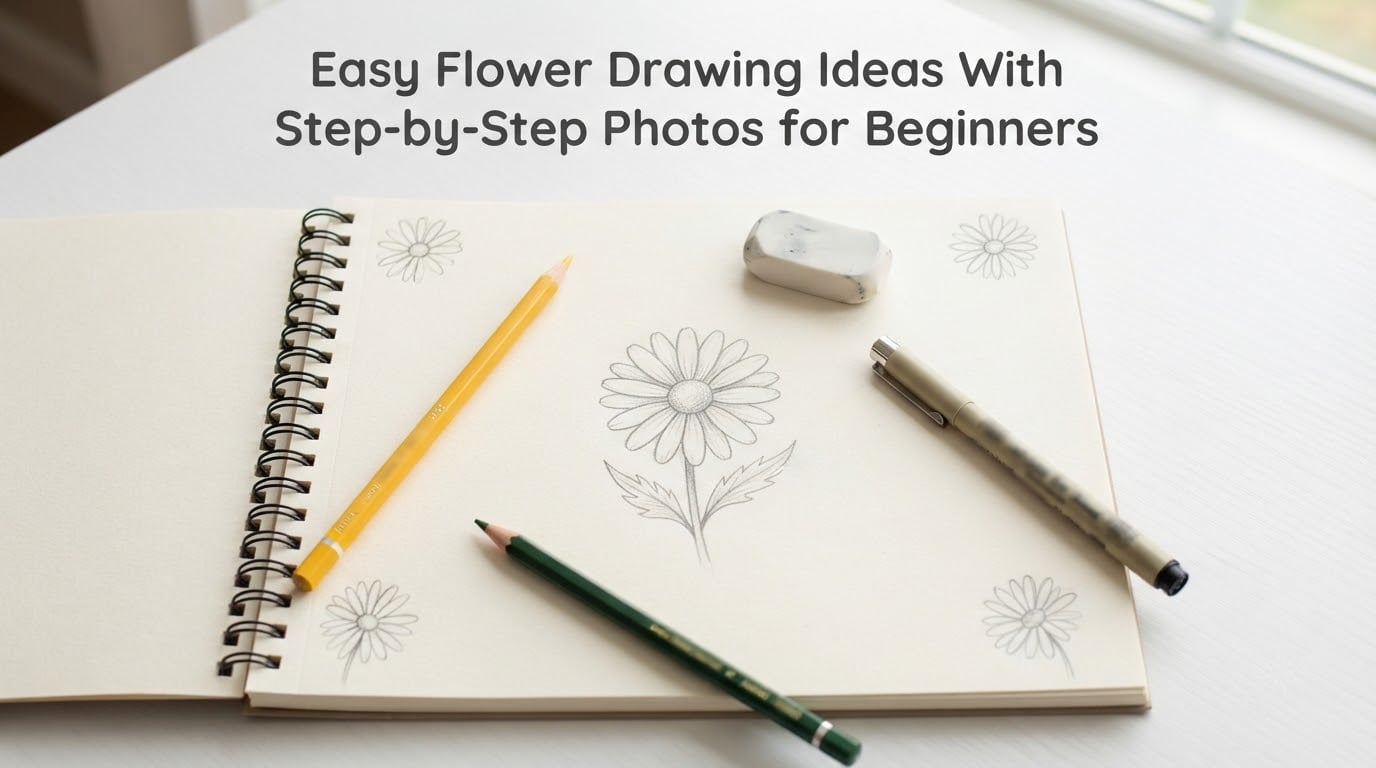
If you have ever looked at a page full of doodled flowers and thought, “I could never draw that,” I want you to take a breath and keep reading. Drawing flowers is one of the most welcoming ways to start a creative habit, and these easy flower drawing ideas will walk you through it, one petal at a time.
Over the past few months, our team practiced beginner floral sketches during quiet evenings and weekend craft sessions. We tried different pencils, fineliners, and colored pencils on every flower we could think of, from daisies in the yard to sunflowers at the farmer’s market. The result is a relaxed, friendly guide built for people who are picking up a pencil for the first time in years.
By the end of this guide, you will know which flowers are easiest for beginners, exactly which supplies to grab, and how to draw five different step by step flower sketches without getting frustrated. We will also cover quick color tips, beginner-friendly mistakes to avoid, and answers to the most common beginner drawing questions.
Table of Contents
Supplies You Need to Start Drawing Flowers
You do not need a fancy art kit to start. Almost any simple flower drawing tutorial will work with tools you probably already own.
Essential Tools
- A graphite pencil: A standard HB pencil is the easiest to control for sketching outlines.
- A clean eraser: A soft white vinyl eraser lifts pencil marks without smudging the paper.
- Smooth drawing paper: A regular sketchbook or printer paper works fine for your first flower sketch.
- A black fineliner (optional): A fine tip pen adds a crisp final outline once your sketch feels right.
Nice-to-Have Upgrades
- Colored pencils: A small set with a warm yellow, leafy green, and a few petal shades covers most simple flower drawings.
- Blending stump: Great for soft shading on petals and leaves.
- Ruler or circle template: Helps if you want perfectly even circles for centers and petals.
If you are planning to doodle in a bullet journal, a fineliner and a thin mechanical pencil travel well and keep your strokes tidy.
Quick Reference: Which Flowers Are Easiest to Draw?
Some flowers are far more forgiving than others. If you are wondering which beginner flower to start with, here is a quick comparison from our team’s practice sessions.
| Flower | Difficulty | Why It Works for Beginners |
|---|---|---|
| Daisy | Easiest | One simple center circle and a few round petals |
| Sunflower | Easy | Repeating petal pattern you can build in steps |
| Tulip | Easy | Almost no detail, just a cup shape and a stem |
| Cherry Blossom | Easy-Medium | Five soft petals with a tiny dot cluster in the center |
| Rose | Medium | Layered petals that teach you shading and depth |
Start with the daisy. It is the friendliest introduction to a flower sketch and it builds the muscle memory you will reuse on every other flower in this guide.
How to Draw a Flower Step by Step
This is the core tutorial of the entire guide: a clean, numbered flower drawing step by step process you can follow in under five minutes. Use it as your warm-up before any other flower drawing.
- Draw the center. Sketch a small circle in the middle of your page. This becomes the heart of your flower.
- Add five to six petals. From the edge of the circle, draw rounded petal shapes evenly spaced around the center.
- Add a second layer of petals. Place a few more petals peeking out between the first ones for natural fullness.
- Draw the stem. Make a single gentle line downward, slightly curved to suggest movement.
- Add two leaves. Sketch one leaf on each side of the stem using simple pointed teardrop shapes.
- Outline and color. Trace your final lines with a fineliner if you like, then add color to the petals, stem, and leaves.
Pause here. Look at what you drew. Almost every flower in this guide starts with the same rhythm: a circle, a ring of petals, a line for the stem, a pair of leaves. Once you feel that rhythm, the rest of these beginner flower sketches feel much easier.
5 More Beginner-Friendly Flowers (Step by Step)
Once you have practiced the basic flower drawing above, try these five beginner flowers one at a time. They are ordered from easiest to a little more challenging so you can build confidence as you go.
1. How to Draw a Daisy Step by Step
The daisy is the friendliest beginner flower of all. It is also the perfect warm-up before moving on to sunflowers and roses.
- Draw a small filled circle in the center.
- Add eight to ten long, oval petals around the center.
- Sketch a straight stem downward.
- Add two simple leaves with a single vein line down the middle.
- Color the center yellow and the petals white or soft pink.
Tip: rotate your paper slightly as you draw each petal so your hand stays relaxed and the petals stay even.
2. How to Draw a Simple Sunflower
Sunflowers look impressive but draw much like a daisy. The difference is the size of the center and the layered petals.
- Draw a large circle and lightly sketch a smaller circle inside for the seed head.
- Add a ring of long pointed petals around the outside.
- Place a second shorter row of petals between the first row.
- Draw a thick stem and two wide leaves.
- Color the center brown and the petals golden yellow.
If you want extra realism, lightly dot the center circle with a fineliner to suggest seeds.
3. How to Draw a Tulip
Tulips are great for practicing graceful curves. The whole flower is essentially one rounded cup shape on a stem.
- Draw a small U shape to start the cup of the tulip.
- Add a curved line on each side rising upward, then close the top with a soft point.
- Sketch a single curving stem line downward.
- Add one long leaf curling out from the base of the stem.
- Color the tulip any color you like: red, pink, yellow, or purple.
Tip: keep the stem slightly curved. A perfectly straight stem will look stiff in the final flower drawing.
4. How to Draw a Simple Rose
Roses look complex, but a beginner rose is just a swirl. Use this version the first few times you try.
- Draw a small loose spiral in the center to mark the inner petals.
- Add two to three petal shapes around the spiral, like overlapping crescents.
- Place an outer ring of larger petals curving outward.
- Draw a stem with two small leaves.
- Add light shading along the edges of the petals for depth.
Roses teach you one of the most useful beginner skills: building a shape from the inside out.
5. How to Draw a Cherry Blossom
Cherry blossoms are a favorite for spring and Mother’s Day cards because they look delicate but draw in only a few steps.
- Lightly sketch a small circle as a guide for the center.
- Add five soft heart-shaped petals around the circle, each with a small notch at the tip.
- Place a tiny dot cluster in the very middle for the stamens.
- Draw a short stem with one small leaf.
- Color the petals soft pink or white.
Tip: draw several blossoms in a small cluster on one branch for a classic spring composition.
Tips for Drawing Flowers as a Beginner
These are the small habits that turn a wobbly first sketch into a drawing you actually want to keep. Our team uses them whenever we open a fresh page.
- Start in pencil. Committing to ink too early causes stress. Pencil lets you erase and try again.
- Use light lines for guides. Heavy guide lines always show through at the end. Keep them airy.
- Draw petals from the center outward. Outward strokes help petals feel like they are opening toward the light.
- Practice the same flower twice. The second drawing is always better than the first, and almost free.
- Keep petals a little uneven. Perfectly identical petals look mechanical. Tiny variations make flowers feel alive.
Common Beginner Mistakes (and Quick Fixes)
- Petals all the same size: Vary them slightly. Real flowers have a few petals bigger than the rest.
- Stem too thick: A thin stem looks more elegant. Match the stem width to the size of the flower head.
- Outline too heavy: Lighten up. A heavy outline flattens the flower instead of giving it shape.
- Forgetting the leaves: Leaves balance the drawing. Even one simple leaf makes the final flower feel complete.
If a step feels too hard, set it down and try a simpler flower drawing first. There is no rule that says you have to finish any single flower in one sitting.
Frequently Asked Questions
What is the easiest flower to draw for beginners?
A simple daisy is the easiest flower to draw for beginners because it only needs a small center circle, a few round petals, a stem, and two leaves. Practicing the daisy once or twice teaches you the rhythm you can apply to nearly every other beginner flower.
What are easy flowers for beginners?
Daisies, sunflowers, tulips, cherry blossoms, and beginner roses are the easiest flowers for beginners. They all use simple shapes like circles, ovals, and gentle curves rather than detailed or layered petals.
What are some tips for drawing flowers as a beginner?
Start with light pencil lines so you can erase easily, draw petals from the center outward, keep your stem thin, vary petal sizes a little so they feel natural, and practice the same flower more than once. Building a flower from a small inner spiral outward is a great way to add depth without adding difficulty.
How to make a flower step by step?
To make a flower step by step, draw a small center circle, add five to six rounded petals around it, layer in a second row of petals, draw a stem downward with two leaves, then outline and color your drawing. The whole process usually takes under five minutes once you have practiced it a few times.
How do you draw a bouquet of flowers?
To draw a bouquet of flowers, first sketch three to five overlapping circles in the middle of the page to map where each flower head will go. Add simple stems and leaves fanning out from one point near the bottom, vary the flower types and sizes for visual interest, then tie everything together with a bow or ribbon at the base.
What is the hardest flower to draw?
Realistic roses, lilies, orchids, and hydrangeas are usually considered the hardest flowers to draw because of their layered petals, delicate shading, and complex shapes. For beginners, sticking to daisies, tulips, and sunflowers is a much friendlier starting point until your hand is more confident.
Final Thoughts: Start With One Petal at a Time
Learning easy flower drawing is not about being gifted. It is about showing up with a pencil and allowing yourself a few messy first tries. Pick the daisy from this guide, draw it once tonight, and again tomorrow. That single practice is enough to start a real drawing habit in 2026.
If you want to keep going, our team is putting together more beginner-friendly flower drawing tutorials throughout the year. Bookmark this page, share it with a friend who has been wanting to draw, and come back whenever you need a quick refresher on how to draw a flower step by step.