
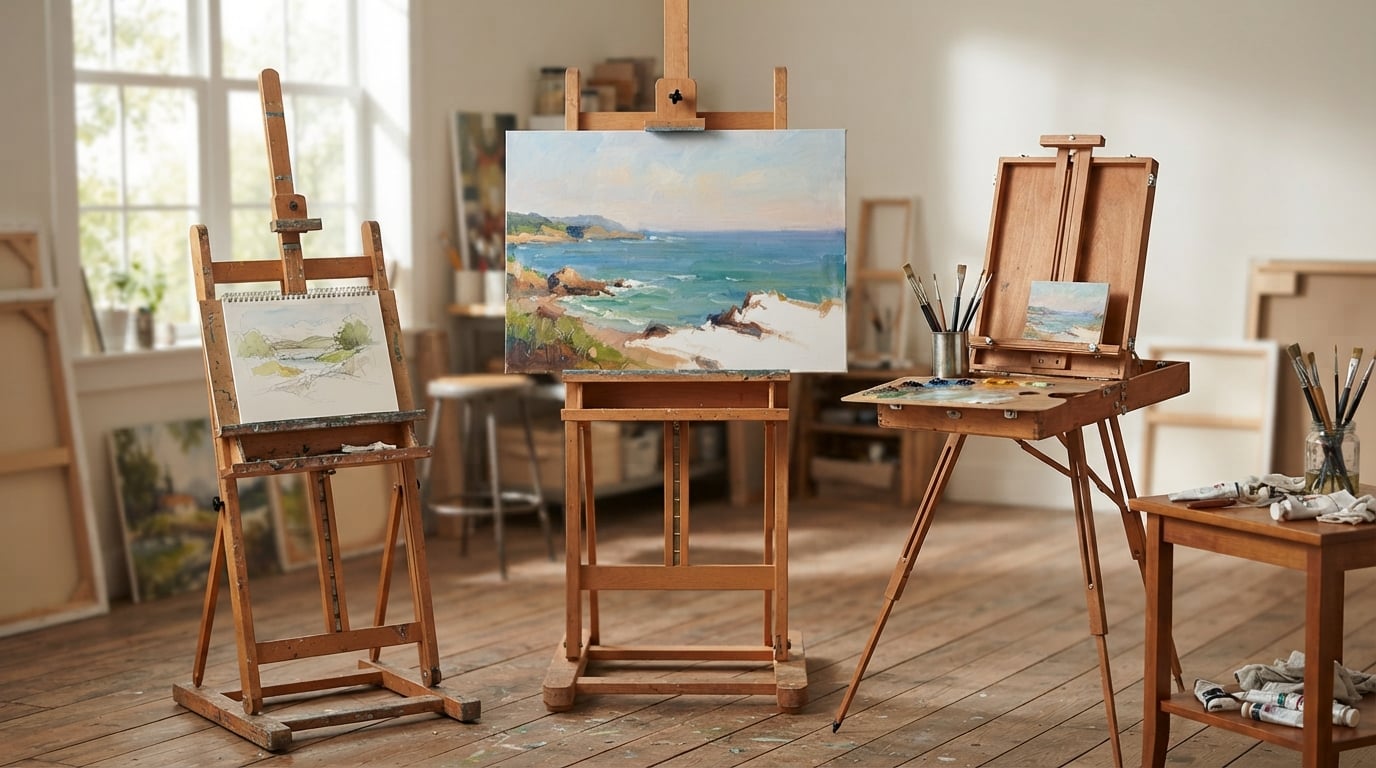
Choosing the right easel shapes how every painting session feels, from the way your brush moves across the canvas to how your back feels after three hours of work. I have watched students wrestle with flimsy tabletop stands, then graduate to H-frame studio workhorses, then fall in love with French easels for plein air weekends. The right easel is the one that disappears into your routine so you can focus on color and composition.
In this guide, I walk you through the three most popular easel types: tabletop, H-frame, and French easels. You will learn what each one does best, where they fall short, and how to match an easel to your medium, studio size, and painting style. By the end, you will know which easel belongs in your studio.
Whether you are a beginner buying your first easel, an intermediate artist upgrading from a starter stand, or a professional looking for a portable second easel, this 2026 guide covers everything you need to make a confident choice. No filler, no jargon, just clear recommendations based on real painting experience.
Table of Contents
- What Is a Tabletop Easel and When Does It Make Sense?
- What Is an H-Frame Easel and Why Do Studios Prefer It?
- What Is a French Easel and How Does It Differ From the Other Two?
- Tabletop vs H-Frame vs French Easel: Side-by-Side Comparison
- How to Choose the Right Easel: A Practical Buying Guide
- Start With a Pre-Purchase Self-Assessment
- Match the Easel to Your Painting Medium
- Plan Your Studio Space First
- Prioritize Stability for Heavy Techniques
- Consider Posture and Ergonomics
- Think About Accessibility
- Choose Between Wood and Metal Construction
- Sustainability and Eco-Friendly Materials
- Set a Realistic Budget
- Test Before You Commit
- Frequently Asked Questions
- Final Verdict: Which Easel Should You Choose?
What Is a Tabletop Easel and When Does It Make Sense?
A tabletop easel is a compact stand that sits on a desk, table, or counter and holds small canvases or boards upright while you paint. Most tabletop easels fold flat for storage, weigh under three pounds, and adjust from near-vertical to a flat pastel position with a simple rear prop.
Tabletop easels shine when space is tight and your canvases stay small. If you work on panels up to 16 by 20 inches, watercolor blocks under 12 by 16 inches, or sketchbook pages, a tabletop easel gives you proper painting angle without taking over your living room. I have used tabletop easels for years in small apartments, on kitchen counters during winter, and at art retreats where floor space is shared.
Key Features of Tabletop Easels
Most tabletop easels share a common feature set designed for portability and small-format work. The canvas rest sits near the top, with a bottom ledge that catches the lower edge of your panel. A rear kickstand folds out to set the tilt angle.
- Compact footprint, typically 8 by 10 inches at the base
- Folding design that collapses to a flat board for storage
- Adjustable rear prop with three or four tilt positions
- Lightweight construction, usually between 1.5 and 3 pounds
- Maximum canvas height between 16 and 24 inches
- Built-in drawer or shelf on some models for brushes
Strengths of Tabletop Easels
The biggest strength of a tabletop easel is accessibility. Anyone can set one up in seconds on any flat surface, from a dining table to a hotel desk during travel. Price is another plus, since most quality tabletop easels cost less than their full-size cousins.
Tabletop easels also encourage good posture for seated painters. Because the canvas sits at eye level on a table, you naturally sit upright rather than hunching over a flat desk. Reviewers and teachers often recommend tabletop easels for beginners learning proper painting posture.
Limitations of Tabletop Easels
The main limitation is canvas size. Once you start painting larger than 16 by 20 inches, a tabletop easel becomes unstable and starts wobbling under brush pressure. Heavy impasto and wet oils are also tricky, since the smaller base can tip if you lean into the canvas.
Tabletop easels are also tied to a sitting position. If you prefer to paint standing, or you want to step back and view your work from across the room, a tabletop easel keeps you locked to the chair. For larger studio work, you will need a floor easel.
Best For
Tabletop easels are best for beginners, watercolor and sketch artists, illustrators working on small boards, and anyone with limited space. They are also ideal travel easels when paired with a portable kit. If you paint in a small apartment or shared space, a tabletop easel is often the smartest starting point.
What Is an H-Frame Easel and Why Do Studios Prefer It?
An H-frame easel is a freestanding floor easel built for stability and large canvas work. The name comes from the shape of its rear support, which forms an H when viewed from the side. This four-legged design distributes weight across a wide base, letting the easel hold canvases up to 84 inches tall without wobbling.
H-frame easels are the workhorses of professional studios and art schools. When I taught oil painting at a community studio, every workstation had an H-frame easel, and after three years of daily use, they still stood rock solid. If you paint large, paint with heavy impasto, or you want a permanent studio centerpiece, the H-frame is hard to beat.
Key Features of H-Frame Easels
H-frame easels come in single and double mast configurations. Single-mast designs hold canvases up to about 48 inches tall. Double-mast versions, sometimes called studio easels, extend to 72 or even 84 inches for mural-scale work.
- Wide four-legged base with cross-braced rear support
- Canvas height capacity from 48 to 84 inches
- Adjustable angle from vertical to flat for varnishing
- Heavy-duty construction in kiln-dried beech, maple, or steel
- Built-in canvas holders with adjustable clamps
- Optional castors for moving around the studio
- Weight capacity between 20 and 50 pounds of canvas
Strengths of H-Frame Easels
Stability is the headline strength. The H-frame design resists twisting and rocking even when you lean into a canvas with loaded brushes. This matters when you are doing alla prima oil work or building thick impasto that needs steady contact with the canvas.
H-frame easels also adjust through a wide range of angles. You can tilt forward for pastel work, hold vertical for portrait painting, or lay flat for watercolor washes and varnish coats. The height adjustment means painters from 5 feet to 6 feet 4 inches can find a comfortable standing position.
Longevity is another strength. Quality H-frame easels use kiln-dried hardwoods or welded steel that lasts decades. Many artists use the same H-frame for their entire career.
Limitations of H-Frame Easels
H-frame easels are heavy, often between 20 and 35 pounds even in smaller configurations. Once set up, they stay put. Moving one across the studio takes effort, and assembling it from a flat-pack box can take 30 to 60 minutes.
Price is another consideration. H-frame easels cost more than tabletop or French easels in many cases, especially for double-mast models. Floor space also matters: an H-frame needs a clear zone of about 4 by 4 feet to operate without bumping furniture.
Best For
H-frame easels are best for serious studio painters, oil and acrylic artists working on large canvases, art students, and anyone who paints standing. If you have a dedicated studio space and you want one easel that handles everything from small studies to mural-scale work, an H-frame is the answer.
What Is a French Easel and How Does It Differ From the Other Two?
A French easel is a portable painting box that opens into a tripod easel. The wooden box holds paints, brushes, palette, and panels, then unfolds into a working easel with adjustable legs. French easels are the classic choice for plein air painters who want to travel light and paint outdoors.
The French easel traces back to 19th-century French painters who needed a complete studio they could carry into the countryside. Today, French easels remain popular for outdoor painting, travel workshops, and artists who want one easel that does double duty as a storage case.
Key Features of French Easels
A French easel combines three functions in one package: storage, palette, and stand. The lid opens to reveal a mixing palette, often with thumb holes for comfortable holding. Inside the box, compartments hold up to a dozen tubes of paint plus brushes and palette knives.
- Integrated storage for paints, brushes, and palette knives
- Built-in wooden palette with thumb hole
- Adjustable tripod legs that fold into the box body
- Canvas capacity up to about 34 inches tall
- Forward tilt adjustment for pastel and detail work
- Total weight between 9 and 14 pounds fully loaded
- Available in beech, walnut, and mahogany finishes
Strengths of French Easels
Portability is the defining strength. You pack your paints once, close the lid, sling the strap over your shoulder, and walk out the door. When you reach your painting spot, you unfold the legs, set the angle, and start painting in under two minutes.
French easels are also self-contained. Unlike tabletop easels that need a separate table or H-frame easels that need studio space, a French easel is a complete painting kit. For travel, plein air, weekend workshops, and painting trips, nothing matches the convenience.
Reviewers consistently praise French easels for their versatility. You can use one in the studio as a compact workhorse, then take it outdoors without repacking. Many plein air artists never use any other easel.
Limitations of French Easels
The biggest limitation is canvas size. Most French easels max out around 34 inches tall, which rules out large-format work. The tripod legs also need a level surface, so rocky beaches, steep hills, and windy cliffs can be tricky.
Weight adds up once you load the box with paints and panels. A fully loaded French easel can weigh 14 to 18 pounds, which is heavier than a tabletop easel but lighter than an H-frame. The legs can also flex under heavy brush pressure, especially on uneven ground.
French Easel vs American Easel
The French easel is often compared to the American easel, which uses a similar tripod design but with a lighter aluminum or composite body. French easels use traditional wooden construction and integrated storage. American easels focus on lighter weight and faster setup, often without a built-in palette.
For traditionalists who want a classic feel and integrated storage, the French easel wins. For ultralight travel or quick setups, an American-style easel may suit better. Most outdoor painters I know own at least one of each.
Best For
French easels are best for plein air painters, travel artists, watercolor and oil painters working outdoors, and anyone who wants one easel that works at home and on the road. If your painting life happens outdoors as much as indoors, a French easel is the obvious choice.
Tabletop vs H-Frame vs French Easel: Side-by-Side Comparison
Below is a quick reference table comparing the three easel types across the features that matter most. Use it to scan the differences at a glance before reading the detailed buying guide.
| Feature | Tabletop Easel | H-Frame Easel | French Easel |
|---|---|---|---|
| Best for canvas size | Up to 16×20 inches | Up to 48×84 inches | Up to 24×34 inches |
| Footprint | 8×10 inches | 30×30 inches | 15×18 inches open |
| Weight | 1.5 to 3 lbs | 20 to 35 lbs | 9 to 14 lbs loaded |
| Working position | Seated | Standing | Standing or seated |
| Portability | Highly portable | Studio only | Travel-ready |
| Stability | Light to medium | Maximum | Medium |
| Storage | None | None | Built-in paint box |
| Setup time | 30 seconds | 5 to 10 minutes | 2 minutes |
| Best medium | Watercolor, sketch | Oil, acrylic, large | Oil, acrylic plein air |
| Best space | Small, shared | Dedicated studio | Anywhere outdoors |
Quick Decision Summary
Choose a tabletop easel if you paint small, sit while you work, and need something that disappears into a closet when you finish. Choose an H-frame easel if you paint large, want maximum stability, and have a dedicated studio space. Choose a French easel if you want one easel that travels with you, holds your full kit, and works outdoors as well as indoors.
If you are still torn between two options, I usually tell new artists to start with whichever easel matches the way they already paint most often. The easel that fits your current routine will get used. The easel that fights your routine will sit in the corner.
How to Choose the Right Easel: A Practical Buying Guide
Choosing an easel comes down to answering a handful of honest questions about how, where, and what you paint. Below is the framework I walk through with every student who asks for easel advice.
Start With a Pre-Purchase Self-Assessment
Before comparing easels on paper, answer these questions for yourself. Your answers will point to one of the three types almost automatically.
- What is the largest canvas size you plan to paint in the next two years?
- Do you paint standing, sitting, or both?
- How much studio or storage space can you dedicate to an easel?
- Do you want to paint outdoors, and how often?
- What is your main medium: oil, acrylic, watercolor, or pastel?
- Do you need to store paints and brushes inside the easel?
- Will you move the easel often, or set it up once and leave it?
If your answers cluster around small canvases, seated work, and tight space, you need a tabletop easel. If they cluster around large canvases, standing work, and dedicated studio space, you need an H-frame. If they cluster around travel, plein air, and integrated storage, you need a French easel.
Match the Easel to Your Painting Medium
Different mediums put different demands on an easel. Oil painters working in thick impasto need rock-solid stability to resist brush drag. Watercolor painters need the ability to tilt their paper flat for washes. Pastel artists need forward tilt so loose particles fall onto the easel tray rather than the floor.
For oil and acrylic painting, H-frame easels win on stability, but French easels win for plein air oils. For watercolor, tabletop easels and French easels both tilt to a workable angle. For pastel and drawing, all three can work, though the forward tilt of a French easel is a clear advantage.
If you work in mixed media and switch between oils and watercolors in the same week, a French easel gives you the most flexibility. You get plein air portability plus the angle range needed for different mediums.
Plan Your Studio Space First
Many artists buy an easel before they plan where it will live, then wonder why the easel feels intrusive. Measure your available floor space before choosing. An H-frame needs a clear 4 by 4 foot zone. A French easel needs about 2 by 3 feet when set up. A tabletop easel needs only a chair and a table edge.
Also think about lighting. An easel positioned away from your best window wastes natural light. Position matters as much as easel type. If your studio is small, a French easel that you set up only when painting frees the rest of the room for daily life.
Prioritize Stability for Heavy Techniques
If you paint with thick impasto, palette knives, or loaded brushes that push against the canvas, stability is non-negotiable. H-frame easels lead here, followed by French easels on level ground. Tabletop easels tend to shift under heavy brush pressure, especially on smooth tabletops.
Reviewers report that even solid tabletop easels flex when loaded with oil paint and a 16 by 20 inch canvas. If you know you will work heavy, upgrade to an H-frame from day one rather than replacing your tabletop easel a year later.
Consider Posture and Ergonomics
Many artists overlook how much an easel affects their body. A well-adjusted easel keeps your shoulders relaxed, your neck neutral, and your eyes at a comfortable distance from the canvas. A poorly chosen easel causes neck strain, lower back pain, and fatigue that creeps into your brushwork.
Tabletop easels encourage upright seated posture. H-frame easels let you stand, which is gentler on the lower back for long sessions. French easels let you adjust height and angle so you can stand or sit, whichever feels better that day. If you have existing back or neck issues, an H-frame with adjustable height and forward tilt is often the most ergonomic choice.
Think About Accessibility
Wheelchair users, artists with limited reach, and anyone with mobility concerns should think carefully about easel height and adjustment range. H-frame easels with low minimum heights and a wide tilt range work well for seated painters, including those in wheelchairs. Some artists mount tabletop easels on height-adjustable tables for full control.
French easels can also work for accessibility, since you can set the tripod legs at any height and seat yourself comfortably. The key is testing an easel in person if possible, since adjustment ranges vary widely between models.
Choose Between Wood and Metal Construction
Traditional easels use kiln-dried beech, maple, or walnut hardwoods. Modern easels often use welded steel or aluminum. Each material has tradeoffs.
Wooden easels feel warmer under the hand, age beautifully, and dampen small vibrations. They are also heavier and can warp in very humid studios. Metal easels are lighter, hold adjustment more precisely, and resist humidity. They feel colder and can rattle slightly under heavy brushwork.
For most studio painters, kiln-dried beech remains the gold standard. For travel and plein air, lighter aluminum or composite French easels reduce shoulder fatigue on long walks.
Sustainability and Eco-Friendly Materials
More artists today ask about where their easel wood comes from and how it is finished. Look for FSC-certified hardwoods, water-based finishes, and manufacturers that publish their sourcing practices. Steel easels can also be sustainable if made from recycled metal and built to last decades.
A well-made easel that lasts 20 years is more sustainable than a cheap easel replaced every 3 years. Quality and longevity matter as much as the raw material.
Set a Realistic Budget
Easel prices span a wide range. Tabletop easels run the most affordable, followed by French easels in the mid-range, with H-frame easels often at the top. Budget for the easel itself, plus any accessories like castors, palette extensions, or canvas holders.
I usually recommend spending a bit more than the cheapest option. A mid-range easel from a reputable maker will outlast two or three budget easels and hold its adjustment better over time.
Test Before You Commit
If possible, visit a local art supply store and set up each easel type. Feel the adjustment knobs, check the tilt range, and simulate loading a canvas. Ten minutes of hands-on testing tells you more than any online review.
If you cannot test in person, buy from a retailer with a generous return policy. Paint with the easel for a week, then decide. An easel that does not fit your routine after a real trial never will.
Frequently Asked Questions
How to choose the right tabletop easel?
Choose a tabletop easel based on your largest canvas size, the tilt range you need, and your available table space. Look for a model with a stable base, an adjustable rear prop with at least three angles, and a maximum canvas height that covers your biggest panel. For watercolor or sketch work, prioritize flat tilt. For acrylic or small oils, prioritize canvas security and base weight.
What are the key differences between an A-frame easel and an H-frame easel?
An A-frame easel uses a triangular rear support, making it lighter and more space-efficient but less stable under heavy canvases. An H-frame easel uses a four-legged rear support shaped like the letter H, giving it a wider base and far greater stability for large canvases and impasto work. A-frames tilt forward only and suit smaller studios, while H-frames tilt through a full range and suit serious studio painting.
What is the most stable type of easel?
The H-frame easel is the most stable type, thanks to its four-legged base and cross-braced rear support. Double-mast H-frame models can hold canvases up to 84 inches tall and resist twisting under heavy brush pressure. For plein air or travel, French easels offer strong stability on level ground but cannot match an H-frame on uneven surfaces.
What are the key differences between a French easel and an American easel?
A French easel is a wooden box with integrated storage, a built-in palette, and tripod legs that fold into the body. An American easel uses a similar tripod design but typically features a lighter aluminum or composite frame, faster setup, and no built-in palette or storage compartments. French easels appeal to traditionalists and plein air painters who want a complete kit. American easels appeal to travel painters who prioritize low weight and quick deployment.
Final Verdict: Which Easel Should You Choose?
There is no single best easel for every artist, only the best easel for your studio, your medium, and your routine. Tabletop easels win on price, portability, and small-space living. H-frame easels win on stability, size range, and serious studio work. French easels win on travel, plein air, and integrated storage.
If you are starting out and unsure where your painting life will take you, a tabletop easel is the smartest first purchase. It costs less, fits anywhere, and teaches you proper seated posture. Once you know whether you paint small or large, indoors or outdoors, you can upgrade with confidence to an H-frame or French easel.
For most artists, the right answer is eventually to own two easels: an H-frame for studio days and a French easel for outdoor sessions. Tabletop easels remain useful as a sketching station or a travel backup. With this 2026 guide in hand, you now know exactly how to choose an easel that fits your painting life today and grows with you tomorrow.