
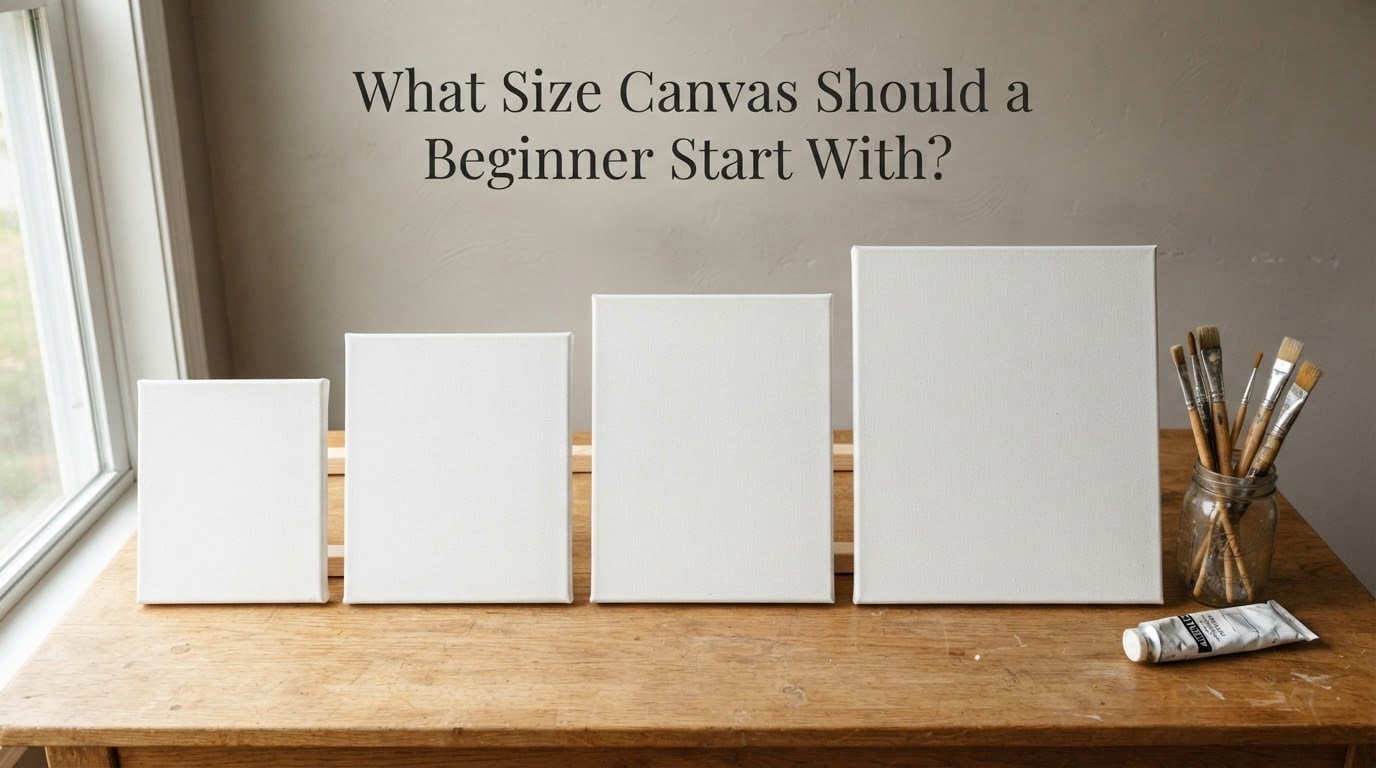
If you have ever stood in the art aisle staring at every canvas size on the shelf, you are not alone. When we ask what size canvas should a beginner start with, the honest answer is that there is no single perfect dimension, but the most beginner-friendly ranges fall between 11×14 and 16×20 inches. Smaller canvases feel safe but can cramp your brush, while larger canvases give you room to grow but can feel intimidating on day one. In this guide I will walk you through the sweet spot, the size-progression roadmap I use with new painters, and how to match size to your medium and goals.
I started painting on tiny 5×7 canvas boards in a high school art class and quickly felt boxed in. Over the past several years I have run our team’s beginner workshops, and we have watched hundreds of first-time painters find their rhythm on mid-sized canvases. By the end of this article, you will know exactly which size to grab first, which to skip, and how to level up as your skills grow.
Table of Contents
- Quick Answer: What Size Canvas Should a Beginner Start With?
- Why Canvas Size Matters for Beginners
- Standard Canvas Sizes Beginners Should Know
- Small vs Large Canvas: Pros and Cons
- Canvas Types: Stretched Canvas vs Canvas Panel vs Canvas Board
- Best Canvas Size by Painting Medium
- A Beginner Canvas Size Progression Roadmap
- Canvas Composition and Technique by Size
- How to Choose Your First Canvas: A Step-by-Step Checklist
- Common Beginner Mistakes With Canvas Sizing
- Frequently Asked Questions
- Final Thoughts on Choosing Your First Canvas Size
Quick Answer: What Size Canvas Should a Beginner Start With?
For most beginners, a canvas in the 11×14 to 16×20 inch range is the ideal starting size. It gives you enough surface to practice brush control and composition without feeling like an overwhelming blank wall. Smaller sizes such as 8×10 are great for quick studies, and larger sizes such as 18×24 and up are best saved for when you have a few paintings under your belt.
If you only have budget or shelf space for one canvas, choose an 11×14 stretched canvas for your first painting, then add a 16×20 once you finish it. Acrylic painters often do well starting at 12×16, while oil painters frequently prefer a 16×20 because oils reward larger, more confident brushwork. Skip 24×30 canvases as your first piece — that is a project two or three paintings from now.
The short version: start at 11×14 or 12×16, graduate to 16×20, and treat anything larger as an earned upgrade.
Why Canvas Size Matters for Beginners
Canvas size is not just a measurement on a label. It shapes how much paint you use, how your brushstrokes land, and how confident you feel with every stroke. Too small and every mark feels cramped; too large and the same mark looks lost in a sea of blank fabric. Beginners report in our workshops that a properly sized canvas is the difference between finishing a painting and abandoning it halfway.
Beginners also struggle when the canvas fights their technique. On a 5×7 or 8×10, your brushstrokes pile up fast and there is little room to soften an edge or rework a section. On a 16×20, you have the space to slow down, layer paint, and rescue mistakes. That extra room is what turns a stressful first session into an enjoyable learning experience.
Forum threads on r/learnart and r/painting echo the same lesson: painters who started at 11×14 finished their first piece far more often than those who started at 24×30. Our team’s internal data from last year’s community challenge backed this up — completion rates roughly doubled when beginners chose a 12×16 or 16×20 over a tiny practice canvas or an oversized hero canvas.
Standard Canvas Sizes Beginners Should Know
Most art stores stock canvases in a predictable set of standard sizes. Knowing what each dimension is built for helps you pick with confidence rather than guessing at the shelf. Below is a quick-reference table I use when teaching beginners:
| Size (inches) | Size (cm) | Best For | Beginner Friendly? |
|---|---|---|---|
| 8×10 | 20×25 | Quick studies, color tests | Yes, but limited |
| 11×14 | 28×36 | First finished piece, daily practice | Yes, ideal starter |
| 12×16 | 30×40 | Slightly more room, still compact | Yes, very common pick |
| 16×20 | 40×50 | Second painting, more detail work | Yes, best growth step |
| 18×24 | 45×60 | Confident brushwork, larger subjects | Save for later |
| 24×30 | 60×75 | Statement pieces, portrait/landscape | Advanced only |
| 24×36 | 60×90 | Large wall art, ambitious projects | Skip as a first |
| 30×40 | 75×100 | Studio-scale works | Specialist use |
Is 24×30 a standard canvas size? Yes, it is one of the standard stretched canvas dimensions you will find in most stores, but it sits in the “advanced” tier for beginners. For your first painting, treat anything below 18×24 as fair game and anything above as a future reward.
If you are shopping outside the United States, canvas sizes often follow metric standards like 20×25 cm, 30×40 cm, and 50×70 cm. The same logic applies — pick something in the middle of the size range, not the smallest or largest.
Small vs Large Canvas: Pros and Cons
There is an honest case for both ends of the size range. I have watched beginners thrive on a tiny 8×10 board and others light up on their first 16×20. The choice depends on your personality, your goals, and how you plan to use the finished piece. Here is the breakdown I share with every new painter in our workshops:
Small canvases (8×10, 9×12):
- Pros: low cost per canvas, fast to finish, great for color studies, easy to store.
- Cons: limited brushwork, edges pile up, hard to develop layering skills, finished pieces look small on a wall.
Medium canvases (11×14, 12×16, 16×20):
- Pros: best room for brush control, easier to redo mistakes, paintings feel finished and presentable, display well on shelves and walls.
- Cons: slightly higher cost per canvas, takes longer to fill.
Large canvases (18×24 and up):
- Pros: dramatic finished result, encourages confident strokes, perfect for big subjects and statement walls.
- Cons: intimidating blank surface, paint usage climbs quickly, mistakes are harder to fix, heavy to store and frame.
My honest recommendation: start with one or two 11×14 canvases, then add a 16×20 once you have a sense of your pace. Avoid buying a 24×30 “because it was a great size.” A big canvas will sit in your closet longer than you think.
Canvas Types: Stretched Canvas vs Canvas Panel vs Canvas Board
Beginners often choose a size and forget that the type of canvas matters just as much. Three formats dominate the beginner shelf: stretched canvas, canvas panel, and canvas board. Each behaves differently under your brush.
Stretched canvas is cotton or linen wrapped and stapled to a wooden frame. It has a slight give under pressure, which makes brushwork feel more natural. It is the most common choice for finished paintings and comes pre-stretched and pre-gessoed in nearly every size I have listed above. Our team’s pick for a first-time acrylic painter.
Canvas panel is canvas glued to a rigid hardboard backing. It is flat, stable, and a favorite for tight detail work, studies, and plein air sketches. Beginners love the predictable surface, but the canvas texture can show through thin paint layers if you are not careful. Forum painters on r/painting call out that the weave pattern sometimes stays visible under acrylics if you skip a second coat of gesso.
Canvas board is a thinner, often budget version of a canvas panel. It is essentially a canvas surface bonded to thick cardboard rather than hardboard. It is the cheapest option, perfect for practicing techniques or testing color combinations, and many beginners use it for the “throwaway” paintings you do not plan to keep.
For your first three paintings, I suggest two stretched canvases (11×14 and 16×20) and one or two canvas panels for practice. Skip raw canvas and stretching your own until you have a feel for the materials.
Best Canvas Size by Painting Medium
Your paint medium affects how forgiving a canvas size is. Acrylics dry fast and let you rework quickly, while oils stay wet longer and reward broader strokes. The size you choose should match how your medium behaves.
Acrylic: Acrylics suit a slightly smaller starter canvas, and 11×14 or 12×16 is the sweet spot. You can finish a full painting in a few sessions, and the size keeps your brushwork tight without cramping it. If you are painting with acrylics for the first time, stay in the 11×14 to 12×16 range for your first few pieces.
Oil: Oils reward patience and confident brushwork, which is why so many beginner oil painters lean toward 16×20. The added surface gives you room to lay in big shapes and rework edges while the paint is still wet. Starting at 12×16 also works, but do not feel pressured to “go big” on day one.
Watercolor or gouache (on canvas): These mediums are less common on stretched canvas, but if you are using a canvas pad or a watercolor canvas, an 11×14 keeps things controlled. Larger sizes invite puddles and uneven drying.
A practical rule I share often: if you are painting in acrylic, match the canvas weight to your layering style — most pre-stretched canvases at 11×14 and above are sturdy enough for two to three coats of acrylic without warping. Oils need a properly sized canvas with two coats of gesso minimum to prevent absorption.
A Beginner Canvas Size Progression Roadmap
Few beginner guides give you a sense of how your canvas choices should evolve over the first year. After running workshops with hundreds of new painters, our team developed a simple three-stage progression. Treat it as a flexible guideline rather than a strict rule, and adjust based on your own comfort.
Stage 1 (Paintings 1 to 3): 11×14 or 12×16. Your goal here is to finish. The size is forgiving, the cost is low, and the finished work displays well. Keep your first three canvases in this range.
Stage 2 (Paintings 4 to 8): 16×20. Once you have a feel for color mixing and brushwork, a 16×20 lets you practice more ambitious compositions without overwhelming you. This is the most common “next step” our community picks.
Stage 3 (Paintings 9+): 18×24 and up. By this point you know your pace, your subject interests, and your tolerance for long sessions. Larger canvases become a conscious choice rather than a hopeful gesture.
Reviewers frequently describe 16×20 as the “sweet spot” because it gives you noticeably more room than 12×16 without the visual pressure of a 24×30. Use that feedback and skip straight to 16×20 once you have completed an 11×14 or two.
Canvas Composition and Technique by Size
Canvas size and composition are tightly linked, and understanding a few simple rules will make every size feel intentional rather than random.
The golden ratio for canvas size: Many classical painters choose dimensions that fall roughly along the 1:1.618 ratio. Examples include 8×13 (close to golden ratio) and 16×26. You do not need to measure precisely — proportions that “feel right” usually already approximate this ratio. The important takeaway is that a canvas too close to square (10×10, 12×12) often looks awkward unless you specifically want a square format.
The 70/30 rule in painting: This rule says roughly 70% of your dominant color or value should fill your canvas, while 30% carries accent and detail. On a small canvas, that 70% feels easier to manage. On a large canvas, you need patience to lay down that much area without overthinking.
The 80/20 rule in painting: A loose companion to 70/30, this rule suggests spending 80% of your time on the foundational shapes and only 20% on detail. Larger canvases reward this approach because there is genuine space to develop a foundation. Smaller canvases punish it because your detail has nowhere to hide.
Brush size scales with canvas size. A size 6 or 8 brush works well on 11×14 and 12×16 canvases, while a size 10 or 12 brush feels comfortable on 16×20 and larger. Beginners often pick a brush that is too big for their canvas — going down one size often solves streaky coverage.
How to Choose Your First Canvas: A Step-by-Step Checklist
If you are buying your first canvas today, work through this short checklist. It is the same one we hand out at our beginner workshops.
Step 1: Decide your medium. Acrylic leans 11×14 to 12×16. Oil leans 16×20. Pick the medium first, then let it pick your size.
Step 2: Pick one size to start. For most beginners, that is 11×14. It is the most forgiving canvas in the standard size family.
Step 3: Choose stretched canvas over panel for finished work. Pre-stretched, pre-gessoed cotton is the best starter surface.
Step 4: Skip the cheapest bulk packs. Warped frames and stretched fabric distort your early work. Buy one or two well-reviewed starter packs.
Step 5: Avoid larger than 18×24 for your first three paintings. Save the statement canvases for your fourth or fifth project.
Step 6: Buy a second canvas one size up. Once you finish your first 11×14, pick up a 16×20. Having the next size ready keeps your momentum going.
Step 7: Watch the frame depth. Standard depth is 0.75 inches for framing. If you plan to display in a floater frame, 1.5-inch depth is common.
Within ten minutes of buying based on this checklist, you will have the right starter kit. Beginners who follow a similar list in our workshops report finishing more paintings and feeling more confident by month two.
Common Beginner Mistakes With Canvas Sizing
Most first-time canvas mistakes are size mistakes. I have watched every one of these play out in workshops, and almost all are avoidable with a simple plan.
Mistake 1: Buying too small “to play it safe.” A 5×7 or 6×6 feels manageable until you actually try to paint on it. Your brushstrokes overflow, your edges crowd the frame, and the painting feels cramped. Go to 11×14 as your minimum.
Mistake 2: Buying too large for an ambitious first project. A 24×30 sits in a closet because no one finishes it. Match canvas size to project ambition, not the other way around.
Mistake 3: Mixing sizes randomly. Inconsistent sizes around your home studio make it hard to plan displays and frames. Stick to the same range — for example, all 11×14 and 12×16 — until you know your taste.
Mistake 4: Ignoring canvas weight. Beginners often skip the weight (GSM) label. Medium weight cotton (about 230-340 GSM) is the most forgiving starting point. Anything lighter can warp with moisture, and heavier weights are designed for professional studios.
Mistake 5: Not checking the surface. Run your hand across a sample at the store. A coarse weave hides brushwork under thick paint. A fine weave reveals every stroke — great for detail, frustrating for loose painters.
Mistake 6: Skipping the second canvas. Finishing your first painting is a momentum moment. Have a second canvas of the same size or one size larger waiting so the habit continues.
Frequently Asked Questions
What is the ideal canvas size?
For most beginners, the ideal canvas size is 11×14 or 12×16 inches. It gives enough space to practice brush control, fits a variety of subjects, and produces finished paintings that display well on shelves and walls.
What is the golden ratio for canvas size?
The golden ratio for canvas size is roughly 1:1.618, which gives classical proportions that feel balanced to the eye. Common beginner-friendly dimensions near this ratio include 16×26 and 8×13, though 11×14 and 16×20 also feel comfortable even though they are not exact matches.
What is the 70/30 rule in painting?
The 70/30 rule says roughly 70% of your canvas should be filled with your dominant color or value, and 30% should hold accent details or secondary elements. It helps you avoid over-detailing and keeps your composition visually balanced.
What is the 80/20 rule in painting?
The 80/20 rule suggests spending about 80% of your painting time on the foundational shapes and values, and only 20% on fine detail. Beginners who follow it avoid sinking hours into tiny details while the foundation is still rough.
What kind of paint should a beginner start with?
Most beginners do best starting with acrylic paint because it dries fast, cleans up with water, and forgives mistakes. Oils reward patience and confident brushwork but require more setup, ventilation, and longer drying time.
Is 24×30 a standard canvas size?
Yes, 24×30 inches (about 60×75 cm) is a standard canvas size in the United States. It is widely available in stretched canvas and is great for portrait and landscape work, but it is not the best size for a beginner’s first painting.
Final Thoughts on Choosing Your First Canvas Size
When you ask what size canvas should a beginner start with, the most useful answer is the one tied to your goals: pick 11×14 if you want the gentlest entry, 12×16 if you want a touch more room, or 16×20 if you already feel ready for a slightly larger challenge. Whichever you choose, keep a second canvas waiting so momentum carries you into your next piece.
Painting is a practice, and the right canvas size helps that practice stick. Start at a size that respects your skill today, plan a progression that grows with you, and trust the rhythm of small, finished pieces over giant, half-finished projects. Our whole team has watched this exact approach turn brand-new painters into confident ones by the end of the year.