
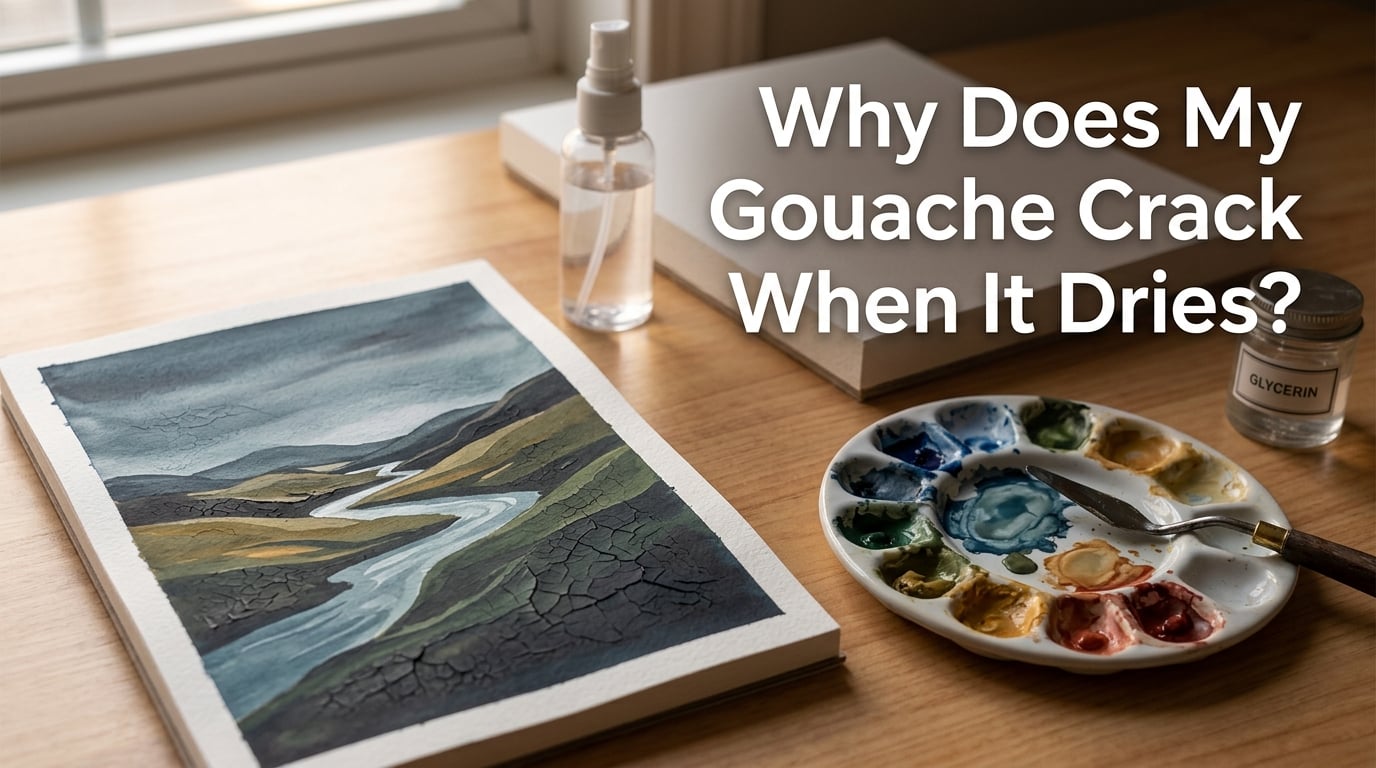
If you have ever lifted a finished gouache painting only to find a fine web of cracks running across the surface, you already know how discouraging this problem can be. I have watched students set down a brush, walk away, and come back to a once-smooth passage that now looks like dry riverbed. So let’s answer the core question: why does my gouache crack when it dries? In short, gouache cracks because the binder shrinks as water evaporates faster than the paint film can release tension, and when that shrinkage stress beats the adhesion to your support, the surface splits. The good news is that cracking is almost always avoidable once you understand the three forces at play: the paint itself, the surface beneath it, and the air around it.
Table of Contents
- Why Does My Gouache Crack When It Dries?
- Paint Application Mistakes That Cause Cracking
- Support and Substrate Choices That Prevent Cracking
- Environmental Factors: Humidity, Temperature, and Drying Speed
- Traditional Gouache vs Acryla Gouache vs Acrylic: How Each Cracks
- 7-Step Prevention Checklist to Stop Gouache Cracking
- How to Fix Cracked Gouache on Palette and Paintings
- Frequently Asked Questions
- Final Thoughts
Why Does My Gouache Crack When It Dries?
Gouache cracks when the drying paint film shrinks more than it can stretch, and the resulting stress exceeds either the film’s tensile strength or its grip on the support. This single mechanism explains nearly every cracking problem artists run into, whether the paint is sitting on a palette or sitting on a finished painting.
The Science Behind Cracking and Crazing
Gouache is a water-based paint made of pigment bound by gum arabic (in traditional gouache) or by an acrylic polymer (in acryla gouache). As water leaves the film, the binder contracts. Pigment particles do not shrink at the same rate, so the binder pulls tight around them like a net. If the film is thin and well bonded, this shrinkage is invisible. If the film is thick, poorly bonded, or drying too fast, the stress has nowhere to go and the surface fractures.
This network of fine cracks has a specific name: crazing. When the cracks are larger and the paint flakes at the edges, you are seeing delamination, the same problem at a more advanced stage. Both are symptoms of the same root cause.
How Binder and Pigment Load Drive Shrinkage
Two formulation variables control how much a gouache film wants to shrink. The first is the binder ratio, which is the proportion of gum arabic (or acrylic polymer) to pigment. A high binder ratio means more shrinkage. The second is the pigment load, which is the amount of pigment packed into each drop of binder. Heavily pigmented paints shrink less; binder-heavy paints shrink more.
Budget gouache sets often have more binder and less pigment, which is why some artists notice that cheap gouache cracks faster than professional brands. Conservation experts on the MITRA forum have noted the same pattern, observing that gouache applied over a hardboard panel can shrink enough to crack when the priming swells or rewets beneath it.
Paint Application Mistakes That Cause Cracking
How you apply the paint matters as much as which paint you choose. Cracking is rarely about a single bad decision; it is usually the sum of several small ones.
Applying gouache too thick. Thick passages behave like mud cracks in a desert. The surface dries and shrinks while the interior stays wet, and the top layer splits as it pulls tight. If you want a thick, opaque layer, build it up in two or three thin passes instead of one heavy one.
Overworking a wet passage. Every brushstroke rewets the layer beneath it and lifts fresh pigment into the surface you are trying to dry. The result is a film with no clean internal structure, more prone to cracking as it finally dries.
Reactivating layers you wanted to keep dry. Traditional gouache is famously re-wettable, which is one of its charms and one of its traps. If you brush over a passage you meant to leave alone, you soften the dried binder and weaken the film. A light spray of fixative between layers can lock a dried passage in place before you continue.
Support and Substrate Choices That Prevent Cracking
The surface you paint on decides how much freedom your film has to move. A flexible support moves with the shrinking paint, while a rigid support holds still and forces the paint to absorb all the stress.
Flexible supports (paper, sketchbook pages, stretched canvas) bend slightly as the paint dries, which absorbs some of the shrinkage. This is one reason gouache behaves beautifully on heavyweight watercolor paper. The drawback is that the support itself can warp, and any later flexing can reopen microcracks.
Rigid supports (hardboard, cradled wood panels, museum board) stay flat, which is what most display and framing situations need. The paint film must do all the flexing, and if it cannot, it cracks. Conservation specialists at MITRA recommend a paper-faced support over a rigid panel as a compromise, giving you flatness with a slightly forgiving interface.
Priming matters. An acrylic gesso ground creates mechanical tooth, the microscopic roughness that grips the paint film. Slick grounds let the paint slide as it shrinks. Two thin coats of gesso, lightly sanded between coats, give the paint something to hold onto.
Environmental Factors: Humidity, Temperature, and Drying Speed
Gouache wants to dry slowly and evenly. Anything that speeds up the surface while the inside stays wet is a cracking risk. Hot rooms, direct sun, hair dryers, and low humidity all push the surface to skin over too fast.
Plein air painters working in desert or high-altitude conditions report this constantly. Reddit users in dry climates note that even professional brands crack within minutes when the air is bone-dry. A simple workaround is to mist the back of the paper or the studio air, or to work under a shading umbrella so direct sun never hits the wet panel.
On the opposite end, very high humidity slows drying to a crawl. Gouache stays tacky, dust sticks to it, and any subsequent layers sink into the previous one. Aim for a comfortable studio humidity around 50 percent and a stable room temperature.
Traditional Gouache vs Acryla Gouache vs Acrylic: How Each Cracks
These three paint families share a name but behave very differently as they dry. Understanding the differences helps you pick the right one before you start, instead of fixing cracks later.
Traditional gouache uses gum arabic as a binder. It stays re-wettable, dries to a soft matte finish, and is the most prone to cracking in thick layers because the binder is relatively flexible but not very strong.
Acryla gouache uses an acrylic polymer binder. It dries water-resistant but shares the matte opacity of traditional gouache. Acryla gouache forms a tougher film and cracks less, but it also reactivates less, so corrections are harder.
Acrylic paint uses a stronger acrylic emulsion. It forms a flexible, durable film and rarely cracks on its own. The tradeoff is that it is no longer water-soluble once dry, so the reactivation tricks that make gouache so forgiving simply do not work.
Holbein, Turner, and M. Graham all behave slightly differently within these families because of their specific binder ratios. Artists on Reddit report that M. Graham’s higher gum content gives a creamy, re-wettable feel with a touch more shrinkage risk, while Turner Acryla is praised for cracking resistance in heavy applications.
7-Step Prevention Checklist to Stop Gouache Cracking
Use this checklist before you start a painting, and you will solve most cracking problems before they begin.
- Choose a heavyweight, sized paper (140 lb / 300 gsm or higher) for flexible work, or a gessoed hardboard panel for rigid work.
- Apply two thin coats of acrylic gesso on rigid supports, sanding lightly between coats to build mechanical tooth.
- Mix gouache with enough water to flow smoothly, but not so much that it puddles. Aim for the consistency of heavy cream.
- Build up opaque passages in two or three thin layers, letting each layer dry before adding the next.
- Avoid overworking wet areas; lay a stroke and leave it.
- Spray a light coat of fixative between layers if you need to lock a passage before continuing.
- Work in a stable environment around 50 percent humidity and out of direct sun or drafts.
How to Fix Cracked Gouache on Palette and Paintings
Cracked gouache on a palette is a different problem from cracked gouache on a painting, and the fixes are different too.
Fixing Cracked Gouache on Your Palette
If your palette paint has skinned over or cracked, the binder is still good underneath. Add a few drops of water, let it sit for two or three minutes, then stir with a palette knife until smooth. A Reddit user fixed a badly cracked set of Holbein this way after simply soaking the pans in water overnight. For persistent lumps, add a single drop of glycerin to the rehydration water to soften the dried binder.
Fixing Cracked Gouache on a Finished Painting
Hairline crazing is often best left alone, since overworking the area can make it worse. For visible cracks, mist the painting lightly with water and let the surface relax before touching it. For a more durable repair, seal the finished painting with a coat of spray fixative or a thin layer of varnish, which protects the weakened film without rebuilding it. Some artists seal gouache with Mod Podge as a final protective coat, though this slightly darkens the matte finish.
Frequently Asked Questions
How do you stop paint cracking when it dries?
Apply gouache in thin layers, let each layer dry before adding the next, use a flexible or properly gessoed rigid support, and work in stable humidity around 50 percent. A light spray of fixative between layers locks dried passages in place.
Is it okay to let gouache dry?
Yes. Traditional gouache is designed to dry and be reactivated with water later, which is one of the medium’s defining features. Letting gouache dry between sessions is normal and will not damage the paint on its own.
Can you fix dried out gouache?
Most dried gouache revives cleanly. Add a few drops of water to the pan or palette well, wait two or three minutes, then stir with a palette knife. A single drop of glycerin helps with stubborn pans. If the paint has fully hardened into pebbles, replace it.
Is gouache just watered down acrylic?
No. Traditional gouache uses gum arabic as a binder and stays water-soluble when dry. Acrylic uses a polymer emulsion that becomes water-resistant permanently. Acryla gouache sits between the two, with an acrylic binder but the matte opacity of traditional gouache.
Final Thoughts
Gouache cracks when shrinkage stress outruns the paint film’s ability to stretch or stick. Control the paint thickness, choose the right support, and watch the room humidity, and the same problem that ruined your last painting will quietly stop happening.