
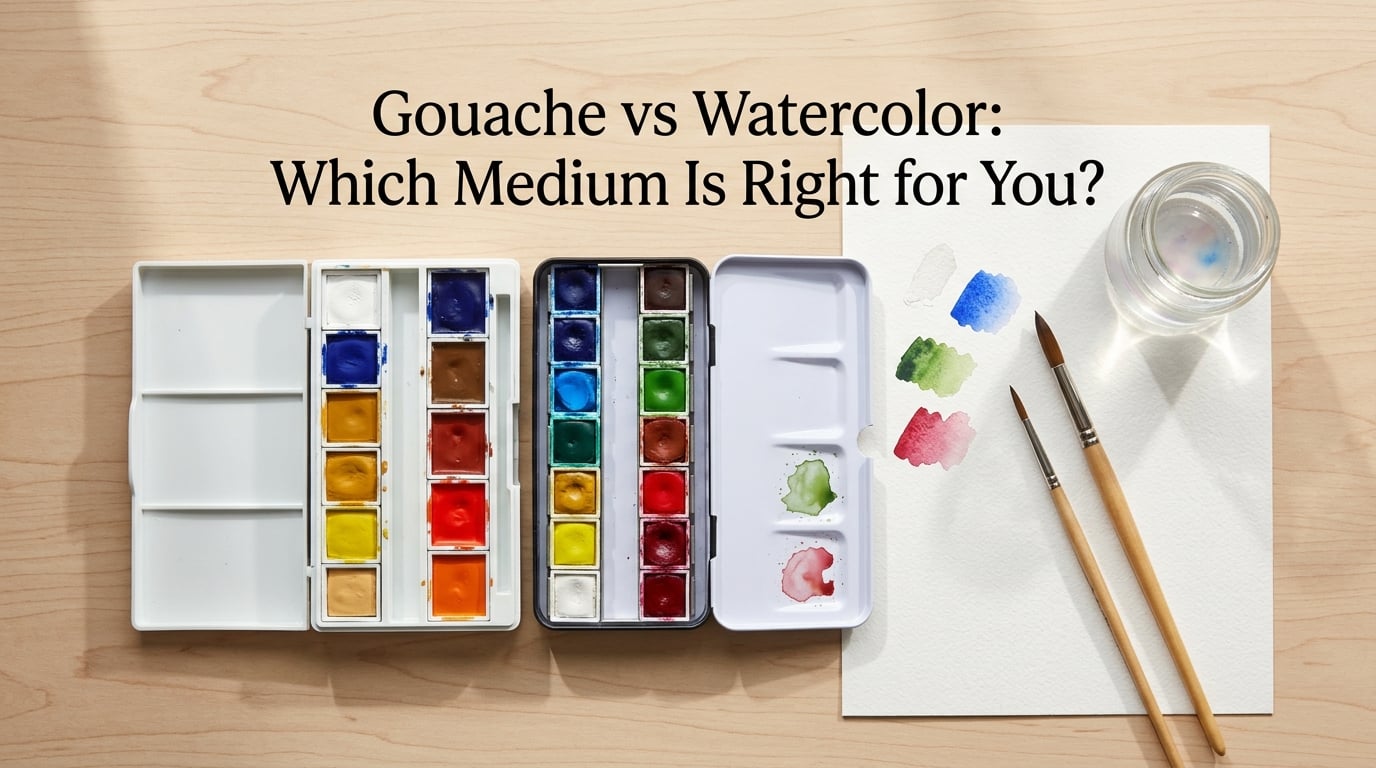
Gouache is opaque, matte, and forgiving, which makes it ideal for illustration and bold graphics. Watercolor is transparent and luminous, which makes it ideal for atmospheric washes and delicate landscapes. Pick gouache if you want crisp edges, flat color, and easy corrections. Pick watercolor if you want soft blends, glowing light, and a meditative painting process.
I have worked with both mediums for years, and the question I hear most often from new artists is exactly what you are probably wondering right now. Both are water-based paints that share brushes, paper, and palettes, but they behave very differently once they hit the page. This guide breaks down the real differences, lays out the pros and cons of each, and gives you a clear framework for choosing the right medium for your style in 2026.
Table of Contents
- Quick Comparison: Gouache vs Watercolor at a Glance
- What Is Gouache?
- What Is Watercolor?
- Key Differences Between Gouache and Watercolor
- Pros and Cons of Each Medium
- Can You Use Gouache and Watercolor Together?
- Which Medium Is Right for You? A Decision Framework
- Frequently Asked Questions
- The Bottom Line: Try Both, Choose Your Style
Quick Comparison: Gouache vs Watercolor at a Glance
Before we go deeper, here is the side-by-side look at how these two water-based paints actually differ. This is the table I wish I had when I was starting out.
| Attribute | Gouache | Watercolor |
|---|---|---|
| Opacity | Opaque, covers underlying layers | Transparent, lets paper show through |
| Finish | Matte and velvety | Luminous with a slight satin sheen |
| Drying time | Quick to dry on the palette | Slower dry, easy to lift when wet |
| Rewettable | Yes, reactivates with water | Yes, reactivates with water |
| Layering | Easy, paint light over dark | Harder, plan highlights in advance |
| Mistake correction | Simple, paint over the area | Difficult once a layer dries |
| Color shift | Dries slightly darker | Dries slightly lighter |
| Best paper | Mixed media or watercolor paper | Watercolor paper (100 percent cotton preferred) |
| Best for | Illustration, design, flat color, lettering | Landscapes, florals, atmospheric washes |
| Beginner friendliness | High, very forgiving | Medium, requires planning ahead |
What Is Gouache?
Gouache is an opaque, water-based paint that dries to a soft matte finish. The pigment particles in gouache are larger and more densely packed than those in watercolor, and most formulas include an opacifier (often a chalk or titanium white additive) that blocks light from passing through the paint layer.
The word gouache comes from the Italian guazzo, meaning “water paint,” and the medium has roots stretching back several centuries. Renaissance manuscript illuminators used a similar opaque watercolor for illuminated pages, and the modern form really came into its own in the 18th and 19th centuries as a design and poster medium.
Van Gogh painted with gouache on several occasions. He used it for his Boats at Saintes-Maries series and a number of sketches, where its opacity gave him punchy color fields that oil paint could not deliver as quickly.
Today gouache is the go-to medium for animation studios, illustrators, and graphic designers. Studio Ghibli backgrounds, many modern magazine illustrations, and most designer gouache sets you see in art supply stores exist because this paint hits a sweet spot between fast setup and graphic impact.
What Is Watercolor?
Watercolor is a transparent, water-based paint made by suspending pigment in a water-soluble binder, usually gum arabic. When you apply a wash, light passes through the paint layer, hits the white paper beneath, and bounces back to your eye, which is what creates that signature luminous glow.
Traditional watercolor is one of the oldest painting mediums in continuous use. Renaissance botanical illustrators like Albrecht Durer produced watercolor studies in the late 1400s that still look vivid today, and English watercolorists like J.M.W. Turner and John Singer Sargent pushed the medium into fine art territory in the 18th and 19th centuries.
Watercolor has a few defining characteristics that make it feel different from any other paint. The paint is built up in transparent layers called glazes, and you typically have to plan your lightest values in advance because adding white back in is very hard once a layer dries.
That constraint is also what gives watercolor its charm. Practitioners on Reddit r/Watercolor often describe the medium as a dance with transparency, where the paper does half the work and the artist guides the rest.
Key Differences Between Gouache and Watercolor
Both paints share water, brushes, and many of the same pigments, but the way they behave on the page is fundamentally different. Here is the breakdown of what actually changes once you start painting.
1. Opacity and Light Handling
Gouache is opaque because its pigment particles are larger and the paint contains opacifiers. Light cannot pass through a dried gouache layer, so each stroke covers whatever is below it.
Watercolor is transparent because its pigment particles are very fine and there are no opacifiers in the formula. Light travels through the paint, hits the paper, and reflects back, which is what produces the medium’s glow.
2. Finish and Texture
Gouache dries matte and velvety. There is almost no shine on the surface, and the paint looks the same wet or dry in terms of sheen.
Watercolor dries with a soft satin sheen on darker passages, and the paper texture stays visible through thin washes, which is part of why artists love it.
3. Layering and Corrections
Gouache lets you paint light over dark because every new layer is fully opaque. If you make a mark you do not like, you wait for it to dry and then paint right over it.
Watercolor forces you to work dark to light. Once a layer dries, lifting pigment is difficult and adding opaque white disrupts the transparent effect, so artists mask highlights in advance with masking fluid or simply leave the paper bare.
4. Drying Time and Reactivation
Both gouache and watercolor are rewettable. Add water to a dried layer and the paint softens again, which is handy for blending and edge work but also means a stray water droplet can ruin a finished passage.
Gouache dries a little faster on the palette and reactivation happens within minutes. Watercolor takes longer to dry, but the rewetting window extends much further, which is one reason watercolorists work in sections.
5. Paper and Surface
Watercolor behaves best on dedicated watercolor paper, ideally 100 percent cotton and at least 140 lb (300 gsm) weight so the paper can take heavy washes without buckling.
Gouache is more forgiving. It works on watercolor paper, mixed media paper, illustration board, and even some sketchbook papers because the paint sits on top rather than soaking in.
6. Color Shift
Gouache dries slightly darker than it appears wet. If you mix a value that looks right on the palette, expect it to deepen a touch on the page.
Watercolor dries slightly lighter than it appears wet. Wet washes always look more saturated than the final dry result, which catches almost every beginner off guard.
Pros and Cons of Each Medium
Neither medium is universally better. Each has clear strengths and real downsides, and the right choice depends on what kind of painting you want to make.
Pros of Gouache
- Opaque coverage lets you paint light over dark and correct mistakes easily
- Matte finish is a strong match for illustration, design, and flat graphic styles
- Quick drying time keeps the workflow tight
- Works on a wider range of papers and surfaces than watercolor
- Beginner-friendly because errors are easy to fix
Cons of Gouache
- Dries darker than expected, which can throw off value planning
- Cracks if applied too thickly in a single pass
- Rewetting can lift underlying layers unexpectedly
- Not as luminous as watercolor, so it lacks the glowing depth many artists love
Pros of Watercolor
- Transparent layers create a luminous glow no other paint can match
- Portable and fast to set up, perfect for travel and urban sketching
- Longer drying window gives more time for soft blends
- Forces a thoughtful, layered approach that builds strong planning skills
Cons of Watercolor
- Very hard to correct mistakes once a layer dries
- Highlights must be planned in advance, which slows quick studies
- Requires higher-quality (and more expensive) paper for best results
- Less beginner-friendly because the medium punishes overworking
Can You Use Gouache and Watercolor Together?
Yes, you can absolutely mix gouache and watercolor in the same painting, and many artists do. The two mediums share a water-based binder system, so they layer and blend with each other without any special medium or additive.
The most common approach is watercolor first, then gouache on top. Paint your washes and glazes as normal, let them dry, and use gouache for opaque highlights, accents, and small corrections. White gouache in particular is a staple addition for watercolorists who need a way to recover a lost light area or add a sharp highlight without resorting to masking fluid.
A few practical tips from artists who combine them regularly:
- Keep a small tube of white gouache in your watercolor kit for emergency highlights
- Use gouache at the very end of a painting so the underlying watercolor washes stay clean
- Avoid scrubbing the gouache once it touches dry watercolor, or you may lift the layer beneath
- Stick to artist-grade gouache if you want lightfastness that matches your watercolor
If you want to try the reverse (gouache first, watercolor over the top), be aware that watercolor will bead up on the gouache surface. A light mist of water on the gouache layer before applying watercolor helps the new wash grab and flow.
Which Medium Is Right for You? A Decision Framework
The best medium is the one that matches the kind of art you actually want to make. Here is how I think through the choice based on what artists tell me they want from their painting practice.
Choose Gouache If You Want
- Bold, flat color blocks with crisp edges
- The ability to paint light over dark and fix them on the fly
- A medium that forgives mistakes and rewards experimentation
- Illustration, poster design, lettering, or animation-style work
- Quick studies with fast setup and predictable results
Choose Watercolor If You Want
- Soft, luminous washes with a glowing inner light
- Landscapes, florals, atmospheric scenes, or botanical work
- A meditative, planning-forward painting process
- Lightweight, portable gear for travel and urban sketching
- To build strong foundational skills in value and color theory
Choose Both If You Want
- Maximum flexibility across illustration and fine art
- The luminous glow of watercolor with the corrective power of gouache
- A kit that covers lettering, design, plein air sketching, and studio work
For total beginners, gouache is often the easier starting point because corrections are simple. For artists who want to develop strong planning skills and classic fine art technique, watercolor is the better teacher. Many artists keep both in their kit and switch based on the project.
Quick Troubleshooting Tips
Forum threads on Reddit r/Gouache and r/Watercolor are full of the same recurring questions, so here is the short version of the answers that come up most often.
- If your gouache cracks, you applied it too thick. Thin with water and build in layers.
- If your gouache reactivates when you did not expect it, mist the surface with water instead of brushing, and let the paint settle.
- If your watercolor looks muddy, you are layering wet-on-wet too early. Let each layer dry fully before adding the next.
- If your watercolor dries too pale, plan ahead and mix a slightly more saturated wash than you think you need.
Frequently Asked Questions
Which is better for beginners, gouache or watercolor?
Gouache is generally easier for beginners because it is opaque, dries quickly, and lets you paint over mistakes. Watercolor teaches foundational skills but requires more planning and a higher tolerance for happy accidents.
Did Vincent van Gogh use gouache?
Yes, Vincent van Gogh used gouache on several works, including parts of his Boats at Saintes-Maries series and various sketches, where its opacity and matte finish suited his graphic color fields.
What are the disadvantages of using gouache?
Gouache dries slightly darker than expected, can crack if applied too thickly, and reactivates with water, so a stray droplet can disturb a finished passage. It is also less luminous than watercolor.
Is gouache just watered down acrylic?
No, gouache is not watered down acrylic. Traditional gouache uses a water-soluble binder like gum arabic and stays rewettable, while acrylic paint uses a plastic binder that becomes permanent once dry. Acrylic gouache is a separate product that blends traits of both.
Can I use my watercolor brushes with gouache?
Yes, watercolor brushes work well with gouache. Most watercolor brushes, especially soft synthetic or natural hair rounds, hold plenty of water and pigment for gouache work. Avoid using cheap brushes that may shed.
Can I mix gouache and watercolor in the same painting?
Yes, both mediums share a water-based binder, so they layer cleanly. Paint watercolor washes first, let them dry, then use gouache for opaque accents and highlights. Many artists keep a tube of white gouache in their watercolor kit for quick corrections.
The Bottom Line: Try Both, Choose Your Style
Gouache vs watercolor is not a battle with a winner. Both are water-based, share the same basic tools, and reward practice. Gouache gives you bold color and easy corrections. Watercolor gives you glowing light and a meditative process.
My honest recommendation: pick up a small starter set of each, paint the same simple subject twice (a single apple or a leaf works well), and notice which one feels more like the artist you want to be. Most artists who do this test end up with a clear favorite, and many keep a tube or pan of the other medium around for accents and corrections. The gouache vs watercolor choice gets much easier once the paints are on the page in front of you.