
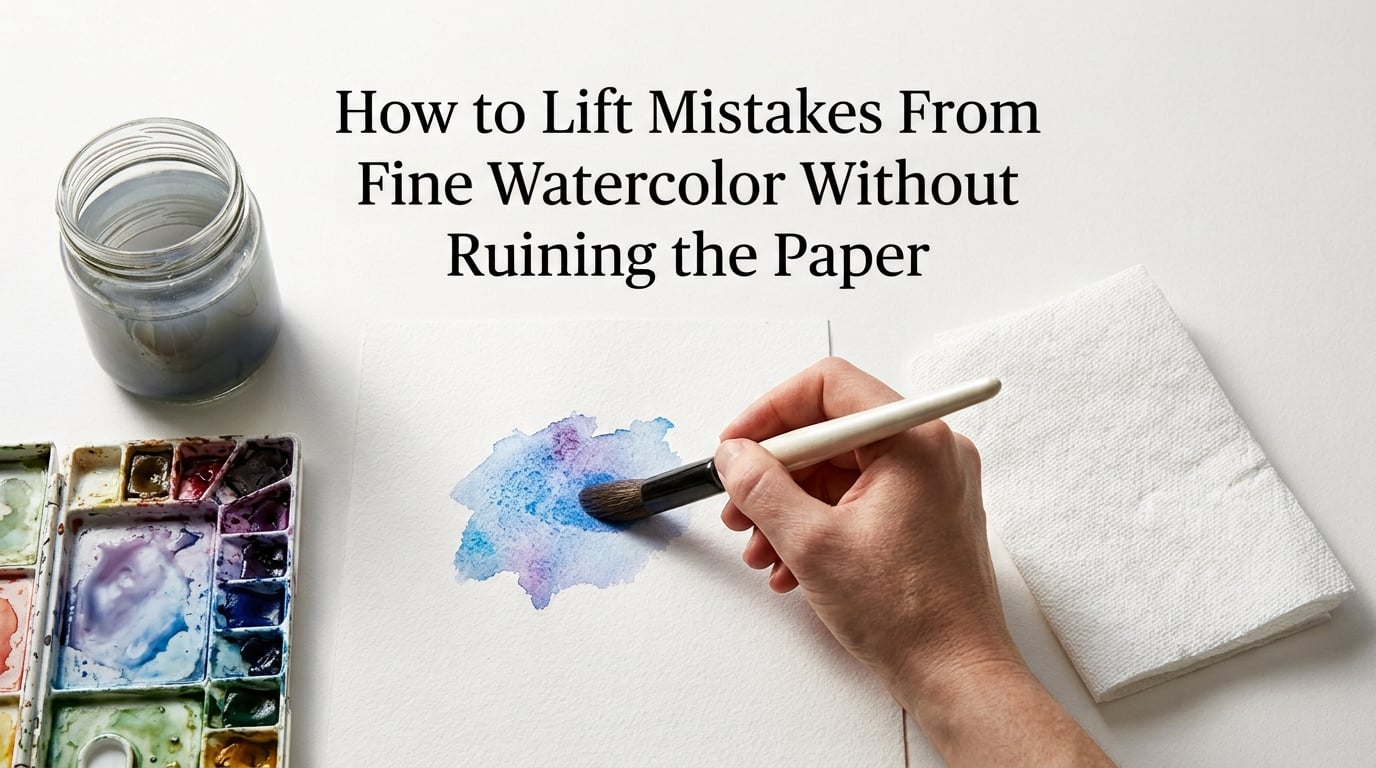
Yes, you can lift mistakes from watercolor without ruining the paper. The fastest method is to take a clean damp brush, swirl it over the still-wet pigment in gentle circular motions, then blot with a lint-free paper towel. The technique works best on 100% cotton paper, with clean water, and before the paint fully dries. Below I walk through the exact steps, the tools I reach for, and the moments when it is smarter to stop trying to lift and start painting over the mistake instead.
I have ruined my share of watercolor paper over the years, including one memorable sunset where I scrubbed so hard I wore through to the backing board. So this guide comes from real practice, not theory. If you are looking for how to lift mistakes from watercolor without ruining the paper, the short answer is: act quickly, work gently, use clean water, and know when your paper has had enough.
Table of Contents
- Quick Answer: The Four Main Watercolor Correction Techniques
- How to Lift Mistakes From Watercolor Without Ruining the Paper
- Blotting Mistakes With a Paper Towel or Tissue
- Scrubbing and Rubbing for Stubborn Pigment
- Scraping and Sanded Eraser Methods
- Painting Over Mistakes With Gouache or Opaque White
- Paper and Pigment Guide: When Lifting Will and Will Not Work
- When to Stop Trying to Lift
- Prevention: How to Avoid Needing to Lift
- Frequently Asked Questions
- Conclusion
Quick Answer: The Four Main Watercolor Correction Techniques
Most watercolor mistakes can be fixed with one of four techniques. The right choice depends on how wet the paint is, what type of paper you used, and how staining the pigment is.
- Lift with a thirsty brush: best for wet or freshly dried mistakes on cotton paper. Low damage risk.
- Blot with a paper towel: best for bloomed puddles or backruns that are still damp. Zero damage risk.
- Scrape or scratch: best for dried stains on tough cotton paper. Moderate damage risk.
- Cover with gouache or opaque white: best for mistakes you cannot fully remove. Zero damage to paper, but changes the look.
Below I break down each one in detail, with the exact brush strokes, paper choices, and warning signs that tell you it is time to stop.
How to Lift Mistakes From Watercolor Without Ruining the Paper
The core lifting technique is simple. You take a clean, damp brush, touch the unwanted pigment, give it a second to reactivate, then blot or stroke it away. The trick is keeping the brush clean and the water clean the entire time. Dirty water just pushes pigment around. It does not remove it.
The wet-on-wet lifting method
This is the safest moment to correct a mistake. The paint is still mobile and lifts out easily.
- Rinse your brush thoroughly in clean water, then squeeze most of the water out so the brush is damp, not soaked.
- Touch the damp brush to the mistake in gentle circular motions for 5 to 10 seconds.
- Without rinsing, blot the area with a folded paper towel or a clean tissue.
- Repeat steps 1 through 3 with a freshly rinsed brush until the area is as light as you need.
A cotton round or a Viva paper towel works better than cheap tissues because they do not leave lint behind. Reviewers on watercolor forums specifically call out Viva towels for this reason.
The thirsty brush technique for dried paint
Once the paint has dried, you can still lift a lot of color if your paper is 100% cotton. The thirsty brush method works by using a damp (not wet) brush to reactivate the pigment, then absorbing it back into the brush hairs.
- Dampen a clean lifting brush or a soft mop brush, then blot it on a paper towel so it is barely damp.
- Press the brush onto the dried pigment and hold for 3 to 5 seconds, letting water wick into the dried paint.
- Without rinsing, draw the brush gently across the area to lift pigment into the brush.
- Rinse the brush, blot it dry, and repeat until you have removed what you can.
A thirsty brush loads pigment the way a sponge loads water. You can see the color rising into the bristles. When the brush stops picking up color, you have reached the lifting limit of that pigment on that paper.
When wet versus dry matters
Speed matters because cotton paper holds pigment loosely at first. As it dries, the pigment settles into the paper fibers and the sizing locks it in. Hot press paper gives you more working time than cold press because the smoother surface absorbs more slowly. Student grade paper, by contrast, drinks up water and pigment almost instantly, which is why lifting almost never works on it.
Blotting Mistakes With a Paper Towel or Tissue
Blotting is the gentlest correction of all, and the only one with zero damage risk. It works on wet paint and on damp paint. It does not work on fully dried pigment.
Fold a lint-free paper towel into a small pad. Press it firmly onto the wet mistake, hold for a second, then lift straight up. Do not smear side to side. Smearing moves pigment around and creates backruns, which are the half-moon blooms you see when wet edges bleed into drying washes.
For a small spot, a cotton bud works beautifully. Dip it in clean water, touch the spot, then blot with the towel. Reviewers on watercolor forums use this for tiny errors like a stray brush flick in a sky wash.
Stopping backruns and blooms
Backruns and blooms are the same thing. They happen when a wet edge meets a drier wash and pushes pigment outward in a cauliflower shape. To stop one mid-formation, blot the wet edge immediately with a paper towel. The cauliflower will not grow further once the moisture is gone.
Scrubbing and Rubbing for Stubborn Pigment
Scrubbing is the most aggressive lifting method, and the one most likely to damage paper. Use it only on 100% cotton paper, only on dried pigment, and only when softer methods have failed.
- Wet the area gently with a clean brush.
- Wait 10 seconds for the pigment to soften.
- Use a soft brush (a mop brush or a dedicated lifting brush) in small circles, no pressure.
- Blot with a paper towel. Rinse the brush. Repeat.
If the paper starts to pill or feel fuzzy under the brush, stop immediately. Pilling means you have broken the surface fibers and the paper is now permanently roughened in that spot. No further lifting will fix it. Move on to scraping, covering, or accepting the mark as part of the painting.
The magic sponge question
Melamine foam sponges (the white Magic Eraser type) come up often in watercolor forums. They do lift pigment, but they also scuff the paper surface. Reviewers who have tried them report fuzzy spots and lifted fibers on cotton paper, and outright destruction of student grade paper. I do not recommend them for lifting. They are useful for cleaning your palette, not your painting.
Scraping and Sanded Eraser Methods
When a mistake has dried and you need to remove pigment from a defined area, scraping can be more controlled than scrubbing. It is also the method that most clearly shows how the paper reacts to correction.
Using a scraper nib or scalpel
A pottery scraper nib or a fresh scalpel blade lets you scratch off the topmost pigment particles. Hold the blade nearly flat to the paper and use short, gentle strokes. The pigment comes off as fine dust. Wipe the blade often.
This method works well for small, sharp highlights, like catching light on a wet stone or sharpening the edge of a cloud. It does not work for large soft areas because the scratches show. It is also risky on thin or student grade paper, where the blade can dig in and tear the sheet.
Using a sanded eraser
A sanded eraser (such as a Tombow Mono or a Faber-Castell eraser pencil) is the gentler scraping option. Rub it in small circles over the dried stain. The abrasive grinds pigment off the paper surface. Use it sparingly, in layers, and stop as soon as the color has lifted.
Sanded erasers work better on hot press paper because the smooth surface sands evenly. On cold press, the texture can snag the eraser and create uneven spots. They do not work at all on student grade paper because the surface pills instantly.
Painting Over Mistakes With Gouache or Opaque White
Sometimes the smartest move is to stop trying to remove the mistake and start covering it. This is where gouache and opaque white watercolor come in. Both are denser and more opaque than regular watercolor, so they sit on top of dried washes instead of soaking in.
When to cover instead of lift
Covering is the right call when the pigment is highly staining (rose madder, phthalo green, ultramarine), when the paper has been lifted too many times already, or when the area is too large to lift cleanly. Beginners on forums often describe arriving at covering after a long, frustrating attempt to lift a dark spot, only to find gouache covered it in two strokes.
How to cover without making it obvious
- Let the area dry completely. Painting wet-over-wet just creates a new bloom.
- Mix a gouache or opaque white to match the surrounding tone. Sample on scrap paper first.
- Apply in thin layers, letting each layer dry before adding the next. Thick gobs dry unevenly and crack.
- Soften the edges of the cover-up with a clean damp brush so it blends into the surrounding wash.
Gouache dries slightly matte and a touch lighter than it appears wet. Always test your color match on a scrap of the same paper before touching the painting.
Paper and Pigment Guide: When Lifting Will and Will Not Work
Half of the success of lifting comes from choosing the right paper and pigment to start with. If you work on the wrong paper, no amount of technique will save the mistake.
100% cotton paper versus student grade paper
Cotton paper holds pigment loosely on the surface, which is exactly why lifting works on it. Student grade paper (wood pulp based) absorbs pigment deep into the fibers almost instantly, and the surface pills the moment you add water for lifting. If you only have student grade paper available, accept that mistakes are mostly permanent and plan accordingly.
Arches, Fabriano Artistico, and Saunders Waterford are cotton papers that watercolor artists repeatedly recommend for lifting work. Even among cotton papers, the heavier weights (300 lb / 640 gsm) handle more correction cycles than lighter weights because they have more fiber to give.
Hot press versus cold press paper
Hot press paper is smooth and absorbs more slowly. That gives you extra seconds to lift before the pigment locks in. Cold press paper has more tooth, so pigment settles into the dips faster and is harder to reach. For lifting mistakes, hot press is more forgiving. For the textured look, cold press is the standard, and you simply have to lift more quickly.
Staining versus non-staining pigments
Some pigments stain the paper permanently, meaning they leave a ghost even after you lift most of the color. Quinacridones, phthalos, ultramarine, rose madder, and indigo are common staining colors. Yellows, most earth tones, and most transparent oranges lift cleanly.
Check the manufacturer’s staining rating when you buy paint. Daniel Smith and Winsor & Newton both label whether a color is staining, lifting, or granulating. A quick glance at the tube saves hours of frustration later.
When to Stop Trying to Lift
The hardest lesson in watercolor correction is knowing when to stop. Three signs tell you the paper has taken all it can.
- Pilling: the surface feels fuzzy or raised. Stop lifting right away.
- Thinning: you can see the white of the paper through a translucent spot when you hold it to the light. The fibers are wearing thin.
- Discoloration: a yellow or brown tint has appeared where you have been working. The paper is breaking down chemically.
When any of these appear, switch to covering with gouache, or pivot the mistake into the painting. Many watercolor artists describe happy accidents that started as failed corrections. A bloomed sky can become a soft cloud. A dark spot can become a tree trunk. Sometimes the cleanest fix is to lean into the mistake.
Prevention: How to Avoid Needing to Lift
The best correction is the one you do not have to do. Three habits keep mistakes rare.
- Test colors on scrap paper: a corner of the same sheet before you commit to the painting.
- Work light to dark: watercolor dries lighter, so starting pale and layering up gives you room to adjust.
- Stop before you think you should: overworking is the single most common cause of mistakes. Paint, step back, and look before adding more.
A value study on the same paper, done in graphite before you add color, can save a full painting. It also reveals composition problems while they are still cheap to fix.
Frequently Asked Questions
How to lift watercolor from paper?
Dampen a clean brush, swirl it over the pigment in gentle circles, then blot with a lint-free paper towel. Repeat with a freshly rinsed brush until the area is light enough. It works best on 100% cotton paper and while the paint is still wet or freshly dried.
What does vinegar do to watercolor?
Vinegar is a mild acid that can soften dried pigment and break down paper sizing, which is why some artists use it to lift stubborn stains. It also weakens the paper fibers, especially on student grade paper, so use it sparingly and only as a last resort on cotton paper.
How to fix watercolor mistakes?
Match the technique to how wet the paint is and what type of paper you used. Blot wet mistakes with a paper towel. Lift damp or dried paint with a thirsty brush. Scrape fully dried stains with a sanded eraser or scalpel. Cover anything you cannot fully remove with gouache or opaque white.
What is the golden rule of watercolor?
The most quoted rule is to work light to dark, because watercolor dries lighter than it appears wet. Starting with pale washes and building up in layers gives you room to fix mistakes by lifting or glazing, rather than painting too dark too soon.
Can you lift watercolor mistakes after they dry?
Yes, on 100% cotton paper you can lift a lot of color even after it dries. Use a barely damp lifting brush, press it onto the stain for a few seconds, then draw the color into the brush. Rinse and repeat. Highly staining pigments like phthalo green and ultramarine will still leave a faint ghost.
Conclusion
Knowing how to lift mistakes from watercolor without ruining the paper comes down to three habits: work on 100% cotton paper, keep your water and brushes clean, and stop as soon as the surface starts to pill. The techniques above, blotting, lifting, scrubbing, scraping, and covering, are tools in a kit, not steps in a sequence. Choose the right tool for the mistake in front of you, and know when the smartest move is to leave the mark alone and call it part of the painting.
Before you tackle a finished piece, spend an afternoon practicing on scrap paper. Try lifting each color in your palette, on both hot press and cold press, so you know what your paper and pigments will give back. That small investment is what separates watercolor artists who fight their mistakes from the ones who barely seem to make any.