
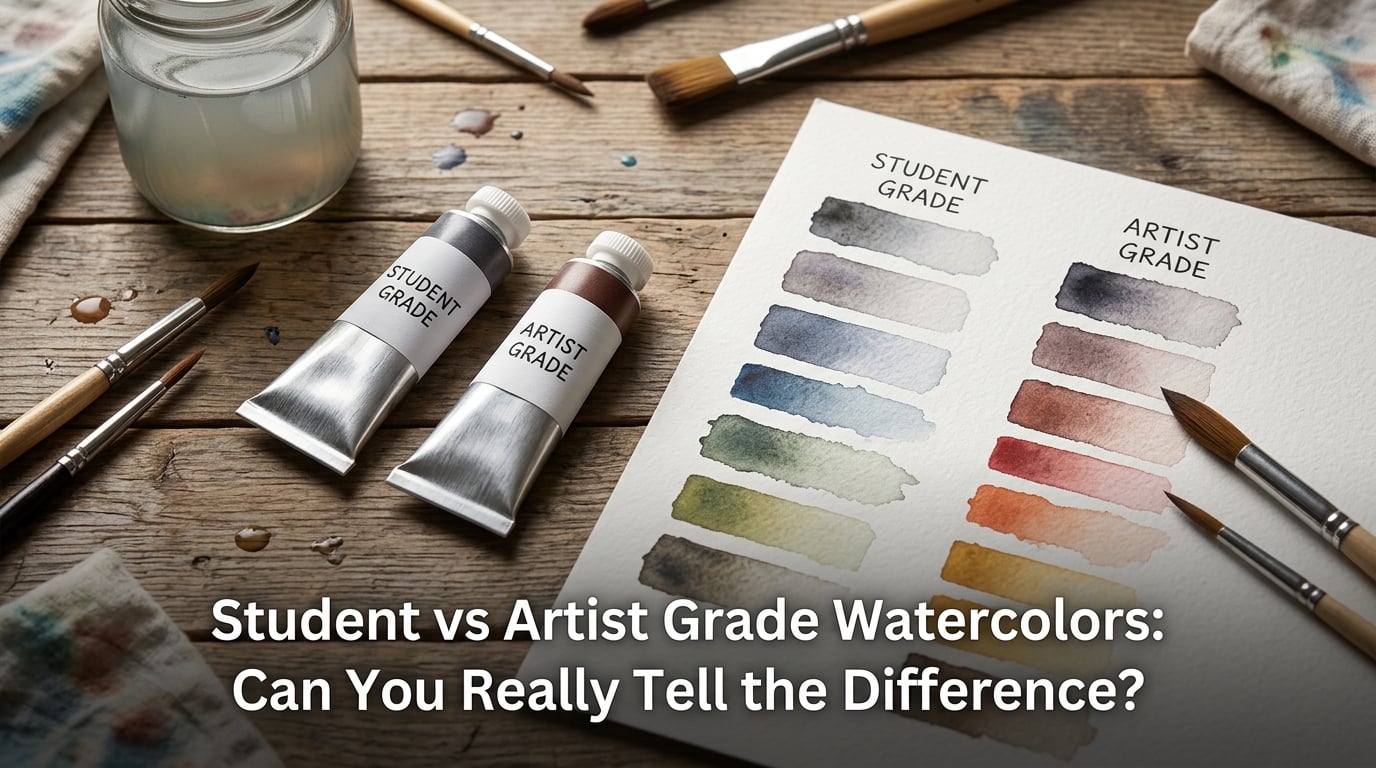
Yes, you can tell the difference between student vs artist grade watercolors—but whether that difference matters depends entirely on what you’re trying to achieve. After testing dozens of paints across both grades over the past year, I’ve found the gap between them is real but often misunderstood. The pigment concentration in artist grade delivers more intense color with fewer layers. The lightfastness ratings protect your work for decades instead of years. But here’s what surprised me: student grade isn’t “bad” paint. It’s engineered differently for different purposes, and knowing when to use each grade will save you money and frustration.
This guide breaks down the real differences, shows you practical tests you can try at home, and helps you decide which grade fits your current needs. I’ll also debunk some persistent myths that keep beginners from making confident choices. By the end, you’ll know exactly when student grade is the smarter buy and when artist grade is genuinely worth the investment.
Table of Contents
- What Are Watercolor Paint Grades?
- Student vs Artist Grade Watercolors: The Key Differences
- Can You Really Tell the Difference? Putting Grades to the Test
- When Student Grade Watercolors Are Actually the Better Choice
- When Artist Grade Watercolors Are Worth the Investment
- Brand Recommendations by Grade
- Common Myths About Watercolor Grades Debunked
- Frequently Asked Questions
- Conclusion
What Are Watercolor Paint Grades?
Watercolor paint grades classify paints by their pigment quality, concentration, and intended use. The two main categories you’ll encounter are student grade and artist grade (also called professional grade). Each serves a different purpose, and understanding their definitions helps you choose wisely.
Student grade watercolors contain less pigment and more fillers than artist grade, making them more affordable for beginners and high-volume practice. Manufacturers design these paints to be cost-effective while still delivering reasonable color. The trade-off comes in vibrancy, lightfastness, and mixing behavior—but that doesn’t mean they’re poor quality. Many student grade lines from reputable brands perform well for learning and casual work.
Artist grade watercolors use pure, high-quality pigments at higher concentrations with minimal fillers. These paints deliver maximum color intensity, superior lightfastness, and cleaner mixing properties. Professional artists creating saleable or exhibition work typically choose this grade. The higher cost reflects the quality of raw materials and the archival nature of the finished work.
You might also see classroom grade paints marketed toward schools and young children. These contain even less pigment and more filler than student grade, with a focus on washability and safety over color quality. I won’t cover classroom grade in depth here since it falls below what most hobbyists and aspiring artists need.
Student vs Artist Grade Watercolors: The Key Differences
The differences between student vs artist grade watercolors come down to four main factors: pigment concentration, fillers and additives, lightfastness, and overall paint behavior. Each factor affects how your paintings look and how long they last. Let’s examine each one in detail.
Pigment Concentration: The Core Difference
Pigment concentration determines how much color your paint delivers per brushstroke. Artist grade watercolors typically contain 25-50% more pigment by weight than comparable student grade colors. This means you get richer, more intense color from a single wash when using artist grade.
With student grade, you’ll often need two or three layers to achieve the same depth of color. That extra layering takes time and can lead to overworking your paper. I’ve noticed this most clearly with deep colors like Ultramarine and Alizarin Crimson—the artist grade versions deliver in one wash what student grade needs multiple passes to build.
The concentration difference also affects mixing. Artist grade paints mix more cleanly because the pigments are purer. Student grade mixes can turn muddy faster, especially when combining three or more colors. This matters most for complex color mixing in landscapes and portraits.
Fillers and Additives: What’s Actually in Your Paint
Student grade watercolors use fillers to extend the pigment and reduce cost. Common fillers include kaolin (a type of clay), chalk, dextrin, and glycerine. These additives bulk up the paint volume without adding color. The result is a less concentrated paint that requires more product to achieve the same effect.
Fillers aren’t inherently bad—they serve a purpose. They make student grade paints more affordable and often easier to rewet from dry pans. Some artists actually prefer the slightly softer feel of certain student grade paints for specific techniques. But fillers do change how the paint behaves.
Artist grade watercolors minimize or eliminate fillers, using just pigment and binder (usually gum arabic). This purity gives you more control over color intensity and transparency. You can always add water to thin the paint, but you can’t add pigment that isn’t there. The filler-free formula also means each tube or pan lasts longer in practical use—less paint delivers more color.
Lightfastness and Longevity
Lightfastness measures how well a color resists fading when exposed to light over time. Artist grade watercolors typically use more lightfast pigments and rate their colors using the ASTM or Blue Wool scale. Many student grade colors use less stable pigments or pigment mixes that fade faster.
This difference matters most for artwork you want to display, sell, or pass down. A student grade painting displayed in direct sunlight might show noticeable fading within a few years. An artist grade painting using the same subject could last decades without visible change.
Not all student grade colors fade quickly—blues and earth tones tend to be more stable. Reds, purples, and some yellows are most vulnerable. Check the lightfastness rating on the paint tube or manufacturer’s website if longevity matters for your work. Many brands now include this information even for student grade lines.
Transparency, Staining, and Granulation
Artist grade watercolors offer more predictable transparency ratings and granulating behavior. Transparency tells you how much the paint will show underlying layers—critical for glazing techniques. Staining colors sink into the paper fibers and resist lifting, while non-staining colors sit on the surface and lift easily.
Granulation creates texture as the pigment particles settle unevenly in the paper texture. Some pigments naturally granulate (like Ultramarine), while others remain smooth. Artist grade paints tend to show granulation more clearly because the purer pigment particles behave more consistently.
Student grade paints may behave less predictably because fillers can interfere with these properties. The transparency might be different than expected, or granulation might not appear at all. For most learning situations, this inconsistency isn’t a dealbreaker. But if you’re developing specific techniques that rely on these properties, artist grade gives you more control.
Can You Really Tell the Difference? Putting Grades to the Test
Yes, you can see the difference between student vs artist grade watercolors—but the visibility depends on your technique, paper quality, and the specific colors you compare. Here are practical tests you can try yourself.
The Single-Wash Test
Paint a single graded wash of the same color from each grade on the same paper. Artist grade will typically show more intensity at the dark end and a more vibrant glow in the mid-tones. Student grade often appears slightly washed out or chalky, especially with transparent colors like Phthalo Blue.
The difference jumps out most with staining colors like Phthalo or Quinacridone pigments. These colors show their full intensity in artist grade but look muted in student grade. With earth tones and granulating colors, the gap narrows considerably.
The Layering Test
Paint three identical subjects—one with student grade, one with artist grade, and one where you try to match the artist grade result using extra layers of student grade. You’ll likely find that student grade can approach artist grade intensity with enough layers, but the process takes longer and risks overworking the paper.
I tested this with a simple landscape and found the student grade version needed about 40% more layers to match the artist grade’s depth. The extra work wasn’t impossible—just more time-consuming and harder on the paper.
The Mixing Test
Mix the same secondary colors from primary tubes in both grades. Artist grade mixes tend to stay cleaner and more vibrant. Student grade mixes can turn muddy faster, especially when mixing three or more colors.
The difference shows most clearly when mixing complements to create grays or neutrals. Artist grade produces cleaner, more interesting neutrals. Student grade neutrals can look flat or chalky because fillers interfere with the pigment interactions.
The Paper Factor
Here’s what many guides miss: paper quality often matters more than paint grade for visible results. I’ve painted identical washes with student grade paint on quality cotton paper and with artist grade paint on cheap cellulose paper. The student grade on good paper looked better every time.
Good paper (100% cotton, at least 300gsm/140lb weight) handles water better, accepts more layers, and lets the pigment sit on the surface rather than absorbing into pulp. If you’re choosing where to invest your budget, quality paper before artist grade paint gives you more visible improvement.
When Student Grade Watercolors Are Actually the Better Choice
Student grade watercolors aren’t a compromise—they’re often the right tool for specific situations. Here’s when they make more sense than artist grade.
Learning and Practice
When you’re learning watercolor techniques, you need to make mistakes. Lots of them. Student grade lets you practice washes, color mixing, and brush control without the guilt of “wasting” expensive paint. I recommend learning entirely with student grade until you’ve built consistent fundamental skills.
The money you save on paint can go toward better paper, which actually does accelerate your learning. You’ll also paint more freely when you’re not mentally calculating the cost of each brushstroke.
High-Volume Work
Sketchbooks, travel journals, and quick studies consume paint rapidly. If you’re filling a sketchbook page a day, artist grade becomes expensive fast. Student grade handles this volume beautifully while keeping costs manageable.
Many professional artists keep student grade sets specifically for sketchbook work. The slightly lower intensity rarely matters for small-scale studies, and the forgiving nature of student grade paints suits experimental mark-making.
When You Don’t Need Archival Quality
Not every painting needs to last 100 years. Greeting cards, practice sheets, color tests, and playful experiments all work fine with student grade. If the work won’t be displayed long-term or sold, there’s no practical reason to use artist grade.
I use student grade for color mixing charts, technique experiments, and warmup paintings. These pieces teach me something valuable but don’t need to survive decades of light exposure.
Travel and Outdoor Painting
Student grade pans rewet more easily than some artist grade paints, making them practical for field work. The lower cost also reduces anxiety about loss or damage. Many plein air painters carry a compact student grade set for exactly these reasons.
The slightly reduced vibrancy often doesn’t matter outdoors, where natural light makes even muted colors pop. And if you drop your palette in a stream, you’re out less money.
When Artist Grade Watercolors Are Worth the Investment
Artist grade watercolors justify their cost when quality, longevity, or specific professional requirements come into play. Here’s when upgrading makes sense.
Creating Saleable or Exhibition Work
If you sell your paintings or show them in galleries, artist grade becomes essential. Buyers expect archival quality, and galleries often require it. Using lightfast pigments protects your reputation—nothing damages an artist’s credibility faster than a collector’s painting fading within a few years.
Exhibition standards also favor artist grade for color consistency and mixing reliability. The predictable behavior of professional paints reduces surprises during critical pieces.
Archival Quality for Heirloom Pieces
Paintings you want to pass down to family or keep for decades should use artist grade. The investment in archival materials protects the emotional value of the work. Portraits of loved ones, significant life events, and meaningful landscapes deserve the longevity that professional pigments provide.
Specific Colors That Shine in Artist Grade
Certain colors show dramatic differences between grades. Transparent staining colors like Phthalo Blue and Quinacridone Rose deliver vastly more intensity in artist grade. Granulating colors like Ultramarine and French Ochre show their beautiful texturing effects more clearly without fillers flattening the pigment behavior.
If you work with glazing techniques, artist grade transparency ratings become essential. The predictable layering behavior lets you build luminous depth that student grade struggles to match.
Signs You’re Ready to Upgrade
Consider upgrading when you consistently feel limited by your current paints rather than your skills. Signs include: frequently needing multiple layers to achieve the intensity you want, experiencing frustration with muddy mixes, feeling like your colors lack the vibrancy you envision, or starting to sell work regularly.
Another sign: you’ve stopped thinking about technique and started thinking about color. When your brushwork becomes automatic, better paint lets you push your color work further.
Brand Recommendations by Grade
Not all brands within each grade perform equally. Here are reliable options for student and artist grade watercolors.
Top Student Grade Brands
Winsor & Newton Cotman offers excellent quality for a student grade line, with good pigment load and reliable lightfastness in many colors. The colors rewet easily from pans, making them practical for travel sets and beginners building fundamental skills.
Daniel Smith Essentials student line brings the company’s reputation for quality to a more accessible price point. The pigment information remains transparent even at this grade, helping you make informed choices.
Van Gogh watercolors from Royal Talens straddle the line between student and artist grade. They contain more pigment than typical student paints and offer good lightfastness for the price. Many artists use Van Gogh as a stepping stone between true student and professional grades.
Top Artist Grade Brands
Daniel Smith makes some of the most distinctive watercolors available, with unique colors like Moonglow and Shadow Violet that behave beautifully. Their pigment information is thorough and honest.
Winsor & Newton Professional offers reliable, consistent colors with excellent lightfastness. The range includes many single-pigment colors for clean mixing.
M. Graham produces honey-based watercolors that rewet beautifully in palettes. The binder gives a slightly different feel that some artists prefer for its softness and flow.
Holbein and Schmincke both offer excellent quality with distinct handling characteristics. Holbein uses no ox gall, producing a smoother flow, while Schmincke’s traditional formula includes it for specific brush behavior.
Building a Hybrid Palette
You don’t have to choose all one grade. Many experienced painters use artist grade for key colors that matter most (usually the expensive, transparent, staining pigments) and student grade for colors that matter less (earth tones, opaque colors, and colors you use in large quantities for washes).
This hybrid approach stretches your budget while giving you the quality where it counts. Start by upgrading one or two colors you use constantly, then expand as your work develops.
Common Myths About Watercolor Grades Debunked
Several persistent myths about watercolor grades cause confusion and anxiety for beginners. Let’s clear them up.
Myth: Artist Grade Will Instantly Improve Your Paintings
Better paint doesn’t fix fundamental technique problems. If your washes are uneven, your color mixing muddy, or your brush control inconsistent, artist grade won’t help. These skills develop through practice, and student grade serves that practice perfectly well. Upgrading paint before upgrading skills is like buying a better tennis racket to fix a weak backhand.
I’ve seen beginners switch to artist grade and feel disappointed when their paintings didn’t transform. The paint matters, but it’s one factor among many.
Myth: Student Grade Is “Bad” Paint
Student grade watercolors from reputable brands are real watercolor paint—not “fake” or “garbage.” They contain actual pigments and real gum arabic binder, just at different ratios. Many professional artists started with student grade and still use it for specific purposes.
The difference is engineering for different uses, not quality tiers like “good” and “bad.” Student grade costs less because it contains less pigment and more extender, not because it’s defective.
Myth: You Can’t Mix Student and Artist Grade
You absolutely can mix different grades in the same painting. The pigments don’t know or care which tube they came from. What changes is predictability: mixing grades means you can’t rely on consistent behavior across your palette.
For learning and practice, mixing grades works fine. For professional work requiring archival quality, mixing grades complicates your lightfastness guarantees—but it won’t cause any chemical disasters.
Myth: All Professional Artists Use Only Artist Grade
Many professional artists use student grade for specific purposes: sketchbooks, teaching demonstrations, quick studies, and experimental work. The idea that “real” artists only use professional materials is marketing, not reality.
Smart professionals choose materials based on the specific project, not on status signaling. A teaching artist might use Cotman in class for its predictable behavior and cost, then Daniel Smith for gallery work.
Myth: Student Grade Always Fades Quickly
Lightfastness varies by pigment, not just by grade. A student grade Ultramarine (one of the most stable pigments) will outlast an artist grade Alizarin Crimson (notoriously fugitive). The grade gives you averages and expectations, but individual pigment chemistry matters more.
Check the specific lightfastness ratings for each color you use. Many student grade lines now include this information on tubes and manufacturer websites.
Frequently Asked Questions
What is the difference between student watercolor paint and artist watercolor paint?
Student grade watercolors contain less pigment and more fillers than artist grade, making them more affordable but requiring more layers for the same color intensity. Artist grade uses pure pigments at higher concentrations for superior vibrancy, cleaner mixing, and better lightfastness.
What is the best student grade watercolor paint?
Winsor u0026amp; Newton Cotman, Daniel Smith Essentials, and Van Gogh watercolors rank among the best student grade options. Cotman offers reliable performance and easy rewetting, Daniel Smith provides transparent pigment information, and Van Gogh delivers higher pigment load than typical student paints.
Are Van Gogh watercolors artist grade?
Van Gogh watercolors from Royal Talens occupy a middle position between traditional student and artist grades. They contain more pigment than typical student paints but less than full artist grade. Many artists consider them a bridge grade that offers good quality at a moderate price.
Can you mix student and artist grade watercolors?
Yes, you can mix student and artist grade watercolors in the same painting without any chemical problems. The pigments blend normally. Keep in mind that mixing grades means your overall lightfastness will vary by color, so check individual pigment ratings for archival work.
Do student grade watercolors fade faster?
Some student grade colors fade faster than artist grade equivalents, but not all. Lightfastness depends on the specific pigment, not just the grade. Blues and earth tones tend to be stable in both grades, while reds, purples, and some yellows are more vulnerable. Check individual lightfastness ratings for colors that matter.
Conclusion
The difference between student vs artist grade watercolors is real and visible—but it’s also situational. Student grade paints serve beginners, practice work, and high-volume use beautifully. Artist grade delivers the vibrancy, lightfastness, and consistency that professional and archival work demands. Neither is inherently better; they’re tools for different jobs.
My recommendation for 2026: start with quality student grade paints from a reputable brand, invest in good paper, and focus on building fundamental skills. Upgrade to artist grade when your work consistently outperforms your materials—not when marketing tells you to. The right paint at the right time makes all the difference.
Experiment with both grades. Run your own side-by-side tests. Notice where the differences matter for your specific style and subjects. That hands-on knowledge will serve you better than any guide, including this one. Your paintings will tell you when it’s time to upgrade.