
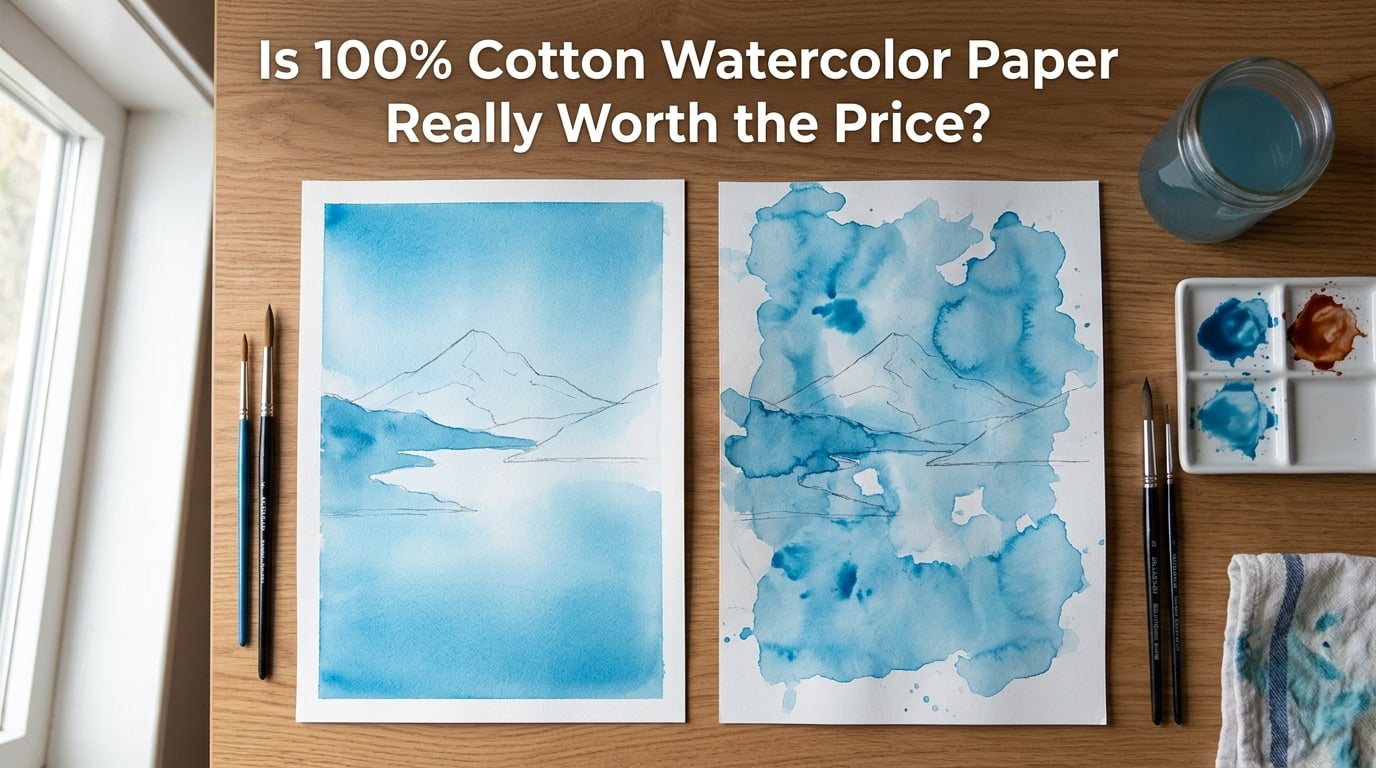
Is 100% cotton watercolor paper really worth the price? After two years of painting on both cotton and cellulose papers, I can give you a direct answer: cotton paper is worth it for finished artwork, but it is a waste of money for daily practice. The real question is not “is cotton better?” It clearly is. The real question is “is the upgrade justified for what I am painting this week?”
I have spent hundreds of sheets on both sides of this debate. I have ruined expensive cotton paper with sloppy washes and I have rescued bad paintings on cheap cellulose with careful lifting. In this guide I will walk you through the fiber science, the real cost per painting, the texture choices, and the exact scenarios where cotton paper pays for itself versus when it is a waste of your money.
Table of Contents
- Quick Answer: Is 100% Cotton Watercolor Paper Worth the Price?
- What Makes 100% Cotton Watercolor Paper Different
- Cotton vs Cellulose Watercolor Paper: The Honest Comparison
- Paper Weight and GSM: Why 300 GSM Is the Magic Number
- Cold Press, Hot Press, and Rough: How Texture Changes Your Painting
- Cotton Paper Cost: The Real Cost Per Painting Math
- When 100% Cotton Paper IS Worth the Price
- When 100% Cotton Paper Is NOT Worth the Price
- Beginner Anxiety: How to Stop Wasting Expensive Paper
- How to Test Any Watercolor Paper in 5 Minutes
- Buying Guide: Student, Mid-Range, and Premium Cotton
- Frequently Asked Questions
- What is the difference between cellulose and cotton watercolor paper?
- Is 100% cotton good for watercolor?
- Why is cotton watercolor paper so expensive?
- What is the best watercolor paper for value?
- Can beginners use cotton watercolor paper?
- Does cotton watercolor paper really make a difference?
- When should I upgrade to cotton watercolor paper?
- Final Verdict: Should You Pay More for Cotton Paper?
Quick Answer: Is 100% Cotton Watercolor Paper Worth the Price?
Yes for finished pieces, no for practice. 100% cotton watercolor paper is worth the price when you are painting work you plan to keep, sell, or gift. It is not worth it when you are learning washes, testing color mixes, or filling a sketchbook with daily studies.
Here is the short version:
- Cotton paper absorbs water more evenly, stays wet longer, and resists warping.
- Cellulose (wood pulp) paper is cheaper and perfectly fine for practice and learning.
- You save more by reserving cotton for finished pieces than by buying cheap paper for everything.
- Premium cotton paper makes a real difference only if your technique already supports it.
If you paint mostly to learn, stick with cellulose. If you paint to finish, save for cotton.
What Makes 100% Cotton Watercolor Paper Different
Cotton watercolor paper is made from cotton fibers, not wood pulp. Most premium papers use cotton linters, the short fibers left over from the textile industry, blended into a slurry and formed into sheets on a cylinder mold. The result is a paper with longer, stronger fibers than cellulose.
Longer fibers mean the paper can be wet, scrubbed, lifted, and re-wet without falling apart. Cellulose fibers are shorter and weaker. When you soak them, they swell and pill. When you scrub them, they fuzz up. Cotton fibers just bend and recover.
The second big difference is absorbency. Cotton paper drinks water slowly and evenly. Cellulose paper drinks it fast and unevenly. That is why your washes look luminous on cotton and chalky on cheap paper. The pigment stays suspended in the water film on top, then settles smoothly as the paper dries.
Cotton paper also holds more water before buckling. A 300 gsm cotton sheet can take a fully flooded wash with little warping. A 300 gsm cellulose sheet will buckle badly with the same amount of water. That extra absorbency gives you longer working time, which matters most for wet-on-wet techniques, soft edges, and large gradients.
Cotton vs Cellulose Watercolor Paper: The Honest Comparison
Cellulose paper is not bad paper. It is just a different tool, designed for practice, sketching, and learning. Let me put them side by side.
| Feature | 100% Cotton | Cellulose (Wood Pulp) |
|---|---|---|
| Absorbency | Slow, even | Fast, uneven |
| Working time | Long | Short |
| Lifting and corrections | Excellent | Limited, causes pilling |
| Warping resistance | High at 300 gsm | Low, even at 300 gsm |
| Color vibrancy | Luminous | Chalky, dull |
| Archival quality | 50+ years, acid-free | 5-15 years before yellowing |
| Scrubbing resistance | Excellent | Surface damage |
| Cost per sheet | High | Low |
| Best use | Finished artwork | Practice and study |
Cotton wins clearly on absorbency, lifting, color vibrancy, and archival life. Cellulose wins on price, and that is its only real advantage. If you are learning washes, mixing colors, or filling a sketchbook, cellulose paper is the rational choice.
The mistake I see most often is beginners using cellulose paper, getting frustrated when washes bloom or lift fails, then blaming their technique. Often the paper is the problem, not the painter. If you switch to cotton for that same exercise, your technique will suddenly look much better.
Paper Weight and GSM: Why 300 GSM Is the Magic Number
Paper weight in watercolor is measured two ways: pounds (lb) in North America and grams per square meter (gsm) elsewhere. They are not the same number. 140 lb cold press equals 300 gsm. 300 lb equals 600 gsm. The higher the number, the thicker and more absorbent the paper.
For most painting, 300 gsm (140 lb) is the standard. It holds enough water for serious washes without buckling too badly, and it is the most common weight sold in pads and blocks.
Lighter paper, around 200 gsm (90 lb), is fine for sketchbook work, dry brush studies, and quick studies. You will get warping if you flood it, so stretch it or accept the wrinkles.
Heavier paper, 600 gsm (300 lb), is for professional gallery work, large washes, and any painting you do not want to stretch. It is heavy to mail and expensive, but it takes abuse that would destroy lighter sheets.
If you only buy one weight, buy 300 gsm. It is the workhorse of watercolor.
Cold Press, Hot Press, and Rough: How Texture Changes Your Painting
Texture is the surface tooth of the paper. Each texture changes how your brush behaves and how your paint settles.
Cold press has a medium tooth. It is the most popular texture because it handles most techniques well. Washes look slightly broken, granulation shows up, and lifting is forgiving. Beginners should start with cold press.
Hot press is smooth. It is best for detail work, illustration, botanical painting, and tight controlled washes. Granulation disappears, edges stay crisp, and lifting is harder because pigment sits on the surface. Use hot press when you want precision.
Rough has heavy tooth. Pigment pools in the valleys and skips over the peaks. Granulation is dramatic, edges are naturally broken, and the paper has a textured look even without paint. Rough is for expressive work, textured skies, and granulating pigments.
Most artists own cold press as their default, then add hot press or rough for specific needs. If you only buy one texture, buy cold press.
Cotton Paper Cost: The Real Cost Per Painting Math
Let me do the math that most articles skip. Premium 100% cotton paper runs about 4 to 6 times the cost of cellulose paper per sheet. That sounds steep until you divide by what the sheet actually does.
A 300 gsm cotton sheet, 22 by 30 inches, gives you four to six quarter-sheet paintings depending on how you crop. If each finished painting sells or stays in your portfolio, the cost per painting is small. The cost per hour of painting is even smaller.
Now compare that to cellulose practice paper at one third the price. If you use that practice paper for daily studies and only paint finished work on cotton, you spend less overall than an artist who paints everything on cotton, and your finished pieces look better.
Here is a real-world example from my studio. I paint about 20 practice sheets a month on cellulose. I finish about 4 paintings a month on cotton. The cellulose cost is low. The cotton cost, divided across 4 paintings, is modest per piece. If I had painted everything on cotton, I would have spent more than triple, with no improvement in finished work.
The math works out the same for students, hobbyists, and working artists. The trick is not buying more cotton paper. It is buying less, used well.
When 100% Cotton Paper IS Worth the Price
Cotton paper is worth it when you are painting work that will be kept, sold, gifted, or displayed. The upgrade pays off in five specific situations.
- Finished pieces for sale or commission. Cotton paper gives you the lifting, the vibrancy, and the archival life a buyer expects.
- Portraits and people. Soft skin tones and layered washes need even absorbency. Cellulose causes blotchy skin.
- Wet-on-wet techniques. Large washes, gradients, and blooms need working time cotton provides.
- Lifting and corrections. If you scrub, blot, or rework, cotton survives. Cellulose pills and tears.
- Gift paintings and heirlooms. Acid-free cotton keeps its color for decades. Cellulose yellows in a few years.
If your painting matches any of these, cotton paper is the right tool.
When 100% Cotton Paper Is NOT Worth the Price
Cotton paper is a waste of money when the painting is throwaway, practice, or learning. The upgrade does not help, and in some cases it hurts because beginners fear wasting it.
- Daily practice sheets. You will throw these away. Use cellulose.
- Learning new techniques. Wet-on-wet tests, color swatches, brush drills. Use cheap paper so the cost of failure is zero.
- Sketchbook journaling. Daily pages and travel sketches. Lightweight cellulose is fine.
- Color mixing studies. Mixing charts and pigment tests. Cellulose handles this perfectly.
If you are still building fundamental skills, save your cotton money for the day you finish a piece worth keeping. That day comes faster than you think, and you will be glad you waited.
Beginner Anxiety: How to Stop Wasting Expensive Paper
The biggest hidden cost of cotton paper is not the price. It is the psychological pressure. Beginners often buy a sheet of expensive cotton, paint nervously, and ruin it because they were too cautious to commit to the brushstroke.
I have seen this dozens of times on watercolor forums. New artists buy Arches or Fabriano Artistico, then freeze up because the paper feels too valuable to waste. They paint tiny, hesitant strokes on a sheet that deserves bold work.
The fix is a hybrid strategy. Use cellulose paper for the first 20 to 30 paintings. Learn washes, learn lifting, learn your brush on cheap sheets. By the time you switch to cotton, your hand is steady and your judgment is sound. You will paint better on cotton paper because you earned the confidence to use it.
Another trick: cut your cotton sheets into quarters. A quarter sheet costs less per painting, takes the pressure off, and gives you four chances to paint boldly instead of one nervous attempt.
How to Test Any Watercolor Paper in 5 Minutes
Before you commit to a paper, run five quick tests. These work for cotton, cellulose, and blends, and they take about 5 minutes total.
- Wet finger test. Press a wet finger into the paper for 10 seconds. Cotton absorbs slowly. Cellulose absorbs almost instantly.
- Wash test. Paint a single thin wash across a test sheet. Cotton dries evenly. Cellulose dries in blotchy patches.
- Lift test. Lay down a dark color, let it dry, then scrub with clean water. Cotton releases the pigment. Cellulose pills.
- Scrub test. Rub the paper firmly with a damp brush. Cotton survives. Cellulose fuzzes up.
- Fold test. Fold a corner hard. Cotton creases cleanly. Cellulose cracks and breaks.
These five tests tell you almost everything about how a paper will behave in real painting. Run them on any paper you consider buying, especially new brands.
Buying Guide: Student, Mid-Range, and Premium Cotton
You do not have to buy premium cotton to start. There is a smart progression from cellulose to cotton, and each tier has its place.
Student grade cellulose. This is your learning paper. Canson XL, Strathmore 400, and similar pads are cheap, available everywhere, and forgiving enough for daily practice. Use this for your first 30 to 50 paintings.
Mid-range cotton blends. Papers like Fabriano 5 or mixed rag options give you some cotton benefit at a lower cost. They handle wet-on-wet better than cellulose, lift modestly, and give you a feel for cotton behavior without the premium price.
Premium 100% cotton. Arches, Fabriano Artistico, Saunders Waterford, and Hahnemuhle are the standard. Buy these when you are painting work you want to keep, sell, or gift. The upgrade is real and worth it for finished pieces.
The mistake is jumping to premium cotton too early. Beginners who start on premium paper often paint less because they fear wasting it. Start on cellulose, move to mid-range blends, then graduate to premium cotton. You will paint more, learn faster, and spend less in the long run.
Frequently Asked Questions
What is the difference between cellulose and cotton watercolor paper?
Cellulose paper is made from wood pulp. Cotton paper is made from cotton fibers. Cotton fibers are longer and stronger, which makes cotton paper absorb water more evenly, resist warping, allow lifting and scrubbing, and last longer as archival material. Cellulose paper is cheaper and works well for practice and study.
Is 100% cotton good for watercolor?
Yes. 100% cotton is the highest grade of watercolor paper. It produces more vibrant washes, allows wet-on-wet techniques, lifts pigment cleanly, and resists damage from repeated corrections. It is the standard for finished artwork, gallery pieces, and any painting you want to keep long-term.
Why is cotton watercolor paper so expensive?
Cotton fibers cost more than wood pulp, and the manufacturing process is slower. Premium cotton paper is made on cylinder molds using traditional methods, with gelatin sizing for archival quality. The result is a paper that costs more per sheet but lasts decades longer.
What is the best watercolor paper for value?
For value, buy mid-range cotton blends like Fabriano 5 for finished study work, and use cheap cellulose like Canson XL for daily practice. This combination costs less than buying premium cotton for everything and gives you the right tool for each job.
Can beginners use cotton watercolor paper?
Yes, but it is better to learn fundamentals on cellulose first. Beginners often feel anxious about wasting expensive cotton paper, which leads to hesitant painting. Practice washes, lifting, and brush control on cheap paper, then move to cotton once your hand is steady.
Does cotton watercolor paper really make a difference?
Yes, especially for lifting, color vibrancy, warping resistance, and archival life. The difference is most noticeable in wet-on-wet washes, layered paintings, and corrections. For simple flat washes and quick studies, cellulose performs adequately.
When should I upgrade to cotton watercolor paper?
Upgrade when you start painting work you plan to keep, sell, or gift. A good rule is after 30 to 50 practice paintings on cellulose, or whenever you finish a piece you want to preserve long-term. Many artists keep cellulose for practice and cotton for finished work.
Final Verdict: Should You Pay More for Cotton Paper?
Is 100% cotton watercolor paper really worth the price in 2026? Yes, but only for the right paintings. Cotton paper is worth it for finished artwork, gifts, portraits, wet-on-wet washes, and any piece you want to keep for decades. It is not worth it for daily practice, learning new techniques, or sketchbook pages.
The smart approach is a hybrid: cheap cellulose for learning and practice, premium cotton for finished work. You will spend less overall, paint more confidently, and your finished pieces will look better because the paper supports your technique.
Start with what you can afford, paint often, and upgrade when your work demands it. That is the honest answer.