
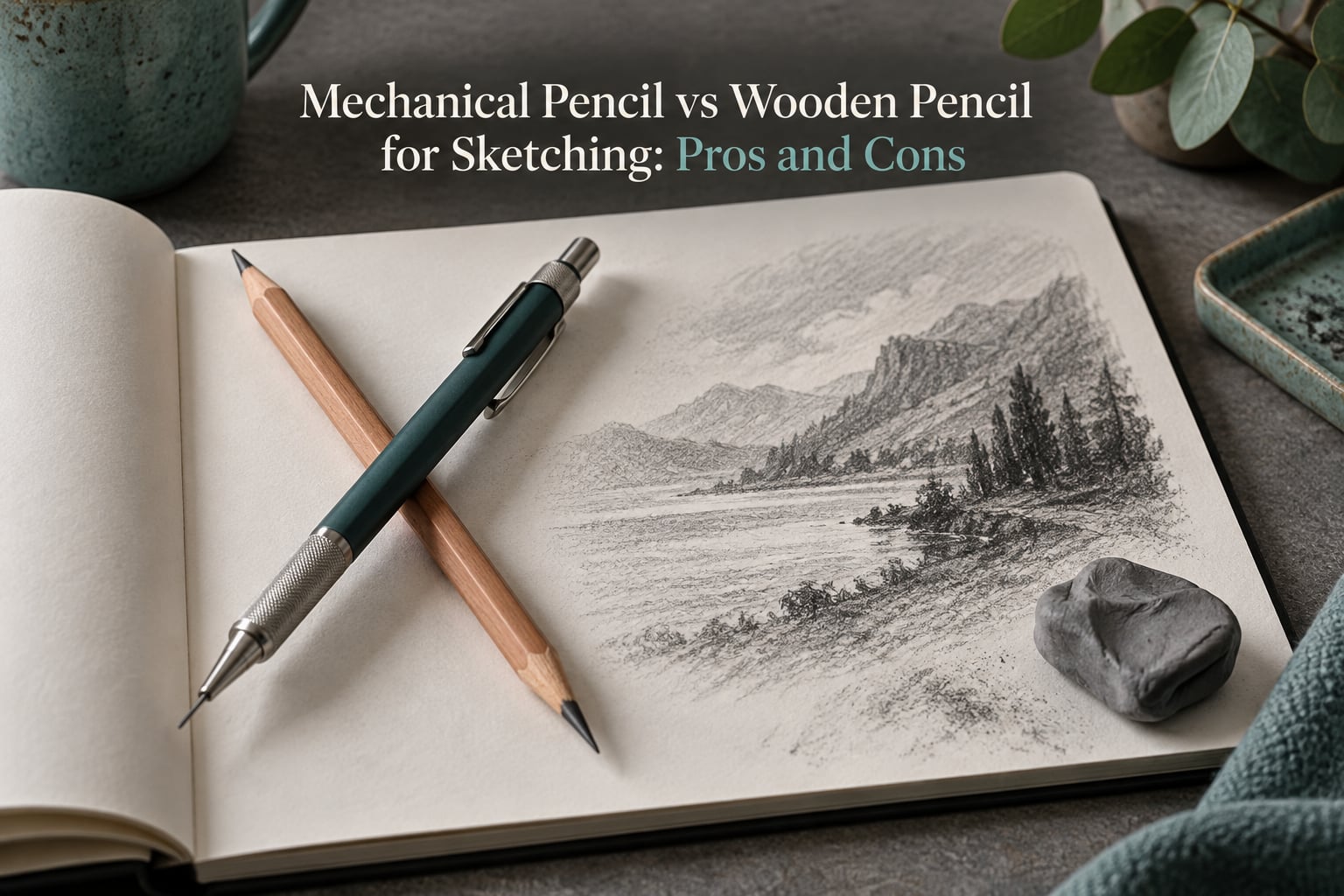
A wooden pencil is the better sketching tool when you need tonal range, shading and pressure-varied line weight, while a mechanical pencil is the better sketching tool when you need a consistent line, no sharpening, and a pencil that survives a notebook bag. The best answer for most artists is to use both in the same drawing.
That is the mechanical pencil vs wooden pencil for sketching question in one line, and the rest of this guide unpacks why. We have drawn with both for years, compared them on the same paper, and read through what sketchers actually complain about in forums. The trade-off is real, but it is narrower than most product pages make it sound.
Both pencils mark paper with exactly the same material. Neither contains lead. More on that in a moment, because the myth causes real confusion about what the two pencils can physically do.
Table of Contents
- Mechanical Pencil vs Wooden Pencil for Sketching at a Glance
- What Is the Difference Between a Mechanical and a Wooden Pencil?
- Wooden Pencils for Sketching: Pros and Cons
- Mechanical Pencils for Sketching: Pros and Cons
- The Real Difference Artists Care About: Tonal Range and Pressure Control
- Lead Holders and Woodless Graphite: The Third Option
- Which Is Better for Common Sketching Situations?
- Sharpening, Erasing and Smudging Practicalities
- Cost Comparison Over Time
- Environmental Impact: Which Pencil Is Greener?
- How to Choose: A Decision Checklist by Artist Type
- Frequently Asked Questions
- What type of pencil is best for sketching?
- Is a 0.5 or 0.7 mechanical pencil better for drawing?
- Why does my mechanical pencil keep breaking lead?
- Can you shade with a mechanical pencil?
- Are mechanical pencils better for the environment than wooden pencils?
- Why do Japanese students use mechanical pencils?
- Conclusion: The Two-Pencil Setup
Mechanical Pencil vs Wooden Pencil for Sketching at a Glance
This table is the fastest way to see where each pencil wins. Read the tonal range row twice, because it is the single biggest practical difference between the two.
| Attribute | Wooden pencil | Mechanical pencil |
|---|---|---|
| Line consistency | Varies naturally as the point wears | Constant width from first stroke to last |
| Sharpening | Required every few minutes | Never, though the point dulls over time |
| Tonal range in one tool | Very wide, from 9H through 8B | Limited, one grade at a time |
| Pressure tolerance | Handles heavy pressure on soft grades | Thin lead snaps under heavy pressure |
| Darkness available | Up to 8B on soft woodcase grades | Practically up to 4B in most refills |
| Lead breakage | Rare | Common if the tip is extended too far |
| Best for | Shading, values, texture, life drawing | Line work, notes, drafting, sketching on the move |
| Worst for | Fast note-taking, travelling without tools | Broad tonal shading in a single pencil |
| Disposable parts | Wood and graphite, both biodegradable | Plastic body, refill tubes |
| Stakes on a sketch | Low, it is easy to replace | Higher, it is your main instrument |
My own rule after a few years of testing: if the sketch needs shadows, use a wooden pencil. If the sketch needs precision, use a mechanical one.
What Is the Difference Between a Mechanical and a Wooden Pencil?
A wooden pencil is a stick of graphite, glued into a cedar or similar wood casing, with the point sharpened back to reveal the core. A mechanical pencil is a plastic or metal tube holding a thin replaceable graphite refill that a click or twist mechanism pushes forward.
Neither pencil contains lead. The core is a mixture of graphite and clay, and it is the clay content that sets the hardness. Harder grades carry more clay and mark faintly, softer grades carry less clay and mark darkly. The word lead is a leftover from a time when writers genuinely drew with the metal, and it is still used loosely for mechanical refills, which is why you will hear both terms in shops.
What the HB scale actually means
HB sits in the middle of the scale, a standard balance between hardness and softness. Moving toward B, or 2B, 4B, 6B and 8B, gives progressively softer and darker cores. Moving the other way, H, 2H, 4H and up to 9H, gives harder and lighter cores. A 2B is roughly twice as dark as an HB, and an 8B is dark enough to fill large areas of shadow without much pressure.
Mechanical refills are labelled by diameter instead, at 0.3mm, 0.5mm, 0.7mm and 0.9mm, and each is available in a range of the same grades. A 0.5mm HB refill and a woodcase HB do not behave identically, which is a point worth returning to later.
Wooden Pencils for Sketching: Pros and Cons
Pros of wooden pencils for sketching:
- The widest tonal range available in a single pencil, from a faint 9H guideline to a near-black 8B mass
- Line weight changes as the point wears, which gives natural taper and expressive marks for free
- Soft grades absorb heavy pressure, so you can press hard without anything snapping
- Each grade is a fixed, predictable darkness, which makes value planning much easier
- The casings are wood and the cores are graphite and clay, so a discarded pencil is not a persistent plastic problem
- Sharpening is a deliberate, physical part of the drawing rhythm that many artists find meditative
Cons of wooden pencils for sketching:
- You need a sharpener within reach at all times, or your line quality degrades fast
- Short pencils are discarded as stubs, which bothers people who hate waste
- They roll off a sloping desk, vanish down a sofa, and cannot survive a loose bag
- A blunt core dragged across paper creates a fuzzy, thick mark that is not what you meant
- They cannot produce a genuinely hairline, uniform stroke
Which graphite grades to keep for sketching
You do not need a full box of twenty-four. Six or seven grades cover almost all sketching, and a small set of soft grades plus one hard grade does most of the work.
| Grade | What it does | Sketching use |
|---|---|---|
| HB | Mid grey, balanced | Everyday line work, construction lines, notes |
| 2B | Soft dark grey | General line weight, light shading |
| 4B | Dark | Mid-tone masses, hatching, form shadows |
| 6B | Very dark | Deep shadows, filling in blacks |
| 8B | Near black, very soft | Solid dark areas, bold emphasis, charcoal-like work |
| 2H to 4H | Hard, light grey | Light guidelines, construction under-drawings |
| 9H | Very hard, faint | Architectural detail, technical line work |
Mechanical Pencils for Sketching: Pros and Cons
Pros of mechanical pencils for sketching:
- No sharpener, no pencil case, nothing to forget before you start
- A constant line width, which is exactly right for technical, architectural and measured drawing
- Refills are cheap to replace and the body lasts for years
- Works in cold weather, in a car, in a lecture hall and anywhere without a flat surface
- Different thicknesses let you change line weight by swapping a refill rather than a pencil
- Cleaner to handle in a shared or public space because nothing is sharpened away
Cons of mechanical pencils for sketching:
- Thin lead snaps under heavy pressure, which interrupts the drawing exactly when you are committed to a mark
- You get one darkness per refill, so tonal work means repeatedly changing leads
- The line does not taper, so marks can look uniform and lifeless on organic subjects
- The built-in eraser is small and smudges paper, so you will want a separate one
- Losing the tube is a real risk in a bag, and the cap is easy to lose
- Some examination boards and standardised tests restrict or ban mechanical pencils
Is a 0.5 or 0.7 mechanical pencil better for drawing?
Take 0.5mm as the default and 0.7mm if you mostly shade. 0.5mm gives you a line that is thin enough to suggest a hairline and still dark enough to read, and it survives a firm hand far better than 0.3mm. 0.7mm gives a fuller, more graphite-like line and a slightly wider tonal band, but it needs a lighter touch. 0.3mm suits technical line work and fine detail rather than sketching. 0.9mm is a shading tool in all but name.
Users on r/learntodraw report sketching for years on a single 0.5mm mechanical pencil before moving to higher-end bodies, which matches our own experience: the thickness matters far more than the mechanism.
Why does my mechanical pencil keep breaking lead?
Almost always one of three causes. First, too much lead extended from the tip, which is the leading cause and the easiest to fix: let only a few millimetres out, since the lead is weakest where it emerges from the nose. Second, too much clay in the grade, so switch from HB toward B or softer when you need pressure. Third, gripping too close to the tip, which pushes load onto the point instead of the body.
Keep a spare tube in your kit rather than in a drawer. A clear plastic refill case in a pocket fixes most of the frustration people describe in r/mildlyinfuriating and r/PetPeeves, because a snapped point stops being an interruption when the replacement is in your hand.
The Real Difference Artists Care About: Tonal Range and Pressure Control
Everything else on this page is a convenience. This is the artistic difference. A woodcase pencil delivers a thick core whose point grinds into a taper, so the mark starts crisp and softens as you travel. A mechanical pencil delivers a thin core at a fixed width, so the mark never changes on its own. That single physical fact drives almost every artistic preference in the debate.
Pressure control is the other half. Because a mechanical lead is thin, the force needed to produce a dark mark also concentrates on a tiny contact area, and at some point the lead snaps rather than marks. A 6B woodcase pencil has enough material to be pushed hard and still leave a mark. Sketchers in r/learnart who work with thick woodless graphite sticks describe exactly this advantage.
That is also why the same HB does not behave the same way in both pencils. A woodcase HB gives a firm, slightly textured line, while a 0.5mm HB mechanical gives a thin, even one. Neither is wrong, but they are not interchangeable, and choosing by the label alone is how people end up disappointed.
For hatching and cross-hatching, a soft woodcase pencil is better because the strokes overlap softly. For mechanical, use a soft grade and a light hand, and build tone with spacing rather than pressure. Blending is easier with a smudge stick and a wooden pencil, since a mechanical point does not hold a useful amount of graphite to smear.
Lead Holders and Woodless Graphite: The Third Option
If you want the wooden pencil feel without the sharpener, consider a lead holder or propelling pencil. It takes a thicker 2mm chunk of graphite in a metal or wooden tube and gives you pressure and tonal range on a single stick, in a chosen grade. Several users in r/pencils convert short wooden pencils into improvised lead holders rather than binning them, which also solves the stub problem.
The trade-off is the mechanism itself. Lead holders are less precise, the point must still be shaped by hand, and they are fiddly at thin line widths. For life drawing and gesture work they are excellent, and for technical precision they are the wrong tool.
Which Is Better for Common Sketching Situations?
| Situation | Reach for | Why |
|---|---|---|
| Life drawing | Wooden pencil | Broad tonal range matters most when time is short |
| Gesture drawing | Either | Speed rules, so a mechanical wins for quick travel |
| Portrait sketch | Both | Wooden for form shadow, mechanical for the contour |
| Value study | Wooden pencil | Needs several distinct tones |
| Hatching and texture | Wooden pencil | Taper and pressure vary the stroke |
| Outdoor sketching | Mechanical | Nothing to spill, nothing to sharpen on a slope |
| Classroom and exams | Wooden pencil | Several are permitted when mechanical is not |
| Technical and architectural | Mechanical | Constant line width, 0.3mm or 0.5mm |
| Note-taking and journaling | Mechanical | Fast, no debris, refillable |
| Character and concept work | Both | Loose thumbnails in 2B, refined lines in 0.5mm |
The hybrid workflow is the one we recommend most: lay in the structure and values with a wooden pencil, then refine the key edges with a mechanical. Most working artists settle on some version of this without naming it.
Sharpening, Erasing and Smudging Practicalities
Sharpening is a real recurring cost in time. A wooden pencil in active use is worth touching to a sharpener every few minutes, and a poor-quality sharpener will chew the point into an unusable cone. A hand sharpener with a small hole or a blade sharpener preserves the point shape better than a large classroom model.
When a woodcase pencil gets too short to hold, do not bin it. Sharpen it to a longer taper and keep using it, or fit it into a lead holder. That single habit answers most of the waste complaints we read about.
Erasers differ more than most buyers expect. The small eraser cap on a mechanical pencil is often hard vinyl, which smudges and can polish the paper surface. A separate soft vinyl eraser lifts cleanly, and a kneaded eraser picks up graphite without dragging the paper. Smudge sticks and tortillons lift or push tone for blending, which a mechanical tip cannot do usefully.
Smudging also depends on paper tooth, not just the pencil. On smooth hot-press paper, both pencils sit on the surface and wipe away easily. On textured paper, graphite settles into the tooth and a mechanical pencil leaves a brighter, grainier mark than a soft woodcase grade, which fills the texture more fully.
Southpaw sketchers get the same smudging problem twice, because the heel of the hand rests on the drawing surface. Rotate the paper so the working edge stays clear, or use an acetate sheet under your hand, and put a scrap of paper under the palm for graphite work.
Cost Comparison Over Time
Measured purely by what you consume, the comparison is close. A sharpener produces a small amount of waste every few minutes, and a woodcase pencil lasts a reasonable number of drawing sessions before it is too short to use.
A mechanical pencil consumes a tube of lead every few hours in heavy sketching, though the body itself stays with you indefinitely. What changes the picture is the base: one mechanical pencil is a far larger initial outlay than a woodcase pencil, and that body cost is amortised over a very long life. Students and note-takers get that amortisation almost immediately, which is why the mechanical pencil wins the everyday cost comparison in classrooms.
Artists shading hard consume soft woodcase grades much faster than a single refill, so per-session consumption can be heavy. The honest summary is that a mechanical pencil costs more to start and less to keep, and a wooden pencil costs less to start and more per hour of shading.
Environmental Impact: Which Pencil Is Greener?
Neither option is clean, and the answer depends on how long you keep each tool. A woodcase pencil is mostly cedar plus graphite and clay, so it is largely biodegradable in a landfill, and it never leaves a plastic body behind. FSC-certified wood adds a traceable sourcing layer if that matters to you.
A mechanical pencil keeps its body for years and replaces only the lead, which is the more resource-efficient pattern in principle. In practice the plastic housing, the eraser cap and the refill packaging are the problems, not the graphite. Buy a body you will keep, choose a refillable model over a disposable one, and the impact per drawing hour falls sharply.
Extending wooden pencils, using lead holders made from old stubs, and buying refills in bulk rather than blister packs all reduce waste. Most of the environmental case is really a case for keeping tools longer, and both pencils benefit from that.
How to Choose: A Decision Checklist by Artist Type
- Do you shade or build values in the same session? If yes, start with wooden pencils in HB, 2B, 4B and 6B.
- Do you draw without a desk or a sharpener nearby? If yes, keep a 0.5mm mechanical pencil as your travelling tool.
- Do you need a genuinely hairline, unchanging line? If yes, mechanical, at 0.3mm or 0.5mm.
- Do you press hard, lean on the paper, or draw from the wrist? If yes, wooden or a lead holder.
- Are you preparing for an exam? Check the rules, then pack woodcase pencils.
- Do you draw outdoors or on location? Mechanical, with a spare tube of lead and one soft grade.
- Do you hate carrying tools? Mechanical, and accept narrower tones.
- Do you hate the sound and interruption of sharpening? Mechanical, or a lead holder.
- Can you keep both? Then use the two-pencil split: wooden for tone, mechanical for line.
Frequently Asked Questions
What type of pencil is best for sketching?
A wooden pencil is generally best for sketching because it offers a far wider tonal range, from 9H through 8B, and its point tapers as it wears, which gives natural line variation. A mechanical pencil is better when you need a constant line width, no sharpening, and a tool that travels well. Most working artists use a wooden pencil for values and shading and a 0.5mm mechanical pencil for refined line work.
Is a 0.5 or 0.7 mechanical pencil better for drawing?
Choose 0.5mm as the default for drawing. It is thin enough to suggest a hairline, dark enough to read, and far more resistant to snapping than 0.3mm. Choose 0.7mm when you mostly shade or want a fuller, more graphite-like mark, and use a light hand to reduce breakage.
Why does my mechanical pencil keep breaking lead?
The usual cause is too much lead extended from the tip, so only a few millimetres protrude. Harder grades break sooner under pressure, so move toward B or softer when pressing. Gripping too close to the point also pushes load onto the lead. Keep a spare tube in your pocket and a soft-grade refill as a backup.
Can you shade with a mechanical pencil?
Yes, but with limits. Use a soft grade such as 2B or 4B, keep your hand light, and build tone with spacing between strokes rather than pressure, since pressure breaks thin lead. For wide tonal range, hatching or filling a solid black, a 6B or 8B woodcase pencil reaches a darkness that most mechanical refills do not.
Are mechanical pencils better for the environment than wooden pencils?
It depends on lifespan. A woodcase pencil is mostly wood, graphite and clay, so it is largely biodegradable, while a mechanical pencil keeps one plastic body for years and replaces only the lead. In practice a durable refillable mechanical pencil can have a lower impact per drawing hour, but disposable plastic bodies and single-use packaging erase that advantage.
Why do Japanese students use mechanical pencils?
Because a 0.5mm mechanical pencil gives a precise, thin, erasable line with no sharpening, and many Japanese schools require a writing implement that produces a clear, uniform result. A 0.3mm lead is standard for the neat character-based script used in Japanese schooling, and mechanical pencils are simply the norm in that classroom tradition.
Conclusion: The Two-Pencil Setup
Mechanical pencil vs wooden pencil for sketching is not a fight with a winner. The wooden pencil wins on tonal range, pressure control and warm-up speed, and the mechanical pencil wins on consistency, portability and never needing a sharpener.
Buy a small set of wooden grades for tone, keep a 0.5mm mechanical pencil for line, and stop choosing between them. That two-pencil setup is what we have used for every sketch in this guide, and it is the answer we give whenever someone asks which one to buy first.
Updated for 2026.