
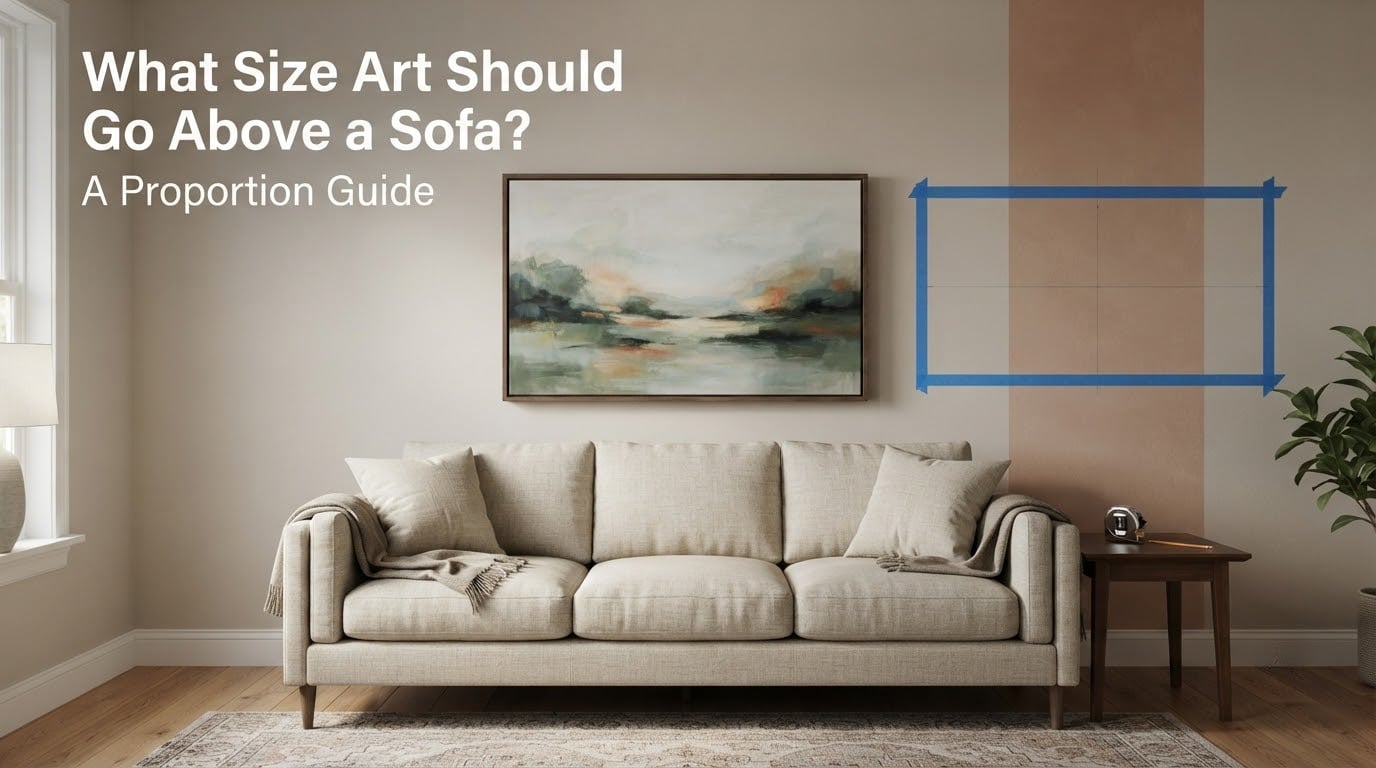
Art above a sofa should span about two-thirds of the sofa’s width (60-75% is the working range), hang 6-8 inches above the sofa back, and sit with its centerline roughly 57-60 inches from the floor. Those three numbers answer the question, and everything below this point is how to apply them to your specific room.
Getting this right is mostly arithmetic rather than taste. Art that is too small floats on the wall, disconnected from the furniture, and art that is too large swallows the room and makes the sofa look short. Scale is the whole game.
Below you’ll find the exact conversion table, the layout options, the measurement method, and the mistakes that come up most often when people try this on their own.
Table of Contents
- Table of Contents
- What Are the Rules for Hanging Art Above a Sofa?
- What Is the 2/3 Rule, and Why Does Some Guidance Say 60-75%?
- How Big Should Art Be Over a Couch? Sofa Width to Art Size Table
- How High Should Art Hang Above a Couch?
- Layout Options That Work Over Almost Any Sofa
- How to Measure and Tape It Out Before You Buy
- The Standard Art Size Cheat Sheet You Can Actually Order
- Print Size vs Framed Size vs Mat Size
- Special Cases: Sectionals, Vaulted Ceilings, Narrow Walls, and Rentals
- Common Sizing Mistakes and the Quick Fix for Each
- Frequently Asked Questions
- What are the rules for hanging art above a sofa?
- What is the 2/3 rule for sofas?
- How big should my art be above my couch?
- How high should art hang above a couch?
- What is the 57 rule for hanging art?
- How should art be placed above a sofa?
- How much space between three pictures above a couch?
- What size art for a sectional or L-shaped sofa?
- Is it better for art to be too big or too small?
- What are the 3-5-7 rule and the 70/30 rule in decorating?
- Final Word
Table of Contents
- What Are the Rules for Hanging Art Above a Sofa?
- What Is the 2/3 Rule, and Why Does Some Guidance Say 60-75%?
- How Big Should Art Be Over a Couch? Sofa Width to Art Size Table
- How High Should Art Hang Above a Couch?
- Layout Options That Work Over Almost Any Sofa
- How to Measure and Tape It Out Before You Buy
- The Standard Art Size Cheat Sheet You Can Actually Order
- Print Size vs Framed Size vs Mat Size
- Special Cases: Sectionals, Vaulted Ceilings, Narrow Walls, and Rentals
- Common Sizing Mistakes and the Quick Fix for Each
- Frequently Asked Questions
What Are the Rules for Hanging Art Above a Sofa?
There are four rules, and they apply to nearly every living room. The first three do the visual work, and the fourth stops you from undoing the first three.
- Match the width. The artwork, or the total combined width of a grouping, should cover roughly 60-75% of the sofa’s width. Two-thirds, or 0.66, is the midpoint most designers reach for.
- Leave a small gap. The bottom edge of the art should sit 6-8 inches above the top of the sofa back. Some designers push that to 8-10 inches, which is a stylistic variant rather than a correction.
- Center on the sofa, not the wall. The midpoint of the art grouping lines up with the horizontal center of the sofa. If the sofa is off-center on the wall, the art goes with the sofa.
- Check the centerline before you commit. A comfortable centerline falls between 57 and 60 inches from the floor. If your clearance and your sofa height push the art far above that, trust the clearance rule and adjust the grouping instead.
Rule four is where most people get stuck, and it deserves a longer explanation. The 57-60 inch number is a general gallery standard for art hung on a blank wall, measured to the center of the piece. It is a good default, but it was never designed to sit above a 40-inch-tall sofa.
Home decorators in Reddit threads like r/HomeDecorating and r/DesignMyRoom push back on the gallery height constantly when it comes to sofas. The recurring correction is the same: measure up from the furniture, not down from a fixed number.
What Is the 2/3 Rule, and Why Does Some Guidance Say 60-75%?
The 2/3 rule, also called the two-thirds rule of hanging art, says the art should be two-thirds the width of the furniture beneath it. Some guides say 60-75% instead. Both are describing the same idea with different rounding.
Two-thirds is 66.6%. The 60-75% band is a tolerance zone around that number, wider at the top end because a slightly larger piece reads as intentional while a slightly smaller piece reads as an oversight. If you have to pick one number, pick 66%.
Here is the honest picture of where the competing numbers come from and when each one applies.
| Guidance | What It Means | When to Use It |
|---|---|---|
| Two-thirds (66%) | Art width equals about 0.66 of the sofa width | Your default. Works in most rooms, most styles, most sofas. |
| 60-75% of width | A tolerance band around the 2/3 number | When you are between two print sizes and want permission to choose the larger one. |
| Full sofa width | Art spans the entire piece of furniture | Large, confident rooms with high ceilings. Rare in a normal living room. |
| 8-10 inches of clearance | A taller gap between sofa back and art | High-back sofas, vaulted rooms, or when the art feels crowded against the upholstery. |
| 57-60 inch centerline | Center of the art measured from the floor | Blank walls with no furniture. A sanity check above a sofa, not the primary rule. |
When 2/3 and 60-75% disagree for your room, the resolution is simple. Measure your sofa, then look at the two numbers it produces. If they fall within a couple of inches of each other, the choice does not matter visually.
If they do not, ask which piece you actually want. The rule exists to serve the room, not the other way around. A 40-inch-wide print above an 84-inch sofa is 48% of the width, which is too small regardless of how the numbers are framed.
How Big Should Art Be Over a Couch? Sofa Width to Art Size Table
Multiply your sofa width by 0.66 for the target art width. This table does that for the most common sofa sizes, then gives you a single-piece size and a multi-piece option for each.
| Sofa Width | Target Art Width (60%) | Target Art Width (66%) | Target Art Width (75%) | Best Single Piece | Best Multi-Piece Option |
|---|---|---|---|---|---|
| 60 in (5 ft loveseat) | 36 in | 40 in | 45 in | One 36×24 horizontal | Two 18×24 panels, 2 in apart |
| 72 in (6 ft sofa) | 43 in | 48 in | 54 in | One 48×30 or 50×30 | Two 22×30 panels, 2-3 in apart |
| 84 in (7 ft sofa) | 50 in | 55 in | 63 in | One 60×40 horizontal | Three 18×24 panels, 2-3 in apart |
| 96 in (8 ft sofa) | 58 in | 63 in | 72 in | One 60×40 or 72×36 | Three 20×30 panels, 3 in apart |
| 120 in (10 ft sectional) | 72 in | 79 in | 90 in | One 72×48 oversized | Four 18×24 panels, 3 in apart |
Read the target columns as a range, not a single answer. The 60% column is your floor. The 75% column is the ceiling before the art starts to compete with the sofa.
One thing to notice: the single-piece column rarely lands on a standard print size at the upper end. That is normal, and it is why custom sizing exists. It is also why the framing math in a later section matters.
For multi-piece layouts, add the widths and the gaps together, then check the total against your target. Three 18-inch panels with 2-inch gaps span 58 inches, which lands right in the middle of the band for a 96-inch sofa.
How High Should Art Hang Above a Couch?
Leave 6-8 inches between the top of the sofa back and the bottom edge of the art. That gap is the visual bridge that ties the two objects together, and it is the single most reliable number in this whole guide.
Here is how to reconcile clearance with the 57-60 inch centerline. Add your sofa’s back height, add 6-8 inches of clearance, and that gives you the bottom edge of the art. Add half the art’s height and you have the centerline.
Worked example: a sofa with a 34-inch back, plus 7 inches of clearance, puts the art’s bottom edge at 41 inches. A 30-inch-tall canvas then centers at 56 inches, which lands right in the gallery range. The two rules agree, which is why most standard sofas feel easy.
They stop agreeing when the sofa back is unusual. High-back sofas over 40 inches tall push the art’s centerline above 60 inches no matter how carefully you hang it, and there is nothing wrong with that. Low-back sofas under 30 inches can leave the art floating high, and there you usually tighten the gap to 6 inches.
| Sofa Back Height | Recommended Clearance | Resulting Centerline (approx.) | Note |
|---|---|---|---|
| Under 30 in (low back) | 6 in | 52-58 in | Art can feel high. Add a taller piece or lower the gap. |
| 30-40 in (standard) | 6-8 in | 54-64 in | The easy case. Most rules agree here. |
| Over 40 in (high back) | 8-10 in | 66 in and above | Go slightly wider to hold the wall visually. |
Is your art hung too high? Check the bottom edge first, not the center. If the gap is bigger than about 10 inches, it reads as too high no matter where the centerline sits.
The other half of the height question is centering. The art should center on the sofa’s horizontal midpoint, not on the wall’s. In rooms where the sofa is pushed to one side of the wall or sits under a window with a defined center, center on the furniture and let the art look slightly asymmetric to the room.
Layout Options That Work Over Almost Any Sofa
The total width is what matters, not the number of pieces. A diptych, a triptych, and a single canvas all work if they add up to the same span. Pick the layout based on the wall, the art you like, and how much visual weight the room already carries.
Single statement piece
One large horizontal canvas or framed print at the full target width. Cleanest option and the safest default for a standard sofa.
Go vertical instead when the wall is tall, the ceiling is vaulted, or the art itself has a vertical composition. A tall piece carries more visual weight, so pull the width back toward the 60% end of your band.
Diptych
Two pieces hung side by side, close enough to read as one composition. Unlike a balanced pair, a diptych is two halves of a single image or two closely related pieces.
Spacing is 2-3 inches between frames. So two 22-inch pieces with 2-inch gaps span 46 inches, which suits a 72-inch sofa at 64% of the width.
Triptych
Three panels. This is the most requested multi-piece layout in decorating forums, and the most commonly botched, because people space the panels too far apart.
Keep the gaps even and tight, 2-3 inches, and keep the outer edges of the outer panels aligned with your target span. A triptych that spans too little width is the classic “art feels too small” complaint.
Balanced pair
Two unrelated but equally weighted pieces, often one above the other or symmetric on the wall. Unlike a diptych, these are not halves of one image, so the matching element is size and visual weight rather than subject.
Make the two pieces the same dimensions, or close enough that the pair reads as intentional. Mismatched sizes work only if the difference is deliberate and obvious.
Stacked pair
Two pieces stacked vertically, which suits a wall with more height than width, or a low-back sofa where a single horizontal piece leaves the wall feeling top-heavy.
The combined height should land in the same visual zone as a single piece would. A stacked pair that stretches from 50 to 85 inches reads as a tower, not a grouping.
Mini gallery wall
Several smaller works in a tight grid or salon arrangement. The outer boundary of the grid is what gets measured, and it should hit the same 60-75% target.
Keep the gaps consistent, roughly 2-3 inches, and let the arrangement be a rectangle rather than an organic shape. Odd-shaped groupings above a sofa tend to look unsettled.
Picture ledge styling
A long shelf with frames and objects leaning against the wall. The ledge length follows the same width rule, and it is the easiest option to restyle later without new holes in the wall.
How much space between pieces above a couch?
Two to three inches between frames, consistent across the whole grouping. Wider gaps make separate pieces look unrelated, and tighter gaps start to read as one image.
One side note on visual weight: a common decorating guideline is that roughly 70% of a room’s visual weight should come from a small number of large elements and 30% from many small ones. Applied to a wall, that means one or two large pieces and a few small supporting objects, not five mid-sized frames of equal weight.
How to Measure and Tape It Out Before You Buy
Measure first, order second. It takes ten minutes and prevents the most expensive decorating mistake, which is art in the wrong size.
- Measure the sofa’s full width arm to arm, along the front edge. Do not measure the seat cushions or the inside span between the arms, since the visible mass includes the arms.
- Multiply by 0.66 for your target art width. Round to the nearest standard print size or to a size your framer can build.
- Measure the sofa’s back height from the floor to the top of the back cushion or frame, whichever is higher.
- Add 6-8 inches to that back height to get the bottom edge of your art, then add half the art’s height for the centerline.
- Mark the wall with painter’s tape before anything is ordered.
The tape-it-out method is the one people in r/malelivingspace and r/interiordecorating keep recommending when a decision feels uncertain. Tape a rectangle at your target dimensions on the wall, step back from the doorway, and live with it for a day.
It catches three things no photograph will show you: whether the width feels right against the sofa in the actual room, whether the gap looks right at eye level while seated, and whether the art collides with a lamp, a window, or a nearby shelf.
Adjust the tape, not your plan. Widening the rectangle by 4 inches is a fast fix when it looks undersized, and nobody has to rehang anything.
The Standard Art Size Cheat Sheet You Can Actually Order
Most art prints are sold in standard sizes, so it pays to know which ones exist. Below are the sizes you will actually find, and where each one lands against a sofa.
| Standard Print Size | Orientation | Suits A Sofa Of | Notes |
|---|---|---|---|
| 8×10 | Vertical | Not enough for a single piece | Gallery wall component only. |
| 11×14 | Both | Not enough for a single piece | Popular in a five or seven piece grid. |
| 16×20 | Both | 60 in and under, grouped | Works well as one panel of a triptych. |
| 18×24 | Vertical | 60-84 in, grouped | The workhorse panel size for three-piece layouts. |
| 20×30 | Vertical | 84-96 in, grouped | Pairs well with 2-3 inch gaps. |
| 24×36 | Both | 72-84 in, single | Often sold as a standard poster size. |
| 30×40 | Horizontal | 84-96 in, single | A very common frame size. |
| 36×48 | Both | 96 in, single | Standard for a 7-foot sofa at the wider end. |
| 40×60 | Horizontal | 96-120 in, single | Statement canvas territory. |
| 48×72 | Horizontal | 120 in sectional | Oversized. Measure your wall twice. |
When the number you need falls between two standard sizes, buy the larger one and let the frame’s mat or the piece’s negative space do the trimming. A slightly larger print with a wide mat can hit an exact target width.
Print Size vs Framed Size vs Mat Size
A print, a mat, and a frame are three different measurements, and ordering the wrong one is the most common purchasing mistake in this whole process.
Print size is the image itself, measured width by height. Framed size is the outside measurement of the frame, which is always larger than the print. Mat size is the visible border opening down to the image, which is smaller than the print.
The math is straightforward. A 36×48 print in a 1.5-inch frame with a 2-inch mat has an outside dimension of 43.5×55.5, while the visible image area is 32×44. That is more than 7 inches of added width from the frame alone.
That is why you should decide whether you are ordering a print or a finished piece. If you are buying a print to frame yourself, subtract the frame and mat from your target width to find the print size you need. If you are buying pre-framed art, compare the framed size directly against your target.
A floater frame, where the frame floats around the print with a visible gap, reads lighter and more contemporary. It also makes the print look smaller than a traditional close-mount frame, so many people go up one standard size when choosing one.
Two practical notes. A wide mat visually lightens a piece and lets a slightly larger print fit a fixed span. And the depth of the frame changes the shadow on the wall, which is why oversize pieces often look better with a shallow profile frame.
Special Cases: Sectionals, Vaulted Ceilings, Narrow Walls, and Rentals
Sectionals and L-shaped sofas
Measure the visual mass, not the entire L. A 120-inch L-shaped sectional does not want 79 inches of art hung over its corner, because most of that length is not on the wall you are hanging from.
Identify the longest uninterrupted run of seating that sits against the wall in question. That run is your sofa width. On a typical L-shaped sectional with a 96-inch main body and a 40-inch return, a 63-inch art width over the main body is the right call, and the return usually gets its own smaller piece or nothing.
Tall and vaulted ceilings
Standard proportions stretch. A 66-inch art group that looks grounded under a 9-foot ceiling can look like a coaster on a 12-foot wall, and the gap between the art and the sofa will read as a canyon.
Go vertical. A tall piece or a stacked pair occupies the wall’s height and keeps the composition connected to the furniture. In very tall rooms, close the gap to 8-10 inches so the art stays part of the seating group, and consider a larger piece at the 70-75% end of the band.
If the room is minimalist and the wall is enormous, going slightly larger than your target is a legitimate choice. Just check the tape outline before committing.
Narrow walls and small rooms
When the wall physically cannot take 66% of the sofa, scale down with intention rather than shrinking arbitrarily. 50-55% of the width reads as deliberate in a tight room, and 40% reads as an oversight.
Going smaller is fine, going disconnected is not. The bottom edge still needs its 6-8 inch clearance and the art still needs to center on the sofa, or it will read as an unrelated picture rather than art above furniture.
Rental apartments and no-damage hanging
Oversized art is genuinely heavy, and this is a real blocker for people in rentals. A 40×60 canvas in a frame can run 30-50 pounds, which is a two-person lift and a proper wall anchor, not a couple of picture hangers.
For lighter pieces, use adhesive hooks rated for the weight and patch the wall afterward. For anything heavy, use proper anchors into studs, and get help lifting it level. A canvas that hangs two degrees off is noticeable from across the room.
Two-person tape is the practical answer to the whole problem. Test the size before the piece is heavy enough to matter.
The same rule in other rooms
Over a bed, the two-thirds rule works identically, with one adjustment: the target width is often 2.5 to 3 times the mattress width, because the headboard and the frame read as one piece of furniture.
Above a mantel, keep the art narrower than the mantel, roughly 60-70% of its width, and never let the art or the frame overhang the mantel ends. A low firebox is the exception, since a tall piece there competes with the chimney breast.
Common Sizing Mistakes and the Quick Fix for Each
These are the issues that come up over and over in home decorating discussions, in the order I would fix them.
- Using the 57-60 inch gallery height as the primary rule. Measure up from the sofa back instead. If your gap is 10 inches or more, lower the art.
- Art that is too small for the sofa. Widen to 66-75% of the sofa width, or switch to a three-panel layout at the same total span.
- Multi-piece gaps too wide. Tighten to 2-3 inches between frames, evenly. This is the fastest fix for a triptych that reads as three unrelated prints.
- Centering on the wall instead of the sofa. Line the art’s midpoint up with the sofa’s midpoint, even when the sofa is not centered on the wall.
- Ordering a print size and forgetting the frame. Decide whether you are buying a print to frame or a finished piece, and measure accordingly.
- Forgetting a high or low sofa back. Recheck your clearance against the back-height table. High backs need 8-10 inches and slightly more width.
- Hanging a single small piece in a very wide room. Go bigger, go vertical, or add a second element. Sparse walls need more scale, not less.
On the question of whether art should be too big or too small: err large. Reviewers and decorators agree that a slightly oversized piece looks confident, while a slightly undersized one looks accidental. If you are choosing between two sizes and the larger one still fits your wall, take the larger one.
Frequently Asked Questions
What are the rules for hanging art above a sofa?
Four rules cover almost every case. Match the width: the art or grouping should span 60-75% of the sofa’s width, with two-thirds as the midpoint. Leave a 6-8 inch gap between the sofa back and the bottom edge of the art. Center the art on the sofa’s midpoint rather than the wall’s. Finally, sanity-check the centerline against the 57-60 inch gallery standard, adjusting the grouping rather than the clearance if the two conflict.
What is the 2/3 rule for sofas?
The 2/3 rule says artwork above a sofa should be about two-thirds the width of the sofa beneath it, so an 84-inch sofa wants art around 55-56 inches wide. It is the same principle as the 60-75% range that other guides give, just rounded. Two-thirds is 66.6%, and the wider band exists because a slightly larger piece reads as confident while a slightly smaller one reads as an oversight.
How big should my art be above my couch?
Measure the sofa arm to arm and multiply by 0.66. A 60-inch loveseat wants 40 inches of art, a 72-inch sofa wants 48, an 84-inch sofa wants 55, a 96-inch sofa wants 63, and a 120-inch sectional wants around 79. Aim to land between 60% and 75% of the sofa width. If you land between two standard print sizes, take the larger one and narrow it with matting if needed.
How high should art hang above a couch?
Leave 6-8 inches between the top of the sofa back and the bottom edge of the art, using 8-10 inches if the sofa has a tall back or the ceiling is high. To find the centerline, add the sofa’s back height plus the clearance plus half the art’s height. For most sofas with backs between 30 and 40 inches, that lands the center between 57 and 60 inches from the floor, which is the standard gallery height.
What is the 57 rule for hanging art?
The 57 rule is a shortcut, not a sofa rule. The center of a piece of art should hang about 57 inches from the floor, which approximates normal eye level. It was designed for art on an open wall. Above furniture, measure the clearance from the furniture instead, since a 40-inch sofa back plus 7 inches of clearance already puts the bottom edge at 47 inches and can push a tall piece well above 57.
How should art be placed above a sofa?
Center the art on the horizontal midpoint of the sofa, not the wall, and keep the bottom edge 6-8 inches above the sofa back. For multi-piece layouts, use even 2-3 inch gaps between panels and align the outer edges of the outermost pieces with your target width. The total span across the whole grouping is what should measure 60-75% of the sofa width, not the width of any individual panel.
How much space between three pictures above a couch?
Leave 2-3 inches of even space between each frame, measured edge to edge. Consistent tight spacing makes three pieces read as one composition. Wider gaps make them look like three separate pictures, which is the most common reason a triptych above a sofa feels disconnected. Also check the total span: three 18-inch panels with 2-inch gaps cover 58 inches, which suits a 96-inch sofa.
What size art for a sectional or L-shaped sofa?
Measure the visual mass rather than the full L-shape. Find the longest uninterrupted run of seating that sits against the wall you are hanging art on, and use that as your sofa width. For a sectional with a 96-inch main body and a 40-inch return, aim for about 63 inches of art over the main body, and treat the return separately or leave it bare.
Is it better for art to be too big or too small?
Err on the larger side. Art that is slightly too large looks deliberate and confident, while art that is slightly too small looks like an oversight or an afterthought. As long as the larger piece fits the wall with a few inches of margin on each side and does not crowd nearby furniture, go up a size. This is the opposite of the common instinct to play it safe.
What are the 3-5-7 rule and the 70/30 rule in decorating?
Neither is a sofa proportion rule. The 3-5-7 rule is about visual rhythm: roughly 3 visual elements, 5 changes in texture or color, and 7 contrasting items in a room. The 70/30 rule is about weight distribution, where most visual weight comes from a few large pieces. Both are useful when balancing a wall, but the width and clearance numbers above are what set art over a sofa.
Final Word
If you take three numbers away from this guide, make them these: art width at 60-75% of the sofa with two-thirds as your target, a 6-8 inch gap above the sofa back, and a centerline that lands between 57 and 60 inches from the floor in a standard room.
Measure your sofa, multiply by 0.66, and tape the outline on the wall before you order. That last step takes ten minutes and it is the reason people end up happy with what they chose.