
Updated for October 2026.
Hang the center of your artwork 57 to 60 inches from the floor, and if it goes above furniture, leave a 6 to 10 inch gap between the top of that furniture and the bottom of the frame. That is the short answer to how high to hang art above a couch or bed, and almost every other guideline on the internet is a variation of it.
I have measured and re-hung art in more living rooms and bedrooms than I can count, and the same mistake shows up every time: the frame goes up at true eye level, the sofa looks abandoned underneath it, and the room reads as two unrelated halves.
The trouble is that advice about this topic rarely agrees with itself. One source says 6 inches above the sofa, the next says 8, a third says 10, and none of them explain when to use which. This guide sorts it out piece by piece, with the exact numbers, the reason behind them, and the exceptions that actually change the answer.
Table of Contents
- Quick Height Cheat Sheet: Every Rule on One Table
- How High to Hang Art Above a Couch or Bed: Start With the 57-Inch Rule
- How High to Hang Art Above a Couch or Sofa
- How High to Hang Art Above a Bed
- The 2/3 Rule: How Large Should the Art Be?
- How High to Hang a Gallery Wall
- Arranging Sets of 2, 3, and 4 Pieces
- How to Mark the Height Before You Drill
- Hanging Hardware by Artwork Weight
- Special Cases: High Ceilings, Low Ceilings, and Odd Walls
- Common Mistakes That Make Art Look Wrong
- Frequently Asked Questions
- How high should artwork be hung above a bed?
- What is the 2/3 rule for wall art?
- What is the 2/3 rule for sofas?
- What is the rule of 57 for hanging art?
- How high should wall art be hung above my bed?
- What are the rules for hanging artwork above my bed?
- Is it Feng Shui-correct to hang pictures above the bed?
- Conclusion
Quick Height Cheat Sheet: Every Rule on One Table
Here is everything in one place. Measure the gap from the top of the furniture to the bottom edge of the lowest frame, and measure the center from the floor to the middle of the artwork or of the entire grouping.
| Situation | Gap Above Furniture | Center Height from Floor | Target Art Width | In Centimeters |
|---|---|---|---|---|
| Above a couch or sofa | 6 to 10 inches (8 to 10 for a tall back) | 57 to 60 inches | Two-thirds of the sofa width | 15 to 25 cm gap, 145 to 152 cm center |
| Above a bed with a headboard | 6 to 10 inches above the headboard | 57 to 60 inches | Two-thirds of the bed width | 15 to 25 cm gap |
| Above a bed with no headboard | 14 to 16 inches above the mattress | 57 to 60 inches | Two-thirds of the bed width | 36 to 41 cm gap |
| Above a console or side table | 4 to 6 inches | 57 to 60 inches | Two-thirds of the table width | 10 to 15 cm gap |
| Above a dining table | 10 to 12 inches, or lower for a pendant light | Seated eye level | Two-thirds of the table width | 25 to 30 cm gap |
| Above a buffet or sideboard | 6 to 8 inches | 57 to 60 inches | Two-thirds of the piece width | 15 to 20 cm gap |
| Blank wall, no furniture | Not applicable | 57 to 60 inches | Whatever fits the wall | 145 to 152 cm center |
| Gallery wall above furniture | 6 to 8 inches from the bottom row | 57 to 60 inches for the whole group | Two-thirds of the furniture width | 15 to 20 cm gap |
Two numbers anchor everything else. The 57 to 60 inch center height applies wherever there is no furniture to anchor to, and the two-thirds width rule decides how big the art should be. Height and size are solved together, never separately.
How High to Hang Art Above a Couch or Bed: Start With the 57-Inch Rule
The 57 to 60 inch center measurement is the single most reliable number in home decor, and it comes from gallery and museum practice rather than opinion. Museums center most work at roughly that height because it approximates the average standing eye level of an adult, so visitors look at the work without tilting their head up or down.
What “Center” Actually Means
Center means the visual middle of the piece, measured straight down to the floor. For a single frame, that is the geometric center of the frame, not the point where the hanging wire or D-ring sits. Hardware usually sits a few inches above center because the wire hangs down over the nail, so if you measure to the hook you will end up with the frame too low.
For a gallery wall, center means the middle of the entire arrangement, including every frame in it, counted as one block of art.
Why the Eye-Level Myth Fails Over Furniture
Your personal eye level while standing is somewhere between 55 and 68 inches, and it drops to about 50 inches when you sit. That is why art hung at your own eye level often looks wrong over a sofa: you are standing when you hang it and sitting when you look at it.
More importantly, a frame floating at eye level with nothing beneath it loses its relationship to the room. Decorative logic says art over furniture belongs to that furniture. A wide gap or an independent height makes the frame read as a separate object that happens to share a wall.
When furniture is present, the gap between furniture and art wins over the floor measurement. When a bare wall is all you have, the 57 to 60 inch rule is the only guide you need.
How High to Hang Art Above a Couch or Sofa
Leave 6 to 10 inches between the top of the sofa back and the bottom of the frame, and set the center of the art between 57 and 60 inches from the floor. For a standard sofa with a back around 30 to 34 inches tall, those two instructions agree with each other, which is exactly why the rule works so smoothly in most living rooms.
Which Gap Number to Use
The conflicting 6, 8, and 10 inch advice each fits a different sofa. Here is how to choose:
- 6 inches suits a low-backed sofa, a loveseat, or a room with a low ceiling where a bigger gap makes the art look stranded in the middle of the wall.
- 8 inches is the safe default for a standard sofa with a mid-height back.
- 10 inches suits a tall-backed sofa or sectional, where a tight gap would crowd the frame.
Measure your actual sofa back before choosing. If the back is 40 inches tall, 8 inches of clearance puts the center near 62 inches, which is above the 60 inch ceiling of the rule. In that case use 6 to 8 inches rather than forcing a 10 inch gap.
Sectionals and Wide Sofas
A sectional changes the target width, not the height. Measure only the main section, not the chaise, when you apply the two-thirds rule, because the art visually pairs with the seating block rather than the whole footprint.
Wide sofas are also where undersized art fails most visibly. One small frame centered over a 100 inch sectional reads as an afterthought, and the wall above the piece looks empty no matter how the height is set.
The Gap Looks Bigger Than It Is
Homeowners on decorating forums repeatedly report the opposite complaint, that a correctly hung piece looks like it is floating. The gap is measured from the top of the back cushion, not from the seat. Measuring from the seat makes the gap look twice as large as it is and tempts you to hang the art lower than the rule allows.
How High to Hang Art Above a Bed
With a headboard, hang the art 6 to 10 inches above the top of the headboard. Without a headboard, hang it 14 to 16 inches above the mattress. The larger gap in the no-headboard case is not a style choice, it is a practical one.
Why the No-Headboard Gap Is Bigger
Several people in bedroom decorating discussions mention the same problem: a piece hung 6 inches above a bare mattress gets hit by whoever sits up in bed. A 14 to 16 inch gap clears a seated head, keeps bedding from brushing the frame, and gives a low bed the visual lift it needs to balance against a tall room.
It also solves the height math. A mattress top sits around 24 to 30 inches, so a 15 inch gap puts the bottom of the frame near 40 to 45 inches and the center of a mid-sized piece close to the 57 inch standard. With a headboard, the headboard itself does that lifting for you.
Tall Headboards Change the Plan
A headboard that reaches 60 inches or more leaves almost no wall above it, and forcing art into the remaining space produces a cramped, crowded look. In that case skip the artwork entirely, use a narrow horizontal shelf, or let the headboard be the statement.
Hanging From the Ceiling Instead
Long pendant drops or a slim fixture hung from the ceiling can work over a bed with a very tall headboard or in a room with vaulted ceilings. People ask about this often, and the answer is that it only succeeds when the drop is long enough to bring the piece to roughly eye level while sitting up in bed.
The 2/3 Rule: How Large Should the Art Be?
The two-thirds rule says the artwork should be about two-thirds as wide as the furniture below it. Art narrower than that looks undersized, and art wider than the furniture pulls the eye away from the sofa or bed and leaves the room feeling lopsided.
Some decorators use a slightly wider ratio for very wide sectionals, landing near three-quarters, but two-thirds is the reliable starting point. Width is measured on the frame itself, not the mat or the visible image inside it.
| Furniture | Typical Width | Target Art Width at Two-Thirds | Example |
|---|---|---|---|
| Loveseat | 60 inches | 40 inches | One 40 by 30 inch piece, or a 24 by 36 inch piece in a wide mat |
| Standard sofa | 72 to 84 inches | 48 to 56 inches | One large frame, or a set spanning 50 inches |
| Large sofa or sectional | 96 to 110 inches | 64 to 73 inches | Two large pieces or a full gallery wall |
| Queen bed | 60 inches | 40 inches | One piece about 40 inches wide, or a set of three |
| King bed | 76 to 80 inches | 50 to 53 inches | A triptych or grid spanning about 52 inches |
| Console table | 36 to 48 inches | 24 to 32 inches | One small piece or a pair |
For a bed, a common preference on forums is a set of three smaller frames over one large piece. The set works as long as the combined span still covers two-thirds of the bed width, and it gives the wall a softer look than a single heavy frame.
How High to Hang a Gallery Wall
Treat a gallery wall as one artwork and center the whole block at 57 to 60 inches from the floor. Then place the bottom row 6 to 8 inches above the furniture below it, and let the rest of the arrangement stack upward from there.
- Keep 2 to 3 inches of equal space between frames, measured edge to edge.
- Make the total span two-thirds of the furniture width.
- Mix frame sizes and orientations rather than matching everything exactly.
- Use an odd number of pieces, or a deliberate even grid, but never a random count.
- Sketch the layout on paper first, including the frame widths, then transfer it to the wall.
Consistent spacing is what makes a grouping read as one piece. Uneven gaps, even with beautiful frames, make the wall look accidental.
Arranging Sets of 2, 3, and 4 Pieces
Once you have the height and width targets, the layout is the last decision. Use the table below as a starting point rather than a rule, and adjust until the group feels balanced from your normal seat.
| Set Size | Best Layout | Spacing | Total Width Guidance | Works Best Above |
|---|---|---|---|---|
| 2 pieces | Side by side, matched heights | 2 to 4 inches apart | Both pieces plus gap equal about two-thirds of the furniture | Standard sofa or queen bed |
| 3 pieces | Symmetrical triptych or large piece flanked by two small | 2 to 3 inches apart | Span two-thirds of the furniture width | Large sofa, king bed |
| 4 pieces | Two-by-two grid, or a stacked pair over a wider pair | 2 to 3 inches horizontally, 3 to 5 inches vertically | Span two-thirds of the furniture width | Wide sofa, sectional, sideboard |
A stacked arrangement wants more vertical room between rows than a side-by-side one, because the eye reads across a row and down between rows. Narrow hallways and stairwells work best with vertical stacking, where each frame sits above the last with 3 to 5 inches between them.
How to Mark the Height Before You Drill
The best way to avoid a permanent mistake is to test the placement before any hole exists. Homeowners who tape the outline on the wall report instant confidence, and it takes about ten minutes.
- Measure your furniture width and multiply by two-thirds to get your target art width.
- Measure the furniture height and add your chosen gap, either 6 to 10 inches for a sofa, 6 to 10 above a headboard, or 14 to 16 above a bare mattress.
- Mark that spot on the wall with a small pencil mark where the bottom edge of the frame will sit.
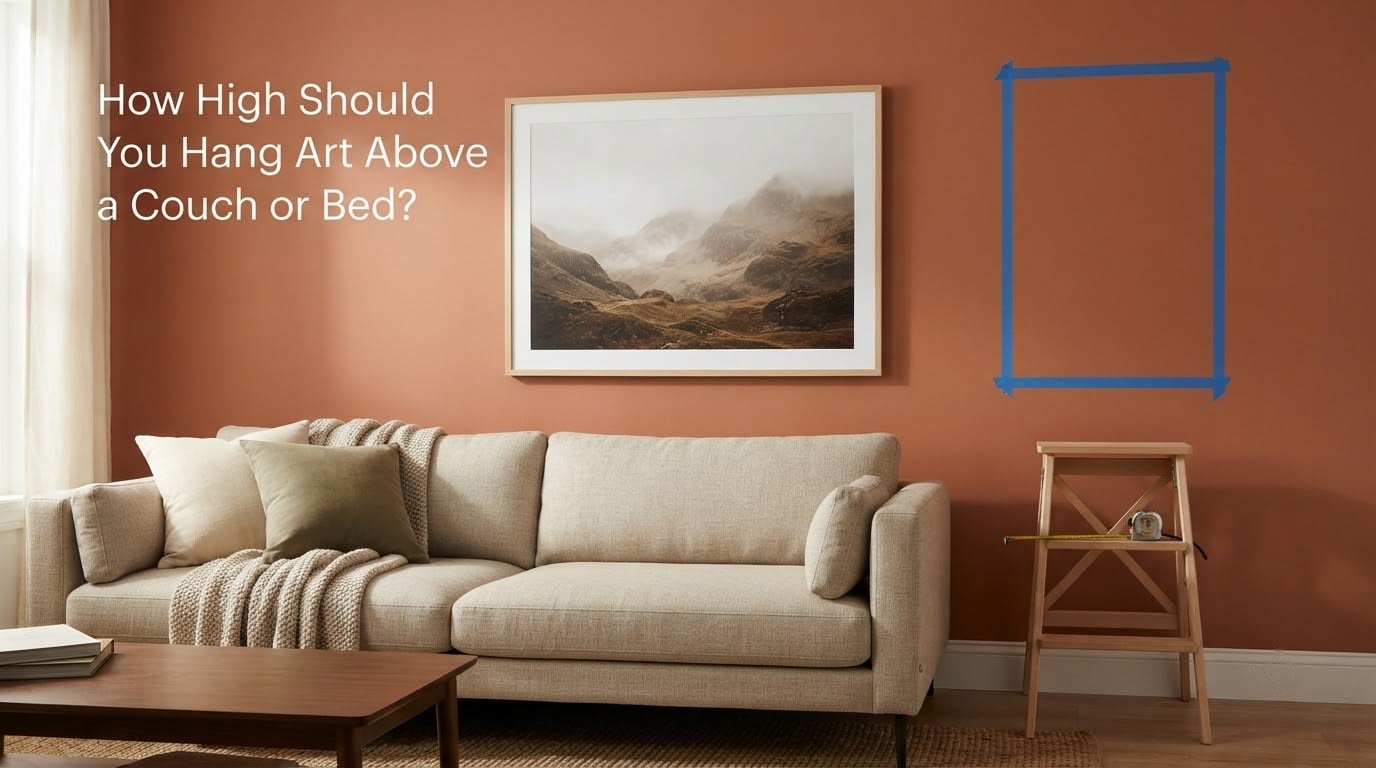
- Tape the outline of your planned arrangement directly on the wall with painter’s tape, including each frame edge.
- Step back and sit down. Look at it from where you actually view the wall, not from where you are standing with a tape measure.
- Photograph it with your phone and look at the image. A photo removes your own height from the equation and shows proportion the way a visitor sees it.
- Adjust and re-tape if the block looks off center, then mark your nail or hook position and remove the tape.
Photographing the tape layout before you drill is the step people skip, and it is the one that catches the most problems. Anything that looks centered while you are holding the camera is often off center once the camera is at eye level.
Hanging Hardware by Artwork Weight
Height and size decide where the art goes. Hardware decides whether it stays there. Use this as a general guide and follow the weight rating printed on whatever you are using.
| Artwork Weight | Hardware | Notes |
|---|---|---|
| Under 5 pounds | Single picture hook or a small nail | Fine for most small frames and lightweight prints |
| 5 to 20 pounds | Two picture hooks or a rated D-ring set | Use two attachment points so the frame cannot pivot |
| 20 to 50 pounds | French cleat or heavy-duty toggle anchor | Toggle anchors are the go-to for hollow drywall |
| Over 50 pounds | French cleat into studs, or professional installation | Studs or a structural anchor, never drywall alone |
For any piece over about 20 pounds, locate a stud or use an anchor rated above the weight of the frame. Framed glass adds weight that the frame material does not suggest, so weigh the finished piece rather than the empty frame.
Two points matter more than the weight rating. The hardware point sits above the visual center, so always measure your center height, then mark the hook lower by however far the wire or cleat hangs down. And whatever you hang above, the hanger must be rated for both the art and the wall surface you have.
Special Cases: High Ceilings, Low Ceilings, and Odd Walls
High and vaulted ceilings. Owners of tall rooms report that raising the center above 60 inches keeps the wall from looking empty. With 10 foot ceilings, a center at 62 to 66 inches can feel right because the whole room is scaled up. Keep the gap above the furniture generous, around 10 to 12 inches, so the art still belongs to the sofa.
Low ceilings. In a low-ceilinged room, drop the gap to about 6 inches. A larger gap leaves the art stranded in the middle of the wall and makes the ceiling feel lower. Closer to the furniture is what makes a short room read as taller.
Chair rails and wainscoting. When a chair rail crosses the wall, hang above it rather than cutting through it, and let the rail act as a visual floor for the arrangement. If the art is small enough to fit entirely between the rail and the ceiling, a centered placement there also works, and you can relax the furniture gap because the rail is doing the anchoring.
Dining rooms. People rarely consider that diners are seated. In a dining room, hang the art lower than the standing rule suggests, roughly centered on the seated eye line, or make sure a pendant light hangs low enough that the two do not compete for the same space.
Leaning art. Resting a large frame on a console or against a shelf is a legitimate alternative, especially in casual rooms. Leaned art solves the height problem entirely because the furniture sets the bottom edge.
Common Mistakes That Make Art Look Wrong
Hanging at your own eye level. Your standing eye level is not the target, and it is not what you use while seated. Use 57 to 60 inches, or let the furniture gap decide.
Measuring to the ceiling instead of the floor. High ceilings make a ceiling-relative measurement produce art that is far too high. Every measurement in this guide starts at the floor.
Art that is too small. A single narrow frame over a wide sofa is the most common sizing error. Scale up to two-thirds of the furniture width, even if it means a set instead of one piece.
Using a gap that is too tight. Art crammed 2 inches above a headboard looks crowded. The gap needs air, even when you are impatient.
Aligning to the wrong center. On a bed, center the art on the bed itself, not on the headboard. A headboard is often off-center from the mattress, and art centered on it looks visibly skewed from the doorway.
Trusting one number blindly. Every number here is a starting point. The 57 to 60 inch range and the 6 to 10 inch gap exist because furniture heights vary, and the right answer depends on your ceiling, your sofa, and how the wall feels when you sit down and look.
Frequently Asked Questions
How high should artwork be hung above a bed?
Above a bed with a headboard, hang art 6 to 10 inches above the top of the headboard, with the center of the piece at 57 to 60 inches from the floor. Without a headboard, hang it 14 to 16 inches above the mattress so it clears the head of anyone sitting up. Center the art on the bed itself rather than on the headboard, which is often slightly off-center from the mattress.
What is the 2/3 rule for wall art?
The art should be about two-thirds as wide as the furniture below it. A 72 inch sofa wants roughly 48 inches of art, and a queen bed wants about 40 inches. Measure the frame itself, not the mat or the image inside it. Art wider than the furniture pulls focus away from the piece it belongs to.
What is the 2/3 rule for sofas?
The artwork above a sofa should span about two-thirds of the sofa’s width. This sets the total width, whether you hang one large frame or a set of several. For wide sectionals, measure only the main seating section and not the chaise. If one frame cannot reach that width, use a pair or a gallery wall instead of an undersized piece.
What is the rule of 57 for hanging art?
The rule of 57 says the center of the artwork should sit 57 inches from the floor, with most designers working in a 57 to 60 inch range. It comes from museum practice and approximates average standing eye level. Measure to the visual center of the frame, not to the hanging wire or D-ring, which sit above it.
How high should wall art be hung above my bed?
With a headboard, leave 6 to 10 inches between the headboard top and the bottom of the frame. Without a headboard, leave 14 to 16 inches above the mattress, which prevents the frame from being hit when someone sits up. In both cases the target center height stays at 57 to 60 inches from the floor.
What are the rules for hanging artwork above my bed?
Three rules matter here. Center the art on the bed, not the headboard. Set the center at 57 to 60 inches from the floor, or work back from a gap of 6 to 10 inches above a headboard and 14 to 16 inches above a bare mattress. Make the art span about two-thirds of the bed width, using a set of three small frames if one large piece cannot.
Is it Feng Shui-correct to hang pictures above the bed?
Traditional Feng Shui practice advises against hanging art directly over a headboard, since the position is associated with instability and pressure on the sleeper. Most practitioners consider it acceptable to place a piece above the bed when it is not a headboard, when the subject matter is calm rather than aggressive, and when the frame is hung high enough to feel light. If you follow the practice, a side wall or a piece set well above the headboard is the safer choice.
Conclusion
To answer how high to hang art above a couch or bed one more time, the short version is simple. Center the art at 57 to 60 inches from the floor, leave 6 to 10 inches between the art and the furniture below, and use 14 to 16 inches when there is no headboard to anchor to.
Size it at two-thirds of the furniture width, tape the outline on the wall before you drill, and check the placement from your usual seat rather than from where you are standing with a tape measure. Those three steps take less than ten minutes and prevent the single most common decorating mistake people make every year.