
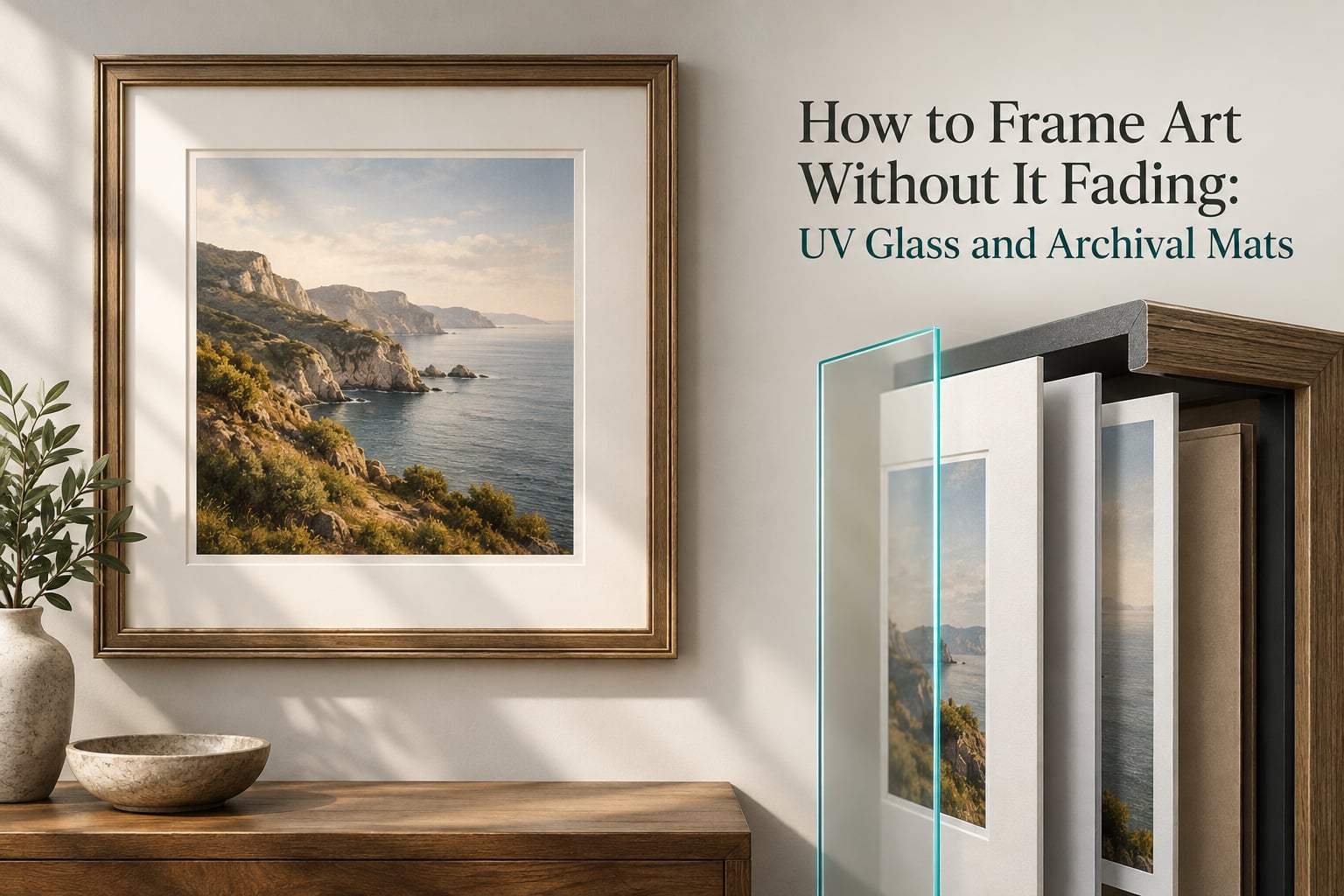
Most fading I see in framed artwork is preventable, and the fix comes down to two materials: UV glass that blocks ultraviolet radiation, and archival mats that stop acid from migrating into the piece. This guide walks through how to frame art without it fading, from choosing glazing to controlling the room it hangs in. Updated for 2026.
Ultraviolet light breaks down the dyes and pigments in paper, photographs, and textiles. Meanwhile, the acids in ordinary mat board and softwood frames migrate outward and yellow whatever they touch. Address only one of those problems and the other keeps working against the piece for decades.
Below you will find the material options, the step-by-step framing process, and a checklist of the mistakes that show up most often. I have framed and rehomed enough work to know which details actually move the needle.
Quick answer: choose glazing that blocks at least 99% of UV, a lignin-free buffered mat, a frame that is either metal or sealed with acid-free tape, and a wall away from direct sunlight with stable humidity. Everything else is refinement.
Table of Contents
- Why Art Fades: The Science Behind UV and Acid Damage
- UV Glass Types Compared: Conservation vs Museum vs Non-Glare
- Archival Mat Boards: Acid-Free, Buffered, and Cotton Rag
- Frame Materials and Sealing Techniques
- Display Environment: Light, Humidity, and Temperature
- How to Frame Art Without It Fading: Step by Step
- Air Gap, Spacers, and Mounting Technique
- DIY vs Professional Framing: When to Use Which
- Media-Specific Framing Guidelines
- Common Framing Mistakes Checklist
- Cleaning, Monitoring, and When to Re-Frame
- Frequently Asked Questions
- Do they make UV glass for a picture frame so it does not fade?
- How to make a picture frame UV resistant?
- How can I protect my art from UV light?
- Should you frame acrylic paintings under glass?
- Can you add UV protection to a picture frame?
- Is non-glare glass worth it for picture frames?
- How to stop photos from fading in sunlight?
- How to tell if frame glass is UV protected?
- Conclusion
Why Art Fades: The Science Behind UV and Acid Damage
Fading in art is a chemical process called photochemical degradation. UV photons break the molecular bonds in dyes and pigments, and the visible color we see is exactly what gets destroyed first. The shift is gradual, then sudden, and it never reverses.
Standard clear glass blocks only about 45% of UV, according to community testing on photography forums such as the Digital Darkroom forum at photo.net. That means a print behind ordinary glass still receives a meaningful share of the damaging wavelengths, which is why paper in a sunny room fades even in a protective frame.
Acid damage works differently and runs in the opposite direction. Wood pulp in standard mat board releases lignin degradation products that migrate into the artwork. The result is a warm brown halo around the edges of the paper, a paper that turns brittle, and inks that bleed or flake.
Light also drives the acid reaction faster. Cool, dim conditions slow both processes, so the same frame in a shaded hallway will outlast the identical frame on a sunlit wall by a wide margin.
What UV actually destroys
- Dye-based inkjet prints: cyan, magenta, and yellow dyes fade first, and the tonal range collapses into a muddy grey.
- Watercolor and gouache: fugitive pigments shift hue, and paper under them yellows unevenly.
- Photographs: silver gelatin prints mirror, and color prints shift toward magenta as the cyan and yellow layers break down.
- Textiles and natural dyes: the most fragile category, since many historic dyes are highly fugitive.
- Paper brighteners: optical whiteners lose fluorescence, and the paper goes dull and yellowish rather than fading evenly.
UV Glass Types Compared: Conservation vs Museum vs Non-Glare
UV glass is conservation-grade glazing engineered to block ultraviolet radiation. Three families cover almost every need: conservation clear glass, museum glass, and non-glare glass. Each trades something different for you.
Conservation clear glass
This is standard clarity with a UV filter bonded to the surface. It blocks 99% of UV, shows no surface texture, and keeps colors exactly as printed. Most framers stock it, and it is the sensible default for prints, documents, and works hung in rooms without glare problems.
Museum glass (anti-reflective)
Museum glass carries an optical interference coating that reduces surface reflection to roughly 1% and blocks 99% of UV. Reflections largely disappear, which matters on dark, high-contrast work and on glazing opposite a window. The tradeoff is price and the fact that no glass is fully scratch-proof.
Non-glare glass (etched)
Non-glare glass is acid-etched on one face, which diffuses reflections into a soft haze. UV-filtered versions block 99% of UV, but the etched surface slightly softens fine detail and needs to sit in direct contact with the glazing surface beneath the mat window.
Acrylic glazing
Acrylic blocks UV well, weighs a fraction of glass, and will not shatter. Photographers working on the photo.net Digital Darkroom forum routinely choose it for large prints and for shipping. A conservation acrylic such as Optium Museum Acrylic is the archival-grade version; a generic acrylic sheet is not.
Glazing comparison at a glance
- Standard clear glass: blocks about 45% of UV, high reflection, full clarity. Fine for interior pieces in dim rooms.
- Conservation clear glass: 99% UV, standard reflection, full clarity. The default for prints, documents, and general display.
- Museum glass: 99% UV, reflection under 1%, full clarity. Best for dark or high-contrast work and frames near a window.
- Non-glare glass: 99% UV available, diffused reflection, slightly softened detail. Best for bright rooms and strongly lit pieces.
- Conservation acrylic: 99% UV, standard reflection, full clarity, shatter-resistant. Best for large works, high-traffic homes, and shipping.
A note that catches people: a 99% UV filter slows fading dramatically but does not stop it. In direct sunlight, a well-glazed print will still degrade, just more slowly. Placement still decides the outcome.
Archival Mat Boards: Acid-Free, Buffered, and Cotton Rag
An archival mat board is a lignin-free, acid-free board that separates the artwork from the glazing and the frame. It defines the visible border, protects the edges of the sheet, and blocks airborne dirt.
Acid-free alpha cellulose board
Made from purified alpha cellulose, this is the standard conservation mat. It is naturally acid-free and takes a buffered surface well. Almost all archival mats sold today are of this type, and they are the right choice for most work.
Buffered versus unbuffered
A buffered mat carries a calcium carbonate reserve that neutralizes acids arriving later in the piece’s life. Buffering suits most paper, photographs, and prints. It is not appropriate for some media, notably animal-hide glue gesso and a small number of synthetic or dyed papers that shift color in alkaline conditions.
Cotton rag mats
Cotton rag mats are made from 100% cotton and are naturally acid-free, with no lignin and no optical brighteners. Conservation framers favor them for heirloom pieces, documents, and textiles because they are the most stable option and they tone beautifully over decades.
Optical brighteners
Optical brighteners are additives that make paper look whiter by absorbing UV and re-emitting blue light. Many modern inkjet papers, including some popular exhibition papers, are loaded with them. Framers on photo.net and Photography Stack Exchange report that these papers can lose brightness behind UV-filtering glazing, so for a brightener paper, a 99% UV filter is exactly what protects the color you care about.
Window mat depth
Under glazing, use a core depth of roughly 2.5 mm so the mat window stands slightly proud and keeps the glazing off the artwork. A deeper window (4 mm or 6 mm) suits non-glare glass, whose etched face must not float over the image.
Frame Materials and Sealing Techniques
The frame is a fourth wall for acids. Untreated softwood, MDF, and particle board all contain acidic compounds, and the difference between a decorative frame and an archival one often comes down to a strip of tape.
Metal frames
Anodized aluminum and other inert metal frames need no barrier. They are dimensionally stable, they do not off-gas, and they are the simplest genuine acid-free option. Steel frames require an added corrosion-resistant coating to prevent rust staining.
Wood frames
A high-quality wood frame is fine when the rabbet, or inner lip, is completely sealed. The seal is what traps the frame’s acids inside the wood. Look for a frame sold as archival or conservation grade, and confirm that the back is closed with acid-free tape rather than tacks or glue.
Sealing tapes
Use archival paper tape or linen tape with a neutral pH adhesive, applied to both the rabbet and the backing board. Foil-backed and pressure-sensitive tapes are not archival; their adhesives off-gas into the art over time. Frame and Art Brokers make the same point in their practical guide to archival framing materials: a frame is only as archival as its seal.
Display Environment: Light, Humidity, and Temperature
Materials buy you decades. The room decides how many decades you actually get.
Light
Aim to keep total light exposure low, and treat direct sunlight as the priority to eliminate. Museum practice keeps frequently viewed paper works under 50 lux, and lower is better for anything with fugitive color. LED lighting is the practical choice, since older bulbs emit both heat and UV and fail unevenly.
Even indirect light fades art over time, just far more slowly than direct light. A bright wall opposite a window is a poor spot for a pastel, a watercolour, or a family photograph.
Humidity
Keep relative humidity stable, ideally between 40% and 50%, and avoid swing more than a few points either way. High humidity invites mold and foxing; low humidity makes paper and textile brittle and can open seams in old frames.
Condensation is the emergency case. In humid climates or in basements, cold glazing against warm humid air can fog, and the water eventually reaches the mat and the art. Air conditioning and dehumidification are the real fix, not extra glazing.
Temperature and placement
Keep works off heating vents, radiators, fireplaces, and exterior walls that sweat in summer. Hang them on interior walls, keep them off the floor, and leave air moving behind the frame so heat does not pool.
Staggered hanging helps when a room gets strong light. Combining a 99% UV filter with dim lighting and cool conditions gives a print a measured lifespan measured in decades instead of years, and no coating reverses fading that has already occurred.
How to Frame Art Without It Fading: Step by Step
- Move the piece out of direct light first. Before buying any material, decide the wall. If sunlight strikes it at any point in the day, change the wall or add a shade. Glazing cannot rescue artwork that bakes daily.
- Choose UV-blocking glazing. Aim for 99% UV blocking. Use conservation clear glass for full clarity, museum glass where reflections are a problem, non-glare glass in bright rooms, and conservation acrylic for oversized or heavily handled pieces.
- Pick a lignin-free, buffered mat. Cotton rag when the work is an heirloom or a document, buffered alpha cellulose for most prints and drawings. Skip any mat that smells strongly or has a soft, felted surface.
- Verify the frame is acid-free or sealable. Metal needs nothing. Wood needs an archival seal on the rabbet and a closed back with acid-free tape.
- Maintain the air gap and the surface contact. Put glazing spacers between the mat and the glass. With non-glare glass, make sure the etched face sits in contact with the mat, or the image will look soft and hazy.
- Mount with reversible methods. Use Japanese paper hinges with wheat starch paste, or corner mounts. Both can be reversed later by a conservator, which dry mounting and pressure-sensitive tape cannot.
- Close and log the frame. Seal the back, add spacers on all four sides, and write the date and materials on the back label. That log is what tells you when the frame needs attention years later.
- Inspect once a year. Check for foxing, mat discoloration, bowing, or a bowing or cockling sheet, and check the glazing for scratches or haze. Ten minutes a year is cheap insurance.
Air Gap, Spacers, and Mounting Technique
The air gap is the space between the artwork and the glazing. A small gap is good because it keeps glass off the surface and lets the piece breathe. A large gap is a problem, and the one place it bites hardest is non-glare glass.
Etched glass works by diffusing reflections, and it only does that when it touches the surface beneath. Hold it away from the mat or the image and the reflections come back, but as a blur, which is the hazy look framers argue about. Non-glare glass must sit in contact with the glazing surface below the mat window.
Spacers
Spacers in the range of 1/16 to 1/8 inch are standard between the mat and the glass. On works with a textured surface or heavy pastel, use thicker spacers and a rigid mat so nothing presses into the art. I check spacer placement on every piece before the back goes on, because it is the easiest step to skip and the hardest to fix later.
Hinging versus dry mounting
Japanese paper hinges with wheat starch paste are the gold standard: strong, reversible, and acid-free when the paper is unbuffered. Dry mounting is fast and gives a flat, clean result, but the adhesive is permanent and has a much shorter life than a hinged piece. Keep dry mounting for inexpensive reproductions, and reconsider it for anything you might want to sell later.
DIY vs Professional Framing: When to Use Which
Framing your own work with archival supplies costs a fraction of professional framing, and the result can be identical if the materials are right. The gap between them is precision, cutting, and the willingness to scrap a piece of moulding if the rabbet is wrong.
Handle a piece yourself when it is a reproduction, a recent work of your own, or a document you are only protecting temporarily. Do it yourself when the frame size is a standard size, the glazing is a standard sheet size, and you can source unbuffered Japanese tissue and wheat starch paste.
Go to a professional when the work has real market or sentimental value, when the paper is fragile or cockled, when you need a custom mat window or unusual sizes, or when the frame is a period piece you do not want to cut wrong. Ask for archival materials by name, ask to see the sealed rabbet, and ask what they would use instead of museum glass on a piece that will not be lit hard. A qualified framer should answer both questions without hesitating.
Media-Specific Framing Guidelines
Watercolour and gouache
Mat to full window so the paper edge is hidden, and allow for cockling with spacers. Use hinged mounting, not dry mount. Conservation glass is enough unless the piece sits in strong light.
Pastel and charcoal
Pastel is dust and must never touch glazing. Use spacers of at least 1/4 inch between the mat and the glass, a deep mat window, and a rigid mat layer. Frame under UV-filtered acrylic if the surface is friable.
Textiles, scarves, and embroidery
Textile collectors on PurseForum frame pieces with UV-filtered glazing and a mat that isolates the fabric from acidic mount board. Cotton rag mats are the standard choice. Keep textiles away from exterior walls, where humidity swings are largest.
Photographs and family prints
Use a buffered or cotton rag mat with a window, UV-filtered glazing, and acid-free hinge mounting. For dye-sublimation and brightener papers, the UV filter protects the brightness that non-brightener papers produce on their own.
Documents, diplomas, and certificates
Choose cotton rag mats, conservation clear glass, and cotton paper hinge tape rather than masking tape. Keep the piece flat and out of direct light, and consider a sealed acrylic face for anything stored long term.
Common Framing Mistakes Checklist
- Using standard clear glass, which blocks only about 45% of UV.
- Sealing a wood frame with ordinary tape, letting acids migrate into the art.
- Hanging in direct sunlight because the room is the convenient one.
- Non-glare glass floating above the mat instead of touching it.
- Forgetting spacers, so glazing rests on the artwork.
- Using buffered mat board against a small work on animal-hide glue gesso.
- Dry mounting an original or a piece with resale value.
- Storing framed work flat, where stack pressure causes abrasion and warping.
- Cleaning with ammonia-based products, which can haze coatings and damage paper.
- Leaving a frame unsealed so dust and pollutants settle on the surface.
Cleaning, Monitoring, and When to Re-Frame
Cleaning protocol
Use a soft microfiber cloth and a cleaner free of ammonia and alcohol, or clean with a barely damp cloth and immediately dry. Never spray cleaner directly onto glass, since it runs down onto the mat and art. Non-glare and museum glass need a cleaner approved for coated surfaces, applied with a clean cloth rather than in a spray. Work in small sections and keep the coating free of grit.
Condition monitoring
Check yearly for foxing spots, mat browning at the window line, insect frass, bowing, or a hazy or scratched glazing. Save the back label, and check it at the same time. If the art is valuable and you see any of these signs, photograph the damage before touching anything.
Re-framing timeline
Nothing forces a schedule, but conditions tend to show up on a predictable schedule. At one to three years, confirm the seal is intact and the glazing has no haze. Around five years, inspect the mat window line for discoloration, especially on unbuffered work. At ten years, look at the hinges and the back label for the materials record, and replace glazing that has been scratched or has picked up an anti-static coating residue. At twenty years and beyond, older mats and frames made before conservation standards became common are usually worth replacing, while the art itself is usually fine. A conservator, not a framer, should handle any piece with value where fading, staining, or tears are already visible.
Frequently Asked Questions
Do they make UV glass for a picture frame so it does not fade?
Yes. Conservation-grade UV glass blocks about 99% of ultraviolet radiation, and museum glass and UV-filtered non-glare glass offer the same protection with lower reflections or diffused glare. Standard clear glass blocks only about 45% of UV, so it slows fading but does not prevent it. Direct sunlight fades art even behind UV glazing, so placement matters as much as the glass.
How to make a picture frame UV resistant?
Replace the glazing with 99% UV-blocking glass or conservation acrylic. Seal the back of the frame with acid-free tape so pollutants cannot enter, add glazing spacers to protect the art surface, and move the frame off any wall that receives direct sunlight. Check the UV specification on the glazing label or the manufacturer’s product sheet, since not every piece of glass sold as anti-glare filters UV.
How can I protect my art from UV light?
Use glazing that blocks at least 99% of UV, and reduce the light itself. Hang the piece on an interior wall away from windows, keep it out of direct sun, and use LED lighting rather than bulbs that emit heat and UV. Keep relative humidity near 40-50% and the room cool. Combining filtered light with stable conditions is what extends the life of a print from a few years to decades.
Should you frame acrylic paintings under glass?
Usually not. Acrylic paint is already lightfast, and glazing can trap condensation against the surface, encourage mold in the paint, and make texture harder to see. If a glazed look is wanted, a spacer between the glass and the painting prevents contact. Frame acrylic paintings without glazing or under UV-filtered acrylic, with ventilation, and keep them away from heat.
Can you add UV protection to a picture frame?
You can, in three ways. Swap the glazing for UV-filtered glass or acrylic, which is the most reliable option. Add a UV-filtering film to the interior surface of existing glass, which works but can be scratched and can discolor over time. Or add a UV-protective spray, which is not archival and can yellow, so it is a short-term measure only. Reusing a frame is fine if the rabbet is sealed and the back is closed with acid-free tape.
Is non-glare glass worth it for picture frames?
It is worth it when the frame faces a window, a lamp, or opposite bright walls, since etched non-glare glass diffuses reflections into a soft haze instead of a mirror image. Choose a 99% UV-filtered version so the diffusing finish does not cost you protection. The tradeoff is a slight softening of fine detail, and the etched face must sit in contact with the mat or the image will look foggy. For work in dim rooms, conservation clear glass is sharper.
How to stop photos from fading in sunlight?
Move the photo off any sunlit wall first, because direct light does more damage than any material can offset. Then use 99% UV-filtered glass or conservation acrylic with an acid-free buffered mat, a sealed frame back, and a spacer between the mat and the glass. Lower the light level, use LED bulbs, and keep humidity around 40-50%. Store unused prints flat in acid-free tissue or in a box, and never rely on fading that has already happened to reverse itself.
How to tell if frame glass is UV protected?
Check the product label, spec sheet, or the etched stamp on the glass edge for a UV transmission or UV blocking percentage, and look for a stated 99% figure. If the paperwork is gone, ask the framer who built the frame and check the back label for the materials record. A simple home test is inconclusive, because most devices used to check UV are aimed at visible light. Replace the glazing if you cannot confirm the rating, especially for a valuable piece.
Conclusion
Knowing how to frame art without it fading comes down to a short list: 99% UV-filtered glazing, a lignin-free buffered or cotton rag mat, spacers, reversible hinged mounting, a sealed frame back, and a wall with no direct sun and steady humidity. Get those six right and most fading is taken off the table.
Start with the wall, then choose the glazing, then build the frame. If the piece is valuable or fragile, hand it to a qualified framer or a conservator and ask for the materials by name. Small habits, checked once a year, keep the work looking the way you framed it.