
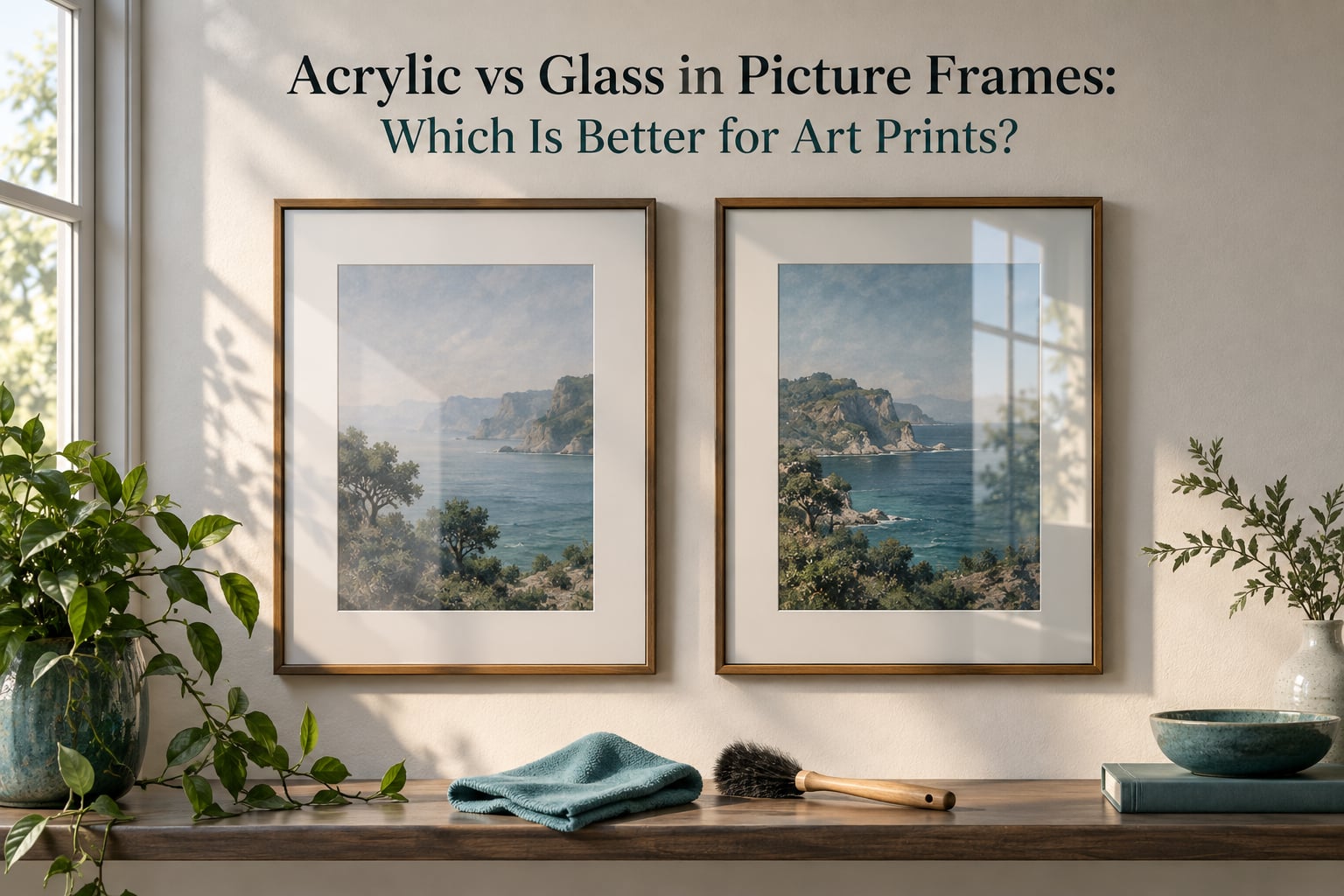
Glazing is the part of a picture frame most people ignore and then think about every time they clean it, hang it, or move it. Acrylic and glass do the same job, covering the print, blocking light, and keeping dust and fingers away from the paper. They behave very differently once the frame is on a wall.
The core question behind this guide is simple: which material protects an art print better over time? Short answer, acrylic wins on weight, impact, and built-in UV filtering, while glass wins on scratch resistance, optical neutrality, and long-term dimensional stability. The right pick depends on the size of the piece, where it hangs, and how much the artwork is worth to you.
We spent time comparing how acrylic vs glass picture frames handle art prints across real framers’ workflows, from small gitlee prints to large gallery pieces, and this guide covers what actually changes for your print. Updated for 2026.
Table of Contents
- Quick Answer: Acrylic or Glass for Art Prints?
- What Is Acrylic (Plexiglass) in Picture Frames?
- What Is Glass in Picture Frames?
- Acrylic vs Glass: Durability, Safety, and Weight
- Which Blocks More UV: Acrylic or Glass?
- Clarity, Glare, and Non-Glare vs Anti-Reflective
- Scratches, Dust, and Static Charge
- Acrylic vs Glass Cost Over the Life of a Frame
- How Each Glazing Reacts to Art Print Media
- Condensation, Vapor Barriers, and Acrylic Bowing
- How to Choose: A Step-by-Step Method
- When to Choose Acrylic
- When to Choose Glass
- Frequently Asked Questions
- Which is better for framing art, acrylic or glass?
- What are the disadvantages of acrylic photo frames?
- Why use acrylic instead of glass for pictures?
- Does acrylic scratch easier than glass?
- Is acrylic better than glass for UV protection?
- Should framed prints have glass or acrylic?
- How do you clean acrylic picture frames without scratching it?
- How do you stop condensation inside a picture frame?
- Conclusion
Quick Answer: Acrylic or Glass for Art Prints?
Choose acrylic for large frames, shipping, children’s rooms, high-traffic walls, and prints you want to move often. Choose glass for small to medium frames, scratch-prone spaces, sharp color-critical prints, and long-term archival display in a stable indoor room.
The single biggest practical difference: acrylic is roughly half the weight of glass at the same size, flexes instead of shattering, and blocks more ultraviolet light by default. Glass is harder, does not bend, and can be finished with true anti-reflective coatings that acrylic cannot fully match.
Choose acrylic when:
- The frame is larger than 24 x 36 inches and weight matters on the wall.
- The framed print will be shipped, carried to shows, or moved between homes.
- Children, pets, or a busy hallway are near the frame.
- You want the highest UV filtering without ordering a special coating.
- The artwork is pastel, charcoal, or another loose, friable medium.
- You plan to hang several frames in a row and want matching, easy handling.
Choose glass when:
- The frame is small enough that weight is not a factor.
- The wall gets touched often, or the frame sits at child eye level.
- Color accuracy matters more than convenience, such as product photography or skin tones.
- The print is valuable and the display location has stable humidity.
- You want a true anti-reflective museum glass that acrylic cannot duplicate.
- You are framing documents, certificates, or artwork with a dry, stable surface.
What Is Acrylic (Plexiglass) in Picture Frames?
Acrylic glazing is a rigid thermoplastic sheet, and plexiglass is simply the trade name most people use for it. It is produced by pouring liquid resin between polished plates, which is called cast acrylic, or by rolling it into a thinner sheet, which is called extruded acrylic.
Cast acrylic is the grade used for fine framing. It is optically clearer, more stable at large sizes, and resists the wavy distortion you see in cheap extruded sheet. Extruded acrylic is cheaper and fine for small decorative frames, but framer’s grade acrylic for art prints should always be cast.
Framing acrylic typically comes in 1.5mm thickness for standard frames, with 2.5mm and 3mm available for conservation work. Thin sheet is more likely to bow, so larger frames want thicker glazing and more rigid retaining hardware.
Brands you will see in this category include Acrylite, Shinkolite from Mitsubishi, and Vivak, a PETG sheet with optical clarity closer to cast acrylic. Framer’s grade means UV filtering and anti-static treatment are built in, not added later.
What Is Glass in Picture Frames?
Picture frame glass is almost always soda-lime float glass, the same base material as drinking bottles and window panes. It is cooled in an extremely uniform ribbon during manufacturing, which is why the surface is flat and the optical quality is excellent.
Standard framing glass blocks roughly 40% of ultraviolet light on its own. That is not enough for a pigment print you want to keep for decades, which is why conservation glass and museum glass exist as upgrades with stronger UV layers and reflection-canceling coatings.
Two glass options matter for art prints. Conservation clear glass sits at about 3mm and focuses on UV blocking with minimal visual change. Museum glass adds anti-reflective coating on both surfaces, which softens reflections dramatically but slightly reduces the perceived sharpness of fine detail.
Glass is also available as laminated or tempered safety glass, which breaks into small pieces rather than long shards. Framers use it for oversized work and for pieces in public or institutional settings.
Acrylic vs Glass: Durability, Safety, and Weight
Acrylic is far harder to break than glass, and that is the reason it has taken over large-format framing. A sheet of acrylic flexes and absorbs an impact where a pane of glass cracks into fragments and drops into the frame.
Weight is the second reason. Acrylic is roughly half as dense as glass, so a 24 x 36 frame loses a meaningful amount of weight on the wall. Framers report that large acrylic frames stay level better and put less strain on hanging hardware, which matters above 24 x 36 inches.
What this means in practice
- Frames under 16 x 20 inches: weight difference is barely noticeable, so decide on clarity and scratch risk.
- Frames between 16 x 20 and 24 x 36 inches: acrylic makes hanging noticeably easier and safer.
- Frames over 24 x 36 inches: acrylic is the default choice for most framers for weight and rigidity.
Safety runs the same direction. Professional photographers who exhibit at art shows report using acrylic exclusively after losing prints to breakage during transport, with no losses once they switched. Museums follow similar logic, often specifying acrylic for loans and travel cases.
Glass still has a durability advantage in one area. A hard glass surface shrugs off scuffs from dust, pets, and repeated cleaning, while acrylic shows fine scratches over years. In a busy hallway, a glass frame may look better simply because it has more surface tolerance.
Which Blocks More UV: Acrylic or Glass?
Acrylic blocks more ultraviolet light than standard glass at the same thickness. Standard acrylic blocks about 66% of UV naturally, while standard framing glass blocks around 40%. Conservation grades push acrylic to 95% or 99% UV blocking.
The UV protection ladder, lowest to highest
- Standard glass: about 40% UV blocking.
- Standard acrylic: about 66% UV blocking.
- UV acrylic such as OP-3: about 95% UV blocking, with a slight warm tint.
- Museum and conservation glazing: around 99% UV blocking for both materials.
Why this matters for art prints: lightfastness testing treats a well-filtered pane of glass and a well-filtered pane of acrylic as roughly equivalent protection. That is good news, because it means the default grade of either material can slow fading substantially when daylight hits the frame.
Two caveats. First, a UV-filtering acrylic with a strong coating can carry a warm tint, and that tint shifts blues and cools. Second, nothing stops fading completely. Even at 99% UV blocking, a print in direct sun will fade faster than the same print in indirect light, so placement matters more than the glazing grade.
Framers treat UV filtering as a modest line item compared with the frame itself. Spending a little more to move from 66% to 99% blocking is a reasonable move for a pigment or giclee print you plan to keep.
Clarity, Glare, and Non-Glare vs Anti-Reflective
Both materials show reflections, and both can be ordered in a matte or non-glare finish that diffuses reflection into a softer haze. Non-glare acrylic is widely available and works well, but it has one drawback: matte surfaces scatter light slightly, which can soften fine detail in a high resolution print.
Glass has an option acrylic cannot match, which is a true anti-reflective coating. Museum glass with this coating on both surfaces looks nearly invisible at normal viewing angles, which is why galleries and high-value print sellers favor it.
The tradeoff is a slight softening. Some print buyers notice the difference on very fine line work, such as architectural photography or black-and-white images, and prefer clear glass even when reflections are less convenient.
Cheap clear glass also carries a faint green tint from iron content in the batch. High quality framing glass minimizes this, but the tint is more visible against white mats and light paper. Clear acrylic is neutral, so it stays truer for color-critical work even in its lower grades.
A useful rule from framers: non-glare acrylic is a good default for most art prints, museum glass is worth it for a single hero piece on a feature wall, and clear glass suits a small room where lights are positioned to avoid glare anyway.
Scratches, Dust, and Static Charge
Acrylic is the number one complaint in framing forums, and it is almost always about scratches and static. Glass is harder than acrylic in the Rockwell hardness sense, so it resists everyday scuffing better. Acrylic is more forgiving of impact but more sensitive to abrasion.
Static is the other half of the problem. Acrylic builds an electrical charge as it is unwrapped, and that charge pulls dust, fiber, and pastel particles straight onto the glazing. Owners often blame the acrylic for scratching when the real sequence is static pulling in grit, then a cloth grinding that grit into the surface.
- Use a clean microfiber cloth dampened with plain water, never paper towel.
- Wipe in one direction rather than circles, which can create swirl marks.
- Use a product made for acrylic for anything beyond dust removal.
- For static, an anti-static brush or a dedicated static-reducing polish works well before the final clean.
- Keep glass cleaner on your shelf and use it on glass only, since residue left behind hazes acrylic.
Glass has its own version of the problem, which is condensation. A cold pane brought into a warm, humid room can fog on the inside surface, and framers treat this as a sign that the artwork needs a sealed or semi-sealed package with a proper back.
In dusty environments, an acrylic frame needs more frequent cleaning because it shows fingerprints and haze. In a low-traffic study, a glass frame may need attention once a year.
Acrylic vs Glass Cost Over the Life of a Frame
Sheet acrylic usually carries a higher per-sheet cost than basic framing glass, and the gap widens for conservation grades and thicker material. That is the purchase decision. The bigger question is what the frame costs you over its whole life.
Breakage is the line item that changes the math. Replacing glazing is straightforward, but a broken pane can damage the artwork underneath, and shipping damage claims often cover the frame rather than the full value of the print. Acrylic removes that risk category almost entirely for shipped work.
Where the money actually goes
- Glazing is a modest share of a custom frame total, with the moulding and matting usually costing far more.
- Acrylic raises the material line and can add to labor, because acrylic is cut differently from glass.
- Glass raises the risk line, since breakage means a replacement plus possible artwork damage.
- Moving a home is where a glass frame most often gets lost in a box.
Framers also note that acrylic sheet pricing tracks oil prices more closely than glass does, so quotes move over time for both materials. Get a current quote from your framer rather than budgeting from an old number.
For a poster or a family photo, spend less on the glazing grade and put the money into a better mat. For a limited edition print you own permanently, the UV grade is worth the small upgrade.
How Each Glazing Reacts to Art Print Media
This is where the difference matters most and where most comparisons stop short. Art prints are not all the same surface, and the glazing interacts differently with each one.
Giclee and pigment inkjet prints
These are stable, fully cured, and dry to the touch, so neither material causes a chemical reaction. Choose based on UV filtering and reflection. Clear acrylic keeps color neutral, while museum glass reduces glare at the cost of a slight softening.
Silver halide photographic prints
Traditional black and white and color photos are light sensitive in the same way pigment prints are, and the same UV rules apply. Silver gelatin prints also develop a silver mirror over time, which shows up more in reflective glazing, so anti-reflective glass is a genuine advantage for vintage photography.
Pastel, charcoal, and chalk
These are friable media, meaning the pigment is loose on the surface and transfers to anything that touches it. This is the one case where acrylic is clearly the right material, because a static dispersive coating prevents the drawing from lifting onto the glazing. With glass, the same artwork is handled with spacers or a sealed package instead.
Encapsulation and ferrotyping
Encapsulation is the technique of sealing the artwork directly between two sheets of acrylic, with spacers and barrier tape at the edges. It is standard practice for pastels, charcoals, and mixed-media works, and it simply cannot be done with glass without a spacers-and-tape package that is thicker and more fragile.
Ferrotyping, sometimes called Newton rings, happens when a print lies flat against a smooth surface and the slight surface tension causes it to bond in patches. It shows as dark rings or a mottled sheen across the image. Glass is more prone to it because it is flatter and more rigid. Spacers or a mat gap eliminate it with either material, and a conservation buffer in a sealed package solves it permanently.
Condensation, Vapor Barriers, and Acrylic Bowing
Glass is a vapor barrier by nature. It does not let moisture pass through it, which is why a sealed package with a rigid back protects an artwork from humidity swings in a room or during transport.
Acrylic is a thermoplastic and is slightly permeable to gases over long periods. For a framed print in a stable indoor room this is rarely a practical concern. In a damp location, an extreme humidity swing, or a museum-style loan, conservators still specify sealed packages with a polyflute backing board and barrier tape for long-term work.
Bowing is the acrylic trade-off most likely to surprise you. Because it is a polymer, a large sheet responds to humidity and temperature and can bow inward, which shows as a distorted reflection across the image. The effect is worst on thin sheet, on large panels, and on frames that flex when hung.
How to prevent bowing
- Use 2.5mm or 3mm acrylic instead of 1.5mm for anything over 24 x 36 inches.
- Choose cast acrylic over extruded sheet, which resists waviness.
- Use a rigid backer board and a retaining system that holds the sheet flat on all four sides.
- Hang large acrylic frames on a flat, solid wall rather than a textured or foam surface.
- Avoid pushing the sheet into a frame that is slightly undersized.
Acrylic also expands and contracts a little more with temperature than glass, so a tight fit is not a virtue. A framer who forces the sheet into a frame with no clearance is setting up a bowed or buckled panel.
How to Choose: A Step-by-Step Method
Work through these steps in order and the decision usually makes itself. Print this list and you have a printable checklist for your next framing job.
Step 1: Measure the frame, not the art
Check the finished outside dimensions. Under 16 x 20 inches, weight and impact are minor factors. Between 16 x 20 and 24 x 36, acrylic clearly helps. Over 24 x 36, treat acrylic as the default and choose glass only for a specific reason.
Step 2: Identify the medium
If the work includes pastel, charcoal, chalk, or any loose media, choose acrylic and ask about encapsulation. If it is a fully cured giclee, inkjet, or photographic print, either material works and the decision moves to light and handling.
Step 3: Set the UV target
Decorative piece: 66% acrylic or standard glass is fine. Print you want to keep a long time: move to 95% or 99% UV blocking. Valuable or limited edition work: specify museum or conservation glazing and ask for a written UV rating on the invoice.
Step 4: Think about the room, not the frame
Direct sun, a bright window opposite the wall, or a spotlit display all raise fading risk and glare. Bright, busy rooms raise breakage and scratch risk. Basements and exterior walls raise condensation and bowing risk.
Step 5: Decide how often the frame moves
Once a year or never, glass is fine. Show transport, moves, and rental rotations push you toward acrylic, which also lowers the value of a breakage conversation with an insurer.
Step 6: Match the grade to the glass or sheet
If you go non-glare on acrylic, expect a softer look. If you want the sharpest possible image and a controlled reflection, pair clear acrylic or clear glass with careful lighting. Ask for a sample before ordering a large quantity.
Step 7: Check the installation detail
Confirm the glazing thickness, the UV rating, the retaining hardware, and the backer board in writing before the frame is assembled. These four details prevent most of the problems that show up a year later.
When to Choose Acrylic
Choose acrylic when the frame is large, the wall is high, or the art travels. It is the standard for frames above 24 x 36, for gallery walls where many frames are installed in a day, and for art show and exhibition transport.
Choose acrylic for homes with children and pets, for hallways and stairwells, and for any frame that gets moved between rooms. It is also the better pick for pastel, charcoal, and mixed-media work because of the anti-static coating and the option to encapsulate.
Choose acrylic for outdoor-adjacent or humid-adjacent locations such as screened porches, basements, and rooms with big swings in humidity, and whenever the highest default UV filtering matters most without a special order.
When to Choose Glass
Choose glass for small and medium frames in quiet rooms where nothing bumps the wall. The optical neutrality, the hardness, and the wide range of anti-reflective finishes make it the traditional choice for fine art display.
Choose glass for high-value prints hung in a climate-controlled interior, especially when you want true museum glass and the sharpest possible image. Silver gelatin photography and fine line work benefit most from anti-reflective glass.
Choose glass for documents, certificates, and diplomas, and for any piece where a stable, non-permeable front with a sealed back matches your conservation plan. It is also the sensible pick for a large print that will never move if the wall hardware is rated for the weight.
Frequently Asked Questions
Which is better for framing art, acrylic or glass?
Acrylic is better for large frames, shipping, children’s rooms, and maximum default UV filtering. Glass is better for small frames, sharp color-critical images, high-traffic scratch-prone walls, and true anti-reflective museum finishes.
What are the disadvantages of acrylic photo frames?
Acrylic scratches more easily than glass, attracts dust through static charge, and can bow at large sizes if thin. Matte non-glare acrylic also softens fine detail slightly, so scratches and haze show sooner than on glass.
Why use acrylic instead of glass for pictures?
Acrylic weighs about half as much, will not shatter into shards on impact, and blocks more ultraviolet light at the same thickness. It also carries a static dispersive coating, which is why it is the standard for pastel and charcoal work.
Does acrylic scratch easier than glass?
Yes. Glass has a harder surface and tolerates everyday scuffs better. Acrylic resists impact but is more sensitive to abrasion, and static charge pulling grit onto the surface makes scratches appear sooner.
Is acrylic better than glass for UV protection?
At standard grades, yes. Standard acrylic blocks about 66% of UV compared with roughly 40% for standard glass. Conservation grades reach 95% or 99% for both materials, which is where they perform comparably.
Should framed prints have glass or acrylic?
Use acrylic for anything over 24 x 36 inches, for shipped work, and for homes with children. Use glass for smaller frames in quiet rooms, for color-critical prints, and when you want true anti-reflective museum glass.
How do you clean acrylic picture frames without scratching it?
Use a clean microfiber cloth lightly dampened with water, wipe in one direction, and use a product made for acrylic for anything beyond dust. Avoid paper towel, glass cleaner residue, and circular motions that create swirl marks.
How do you stop condensation inside a picture frame?
Condensation points to humidity inside the package. Seal the back with a rigid backer board and barrier tape, use spacers so the print does not touch the glazing, and control room humidity. Glass is a natural vapor barrier, so a sealed package with glass helps most.
Conclusion
If you are still weighing acrylic vs glass picture frames for art prints, start with size and handling rather than clarity. Acrylic wins the practical categories: weight, impact, shipping, and default UV filtering. Glass wins the display categories: hardness, optical neutrality, and true anti-reflective finishes.
For most art prints, a large frame, a move, or a house with kids, acrylic is the safer and smarter pick. For a small, valuable, color-critical piece in a quiet room, museum glass earns its place. Ask your framer for the UV rating, the thickness, and the glazing grade in writing, and you will have a frame that still looks right in 2026.