
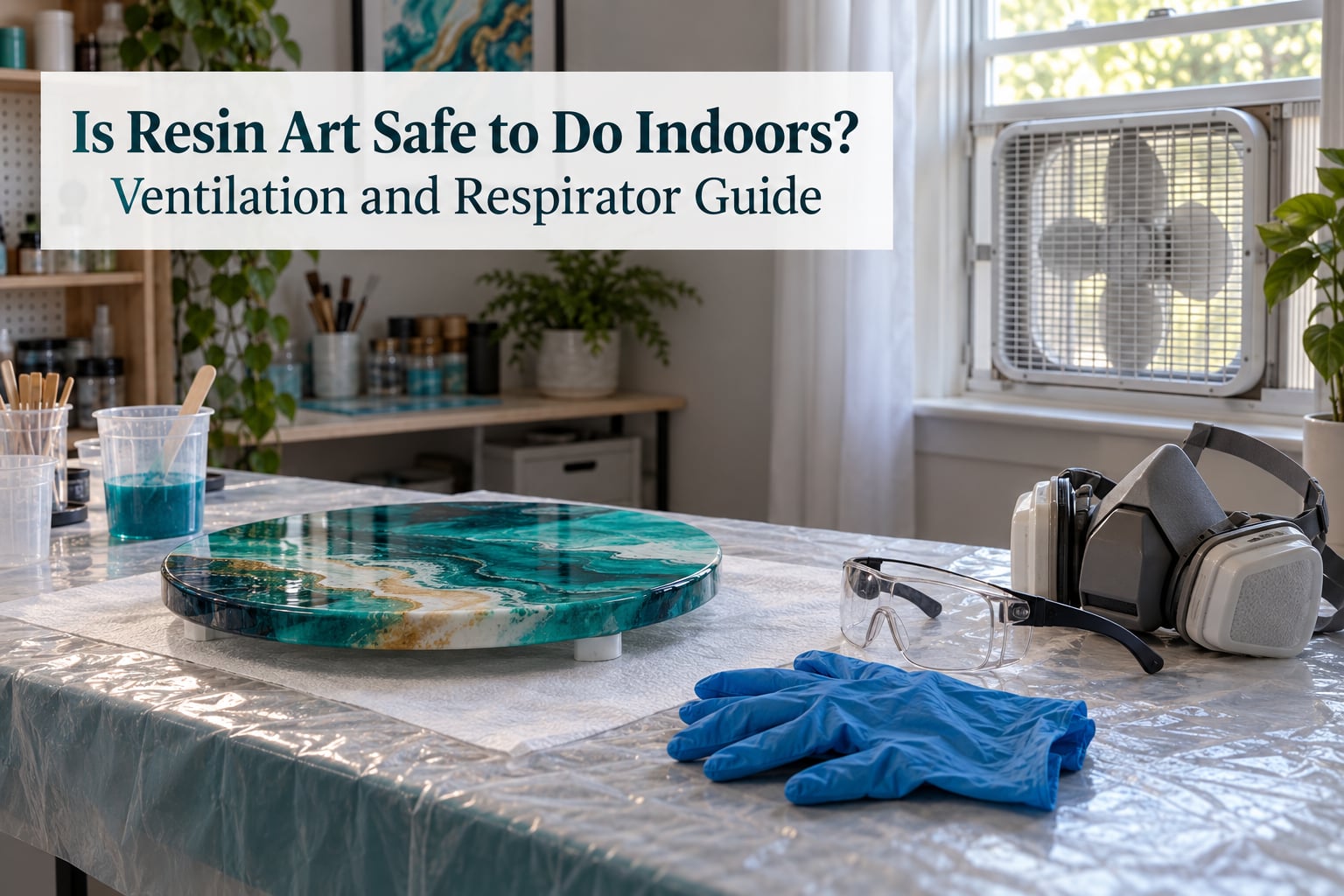
Yes, resin art is safe to do indoors, but only with active exhaust ventilation, a NIOSH-approved respirator with organic vapor and P100 cartridges, and chemical-resistant gloves worn every single time you pour. Those three controls are not optional extras. If a room cannot be ventilated to the outside, or you are not wearing the respirator, move the work outside or postpone it.
That is the honest answer to the question we get asked more than any other, and it is worth sitting with the second half of it. Plenty of hobbyists start pouring in a spare bedroom with a window cracked and a dust mask in a drawer, then wonder why they ended the evening with a headache.
The rest of this guide breaks down what resin fumes actually are, how to ventilate a room properly, which respirator filters do and do not work, how long to keep the air moving after a pour, and the warning signs that mean you should stop entirely. We are working from manufacturer safety data sheets, NIOSH respirator standards and the recurring questions in craft communities.
A note before we start: this is general safety information, not medical advice. Your resin’s own safety data sheet is the controlling document, because formulations differ. If you develop symptoms, talk to a physician.
Table of Contents
- Is Resin Art Safe to Do Indoors? The Short Answer
- What Resin Fumes Actually Are
- The Three Things That Make Indoor Resin Work
- How to Ventilate a Room for Epoxy Resin
- How Much Ventilation Do You Need? The Air Changes Math
- Respirators: Which One, and Is an N95 Good Enough?
- Do Air Purifiers Work? The Honest Answer
- Gloves, Goggles and the Rest of Your Gear
- How Long to Keep Ventilating After You Pour
- Working Indoors With Other People in the House
- Signs of Resin Sensitization
- Frequently Asked Questions
- What kind of respirator do I need to work with resin?
- Is an N95 mask ok for resin?
- Is epoxy resin toxic to breathe in?
- Do I need to wear a respirator when using epoxy resin?
- What are the symptoms of an epoxy skin reaction?
- What are the symptoms of resin toxicity?
- What does epoxy poisoning feel like?
- How long does it take for resin fumes to go away?
- Can I use an air purifier instead of ventilation for resin?
- How do I calculate air changes per hour for my room?
- Your Pre-Session Safety Checklist
- Final Verdict: Working With Resin Indoors
Is Resin Art Safe to Do Indoors? The Short Answer
Resin art is safe to do indoors when the room is under active exhaust that carries fumes outdoors, you wear a proper respirator for the entire session, and your skin is covered. Without those, the uncured resin reaction is a genuine exposure risk.
We have broken the whole thing into three conditions that have to be true at the same time. Miss any one of them and the setup is not safe.
- Exhaust air goes outside. Not into the hallway, not into a recirculating air conditioner, not into an attic. Out of the building.
- You wear an organic vapor respirator with a P100 filter. An N95 handles dust, not fumes.
- Your skin is protected. Nitrile gloves, goggles, long sleeves and closed-toe shoes.
None of these three is hard. The reason we say it plainly is that most accidental resin exposure happens through the gap between them. A person sets up a fan correctly, skips the respirator, and calls it a good session. That is the pattern we are trying to break.
One more framing point, because it matters for beginners: resin is not a single material. Epoxy, UV resin and polyurethane behave differently, and so do the manufacturers’ formulations. But the exposure pathway is the same in every case, which is why the same three rules apply across the board.
What Resin Fumes Actually Are
When you mix epoxy resin with its hardener, you start an exothermic chemical reaction. That reaction releases volatile organic compounds, or VOCs, which evaporate straight into the air at room temperature.
These VOCs are the primary inhalation hazard. They include epoxy components, amine hardeners, and in some products isocyanates. The amine cure in particular produces a strong smell that people mistake for proof of how much is escaping, when odor is actually a poor and unreliable measure of concentration.
Here is the part that catches people out. Off-gassing does not end when the pour ends. It continues from the moment you mix until the piece is fully cured, roughly 72 hours for most epoxies. A tabletop that has been hard to the touch is still off-gassing for days afterward.
The cured-safe myth. Many resin labels say non-toxic when cured, and that statement is technically true and practically misleading. The finished, fully polymerised piece is inert. The liquid you are pouring at the start of the session is not. The label describes the end state, not the process, and the process is where your exposure happens.
Low-VOC is another label worth reading carefully. It describes a reduction, not an absence. A low-VOC epoxy releases fewer VOCs than a conventional one, but it still releases them, and it still off-gasses through the full cure.
Add to the mix a chemical reaction that can run hot enough to smoke if you pour a large volume at once, and you have a situation where the fumes can get worse mid-project, not just at the start. Pouring smaller batches keeps the exotherm under control and keeps your peak exposure down.
The Three Things That Make Indoor Resin Work
Before the details, here is the whole rule set in miniature. If a room cannot satisfy all three, it is the wrong room.
One: exhaust to the outside. Air enters the room from a window or door and leaves through a fan mounted in a second opening, pointing out. That is what moves fumes out of your breathing zone and out of the building.
Two: a NIOSH-approved respirator with organic vapor cartridges and a P100 filter. The organic vapor cartridge handles the gas-phase VOCs. The P100 handles the fine particles, including any mist from pouring and the dust from sanding cured pieces later on.
Three: nitrile gloves, goggles, long sleeves, closed-toe shoes. Skin contact with uncured epoxy is the most common route of sensitisation, and it is far easier to prevent than to undo.
That is the entire method. Everything further down this page is just the detail on how to execute each one.
How to Ventilate a Room for Epoxy Resin
Resin ventilation means capturing fumes at the source and exhausting them outdoors. Not filtering them back into the room, and not diluting them until the smell fades. There is no substitute for moving the air out of the building.
Here are five tiers, from simplest to most controlled.
Tier 1: Open windows and cross-ventilation
Two openings on opposite walls, both wide open, positioned so air flows across the work surface. This is the bare minimum and it works for small pours in a large room on a still day.
Its limit is obvious: it depends on the weather, it cannot be made stronger than a breeze, and it does nothing when the wind is not cooperating. Treat it as a starting point rather than a finished setup.
Tier 2: A box fan exhausting out a window
A window air circulator reversed so it blows out the window, with a make-up air opening on the opposite side of the room. This is the most common step up for apartment dwellers, because it needs no fixed installation.
Two details make it work. Secure the fan so it cannot fall out, and leave a gap around the fan and window frame for make-up air, or you will choke the airflow and reduce it to nothing.
Tier 3: A window exhaust fan
A purpose-built unit that seals into an open window and exhausts through it, usually with a built-in backdraft damper so air cannot reverse. Cleaner, quieter and more reliable than a reversed box fan.
Look for a unit with a variable speed controller. Low speed for small jewelry-scale pours, high speed for large pours where the off-gassing rate is much higher.
Tier 4: An inline duct fan with ducting to outdoors
A duct fan mounted in flexible or rigid ducting that runs to an exterior vent or out through a window. This is the setup most people in apartments and houses without a window in the work room end up with, because you can exhaust through a wall, a soffit or a bathroom-style exterior vent.
This tier pairs naturally with a containment tent. A grow tent or epoxy tent over the work area, with a duct collar and an inline fan pulling air through the tent and out the window, gives you a controlled capture point and keeps fumes out of the rest of the house.
Important warning: a tent with no fan gives you no safety benefit at all. A sealed tent without extraction traps fumes where you are working, which is worse than having no tent.
Tier 5: Dedicated extraction booth or studio
A dedicated room with a fixed exhaust, ideally running a negative pressure to the rest of the house so air is drawn in rather than leaking out under the door. This is the setup for large pours, frequent work, or anyone doing river tables and wall pieces.
Two warnings that apply to every tier. First, always exhaust outward. Blowing air into the room spreads fumes through the whole space. Second, never combine resin work with a recirculating air conditioner or a portable HVAC unit in the same room. Those units move contaminated air around the room and can deposit it on surfaces and ducting where other people will later breathe it.
How Much Ventilation Do You Need? The Air Changes Math
The number most guides give and rarely explain is air changes per hour, or ACH. It is how many times the entire volume of a room’s air gets replaced in one hour. For resin work, eight air changes per hour is a common working target.
Here is the calculation, step by step.
Step 1: measure the room in cubic feet. Multiply the room length by width by height, in feet. A 10 by 12 foot room with 8 foot ceilings is 960 cubic feet.
Step 2: read the fan’s CFM rating. Cubic feet per minute is the airflow figure printed on the fan or in its manual. Use the manufacturer number, not your estimate.
Step 3: calculate ACH. Divide the CFM by the room volume, then multiply by 60. The formula is ACH = (CFM x 60) / cubic feet.
Step 4: compare against the benchmark. Using the numbers above with a 400 CFM fan gives (400 x 60) / 960 = 25 air changes per hour, which is well above the target of 8. A single open window in the same room gives you a fraction of one.
Step 5: verify it in the room. Hold a tissue or a smoke pencil near the exhaust opening. If the air is being pulled out steadily, the airflow is working. This is a sanity check, not a measurement, but it catches a reversed fan or a blocked window immediately.
Two caveats worth keeping in your head. The real requirement comes from the manufacturer of your specific resin, and their safety data sheet takes priority over any number in this article. And air changes per hour is a room-wide average, which is why capture at the source still matters: fumes released in one corner do not mix evenly into the whole volume.
Respirators: Which One, and Is an N95 Good Enough?
Direct answer: an N95 alone is not enough for resin. It filters particles, not VOCs. An N95 is built to capture solid and liquid particulates. Resin fumes are gases and vapours, and a particulate filter will not stop them.
That is not a minor gap. A mask can feel like protection while doing nothing for the actual exposure pathway, which is why this one comes up so often in craft communities.
| Respirator or filter | What it actually filters | NIOSH rating | Use it for resin? |
|---|---|---|---|
| N95 mask | Solid and liquid particles only, such as dust and mist | N95 | Not for fumes. Fine for sanding dust alone. |
| N100 or P100 particulate filter | Particles, at higher efficiency than N95 | N100 or P100 | Yes, as the particle half of a combination cartridge. Not a fume solution on its own. |
| Half-face respirator with organic vapor cartridge plus P100 pre-filter | Gas-phase VOCs and particles together | NIOSH approved combination | Yes. This is the standard indoor setup for small pours. |
| Full-face respirator with organic vapor cartridge plus P100 filter | VOCs and particles, plus your eyes and face | NIOSH approved combination | Yes. Best choice for large pours, sanding, and anyone with existing sensitivity. |
Half-face or full-face? A half-face mask covers the nose and mouth, which means you still need separate goggles. A full-face mask covers the eyes as well, which removes a whole category of splash risk and makes it the better option if you do large pours or sand cured resin.
Full-face is the choice we recommend for beginners who can manage the fit. It protects more, and it is one piece of gear instead of two.
Check for NIOSH approval. Look for the NIOSH approval mark on the mask body. An approval stamp means the exact combination of mask, cartridge and filter has been tested and certified together. This is the single most useful spec to check, and readers consistently rank respirator standards above brand names.
Fit check every time. A respirator that does not seal is a respirator that does not work. Do a negative pressure check by covering the filter inlet and inhaling gently, which should make the mask collapse slightly against your face. Then do a positive pressure check by covering the outlet and exhaling, which should push air out without leaking at the edges.
Facial hair, glasses with temple arms that cross the seal, and scarves all break the seal. If you have facial hair that interferes, a full-face mask with a good fit test is worth the extra effort.
Replace cartridges on schedule, not on smell. Organic vapor cartridges lose capacity as they load, and the standard guidance is to replace them at around 40 hours of use or 30 days after opening, whichever comes first, or immediately if you smell resin through the mask. Never clean or wash the cartridges. Clean and store the mask itself, and keep cartridges sealed until you need them.
Do Air Purifiers Work? The Honest Answer
A HEPA air purifier reduces particles in the air. It does not remove VOCs, and it is not ventilation.
An air purifier is a filter, and filters do not exhaust. A unit with an activated carbon layer can reduce the smell somewhat by adsorbing some vapour at the surface of the carbon, but the contaminated air is then recirculated back into the room rather than removed from the building. A purifier is a good addition to a room that is already properly vented. It is never a substitute for the exhaust.
There is a second limitation. Carbon media has a finite capacity, and once it is loaded it stops absorbing, which often happens without any obvious signal to the user. That means a carbon unit can appear to be working right up until it quietly is not.
If you have a purifier in your setup, treat it as a bonus for dust and odour, not as your fume control.
Gloves, Goggles and the Rest of Your Gear
Nitrile gloves, never latex. Uncured epoxy can trigger latex allergies, and nitrile is the standard choice for resin work. Choose 4 to 6 mil thickness with an extended cuff so the wrist stays covered. Change them immediately if resin contacts the outside, and wash your hands and forearms with soap and water afterward.
Goggles, not safety glasses. You want chemical splash goggles with indirect vents, which deflect a splash away from the lens rather than letting it hit your eye. Glasses with side shields do not protect against a splash that comes from the front or from a pour that runs down the side of a mold.
Long sleeves or coveralls. Disposable coveralls are the simplest option for anyone working regularly. Closed-toe shoes matter, because a spill at bench height ends up on your feet first.
Barrier cream applied to exposed skin before you start reduces the chance of resin reaching it. It is not a substitute for gloves, and it is not a substitute for washing.
First aid, in order of likelihood. Skin contact: wipe with a dry cloth, then wash with soap and water for at least 15 minutes. Do not reach for solvents or acetone on skin; they drive the resin deeper and are themselves irritants. Eye contact: flush with clean lukewarm water for 15 to 20 minutes, remove contact lenses if present, and get medical attention. Inhalation: move to fresh air immediately, and call Poison Control at 1-800-222-1222 in the United States if symptoms persist. Ingestion: call Poison Control rather than inducing vomiting.
Many beginners reach for a solvent when resin hits skin, which is the wrong instinct and a common source of irritation. Water and soap handle the majority of small skin contacts.
How Long to Keep Ventilating After You Pour
Keep the exhaust running for the entire cure. Not until the pour is finished, and not until the surface stops looking wet.
Typical epoxy timelines look roughly like this. Soft cure, where the piece is no longer liquid, runs to around 8 hours. Hard cure, where it is solid to the touch, is usually reached somewhere around 24 hours. Full cure, where the polymerisation has finished, takes up to about 72 hours.
Off-gassing tracks that whole window. The VOCs are released continuously as the reaction runs, which means the ventilation needs to run continuously too. Many people set up an excellent exhaust, pour, turn the fan off when they leave, and undo most of the benefit.
Practical guidance: leave the exhaust running until the piece has reached full cure at roughly 72 hours, keep the room closed to the rest of the household while it does, and keep children, pets and anyone with asthma out of the room entirely until then. Covering the piece slows nothing, but it does stop dust and pet hair from settling into the finish.
Working Indoors With Other People in the House
The question behind most of the messages we receive is not really about the person pouring. It is about the family in the next room, the neighbour in the next apartment, and the pet that lives under the workbench.
Here is how the guidance changes by room type.
| Space | Verdict | Minimum sensible setup |
|---|---|---|
| Apartment or condo | Workable with care. Fume migration to neighbours is the main risk. | Dedicated exhaust to the outside, door under negative pressure, gasket or draft stoppers on the door gap, and no work during hours when neighbours are home with windows open. |
| Spare bedroom or home office | Acceptable for small pours only. | Window exhaust fan on the far wall, make-up air from the door, room closed to the household for the full 72 hours, respirator worn for the full session. |
| Basement workshop | Good choice. Egress is easy and airflow is easier to control. | Inline duct fan exhausting outdoors through a wall vent, monitor for radon and combustion appliance exhaust before you rely on it. |
| Garage studio | One of the better indoor options. | Ducted exhaust to outdoors, garage door kept down, and a hardener inventory kept sealed when not in use. |
| Dedicated studio | Best case. | Fixed exhaust with a negative pressure setup, containment tent for large pours, and a defined resin-only zone with its own storage. |
On fume migration, which is the number one concern we see: the paths are the HVAC return grille, the gap under the door, and any shared stairwell or hallway air. Closing or blocking the return grille nearest your work room reduces the first path. A draft stopper or a rolled towel at the door handles the second. Plastic sheeting hung over the doorway makes a cheap air barrier when you need a real seal.
For households with young children, pets, a pregnant partner, or anyone with asthma, the safest answer is to move the resin work out of the living space entirely, and to keep the cured pieces somewhere the household can enjoy them without sharing the air with the uncured product.
There is also a question about whether respirators are needed outdoors. The honest answer is that it is a matter of preference, and being over-protected is the better default.
Signs of Resin Sensitization
Sensitisation is an immune system reaction to a substance that your body tolerated early on and then started rejecting. Once it develops, it is usually permanent, and it can end your ability to work with resin at all.
The pattern that matters is this: symptoms that begin mildly, seem to settle, and then get noticeably worse each session. Most people misread that as stress or a coincidence. It is the clearest signal that sensitisation is developing.
On skin, look for a red itchy rash that started where resin contacted you, small bumps or blisters, and a reaction that appears after contact rather than during it. A reaction that shows up 12 to 24 hours after exposure, rather than immediately, is characteristic.
On breathing, look for a cough or wheeze that starts after a session, chest tightness, shortness of breath, and headaches and dizziness that arrive in the room and clear once you leave it. Nasal irritation and a runny nose during or after a pour are common earlier signs.
Community members routinely attribute these reactions to an allergy to something else, when they are in fact sensitisation from repeated unprotected exposure. That is why prevention matters more than detection here, because by the time it shows up, the damage is largely done.
If you notice any of these: stop pouring for now, and keep the area ventilated. Wash any skin contact with soap and water. Note what you were working with and when, because that record helps a physician enormously. See a doctor or dermatologist about persistent symptoms. Do not go back to unprotected work and hope the next session goes better, because for a sensitised person it will not.
Frequently Asked Questions
What kind of respirator do I need to work with resin?
You need a NIOSH-approved half-face or full-face respirator fitted with organic vapor cartridges for the VOCs and a P100 or N100 filter for particles. A full-face mask also protects your eyes from splashes. Replace organic vapor cartridges at about 40 hours of use or 30 days after opening, whichever comes first.
Is an N95 mask ok for resin?
An N95 is not enough on its own. It is designed to filter solid and liquid particles such as dust, not the gas-phase VOCs that epoxy and hardener release while curing. You will feel a sense of protection that does not match what the filter actually does. A P100 particulate filter is the right choice for sanding cured resin dust.
Is epoxy resin toxic to breathe in?
Uncured epoxy releases volatile organic compounds as the resin and hardener react, and those VOCs are the main inhalation hazard. Exposure can cause irritation, headache, nausea and dizziness, and repeated unprotected exposure can lead to chemical sensitisation. A fully cured piece is inert, but the liquid product during use is not.
Do I need to wear a respirator when using epoxy resin?
Yes, whenever you mix, pour or sand resin indoors. Wear it for the whole session, not only during the pour, because off-gassing continues as the piece cures. A respirator is one of three required controls, alongside exhaust ventilation to the outdoors and chemical-resistant gloves.
What are the symptoms of an epoxy skin reaction?
A red, itchy rash beginning where resin contacted skin, small bumps or blisters, and swelling. Reactions that appear 12 to 24 hours after exposure rather than immediately are typical. This is how sensitisation starts, and it is usually permanent once it develops. Wash with soap and water, stop exposing the area, and see a dermatologist.
What are the symptoms of resin toxicity?
Common signs include a cough or wheeze after a session, chest tightness, shortness of breath, nasal irritation, and headaches and dizziness that begin in the work room and clear once you leave. Skin irritation and rash are also frequent. If symptoms arrive during a pour, get to fresh air, stop work, and call Poison Control at 1-800-222-1222 if they persist.
What does epoxy poisoning feel like?
Short-term exposure is usually described as a heavy or sweet chemical smell, a chemical burn in the nose and throat, a cough, and a headache that builds over a session. If the smell suddenly gets stronger on a large pour, that is the exotherm running hot. Get to fresh air, ventilate the room, and do not return until the air has cleared.
How long does it take for resin fumes to go away?
Epoxy is typically soft-cured at around 8 hours, hard-cured at around 24 hours, and fully cured at up to 72 hours. Off-gassing continues across that whole window, so keep the exhaust running the entire time and keep the room closed to the rest of the household until full cure.
Can I use an air purifier instead of ventilation for resin?
No. A HEPA purifier removes particles, and activated carbon can adsorb some vapour at a limited capacity, but both recirculate the air instead of removing it from the building. Purifiers are a useful addition to a properly ventilated room and cannot replace exhaust that goes outdoors.
How do I calculate air changes per hour for my room?
Multiply the room length by width by height in feet to get cubic feet, then divide the fan’s rated CFM by that number and multiply by 60. The formula is ACH = (CFM x 60) / cubic feet. Eight air changes per hour is a common working target for resin work, but your resin manufacturer’s safety data sheet takes priority.
Your Pre-Session Safety Checklist
Run through this before every pour, not just the first one of a project.
- Safety data sheet read for your specific resin and hardener, with Section 2 hazards and Section 8 exposure controls reviewed.
- Exhaust fan running and exhausting outdoors, with a clear make-up air path into the room.
- Airflow verified with a tissue or smoke pencil at the exhaust opening.
- Room volume measured and air changes per hour confirmed against your target.
- Respirator in place, NIOSH approval mark checked, and both pressure fit checks completed.
- Organic vapor cartridges within their replacement window, and not past any smell breakthrough.
- Nitrile gloves on, 4 to 6 mil, cuffs tucked into your sleeves.
- Chemical splash goggles on, or a full-face respirator covering your eyes.
- Long sleeves or coveralls on, and closed-toe shoes.
- Hair tied back, room cleared of food, and no children, pets or vulnerable household members present.
- Work planned in small batches to keep the exotherm under control.
- Calendar reminder set for 72 hours to keep ventilation running through full cure.
Final Verdict: Working With Resin Indoors
Resin art is safe to do indoors, and a lot of beautiful work gets made in ordinary rooms. The safety comes from three conditions holding at the same time: exhaust ventilation that carries fumes outdoors, a NIOSH-approved respirator with organic vapor and P100 cartridges, and nitrile gloves with goggles and covered skin.
If your space cannot support a real exhaust, the answer is to change the space, not the rules. Seal resin work into a tent with ducted extraction, move it to a garage or basement, or work outside.
Read the safety data sheet for the bottle in front of you, set up the fan before you open the cap, and you will get years of clean sessions out of a small room.