
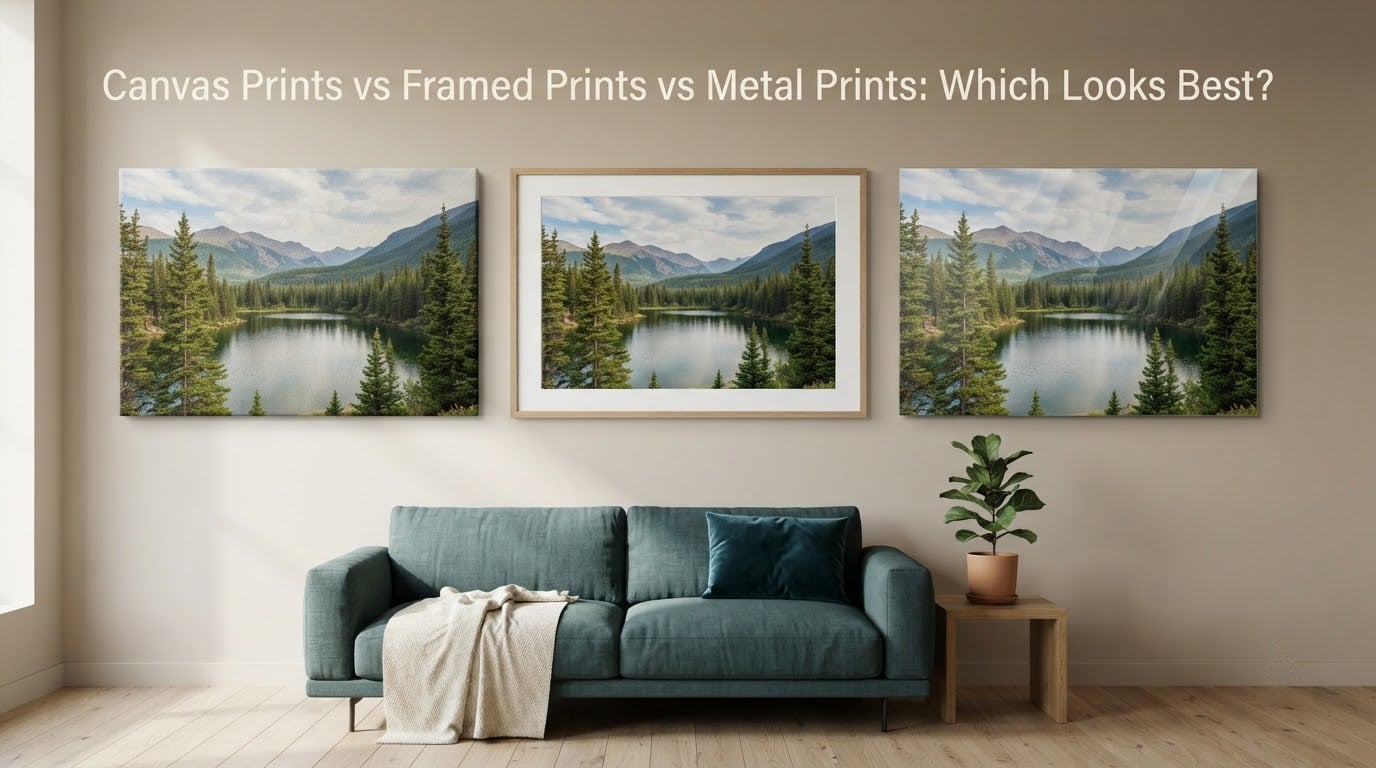
Short answer: canvas prints look best for warm, textured, painterly images in living rooms and bedrooms; framed prints still win for small sizes, multi-piece sets and keepsake gifting; metal prints look best for modern interiors and photographs that need punch and longevity. There is no single best print medium, because each one handles light, texture and durability differently.
That is the whole argument behind most of the confusion in canvas prints vs framed prints vs metal prints discussions online. People treat it as a ranking when it is really a match between a substrate and a room. This guide breaks down what each medium is made of, how it handles light, how long it lasts, and where it belongs on a wall, so you can pick the one that suits your photo and your space.
I have hung versions of all three in the same house over the years, moved them between rooms, and watched how each one aged. The short version: the medium changes the mood, the perceived sharpness, the hanging effort and the lifespan, and no amount of resolution fixes a wrong choice of substrate.
Table of Contents
- Canvas Prints vs Framed Prints vs Metal Prints at a Glance
- What Is a Canvas Print?
- What Is a Framed Print?
- What Is a Metal Print?
- How Canvas, Framed, and Metal Prints Actually Look
- How Long Each Print Lasts
- What Each Print Costs at Common Sizes
- Canvas Depth: Thin vs Thick Gallery Wrap
- Should You Frame a Metal Print?
- Image Resolution and DPI You Actually Need
- Which Print Looks Best in Which Room?
- Which Print Suits Your Type of Photo?
- Is Metal or Canvas Wall Art Outdated?
- Care and Cleaning
- Print Jargon Glossary
- How to Choose: A 5-Minute Decision Checklist
- Frequently Asked Questions
- Are metal prints better than canvas?
- Should canvas prints be framed?
- Should you frame a metal print?
- Are metal photo prints worth it?
- Which print is best for wall art?
- What looks better, canvas or print?
- Is metal wall art still in style?
- Are canvas prints outdated?
- Do metal prints fade in sunlight?
- How long do canvas prints last?
- The Verdict
Canvas Prints vs Framed Prints vs Metal Prints at a Glance
The table below is the fastest way to see the differences. Each row is a factor you actually feel when the print is on the wall.
| Factor | Canvas Print | Framed Print | Metal Print |
|---|---|---|---|
| Surface | Woven cotton or cotton-poly fabric | Photo paper, matte, satin or glossy | Aluminium or Dibond panel |
| Look | Soft, textured, painterly | Sharp, clean, traditional | High-contrast, luminous, modern |
| Colour | Slightly muted by the weave | Most accurate, best tonal range | Most saturated, punchy blacks |
| Glare | None, no glass involved | Possible under glass or acrylic | Reflective surface, angles matter |
| Moisture | Delicate, avoid damp rooms | Vulnerable behind glass in humid rooms | Wipeable, most forgiving |
| Scratches | Abrasions catch the weave | Surface scratches rare, glass is fragile in transit | Scratches and fingerprints show easily |
| Weight | Light to moderate | Heaviest at large sizes | Similar to framed canvas, often lighter |
| Cost tier | Entry to mid | Entry, frame adds cost | Mid to premium |
| Best in | Living rooms, bedrooms, nurseries | Hallways, gallery walls, gifting | Modern rooms, kitchens, offices |
| Care | Dry microfibre cloth only | Dust glass, keep out of sun | Wipe with a damp cloth |
What Is a Canvas Print?
A canvas print is a photograph printed with pigment-based ink onto woven fabric, then stretched over a wooden frame. The frame is made from stretcher bars, and the fabric is pulled taut across the front and folded around the edges.
When the image continues around the sides with no visible border, that style is called gallery wrap. Most gallery-wrapped canvases arrive ready to hang with a wired back or a sawtooth hanger already fitted, and there is no glass anywhere in the process, so there is nothing to glare or break.
The weave is the tradeoff. It breaks up fine detail very slightly, and a low-quality canvas can read as rough, thin and slightly yellow under warm light. A good cotton or cotton-poly blend with archival pigment ink looks far better than the cheapest option, and the difference is visible at arm’s length. The first canvas I ever bought failed on exactly that second point, which is why I now check the material description before anything else.
What Is a Framed Print?
A framed print is a photograph printed onto paper and then mounted in a wooden frame. The paper may be traditional silver halide or an inkjet giclee print, and the surface finish is usually matte, satin or glossy.
Most framed prints sit behind a mat board, which is a thick card window that holds the image off the glass and creates a clean white border. The front is covered with glass, acrylic or UV-filtering glass that blocks a large share of fading ultraviolet light.
This is the oldest and most familiar format, and it is still the most flexible one. You can swap the frame or the mat later, build a gallery wall out of matching sizes, and print a whole series of small pieces at a consistent size. It is also the only one of the three you can cheaply produce in quantity.
What Is a Metal Print?
A metal print is a photograph printed onto an aluminium panel or a Dibond composite, which is two thin aluminium sheets bonded to a rigid plastic core. The image is applied by dye sublimation, where ink turns to gas and bonds into the coating, or by UV printing, and the finished panel is usually sealed under a UV lamination layer.
Because the surface is non-porous, it does not absorb ink the way fabric or paper does. Colours land on top rather than sinking in, which is why metal prints look saturated and slightly luminous, with deep blacks and crisp edges.
Most metal prints come with a metal subframe already fitted, giving them a floating look and a ready-to-hang fitting. Note that a face-mount print under acrylic is a different product: the image sits under a clear plexiglass sheet on a foam board, which gives a glossy, depth-rich look at the lowest price of the three glossy options.
How Canvas, Framed, and Metal Prints Actually Look
Each medium changes how light interacts with the image. Canvas diffuses light through a woven texture, so detail is softened and colour is slightly muted, which reads as painterly. Paper reflects light off a smooth surface, giving maximum sharpness and the widest tonal range, at the risk of glare under glass. Metal reflects light off a hard surface, making colours look luminous and highly saturated.
If you are asking what looks better, canvas or print, the honest answer is that canvas wins for atmosphere and framed print wins for accuracy. Photographers who moved from canvas to framed prints describe the framed version as closer to the file, with the texture stripped away and every fine detail legible.
On the question of whether metal prints are better than canvas, the answer depends on the room rather than the medium. On dpreview forums, photographers generally recommend metal only when the artwork will hang somewhere dark and low-glare, and prefer canvas or a framed print for bright, sunlit rooms. The same thread raises the reverse concern: a reflective surface shows fingerprints and scratches easily, particularly in transit.
How Long Each Print Lasts
Longevity depends on ink, substrate, lamination and light. Fujifilm states a minimum of 75 years for its laminated aluminium prints, even with some direct sun exposure, and that named figure is the most concrete longevity claim in this category.
Canvas and framed prints both use archival pigment ink, which resists fading for decades indoors. The weak point is not the ink but the material around it: canvas stretches and can bow over years, especially on thinner frames and in fluctuating humidity, and framed paper yellows at the edges where the mat meets the glass.
Two practical warnings from photographers on FredMiranda: large stretched canvases are the ones that sag and warp over time, and metal prints are deceptively easy to scratch or fingerprint during shipping. If a metal print will travel, inspect it on arrival before it goes on the wall.
What Each Print Costs at Common Sizes
Prices move constantly, so this is a qualitative guide rather than a price list. At small sizes such as 8×10, framed paper prints and canvas are both entry tier, while metal sits one step above. At mid sizes around 16×20, canvas stays the most affordable, framed prints jump because the frame and glazing scale with area, and metal sits close behind canvas.
At large sizes such as 24×36 the gap widens. Canvas remains the cheapest per square foot, metal holds a middle position, and framed prints become the most expensive because of the frame, mat and glass. Value for money is usually best on canvas for a single large piece and best on framed paper prints for sets of small pieces.
Canvas Depth: Thin vs Thick Gallery Wrap
Should canvas prints be framed? It depends entirely on the stretcher bar depth. Thin canvases are mounted on 3/4 inch stretcher bars and sit close enough to the wall to drop into a traditional frame, which is how they are designed to be used. Thick gallery-wrapped pieces use 1-1/2 inch bars and are meant to be displayed frameless.
A floating frame is the middle ground. The frame has a deep rebate that grips the sides of the canvas while leaving the front edge visibly floating, and it works with both depths. The reason to frame a thick canvas is to control the shadow, not to add protection.
Whichever depth you choose, the bowing risk photographers warn about is real above roughly 24 inches on the thinner bars. Go thicker for a large piece, and check that the back is properly barred before you hang it.
Should You Frame a Metal Print?
Usually no. A metal print is rigid and self-supporting, and the built-in subframe already creates the floating look a frame would provide. Adding a traditional frame usually just adds cost and depth you did not need.
The one exception is if you are matching an existing gallery wall of framed pieces and want the metal print to sit at the same visual weight. A slim float frame handles that, and it goes on without glass, since glazing a metal print only adds reflections.
Image Resolution and DPI You Actually Need
Use the sizing rule from Fujifilm: take your print size and add two zeros. A 20×24 inch print needs roughly a 2000×2400 pixel file, which is a 2:3 aspect ratio, the standard frame of most modern cameras.
As a working minimum, 150 DPI is enough for canvas, because the weave hides softness. Aim for 200 to 300 DPI on framed prints and metal, where the eye looks for crispness. Below about 100 DPI at your chosen size, an image looks pixelated, and no amount of sharpening fixes it.
If your file is smaller than the size you want, enlarging it will show its limits. The common mistake is ordering a statement-wall size from a cropped social media image and being disappointed by softness.
Which Print Looks Best in Which Room?
Room choice matters more than most people expect, mainly because of light and humidity. Here is the short verdict.
| Room or situation | Best choice | Why |
|---|---|---|
| Living room above the sofa | Canvas | Warm texture suits soft furnishings and hides wall texture |
| Bedroom | Canvas or framed print | Calm surface, low light, either finish works |
| Kitchen | Metal | Wipeable and unfazed by cooking steam or splashes |
| Bathroom | Metal | Most resistant to humidity of the three |
| Entryway hallway | Framed print | Traditional finish suits a narrow space and can be grouped |
| Nursery or child’s room | Canvas | No glass to break, forgiving of scuffs |
| Home office | Metal or framed print | Clean lines, low maintenance near a desk |
| Gallery wall, many small pieces | Framed print | Consistent sizing and cheap to repeat |
| Cabin or outdoor-adjacent space | Metal | Hunters and outdoor photographers treat it as the low-maintenance pick |
One note on the wet rooms: none of the three is waterproof, and a metal print in a bathroom still deserves ventilation. It simply tolerates humidity better than fabric or paper behind glass.
Which Print Suits Your Type of Photo?
Match the medium to the image and you will spend less time compensating later. Scenic wide shots with fine detail reward the sharpness of a framed print or the crisp edges of metal, and the weave of canvas can swallow distant textures. When I want the file to read exactly as it does on my screen, that rules canvas out immediately.
Portraits and family photographs are the strongest case for canvas. Skin tones sit naturally on fabric, and the texture softens the digital look that makes large portraits feel clinical on metal. Weddings and keepsake gifting also favour framed paper prints, because the smaller sizes are affordable in multiples and can be matched into a set.
Black and white images look excellent on all three, but the tonal handling differs. Metal gives the deepest blacks and the most contrast, canvas softens the range into a gentler grey, and paper with a matte finish sits in between with the most visible grain.
Low-light and night photography is where metal earns its place. Bright highlights and saturated colour survive the reflective surface where canvas would mute them.
Is Metal or Canvas Wall Art Outdated?
Neither is outdated, and the question is really about interior style. Metal still reads as contemporary and suits clean-lined, modern, industrial and minimalist rooms. Canvas is currently the most flexible of the three, because its warmth works in both traditional and modern homes, which is why so many decorators default to it.
What has fallen out of favour is a glossy, over-saturated large print hung without any relationship to the furniture. Subtlety of finish matters more than the substrate name. A matte canvas in a quiet frame reads as considered; a high-gloss metal print in a bright room can read as dated within a few years.
Care and Cleaning
Keep it simple and avoid chemicals. Dust canvas with a dry microfibre cloth and never use water or solvent, because ink on fabric will lift or bleed. For framed prints, clean the glass with a glass cleaner applied to the cloth rather than the pane, and keep the piece out of direct sun.
Metal is the only one you can wipe with a lightly damp cloth, which is why it suits kitchens and entryways. Use a clean lint-free cloth so you do not grind grit into the lamination, and check the surface for fingerprints before it is mounted.
Print Jargon Glossary
These are the terms you will meet on any print vendor’s page. Giclee is a high-resolution inkjet process using archival pigment ink. Gallery wrap means the image wraps the sides of the stretcher bars with no visible border. Stretcher bars are the wooden frame the canvas is stretched over, usually 3/4 inch or 1-1/2 inch deep. Border wrap is the alternative where a flat white or coloured margin is printed around the image.
Dibond is a rigid aluminium composite panel, while subframe is the metal block fixed to the back of a metal print to create a floating standoff. UV lamination is the clear protective layer sealed over a metal print. A float frame has a deep rebate that leaves the artwork visibly floating inside the frame.
Colour gamut is the range of colours a device or print can reproduce, and it is why the same image looks different on fabric, paper and metal. DPI is dots per inch, the resolution of your source file relative to print size. UV glass filters a large share of fading ultraviolet light between the print and the room.
How to Choose: A 5-Minute Decision Checklist
Answer these six questions in order and the medium decides itself.
- Is the room bright or sunlit? Choose a framed print with UV glass, or canvas. Save metal for dimmer walls where the reflective surface works with you.
- Is there humidity or splash risk? Metal wins for kitchens and bathrooms.
- Is it a single large statement piece? Canvas for warmth, metal for punch, framed for a traditional room.
- Is it a set of several small images? Framed paper prints. Matching sizes and cheap repeats are what canvas and metal are worst at.
- Is it a portrait or a family keepsake? Canvas, or a framed print for a gift set.
- Does your source file hold up? If you cannot hit at least 150 DPI at the size you want, choose a smaller print rather than a larger one.
Frequently Asked Questions
Are metal prints better than canvas?
Metal prints are better when you want saturated colour, crisp edges and a surface you can wipe clean. They are better for dim rooms, kitchens and high-contrast images. Canvas is better for warm, painterly looks, portraits and bright rooms. Photographers on dpreview forums suggest metal suits artwork hung in darker, low-glare locations.
Should canvas prints be framed?
Thin canvases on 3/4 inch stretcher bars are designed to be framed and will sit neatly in a traditional frame. Thick gallery-wrapped canvases on 1-1/2 inch bars are meant to be shown frameless, or placed in a float frame that grips the sides and lets the front edge float.
Should you frame a metal print?
Usually not. A metal print is rigid and usually arrives with a metal subframe that already creates a floating look, so a traditional frame adds cost without adding protection. The exception is matching an existing gallery wall of framed pieces, where a slim float frame makes the visual weight consistent.
Are metal photo prints worth it?
They are worth it for a single large statement piece in a modern room, especially where moisture, fingerprints or low maintenance matter. They are less worth it for a set of small images, where framed paper prints cost less and match more easily. The deciding factor is the room and the photo, not the finish itself.
Which print is best for wall art?
There is one best print per room. Canvas suits living rooms, bedrooms and nurseries. Framed paper prints suit hallways, traditional decor and gallery walls of small pieces. Metal prints suit kitchens, bathrooms, offices and modern interiors. For a single large image in a dim room, metal gives the most impact.
What looks better, canvas or print?
Canvas looks better when you want softness and texture, and it suits portraits and warm interiors. A framed print looks better when you want accuracy, maximum sharpness and a clean traditional finish. If your priority is how close the wall matches your file, choose a framed print on matte paper.
Is metal wall art still in style?
Yes. Metal wall art still reads as contemporary and works well in modern, industrial and minimalist rooms. What tends to date a wall is a very glossy, heavily saturated large print hung without relation to the furniture, rather than the metal substrate itself.
Are canvas prints outdated?
No. Canvas is currently the most flexible of the three print styles because its warmth sits comfortably in both traditional and modern homes. Cheaper canvas with thin bars and rough texture can look tired, but a well-stretched canvas with archival pigment ink still reads as a considered choice.
Do metal prints fade in sunlight?
Quality metal prints are sealed under a UV lamination layer, and Fujifilm states a minimum of 75 years for its laminated aluminium prints even with some direct sun exposure. That claim depends on the lamination and the ink, so check the specification before ordering a piece for a sunlit wall.
How long do canvas prints last?
Canvas prints made with archival pigment ink last decades indoors, and the ink itself is rarely the failure point. The real risks are physical: large canvases on thinner stretcher bars can bow or warp over time, and cheap canvas can yellow under warm light. Choose a deeper stretcher bar above about 24 inches.
The Verdict
So canvas prints vs framed prints vs metal prints comes down to three outcomes: canvas for warmth and texture in the rooms you actually sit in, framed prints for accuracy, sets and gifting, and metal for modern rooms, punch and low maintenance. None of the three is better in the abstract, and the wrong substrate is the fastest way to make a good photograph look worse on a wall.
Answer the six checklist questions, check that your file holds at least 150 DPI at the size you want, and order one. You can always order a second piece in a different medium later, and comparing the same photo across all three is the fastest way to settle the argument for good.