
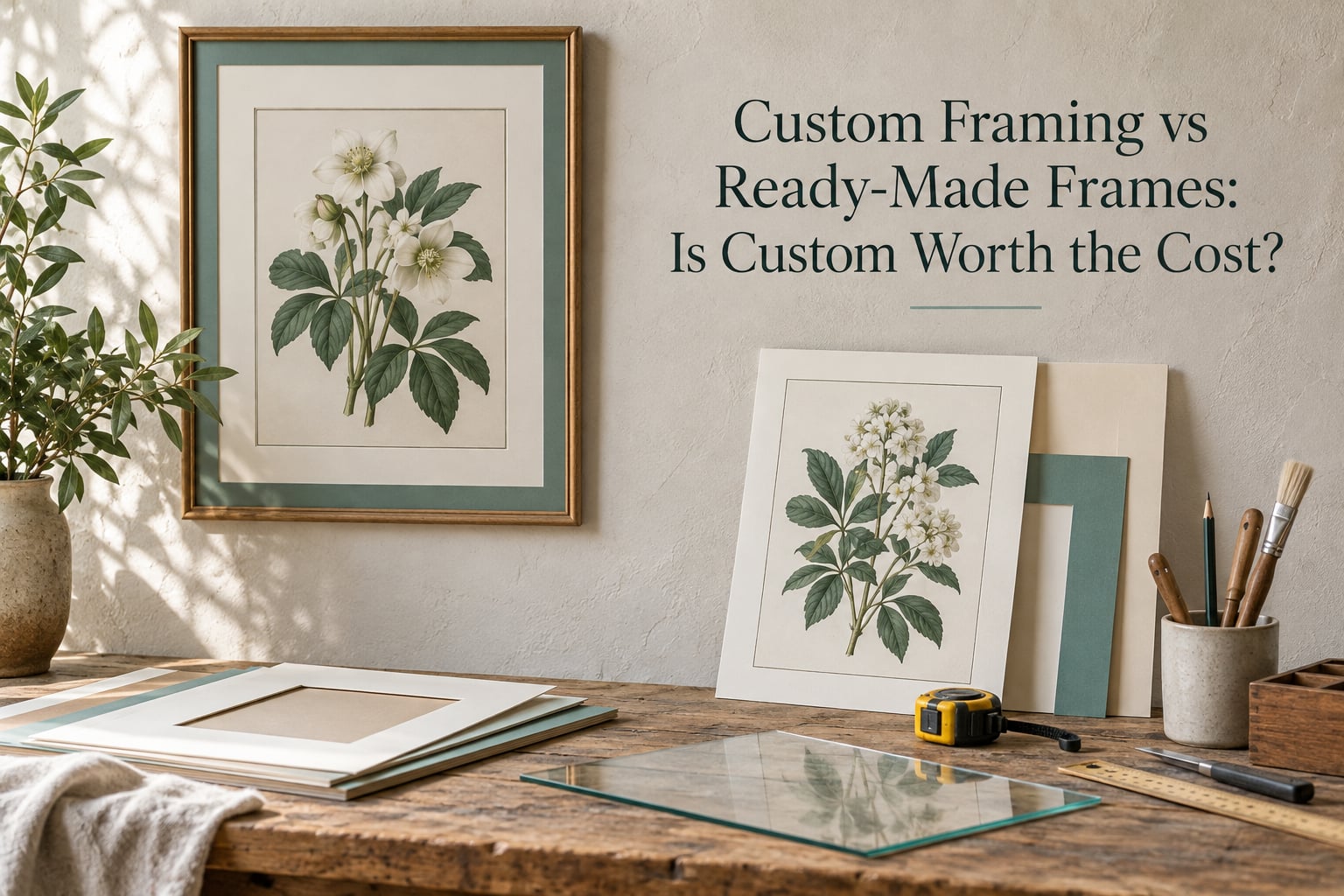
Custom framing is worth the cost when the artwork is irreplaceable, oddly sized, or meant to last for decades. Ready-made frames make more sense for replaceable prints, posters, and gallery walls where appearance matters more than preservation. The sticker price gap between the two can run to ten times or more, but the real question is what each option costs you over the life of the piece.
This guide breaks down the actual differences between the two approaches, what you are paying for in each case, and how to decide without overspending on an ordinary print or underspending on a family heirloom. We have walked through standard sizes, glazing types, matting, and backing materials, and pulled in what working framers say about the jobs that go wrong.
Last updated for 2026.
Table of Contents
- What Custom Picture Framing Actually Is
- Custom vs Ready-Made Frames at a Glance
- What You Are Really Paying For: The Anatomy of a Custom Frame
- Archival Materials Explained: Acid-Free, Lignin-Free and Mat Burn
- Glazing Compared: Standard Glass, UV Glass, Museum Glass and Acrylic
- Why Custom Framing Costs What It Costs
- How to Rescue a Ready-Made Frame With Five Cheap Upgrades
- When Ready-Made Frames Are the Right Choice
- When Custom Framing Is Essential
- How to Decide Between the Two: A Simple Framework
- How to Measure Artwork for Custom Framing
- Six Questions to Ask Before You Order a Custom Frame
- The Long-Term View: What a Bad Frame Costs You
- Frequently Asked Questions
- Is custom framing worth it?
- How much should a custom frame cost?
- How much should I expect to pay for custom framing?
- Is custom framing cheaper at Michaels or Hobby Lobby?
- Why is Michaels custom framing so expensive?
- What does Hobby Lobby charge for custom framing?
- How much does it cost to frame a 24×36 poster?
- What is the difference between custom and ready-made frames?
- Conclusion
What Custom Picture Framing Actually Is
Custom picture framing is a made-to-order service. Every component is cut to your artwork’s exact dimensions, so nothing is trimmed, forced, or cropped. You choose the moulding, the mat, the glazing, and the backing, and a framer assembles the whole package.
A ready-made frame, also called an off-the-shelf frame, arrives as a finished product. You pick a size from a fixed list, drop the art in, and fasten the backing with the tabs or turn buttons already installed.
The difference is really one of control. Ready-made frames give you size convenience and speed. Bespoke framing gives you a fit and a material specification that matches the piece.
What You Hand Over to a Framer
For a standard flat piece, you hand over the artwork itself. For a large canvas or a shadow box, you hand over measurements and often the piece stays with you until the frame is delivered.
- Flat paper works: prints, watercolours, drawings, photographs, posters, diplomas, and documents.
- Stretched canvas: usually measured, since a floater frame has to clear the depth of the stretcher bars.
- Three-dimensional objects: jerseys, memorabilia, and textiles need a shadow box with a deep spacer and an acrylic front.
Ready-made frames simply cannot handle the third category. There is no standard shadow box size for a signed shirt, so that work always goes the custom route.
Custom vs Ready-Made Frames at a Glance
The table below is the short version of the argument. Everything after it is the detail behind each row.
| Factor | Custom Framing | Ready-Made Frames |
|---|---|---|
| Fit | Cut to the exact artwork size | Fixed standard dimensions |
| Time to display | Several days to a couple of weeks | Same day |
| Relative cost | Highest, often several times more | Lowest |
| Backing material | Acid-free board chosen for the piece | Often MDF or hardboard, sometimes painted |
| Matting | Cotton rag or archival board, single or double | Paper mat or no mat at all |
| Glazing choice | Choose glass type or acrylic | Whatever the manufacturer fitted |
| Non-standard sizes | No problem | Requires trimming or matting to fit |
| Hanging hardware | D-rings and wire, or a proper cleat | Often a single sawtooth hanger |
| Assembly environment | Dust-controlled, dry-fitted | Whatever your table is |
| Best for | Heirlooms, original art, unusual sizes | Replaceable prints, posters, gallery walls |
One row deserves emphasis. The backing board is the single most common failure point in cheap frames, and it is the one component most owners never think about.
What You Are Really Paying For: The Anatomy of a Custom Frame
A frame is a small engineered object with four parts. Understanding them makes the price easier to read, because a quote is really a list of materials plus cutting time plus assembly.
The Moulding
The moulding is the visible frame profile. It comes in wood, metal, composite, and plastic, and the profile shape changes how the frame reads on a wall. A wide moulding gives a piece visual weight, while a thin one keeps attention on the image.
Higher-end framers carry FSC certified wood mouldings and finish them with water-based coatings. That is worth asking about, especially if the moulding will sit in direct sunlight.
The Mat or Mount
The mat is a window cut slightly smaller than the opening of the frame, and the artwork is hinged behind it. It creates breathing room around the image, and it is the main defence against the artwork touching the glazing.
A double mat uses two layers with a wider bottom edge, a traditional proportion that draws the eye inward. A float mount uses strips of core to raise the artwork off the backing, which suits paper and fabric.
The Glazing
Glazing is the transparent front layer. It is either glass or acrylic, and each has its own cost, weight, and clarity profile. We compare the four main options further down.
The Backing and Fitments
The backing seals the package and holds everything in place. Custom work uses acid-free board with tabs or D-rings and wire. Ready-made frames commonly use MDF or hardboard, which is dense, cheap, and mildly acidic.
That MDF detail matters more than most buyers expect. It is the origin of the mat burn problem discussed next.
Archival Materials Explained: Acid-Free, Lignin-Free and Mat Burn
Mat burn is the brown halo that appears on artwork where it touches the window mat. It is caused by acid migration, and once it appears it does not come off.
The chain of events usually starts with the backing board. Acidic material in the backing or the mat releases acid into the enclosed air inside the frame, and the acid settles on the paper edges where the image is exposed.
- Acid-free board is made with alpha-cellulose or cotton rag fibre instead of wood pulp, and it is buffered with calcium carbonate to neutralise acids that form over time.
- Lignin-free describes board made without lignin, the wood polymer that yellows and breaks down and gives off acids as it ages.
- Conservation framing means every layer in the package meets archival standards, with UV filtering, acid-free mat and backing, and hinges that do not stress the paper.
Frameers in the trade reference the Library of Congress guidelines when clients ask why conservation specifications exist. The practical takeaway is simpler: paper that costs you real money should not be pressed against acidic board.
Framers on Reddit and the professional forums describe the same pattern repeatedly. A low-cost frame with a standard paper mat can begin showing mat burn within about three years, and yellowing within three to seven. That timeline is the reason a cheap frame is not automatically a cheap decision.
Ready-made frames have improved. Better joints and improved glass are common now, which is why the general quality gap has narrowed compared with a decade ago. The backing and mat materials have not caught up at the budget end.
Glazing Compared: Standard Glass, UV Glass, Museum Glass and Acrylic
Glazing is where custom frames spend money that ready-made frames rarely do. Here is what each option does.
| Option | UV filtering | Reflectivity | Weight | Best for |
|---|---|---|---|---|
| Standard clear glass | Minimal | Noticeable reflections | Heaviest | Reproductions in low-value pieces |
| UV-protective glass | Blocks most UV | Standard reflections | Heavy | Watercolours, photographs, textiles |
| Museum glass | High UV filtering | Very low with anti-reflective coating | Heavy | Museum work, anything hung opposite a window |
| Acrylic | High UV filtering | Light reflections | Lightest | Large work, shadow boxes, high-traffic areas |
UV exposure is the reason a sun-faded print stays faded. Light fades dyes and pigments whether or not anything is touching the artwork, and glazing is the only layer that can slow it down.
Sheet glass versus float glass is worth understanding. Sheet glass is cheaper and carries small flaws called seeds that distort a close view. Float glass is optically cleaner. Many ready-made frames now use float glass, which is one of the genuine quality gains in that category.
Acrylic is lighter and shatter resistant, which makes it the standard for oversized work and shadow boxes. It does scratch more easily than glass, so cleaning matters. Online framing kits typically arrive as acrylic rather than glass for shipping reasons.
Why Custom Framing Costs What It Costs
The sticker shock is real, and it usually comes from a misunderstanding of what the quote contains. A custom price is not a markup on a moulding. It is a sum of four things.
- Material cost for the moulding length, mat board, glazing, backing, and hardware.
- Cutting time to join the moulding, cut mitres, cut the mat window, and cut the glazing.
- Assembly time to hinge the artwork, fit the backing, and seal the package in a clean space.
- Fitting risk, because a custom framer owns the result if a cut goes wrong.
Ready-made frames spread the moulding cost across thousands of identical pieces, so the frame itself is cheap. What is missing is the cutting and assembly, and more importantly the specification.
Where the Price Range Sits
Ranges quoted by framers and reviewers give a usable sense of scale. A single flat piece in a modest moulding with a mat and standard glass is the entry point. A matted piece at a larger size, a shadow box, or a jersey frame sits at the top of the range and can run several hundred dollars once materials and glazing are added.
Size drives the number more than style does. A 24 by 36 poster is a large piece of moulding, a large sheet of glazing, and a large sheet of backing, so every component costs roughly double what the same style costs at 8 by 10.
Big Box Stores Versus Independent Framers
Both national craft chains run a custom framing counter, and the experience is uneven. Framers on forums note that quality at a big box counter varies by the individual staff member, because the counter is often staffed by people who have done the job for weeks rather than years.
The same chains push aggressive percentage-off coupons, and the number people quote on forums after redeeming one still lands in the hundreds. Hobby Lobby shoppers typically report lower starting points than Michaels shoppers, and Michaels is frequently described as the more expensive of the two for the same job.
Independent framers cost more per hour but include consultation, the ability to hold moulding samples in your hand, and a real answer when something goes wrong. Many also extend discounts to artists and local art society members, which can close the gap considerably.
Online Custom Framing Versus Local
Online bespoke services sit between the two. You supply measurements, the service cuts and ships a kit, and you assemble it yourself with acrylic glazing and hinged tabs. The material quality is typically good and the pricing is competitive, but the craftsmanship is in your hands.
That trade is reasonable for a standard-size print. It is a poor trade for a valuable piece, because a dust-free bench and a dry fit are part of what you are paying a framer for.
How to Rescue a Ready-Made Frame With Five Cheap Upgrades
Some of the best advice in framing forums costs almost nothing. If you own a ready-made frame that is not quite right, these five changes take it most of the way toward archival.
- Replace the backing board. Slide out the original hardboard or MDF, cut an acid-free matboard sheet to size, and use it as a liner behind the art. Framers describe this as a small sheet of cheap material that stops the acid migration causing mat burn.
- Add an acid-free mat. Even a thin window mat gives the artwork clearance from the glass and hides uneven edges.
- Swap the turn buttons. Flexible plastic tabs can creep under humidity. Rigid tabs or D-rings with wire hold position better.
- Upgrade the hanger. A sawtooth hanger is fine for a light print and wrong for a canvas or a glass-fronted piece. Use a D-ring set rated for the weight.
- Add UV filtering later. If the frame is otherwise sound, a conservation framer can disassemble it, fit UV-protective glazing, and reassemble it with archival materials for far less than a new frame.
If a frame is going to hold something you cannot replace, stop at step five and do the job properly. These upgrades are for artwork with a replacement cost, not for a sentimental original.
When Ready-Made Frames Are the Right Choice
Ready-made frames are the correct answer more often than the custom framing industry would like to admit. Choose one when the artwork itself is replaceable.
- Mass-market prints and posters. A gallery print can be reordered in a few minutes, so protecting it for thirty years is not a rational priority.
- Standard sizes. If your art is 8 by 10, 11 by 14, 16 by 20, 18 by 24, or 24 by 36, you can walk into a store and finish the same day.
- Gallery walls. A grid of eight frames done as one job costs a fraction of the same wall done as eight custom jobs, and mixing mouldings is part of the look.
- Children’s rooms and rentals. Replaceable art in a space that will be redecorated does not need conservation framing.
- Dorm and first-apartment art. Same logic, with a lower price tolerance.
There is one more case. If you are selling art, framing changes perceived value dramatically. One Australian framer described the business problem plainly: adding a full custom frame to a piece can push the combined price past what the market will pay, so the work either needs a price increase or a smarter framing choice.
For that scenario, a ready-made frame with an acid-free backing and a decent mat is a smart middle path. It looks considered and it does not eat the margin.
When Custom Framing Is Essential
Custom framing stops being optional in a few clear situations. If any of these apply, the ready-made route is off the table.
- Non-standard sizes. Irregular watercolours, odd crops, and mixed-size gallery pieces cannot be forced into a standard frame without trimming the art or matting it awkwardly.
- Valuable originals. Original paintings, signed limited edition prints, and works by a named artist carry resale value that damaged edges and fading would destroy.
- Heirlooms and documents. Wedding portraits, diplomas, birth certificates, military paperwork, and family photographs are irreplaceable in the way a print is not.
- Signed memorabilia. A jersey, a match-worn shirt, or an autographed item needs a shadow box with depth, UV filtering, and dust sealing.
- Works on paper that are light sensitive. Watercolour, pastel, and dyed textiles fade fastest and respond best to UV filtering and buffered mats.
- Framed work you intend to resell or insure. Conservation specification and documented materials are part of the provenance conversation.
Canvas is a special case. A stretched canvas usually wants a floater frame with no glazing at all, so the paint surface is never behind glass. That is a custom job by definition, because the internal dimensions must clear the stretcher depth.
How to Decide Between the Two: A Simple Framework
Work through these questions in order. Most people answer them in under a minute and get a defensible answer.
| Ask yourself | If yes |
|---|---|
| Can I replace this artwork tomorrow at no emotional cost? | Ready-made is fine |
| Is the size standard? | Ready-made is fine |
| Is it a print rather than an original? | Ready-made with an acid-free backing upgrade |
| Will it sit in direct sunlight? | Custom, with UV-protective or museum glazing |
| Is it three-dimensional or unusually thick? | Custom shadow box or floater |
| Is it a family original or heirloom? | Custom conservation framing, no exceptions |
| Do you need it installed this week? | Ready-made, or a local framer with rush service |
Two or more yes answers pointing to custom means custom. If the only yes is about the week you need it, that is a scheduling problem, not a framing problem, and a local shop can often turn a simple job around quickly.
How to Measure Artwork for Custom Framing
Accurate measuring is the part most people get wrong, and wrong numbers mean a frame that does not close. Whether you are visiting a framer or ordering online, measure three things.
- Width, then height, of the artwork itself. Measure the paper or canvas, not the visible image area.
- Depth and height of the stretcher bars if it is canvas.
- Add the mat allowance. The frame is built to the artwork size plus the mat window plus the mat border on each side.
As a worked example, an 8 by 10 print inside a mat with a 2 inch border on every side needs roughly 12 by 14 inches of visible mat, and the moulding is cut to match. That is how standard frame sizes exist at all: they are the artwork size plus a standard mat allowance.
Measure twice, write the numbers down, and take a photo of the artwork next to a ruler as a reference for whoever is cutting it.
Six Questions to Ask Before You Order a Custom Frame
Any framer worth using will answer these without hesitating. If they hesitate, you have found your answer.
- What is the moulding made of, and is it FSC certified?
- Is the mat acid-free and lignin-free, and is it buffered?
- What is the backing board, and why did you choose it for this piece?
- Which glazing am I getting, and what percentage of UV does it block?
- Can you break the price down into materials and labour?
- What is the turnaround time, and what happens if something arrives damaged?
Question five does most of the work. A framer who itemises the quote is showing you where the money goes, and it makes a high number much easier to evaluate than a single lump figure.
Ask about a warranty on the framing work as well. A shop that stands behind its joinery and its dry fit is telling you something about the other half of the job too.
The Long-Term View: What a Bad Frame Costs You
This is the calculation no competitor guide makes, and it is the one that settles the argument most often. Price a frame against the value of what it protects.
A gallery print might be replaceable in a few minutes. A wedding portrait, a diploma, or an original watercolour cannot be replaced at any price. So the correct comparison is not frame cost against frame cost. It is the cost of the frame against the cost of losing the piece.
- Ready-made, unmodified: lowest outlay, with a real chance of mat burn, yellowing, and an unsecured backing in a decade or two.
- Ready-made, upgraded: low outlay, archival backing and mat, standard glazing. A strong result for replaceable work.
- Custom, conservation spec: highest outlay, and effectively a one-time cost for a frame that will still protect the piece in fifty years.
Run that against a decade of direct sun on a window, a humid room, a smoke alarm, or a house move. Most damage accumulates slowly and becomes visible all at once, which is exactly when it is cheapest to prevent and most expensive to ignore.
One more factor that rarely gets discussed: framing affects resale and insurance. Collectors expect conservation specification on valuable work, and an insurer will want to know the piece was housed in archival materials and UV-filtered glazing. The cheap frame is not just a protection decision, it is a documentation decision.
Two Side Routes: Secondhand Frames and the Environmental Question
Secondhand frames are the tempting middle option and the most dangerous. Framers warn about damp and mildew, woodworm, and old acid mounts that have already begun etching the artwork they touch. Some older frames are genuinely beautiful mouldings that would cost more to buy new, but the moulding has to be stripped and refitted before anything goes behind it.
If you go this way, treat the frame as raw material. A local framer can rebuild it with a new backing, new hinges, and new glazing, which usually costs far less than a new frame and gives you the original profile.
On the environmental side, the picture is mixed. A long-lived custom frame with FSC certified wood moulding and a repairable backing can outlive several cheap frames, and the environmental cost of a frame is small next to the embedded cost of the artwork itself. Ask your framer for FSC certification on the moulding and for lignin-free board, and you are making the responsible choice without paying extra for a niche product.
Frequently Asked Questions
Is custom framing worth it?
Yes, when the artwork is irreplaceable, non-standard in size, or meant to last for decades. Custom framing fits the piece exactly, uses archival materials, and slows fading. No, when the art is a replaceable print in a standard size and you want it on the wall this week.
How much should a custom frame cost?
The price scales with size and specification. A single small flat piece with a basic moulding, mat, and standard glass is the entry point. A matted piece at larger sizes, a shadow box, or a jersey frame with deep spacers and acrylic runs into the hundreds. Ask for a materials and labour breakdown.
How much should I expect to pay for custom framing?
Expect the cost to be several times a ready-made frame, with the gap widening as size and complexity grow. The moulding is the base cost, and each additional layer such as double matting, museum glazing, or a shadow box adds to it. Size drives the total more than style does.
Is custom framing cheaper at Michaels or Hobby Lobby?
Shoppers consistently report lower starting points at Hobby Lobby than at Michaels for comparable jobs. Both chains run percentage-off coupons, and a quote after a coupon is still commonly in the hundreds. Quality at either counter depends heavily on which framer is on shift that day.
Why is Michaels custom framing so expensive?
The price covers materials, cutting, and assembly time, plus the shop’s overhead and staff training. Michaels is also frequently priced above Hobby Lobby for the same specification. A quoted price is easier to judge when the shop itemises materials versus labour.
What does Hobby Lobby charge for custom framing?
Hobby Lobby is generally reported as the cheaper of the two national chains, especially with a percentage-off coupon applied. Actual cost still depends on size, moulding choice, matting, and glazing. A single flat piece is the cheapest entry point; shadow boxes and jerseys are the most expensive.
How much does it cost to frame a 24×36 poster?
A 24 by 36 poster is a large piece of moulding, glazing, and backing, so every component costs roughly double what the same style costs at 8 by 10. A standard-size poster can often be framed ready-made the same day. Conservation glazing or a double mat pushes the cost well beyond the basic option.
What is the difference between custom and ready-made frames?
A ready-made frame is mass-produced in fixed standard sizes with whatever mat, glazing, and backing the manufacturer chose. A custom frame is cut to your exact measurements with materials you specify, assembled by a framer, and fitted with proper hanging hardware. Custom costs far more and lasts far longer.
Conclusion
Custom framing vs ready-made frames is not really a question of taste. It is a question of what the artwork is worth to you and how long you need it to last. Ready-made frames are a sensible, low-cost choice for replaceable art in standard sizes, and a modified ready-made frame with an acid-free backing is a genuinely good middle path.
Custom framing earns its cost on heirlooms, originals, non-standard sizes, and anything that will be exposed to light, humidity, or a move. The premium buys an exact fit, conservation materials, UV protection, and professional assembly, and for irreplaceable pieces that is a one-time cost against an unbounded risk.
Decide with one question: if this piece disappeared tomorrow, what would it cost you to replace it? If the answer is nothing, go ready-made and spend the difference on better art. If the answer is more than the frame, get it framed properly.
Updated for 2026.