
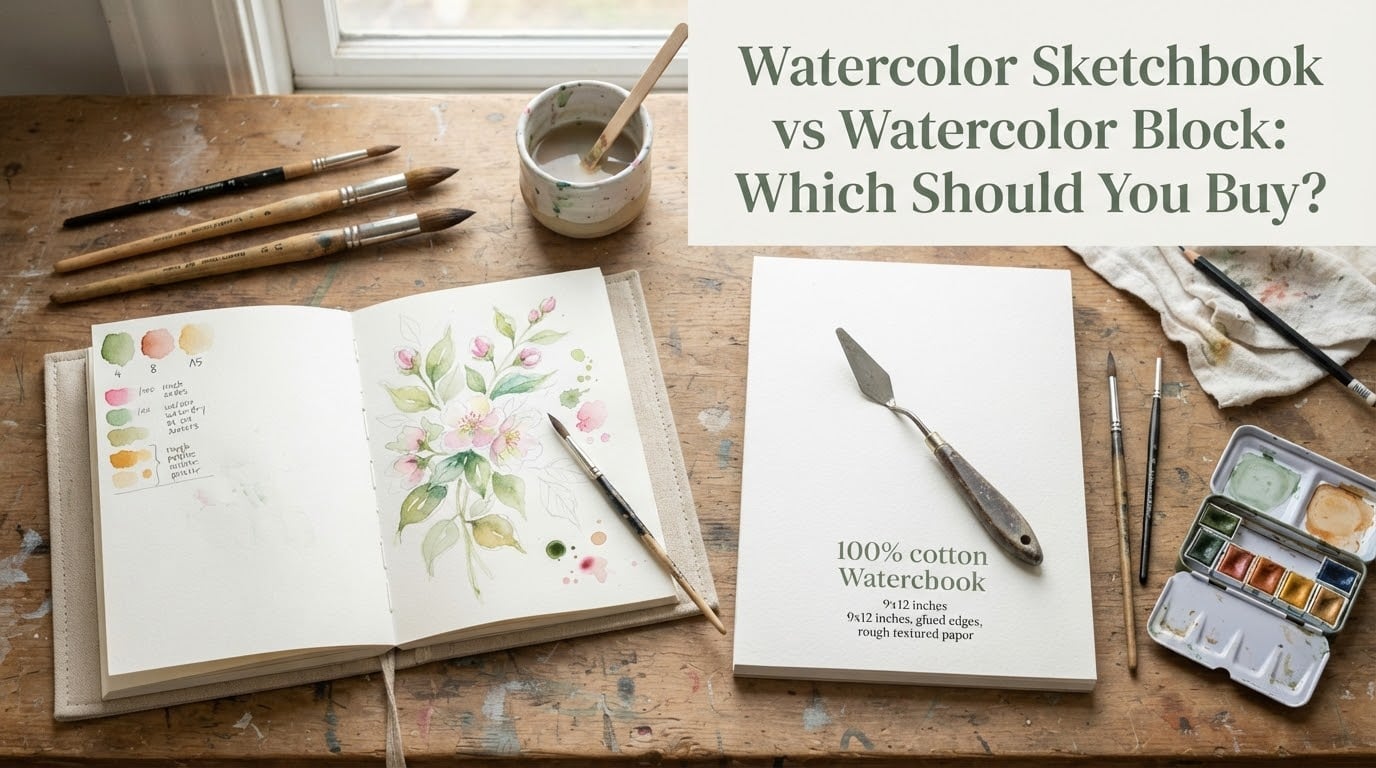
Choosing between a watercolor sketchbook and a watercolor block is one of those small decisions that quietly changes how your paintings feel. After months of testing both formats across studio work, plein air trips, and travel days, I realized the format choice shapes your technique as much as the brush you hold.
In this guide, I’ll walk you through exactly what each format is, how they perform in real painting conditions, and how to pick the one that matches how you actually work. Whether you’re a beginner who just bought your first palette or a working artist debating a studio upgrade, the answers are simpler than the marketing copy suggests.
Let’s start with the shortest possible answer, then build out the reasoning so you can make a confident choice for your own practice.
Table of Contents
- Quick Answer: Watercolor Sketchbook vs Block
- What Is a Watercolor Sketchbook?
- What Is a Watercolor Block?
- Core Differences at a Glance
- Paper Quality Factors That Apply to Both
- When to Choose a Watercolor Sketchbook
- When to Choose a Watercolor Block
- Plein Air and Portability: Real-World Scenarios
- Cost-Per-Painting Analysis
- Sketchbook Binding Types: Which Holds Up Best to Water?
- How to Test Paper Before You Commit
- Decision Matrix: Match Your Painting Style to the Right Format
- Top Recommended Brands by Format
- Frequently Asked Questions
- Final Thoughts
Quick Answer: Watercolor Sketchbook vs Block
A watercolor sketchbook is a bound book of watercolor paper pages you flip or remove, while a watercolor block is a stack of sheets glued on all four sides that stays flat during painting and releases finished work with a palette knife. Sketchbooks win for portability, daily practice, and travel. Blocks win for wet-on-wet techniques, finished studio work, and zero-buckle washes.
That single sentence covers the structural difference. Everything that follows in this guide helps you decide which side of that trade-off matters most for the way you paint.
What Is a Watercolor Sketchbook?
A watercolor sketchbook is a bound collection of watercolor paper sheets, usually between 20 and 60 pages, held together by a binding system that lets you flip through them or remove individual pages. Unlike a regular sketchbook, the paper inside is sized specifically to handle wet pigment without turning to pulp.
Most watercolor sketchbooks come in three common formats: taped or glued pads (one long edge), spiral or wire-bound books (a metal coil along one side), and stitched or perfect-bound books (book-style with glued or sewn spines). Each binding affects how the book lies flat, how much water the paper can take, and how easy it is to remove finished pages.
Sketchbooks are popular with urban sketchers, plein air painters, journalers, and beginners who want a low-commitment way to practice. You open it, paint, and close it. No stretching, no taping, no separate sheet management.
Sketchbook Binding Types Compared
Binding matters more than most buyers expect. The wrong binding will fight you every time you try to paint a two-page spread or soak a heavy wash.
Spiral bound: A wire coil runs along one edge, letting the book fold completely flat and even back on itself. The trade-off is that the coil creates a ridge that interrupts two-page spreads and can press uncomfortably into your painting hand during close work. Spiral books also tend to let water seep into the coil over time, which can rust metal bindings and warp the first and last few pages.
Stitched binding: Also called signature binding, the pages are folded and sewn together in small groups. Stitched books open flatter than perfect bound, hold up well to water on the spine, and look like a real artist’s book. The drawback is that very thick paper (300lb/640gsm) doesn’t fold cleanly, so most stitched watercolor sketchbooks use 140lb/300gsm paper.
Perfect bound: Pages are glued directly to the spine, the same way a paperback novel is made. Perfect bound sketchbooks look clean and professional, but they don’t always open flat on first use and the glue can fail after repeated wetting. They’re common in mid-range and budget watercolor sketchbooks.
Coptic stitch and DIY bindings: Some artists bind their own sketchbooks from loose watercolor sheets, often using coptic stitch (an exposed chain-link sewing pattern) so the book opens completely flat with no glue at all. A DIY 20-sheet sketchbook from a single 9×12 pad runs roughly the cost of one commercial sketchbook, which is why r/ArtistLounge users have been trading this method for years.
Paper Quality in Sketchbooks
Sketchbook paper runs the full quality spectrum, from cellulose student-grade sheets to 100% cotton professional stock. The paper inside determines how your paint behaves, how flat it dries, and how many layers you can lift if you change your mind.
Cotton sketchbooks generally hold more water, give you longer working time for blending, and let you lift color more easily. Cellulose sketchbooks cost less and are great for practice, but they buckle faster, dry faster, and lift less predictably. Both can work beautifully if you match them to the right kind of painting.
What Is a Watercolor Block?
A watercolor block is a stack of watercolor paper sheets glued together on all four edges. The glue holds each sheet flat against the one below it, which is the magic that prevents buckling even when you soak the paper with water.
The purpose of a watercolor block is simple: it lets you paint with as much water as you want without first stretching, taping, or weighting the paper down. When the painting is dry, you slide a palette knife between the top sheet and the glued edge to release it, leaving you with a flat, ready-to-frame piece of work.
Blocks come in weights from 140lb/300gsm all the way up to 300lb/640gsm, though most block manufacturers offer their heaviest paper only in block form (loose sheets of 300lb are rare and expensive). Popular block brands include Arches Aquarelle, Fabriano Artistico, Etchr Lab, and Stonehenge Aqua.
How to Remove Paper From a Watercolor Block
Removing a finished painting from a block is a simple three-step method once you do it the first time:
1. Wait until the painting is completely dry. Rushing this step is the most common cause of torn sheets.
2. Slide a clean palette knife or butter knife into one of the gaps between sheets along the unglued short edge. Most blocks have a small gap already created by the manufacturer.
3. Work the knife slowly along the glued edge to release the sheet. Pull gently, not in a rush. The sheet should come free flat and ready to sign, mat, or frame.
A few artists report that the first sheet sometimes sticks slightly because of glue seepage during manufacturing. If that happens, a light pass with a bone folder along the seam before painting usually solves it.
Core Differences at a Glance
Here is a side-by-side view of how the two formats stack up on the factors that matter most when you’re standing in the art supply aisle.
Format: Sketchbooks are bound pages; blocks are loose sheets held together by glue on four sides.
Buckling resistance: Blocks win decisively. Glue keeps paper flat even under heavy washes. Sketchbooks depend on paper weight and binding.
Portability: Sketchbooks win decisively. A bound book travels easily. A block is bulky and the corners take abuse in a backpack.
Cost per sheet: Loose sheets and sketchbooks typically cost less per page than blocks, which carry a manufacturing premium for the gluing process.
Best techniques: Blocks shine for wet-on-wet, large washes, and finished paintings. Sketchbooks shine for quick studies, ink-and-wash, journaling, and daily practice.
Top brands: For sketchbooks: Stillman & Birn, Moleskine, Etchr, Hahnemühle. For blocks: Arches, Fabriano Artistico, Saunders Waterford, Etchr.
Lifting ability: Cotton paper lifts well in both formats; cellulose paper lifts poorly in both formats. Format isn’t the deciding factor here.
Painting directly on it: Both formats are designed to paint directly on. Blocks just don’t let you flip to a new sheet until you remove the top one.
Paper Quality Factors That Apply to Both
Before you commit to a format, the paper inside either format matters just as much as the binding or gluing. Here are the four factors that actually change how your paint behaves.
Cotton vs Cellulose Paper
Cotton watercolor paper is made from cotton linters (the short fibers left after the cotton gin removes the longer textile fibers). Cellulose paper is made from wood pulp, the same basic material as office paper, but processed to handle water.
Cotton fibers are longer, stronger, and more absorbent than wood pulp. In practice that means cotton paper holds more water without breaking down, gives you longer blending time before the wash dries, and lets you scrub and lift color without pilling the surface. Cellulose paper dries faster, costs less, and is perfectly fine for practice work and quick studies.
A popular r/Watercolor thread captures the difference clearly. One user wrote that they had been struggling with layering and color vibrancy for months until they tried 100% cotton paper. Same paints, same brushes, same technique. The result: “of course the colors are more vibrant and the layers more contrasted.” That single switch solved problems they had been blaming on their skill.
Paper Weight and Buckling Behavior
Paper weight is measured two ways and the numbers mean the same thing. Pound weight (lb) refers to a ream of 500 sheets, while grams per square meter (gsm) measures the actual density. 140lb cold press equals 300gsm, 200lb equals 425gsm, and 300lb equals 640gsm.
Lighter paper (90lb/190gsm) buckles easily and is usually only sold in sketchbooks. Mid-weight paper (140lb/300gsm) is the everyday standard and tolerates moderate washes. Heavy paper (200lb/425gsm and up) is the studio and exhibition standard, holding flat even under heavy water.
Heavier paper also lifts better and stands up to more corrections. If you’ve ever watched a finished painting wrinkle up off the table as it dried, you’ve experienced what lighter paper does. Blocks handle this for you by gluing the sheet flat. Sketchbooks solve it by being heavy enough to weigh themselves down.
When to Choose a Watercolor Sketchbook
Sketchbooks earn their place when portability, daily practice, or quick studies are the goal. I reach for a sketchbook whenever I want to work standing up, on a train, or in a cafe where pulling out a block would be impractical.
Urban sketchers almost always prefer sketchbooks because a bound book fits in one hand and flips page to page. Travel painters prefer sketchbooks because they survive backpack abuse better than the corners of a block. Journalers prefer sketchbooks because the book format invites daily entries and dated pages.
Mixed media artists also tend toward sketchbooks, especially for ink and wash work. A 140lb sketchbook handles watercolor and fountain pen ink together without the ink bleeding the way it does on cheaper cellulose paper.
Finally, sketchbooks are perfect for beginners. A bound book removes the friction of taping paper to a board, choosing a sheet, and managing wet work on a flat surface. You open it, paint on page one, and you’re working in the medium within seconds.
When to Choose a Watercolor Block
Blocks earn their place when the painting itself matters more than the portability of the surface. Studio painters, exhibition artists, and anyone doing large washes or finished work will reach for a block again and again.
Wet-on-wet techniques are where blocks truly shine. When you soak a sheet and let colors flow into each other, the glue keeps the paper flat so the water doesn’t pool in low spots or warp the composition. One plein air painter on r/Watercolor wrote that blocks let the “paper remain flat when wetted, with hardly any warping,” which is exactly why so many outdoor painters bring one even when it means carrying a bit more weight.
Blocks also remove the stretching step entirely. Stretching paper (soaking it and taping or stapling it to a board) is a time-consuming ritual that buys you flat paper for big washes. A block gives you the same flat surface with zero prep.
If you paint finished artwork to frame, sign, or sell, blocks give you a head start. The painting comes off the block already flat, which saves hours of drying under weights and a lot of heartache when a piece curls on the way to the framer.
Plein Air and Portability: Real-World Scenarios
Format choice changes dramatically depending on where and how you paint outside. Here’s how I think through it for the most common outdoor scenarios.
Hiking and backcountry: Weight matters more than paper performance. A small (5×7 or 6×8) spiral sketchbook with 140lb cold press paper is the standard hiking companion. It fits in a chest pocket and survives being knocked against a hip belt.
Urban sketching and cafe work: A mid-sized (8×10 or 9×12) stitched or perfect bound sketchbook is the urban sweet spot. Big enough for interesting compositions, small enough to keep open on a cafe table without dominating the table next to you.
Travel day trips: If you’re driving to a location and have a stable surface, a block becomes realistic. The extra bulk pays off in flatter washes and finished work you can frame at home.
Multi-day travel with finished work: Many plein air painters carry both. A small sketchbook for studies and a block for one or two finished pieces per trip. The block stays in a rigid portfolio box; the sketchbook lives in the day bag.
Cost-Per-Painting Analysis
The format you choose quietly affects how much each finished painting costs you. Here’s a rough way to think about it without locking in specific dollar amounts.
A 140lb/300gsm watercolor block typically contains 20 to 30 sheets. Divide the block price by the sheet count to get the cost per finished painting. A 30-sheet block means you get 30 chances to produce a finished piece at that per-sheet rate.
A watercolor sketchbook typically contains 20 to 60 pages, but the cost is amortized across many quick studies rather than 30 finished paintings. If you use the sketchbook for practice and studies, the cost per finished painting isn’t the right metric. The right metric is cost per page, and that usually comes out lower than a block.
Loose watercolor sheets give you the lowest per-sheet cost but require stretching, taping, or some other system to keep them flat. Some artists buy loose sheets in bulk and bind their own sketchbooks, getting the best of both worlds.
If your goal is finished artwork to frame or sell, the block’s higher per-sheet price is worth it for the flat result. If your goal is daily practice, the sketchbook wins on cost without question.
Sketchbook Binding Types: Which Holds Up Best to Water?
Water destroys most bindings eventually. The question is how long each one lasts under the kind of use watercolor requires.
Spiral binding holds up well to water on the pages but the metal coil rusts over time, especially if you let water pool near the edge. Plastic spiral coils last longer but aren’t common on watercolor sketchbooks. The upside is that spiral-bound books lie completely flat, which is why so many plein air painters put up with the coil.
Stitched binding handles water well because the sewn signatures are made of paper, not glue. Water can wick into the stitching but doesn’t dissolve the structure. Stitched books are the most durable option for serious watercolor work.
Perfect bound sketchbooks use glue at the spine. The glue holds at first but fails after enough wet cycles, especially if the paper is heavy. This is why budget watercolor sketchbooks sometimes fall apart after a year of regular use.
Coptic stitch and DIY bindings have no glue at all, so they hold up to water indefinitely. The trade-off is time. Binding your own sketchbook from loose sheets takes an afternoon, which is why most artists only do it for travel books where durability matters most.
Forum users on r/ArtistLounge have been making their own coil-bound sketchbooks from Canson XL pads and Bee Paper for years. The reported cost is roughly the price of one commercial sketchbook for three home-made ones with laminated covers. The longevity is comparable to commercial spiral books.
How to Test Paper Before You Commit
Before you buy a full block or sketchbook, the smartest move is to test the paper. Here’s the four-step method I use, adapted from beginner watercolor advice and forum wisdom.
1. Get a sample sheet or buy the smallest available pad of the paper you’re considering. Many paper brands sell single-sheet samples or postcard-size packs for exactly this purpose.
2. Paint a single heavy wash across the sheet. Use enough water that the sheet soaks through. Watch how the paper handles the water. Does it buckle immediately? Does the wash pool in low spots? These tell you how the paper will behave under your heaviest techniques.
3. Layer a second color into the wet wash. This is your wet-on-wet test. Note how long the paper stays wet enough to blend (working time) and how the colors move into each other.
4. Once dry, try to lift some of the color with a clean damp brush. If color lifts cleanly without pilling the surface, you have a paper that forgives mistakes. If the surface pills or stays stained, you have a one-shot paper that demands confidence.
A paper that passes all four steps is one worth committing to in a full block or sketchbook. Most of us only need three or four papers we trust.
Decision Matrix: Match Your Painting Style to the Right Format
Here’s the quick-reference matrix I wish I’d had when I started. Match your situation to the right format in seconds.
Daily practice and studies: Sketchbook. Portability and low cost win every time.
Travel and urban sketching: Sketchbook. A bound book survives being packed and unpacked daily.
Wet-on-wet and large washes: Block. The glued edges prevent the warping that ruins wet techniques.
Finished work to frame: Block. You get flat, ready-to-sign paintings without stretching.
Mixed media (ink, gouache, colored pencil): Sketchbook. Lighter weight sketchbook paper handles multiple media well and keeps work organized in one book.
Art journaling and dated entries: Sketchbook. The book format invites daily practice and creates a visual diary over time.
Studio painting with full setup: Block. Use the flatness, then pull the painting and frame it.
Workshops and classes: Sketchbook. One book per workshop keeps your work organized by date and topic.
Top Recommended Brands by Format
These are the brands forum users and professional watercolorists mention most often, organized by format and budget tier.
Sketchbooks under mid-range: Canson XL Watercolor Sketchbook is the standard student practice book. Strathmore 400 Series and Bee Paper are other solid cellulose options. Moleskine Watercolor Sketchbook has a devoted following for journalers.
Mid-range sketchbooks: Stillman & Birn (the Beta and Zeta series especially), Etchr Lab’s sketchbooks, and Winsor & Newton Cotman offer cotton paper in bound formats at reasonable prices.
Premium sketchbooks: Hahnemühle Watercolour Books and Saunders Waterford sketchbooks sit at the top of the market. The paper inside is indistinguishable from loose sheet stock, with the convenience of a bound book.
Blocks under mid-range: Canson XL Watercolor Blocks and Strathmore 400 Series blocks are reliable cellulose options for practice and student work.
Premium blocks: Arches Aquarelle (cold press, hot press, and rough), Fabriano Artistico, and Saunders Waterford blocks are the studio and exhibition standards. Most working artists eventually settle on one of these for finished work.
Frequently Asked Questions
What are the best watercolor paper blocks?
The best watercolor paper blocks for studio and exhibition work are Arches Aquarelle, Fabriano Artistico, Saunders Waterford, and Etchr Lab. For practice and student work, Canson XL and Strathmore 400 Series blocks offer good cellulose performance at lower cost. Premium blocks are typically 100% cotton and come in 140lb/300gsm or 300lb/640gsm weights.
What is the main difference between a watercolor block and a watercolor pad?
A watercolor block has sheets glued on all four edges to keep the paper flat during painting, while a watercolor pad has sheets glued on only one edge (the top) so you can flip through them or tear one out. Blocks are designed for finished wet work; pads are designed for quick studies and practice. Pads also tend to include more sheets at a lower per-sheet cost than blocks.
Do you paint directly on a watercolor block?
Yes, you paint directly on the top sheet of a watercolor block. The glued edges keep the sheet flat under heavy water, which is the entire purpose of the format. When the painting dries, you slide a palette knife under the top sheet along one of the unglued edges to release it, then pull gently to free the finished painting.
What is the purpose of a watercolor block?
The purpose of a watercolor block is to keep watercolor paper flat during painting without stretching or taping it to a board. The glued four edges prevent buckling even under heavy wet washes, which is critical for wet-on-wet techniques, large washes, and finished work. Blocks also release a flat, ready-to-frame sheet when you’re done painting, which saves drying time and gives you a professional result.
Final Thoughts
The watercolor sketchbook vs watercolor block decision really comes down to how you paint and where. Sketchbooks win for portability, daily practice, travel, and mixed media. Blocks win for wet-on-wet, finished studio work, and any technique that demands a perfectly flat sheet. Most working artists end up with both, and that’s not a compromise. It’s how the format choice actually works in practice.
If you’re buying your first watercolor sketchbook or block, start with the format that matches your most common painting situation. Buy a small size, paint in it for a month, and notice which friction points slow you down. The format choice that solves those friction points is the right one for you.