
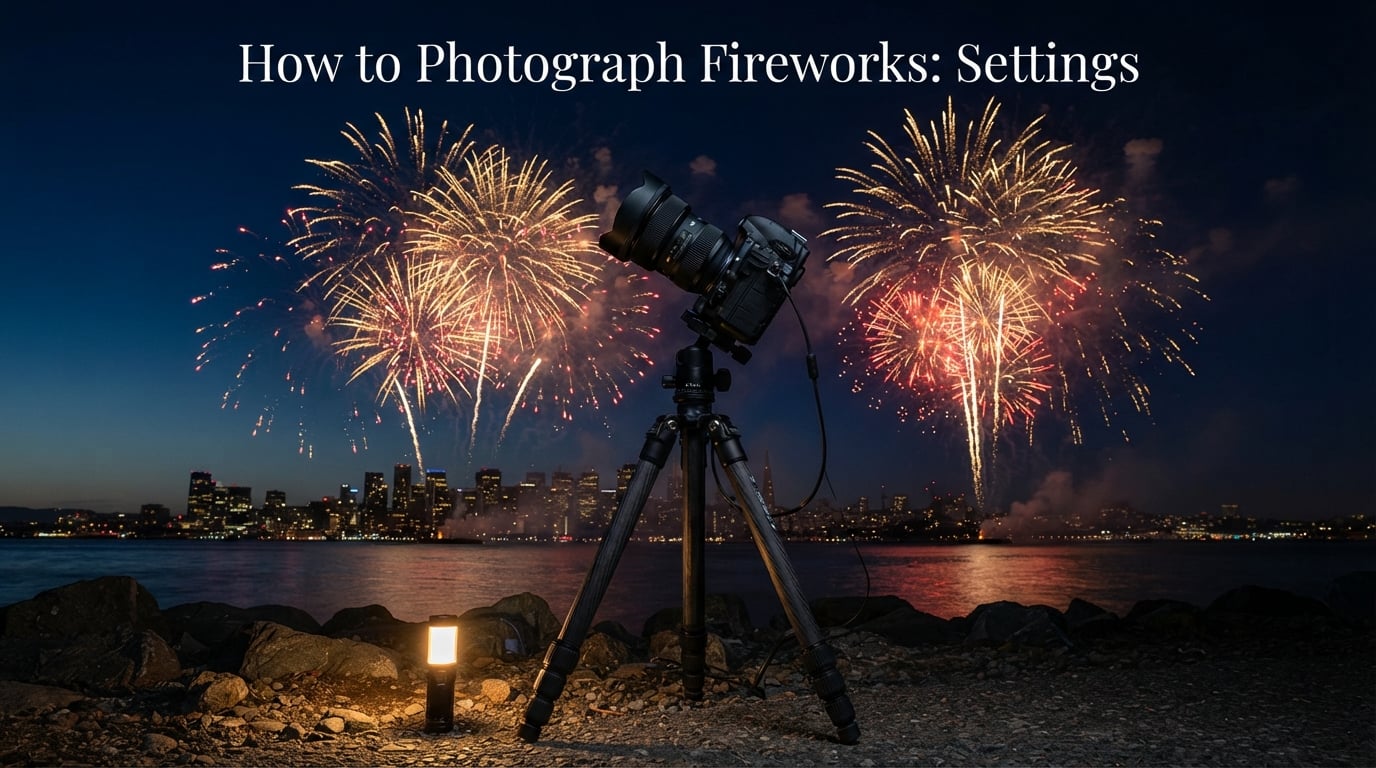
A firework show lasts about five minutes, and your camera gives you one chance to get each burst right. Learning how to photograph fireworks is mostly about knowing the four settings that matter before the first shell goes up, then leaving the camera alone while the sky does the work.
This guide walks through the base settings, the gear checklist, how aperture and shutter speed change the look of a burst, how to focus and trigger the shutter without shaking the tripod, and what to do when you have no tripod or only a phone. I have shot enough shows to know exactly which mistakes cost the most frames.
Table of Contents
- What camera settings should I use to photograph fireworks?
- What gear do you need before the first shell?
- How do shutter speed and aperture change the look?
- How do you focus and fire the shutter without shake?
- Which lens is best for fireworks photography?
- Can you photograph fireworks without a tripod?
- What settings should you use on a smartphone or iPhone?
- How do you fix blurry, blown out or too dark fireworks photos?
- How should you process fireworks photos afterwards?
- What can you do beyond a single burst?
- Frequently Asked Questions
- What camera settings should I use to photograph fireworks?
- What is the best shutter speed to use when photographing fireworks?
- What are the best photography settings for fireworks?
- What camera settings should I use for shooting fireworks without a tripod?
- What is the best iPhone setting for taking fireworks photos?
- What is the best camera lens to use for taking fireworks?
- What is the best combination of ISO shutter speed and aperture?
- What would be the best settings for shooting night time photography?
- Your fireworks photography checklist for 2026
What camera settings should I use to photograph fireworks?
Shoot in manual mode with ISO at base, the aperture stopped down to f/8 to f/16, the shutter set between 2 and 20 seconds (or Bulb), manual focus at infinity, and a tripod with a remote release or the two-second timer. That single combination covers most public displays.
The table below is the full base setup. Everything else on this page is a variation on it.
| Setting | Value | Why |
|---|---|---|
| Mode | Manual (M) | Nothing changes under your hands when the sky suddenly brightens |
| ISO | Base ISO, usually 100 or 200 | Long exposures amplify any noise you add, so start as low as the camera allows |
| Aperture | f/8 to f/16 | Sets burst brightness and keeps stars crisp; smaller values give richer colour |
| Shutter speed | 2 to 20 seconds, or Bulb | Controls trail length, not brightness |
| Focus | Manual, set to infinity | Autofocus hunts in near-total darkness |
| White balance | Daylight or a fixed Kelvin value | Auto white balance shifts colour between frames |
| Trigger | Remote release or 2-second timer | Touching the camera blurs the frame |
| File type | RAW | Recovers highlights that a JPEG clips permanently |
| Long exposure NR | Off | It locks the camera for as long as the exposure ran, and you lose a burst every time |
One rule is worth stating twice because it confuses almost every beginner: shutter speed controls trail length, and aperture controls brightness. On a normal night scene, a longer shutter simply makes the image brighter. With fireworks it changes how far each spark streaks before it dies, and a long enough exposure records several bursts in a single frame.
What gear do you need before the first shell?
Arrive early and work through this list. Most ruined shots are preparation failures, not settings failures.
- Fully charged battery, plus a spare.Long exposures and live view drain a battery faster than you expect, and cold air makes it worse. Spare batteries matter most in winter.
- Formatted memory card with free space.RAW files from a 20-second exposure run to several megabytes each. Format the card in the camera so the file system matches.
- Sturdy tripod with a working head.Wind is common in October and January. Legs spread wide, centre column down, and lock everything before the crowd arrives.
- Remote release, wired or wireless.A cheap two-dollar cable works better than a hand on the shutter button. If you have no remote, the 2-second self-timer does the same job.
- Small flashlight or headlamp.Red light preserves your night vision and keeps the settings readable without ruining your eyes for the dark frames.
- Layered clothing and a clear spot to stand.You will be standing still for an hour. Pick your position before it gets crowded, and keep something below the burst in the frame.
Scout from where you plan to shoot. Look for a dark background, check how much light pollution sits on the horizon, note which way the wind is blowing so smoke drifts away from you rather than across the frame, and leave headroom above the launch point so the trails have somewhere to go.
How do shutter speed and aperture change the look?
Shutter speed sets the length of the streaks. At 2 seconds a single shell becomes a crisp chrysanthemum with short, defined spokes. At 4 to 8 seconds the spokes lengthen into smooth arcs. Push to 20 seconds and a whole sequence of shells draws itself across the frame, which is why stacked-burst photos almost always come from longer exposures.
Aperture sets brightness. A wide aperture such as f/4 or f/5.6 records a burst as a bright, slightly washed blob because every pixel saturates fast. Stopping down to f/11 or f/16 spreads the same light across more sensor area, so the shell holds detail and the colour stays saturated against a black sky.
Here are the effect presets. Every row assumes ISO 100 or 200 and manual focus at infinity.
| Effect you want | Aperture | Shutter speed | What you get |
|---|---|---|---|
| Crisp single burst | f/8 | 2 seconds | Short spokes, clean separation from the background |
| Soft round trails | f/11 | 4 to 8 seconds | Smooth comet arcs, richer colour |
| Long streaking finale | f/11 to f/16 | 10 to 20 seconds | Painted ribbons across the whole frame |
| Several bursts in one frame | f/8 | 15 to 25 seconds | Stacking, with a brighter background from all the shells combined |
| Defocused abstract | f/2.8 to f/5.6 | 1 to 3 seconds | Coloured discs instead of points, requires deliberate focus movement |
| Sparkler light painting | f/8 | 20 to 30 seconds | Hand-drawn lines, with a dark-clothed person holding the sparkler |
Open up one stop or close down one stop from the table and check the first frame on the back of the camera. Most cameras show a live histogram during playback, and a histogram that touches the far right edge means clipped highlights. Fireworks are small, bright, unpredictable sources, so overexposure is easy to fix in post and underexposure is not.
How do you focus and fire the shutter without shake?
Set focus to manual. Turn the ring until the indicator sits on the infinity symbol, then tap the ring lightly with a fingernail or a piece of tape to mark the position so you can return to it later. That marking habit prevents the most common late-show mistake, which is accidentally rotating the focus ring while changing something else.
Verify infinity rather than assuming it. Lens focus is not always calibrated so the infinity mark equals true infinity, especially with wide lenses close to their closest distance. Zoom in on the brightest star in live view, switch to manual focus, and turn the ring until the star is a sharp point. If there is no star, use any distant fixed light, such as a stadium floodlight.
Never press the shutter button with your finger. Use a wired or wireless remote, or set the 2-second self-timer. A finger on the shutter introduces just enough movement to soften the entire frame, and the mistake is invisible in the field because you cannot judge sharpness on a small screen at night.
Bulb mode gives you a different workflow worth learning. With Bulb, you press the remote and hold it, and the shutter stays open until you release. Start on the first distant boom, hold through the burst and the trail-off, then release. A padded hat or a jacket sleeve over the lens cap between shots is a practical trick forum shooters use to stop stray light triggering autofocus while you wait.
Timing the shutter matters as much as the settings. The flash of light arrives well before the sound of the boom travels to you, so watch the sky rather than listening, or estimate the delay and open slightly ahead. A shutter running 2 to 5 seconds will almost always catch something.
Which lens is best for fireworks photography?
A wide-angle lens is the practical default. Between 14mm and 24mm on full frame you can fit the whole display and a foreground, and the wide field absorbs the haze that builds through a long show. A 24mm on APS-C gives an equivalent field of view of roughly 36mm, so it behaves like a 36mm on full frame. That crop factor catches people out, and it is why a lens that felt wide on full frame feels noticeably tighter on a smaller sensor.
A telephoto lens, 70mm to 200mm, isolates a single shell against the dark sky and gives you the richest colour because the burst fills the frame. The trade-off is a narrower view, so a shell that leaves the frame is gone, and you will need to recompose if the launch point moves.
Point the lens away from streetlights, floodlit buildings and car headlights. Light pollution fills the sky with a grey glow that a long exposure amplifies, and it kills the black background that makes fireworks look like fireworks. A full moon has the same effect in the other direction, so check the moon phase before the show and aim away from it when you can. Stopping down to f/11 also reduces vignetting at the corners on fast wide lenses.
Can you photograph fireworks without a tripod?
Yes, but expect a worse frame, and expect your usable shutter speeds to be about 1/15 of a second or less. A hand-held 2-second exposure does not produce a sharp image; it produces a smeared one, and the smear is the reason so many fireworks photos look soft.
Handheld is worth trying when a burst is very bright and the exposure can be short. Try ISO 1600 to 3200, an aperture of f/2.8 or f/4, and a shutter between 1/4 and 1/15 second, brace your elbows against your ribs, and hold the viewfinder to your forehead for a bit of extra support. Shoot in burst mode so you get several attempts. The image will be noisier and the trails will be short, but a sharp bright burst beats a soft dim one.
If you have any flat surface nearby, a wall, a low railing or a bag, rest the camera on it and use a short hand-held exposure. That is halfway between a tripod and a free hand, and it is the cheapest upgrade in this whole guide.
What settings should you use on a smartphone or iPhone?
Modern phones can produce a good fireworks frame, though the limit is the sensor, not the settings. Night mode stacks several seconds of frames, which brightens the image and also brightens the sky, so a long exposure that fixes the burst tends to wash out the background.
Work through this list instead:
- Tap the sky to focus, then pull the exposure slider down slightly so the burst keeps colour instead of turning white.
- Use Night mode, but hold still rather than moving after you press the shutter.
- Shoot a Live Photo rather than a still, so you can pick the exact frame where the shell is at full bloom instead of where the phone decided.
- Turn off the flash. It fires at the end of the exposure and adds a foreground with no sky in front of it.
- Use RAW in the Pro or manual controls if your phone has them, and set the longest shutter the app allows, typically 1 second or 2 seconds.
- Clean the lens before the show. A smudged lens costs you more sharpness than any setting you can change.
If you want the real thing, bring a camera anyway. Phones struggle with the long exposures needed for trails, and they have no way to control aperture.
How do you fix blurry, blown out or too dark fireworks photos?
Almost every fireworks problem falls into one of a handful of failure modes. Find the symptom in the table below and apply the fix.
| Symptom | Cause | Fix |
|---|---|---|
| Whole frame looks soft or doubled | Finger on the shutter button, or a tripod bump | Use a remote release or the 2-second timer and stop touching the camera |
| Bursts look like fuzzy blobs | Autofocus hunting in the dark, or focus ring moved after infinity | Switch to manual focus, verify in Live View, mark the ring with tape |
| White patches in the sky, no colour | Highlights clipped, often a long or multi-burst exposure | Close the aperture one stop, shorten the exposure, or pull the histogram down in playback |
| Frame is too dark to see the burst | Under-exposed shell, or smoke blocking the burst | Open the aperture one stop, or raise shutter speed and stack several frames |
| Bright dots that will not go away | Hot pixels, amplified by long exposures at base ISO | Turn long exposure noise reduction on for the final frame, or remove spots in post |
| Camera seems frozen after a long shot | Long exposure noise reduction processing | Switch it off before the show and fix the noise in editing |
| Later bursts look washed out and flat | Smoke and haze drifting across the launch point | Turn to face away from the smoke, shoot into a darker patch of sky, or expose for the finale |
| Only a few frames from the whole show | Buffer filling, or cards being written slowly | Check card speed, and shoot shorter exposures you can stack later |
One entry deserves more detail. Long exposure noise reduction is designed to average the dark frames, so a 20-second exposure locks the camera for roughly another 20 seconds while it processes. During a six-minute show that is a meaningful chunk of usable time, and it is the reason some photographers miss the finale entirely. Turn it off, keep ISO at base where noise is lowest, and clean up the remaining grain in your editor.
How should you process fireworks photos afterwards?
Work from the RAW file, not the JPEG. The burst core is a tiny area of the frame, so recovering it means pulling highlights down hard in a file that still holds the data.
- Correct the white balance first.Set it to daylight or a fixed value, because auto white balance gave each frame a different tint.
- Pull highlights down.Bring the whites back until the histogram stops clipping. The burst will look flat for a moment, which is expected.
- Lift shadows gently.The foreground needs just enough detail to read as a silhouette against the glow.
- Add noise reduction.Especially on the blacks, and especially if you shot with long exposure noise reduction off.
- Adjust contrast and clarity last.A small clarity increase makes smoke and haze read as atmosphere rather than fog.
- Crop for balance.Many stacked frames are better with the empty half of the sky removed.
Keep the file you edited and note its settings. If you shoot a show every year, matching the same white balance and contrast makes the pictures a series instead of a pile.
What can you do beyond a single burst?
Once the basics are automatic, three variations are worth experimenting with. Stacking several bursts into one frame needs a long exposure of 15 to 25 seconds at f/8, and it is the most common way people get the layered, painted look people try to copy in editing.
Defocused fireworks are the opposite goal. Set a fast wide aperture, start the exposure, and deliberately move the focus ring away from infinity during the two or three seconds. Shells turn into soft coloured discs and rings, and the technique works even when there is no skyline or foreground worth including. Shooters on photography forums describe focus racking as the fallback when the location offers nothing to compose around.
Sparkler light painting takes 20 to 30 seconds at f/8 on a tripod. The person holding the sparkler wears something dark so it does not become a silhouette, and the shutter opens after everyone is in position. It is the easiest way to practise exposure control before a real display, and a good excuse to hand your camera to a friend.
Whatever you try, save the finale. A single frame exposed for the grand finale, with several shells overlapping, often beats twenty tidy single-burst shots from the quiet opening.
Frequently Asked Questions
What camera settings should I use to photograph fireworks?
Use manual mode with ISO at base (usually 100 or 200), the aperture at f/8 to f/16, the shutter between 2 and 20 seconds or in Bulb, manual focus set to infinity, and a tripod with a remote release or the 2-second timer. Shoot RAW and turn long exposure noise reduction off.
What is the best shutter speed to use when photographing fireworks?
Two to four seconds is the best starting point for a single burst, because it gives short, defined trails and good separation between shells. Use 8 to 20 seconds for long ribbons, and 15 to 25 seconds when you deliberately want several bursts recorded in one frame.
What are the best photography settings for fireworks?
Manual mode, base ISO, f/8 to f/16, 2 to 20 seconds, manual focus at infinity, and a fixed white balance. The only two settings you should change during the show are shutter speed and timing, because a show gives you no time to rebuild a full setup.
What camera settings should I use for shooting fireworks without a tripod?
Handheld work needs much faster shutter speeds: try ISO 1600 to 3200, an aperture of f/2.8 or f/4, and a shutter between 1/4 and 1/15 second. Brace your elbows, hold the viewfinder to your forehead, shoot in burst mode, and expect shorter trails and more noise than a tripod gives you.
What is the best iPhone setting for taking fireworks photos?
Tap to focus on the burst and pull exposure down slightly so the colour survives. Use Night mode and hold still, shoot Live Photos so you can pick the best frame, turn the flash off, and use RAW in manual mode with the longest shutter available, usually 1 to 2 seconds.
What is the best camera lens to use for taking fireworks?
A wide-angle lens between 14mm and 24mm on full frame is the practical default because it fits the whole display and a foreground. A 70mm to 200mm telephoto isolates a single shell and gives richer colour. Remember the APS-C crop factor, which makes every focal length roughly 1.5x tighter.
What is the best combination of ISO shutter speed and aperture?
ISO 100 or 200 at f/11 for 4 to 8 seconds is the most useful all-round combination for rich colour and smooth trails. For a crisp single burst use ISO 100 at f/8 for 2 seconds, and for stacked bursts use ISO 100 at f/8 for 15 to 25 seconds.
What would be the best settings for shooting night time photography?
General night photography depends on the subject, and shutter speed usually controls brightness. Fireworks are the exception: because a shell is a small very bright source, aperture controls brightness and colour while shutter speed controls trail length. Fireworks also need manual focus, while landscapes can often use autofocus.
Your fireworks photography checklist for 2026
Set up before you arrive, not during the show. Manual mode, base ISO, f/8 to f/16, 2 to 20 seconds, manual focus at infinity marked with tape, RAW, long exposure noise reduction off, a remote release and a spare battery.
Once you know how to photograph fireworks with those six settings, the rest is choosing a position with a dark sky and a foreground, letting the camera run, and picking the right frame afterwards. Charge the batteries tonight and check the moon phase before you go.