
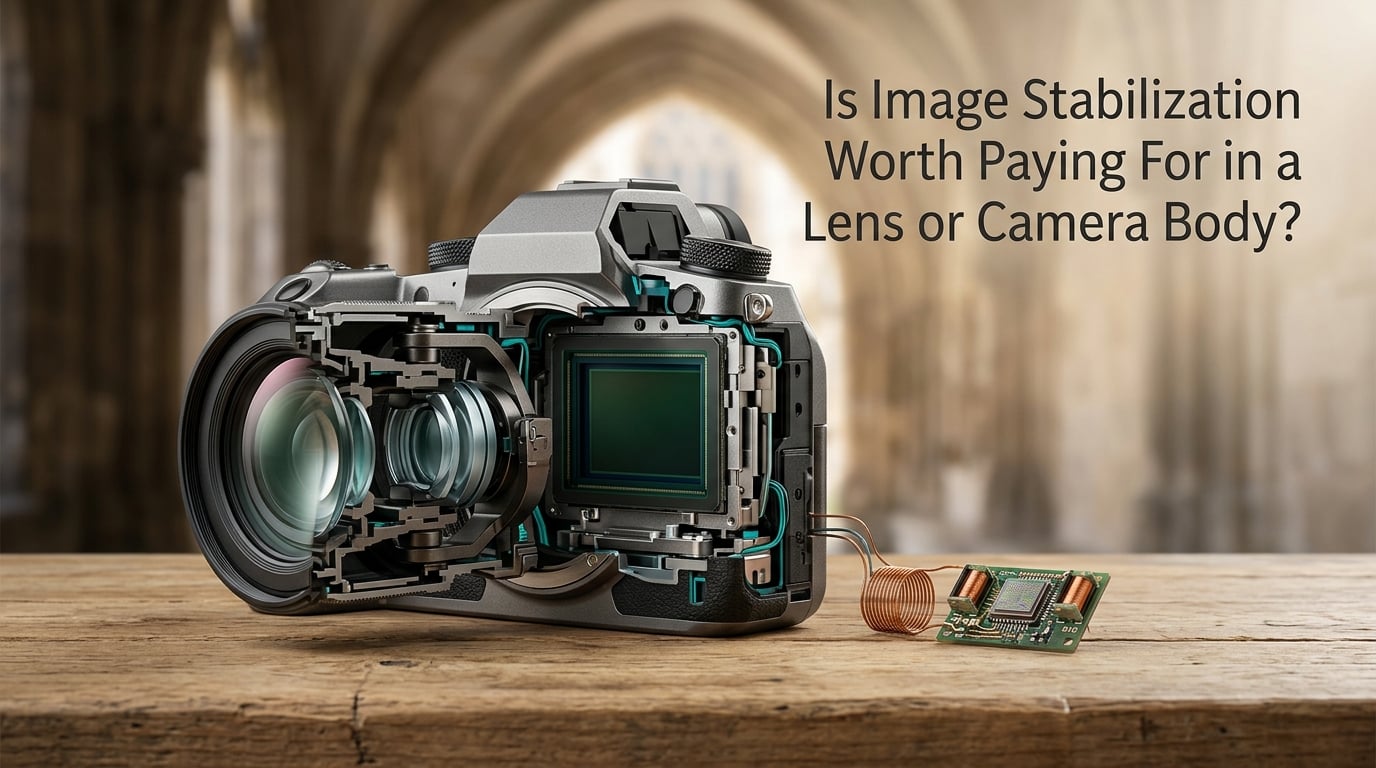
There is a version of this question that is really about money. You have a budget, several bodies and lenses in mind, and one more premium to pay. So the honest answer to whether image stabilization is worth it comes down to a single test: do you regularly shoot handheld, at shutter speeds slower than your lenses want to be at?
If the answer is yes, stabilization is one of the highest-leverage features you can buy, because it converts frames you would have thrown away into frames you keep. If the answer is no, you are paying a real premium for a system that will sit idle most of the time.
This piece breaks down what the technology actually does, where lens-based and body-based systems differ, how many stops you genuinely need, and how to test a stabilization claim before you commit. It should take about ten minutes to read and save you a bad purchase.
Table of Contents
- Is Image Stabilization Worth Paying For?
- What Image Stabilization Actually Does
- OIS, IBIS, and EIS Compared Side by Side
- How Many Stops of Image Stabilization Do You Need?
- OIS vs IBIS: Which One Should You Pay For?
- Five Situations Where Image Stabilization Is Worth Paying For
- Four Situations Where It Is Not Worth the Premium
- The Moving-Subject Trap
- Should You Turn Image Stabilization Off on a Tripod?
- Where Stabilization Shows Up in Video
- How to Test a Lens’s Stabilization Before You Buy
- How to Decide: Three Questions
- Frequently Asked Questions
- Is an image stabilization lens worth it?
- Is body image stabilization necessary?
- Is in-body image stabilization necessary for photography?
- What do stops of image stabilization mean?
- Should you use image stabilization with a tripod?
- When not to use image stabilization?
- At what shutter speed should you use a tripod?
- Which is better, OIS or EIS?
- Is Image Stabilization Worth It? The Short Version
Is Image Stabilization Worth Paying For?
Yes, if you shoot handheld slower than the 1-over-focal-length rule, in dim light, on long lenses, at close focus distances, or in video without support. No, if your work happens in bright daylight at fast shutter speeds, or if you already use a tripod for anything slower than 1/60 second.
The reason this is not a simple yes is that stabilization fixes exactly one kind of blur: the small involuntary movement of your hands. It does nothing for a subject that is moving across the frame. Paying for it makes sense only if camera shake is your actual limiting factor.
There is a second complication that rarely gets explained on a spec sheet. Body-based stabilization protects every lens you will ever mount, while lens-based stabilization protects one lens at a time. That difference changes the arithmetic considerably when you own more than two or three lenses.
Here is the version I would give a friend. Spend on stabilization if you are a documentary, travel, event, wildlife, or indoor shooter who works handheld. Spend on a tripod first if your work is landscape, architecture, studio, or product. Skip the premium entirely if your kit is a daylight walk-around setup with a fast prime or two.
What Image Stabilization Actually Does
Handheld blur comes from the fact that your body is never still. Breathing, pulse, muscle tremor, and the small corrections you make while composing all move the camera a fraction of a millimetre during an exposure. A stabilization system measures that movement and moves something back the other way, so the projected image stays in one place on the sensor while the shutter is open.
Measurement happens with a gyroscope and one or more accelerometers inside the camera. A processor reads those signals, works out which way the camera is tipping or twisting, and drives a motor to counteract it. The mechanism differs depending on where the moving part lives.
The vocabulary you will see on boxes and spec sheets
Image stabilization (IS) is the umbrella term. Canon calls its lens system IS, Nikon calls it VR, Sony and Olympus and Panasonic use OSS, and Fujifilm uses OIS. All of them mean optical image stabilization in a lens.
Optical image stabilization (OIS, VR, IS, OSS) means a floating group of elements inside the lens shifts on a gimbal to hold the image steady. Nothing is cropped, and the lens barrel itself is where the extra complexity and weight live.
In-body image stabilization (IBIS) means the sensor sits on a movable platform and shifts to counteract movement. The lens is untouched, so the correction works with any glass you mount, including manual-focus and vintage lenses on compatible bodies.
Electronic or digital stabilization (EIS) is software. The camera records a wider frame than it outputs, detects movement, and crops and rescales to correct it. You lose real pixels and you gain the stabilisation, which is why EIS is usually a video feature rather than a stills one.
Coordinated control is the handshake between a stabilized lens and a stabilized body. The two systems negotiate which one handles which axis, which is why a hybrid body can extract more from a stabilized lens than either system manages alone.
The axes involved are named pitch (tipping forward and back), yaw (turning left and right), and roll (twisting around the lens axis). Any system that handles all three is called a 5-axis system.
Here is the part most spec sheets skip. A dpreview forum contributor who owns both kinds of systems puts it plainly: in-lens stabilization handles pitch and yaw better, while IBIS covers the x, y and roll component. Modern 5-axis bodies have closed most of that gap, but not all of it.
OIS, IBIS, and EIS Compared Side by Side
All three systems are sold as image stabilization, and they behave very differently in the field. This table is the comparison most buyers actually need.
| System | What moves | Axes corrected | Lenses it covers | Where the cost and weight land | Weak spot |
|---|---|---|---|---|---|
| OIS / VR / IS in lens | A floating internal lens group | Pitch and yaw handled best; roll often limited | That lens only | Lens price and lens weight | Can drift out of alignment over years |
| IBIS in body | The sensor on a floating platform | X, y and roll, five-axis on most current bodies | Every lens you can mount | Body price; no lens weight | Largely cancelled if you shoot on a tripod |
| EIS / digital | Nothing physical, the frame is cropped and rescaled | Whatever the software can correct | Any lens, video only | No hardware cost at all | Crop factor and detail loss |
Read that table as a practical split rather than a ranking. Lens stabilization is better at the two axes that matter most for a shaky hand, and it exists on cameras that have no movable sensor. Body stabilization covers more axes, works with every lens including manual glass, and stays useful even when you eventually stop using a given lens.
Digital stabilization is the odd one out because it trades away image data for stability, and it does so every frame. For video that trade is usually worth it. For a still frame you generally would rather have the pixels.
How Many Stops of Image Stabilization Do You Need?
A stop is a doubling of light or a halving of shutter speed. If stabilization gives you 5 stops, a shutter speed of 1/125 becomes usable at 1/4 second, because each stop takes you down one notch and five notches is the difference between those two numbers.
Most lens systems in circulation advertise between 3 and 5 stops. Current flagship bodies claim 6.5 to 8.5 stops, though every manufacturer measures on its own test protocol, so treat the head-to-head numbers as approximate rather than exact.
Where the useful number comes from is the 1-over-focal-length rule. Handheld, you want a shutter speed roughly equal to 1 over the focal length: 1/50 on a 50mm lens, 1/200 on a 200mm lens. Stabilization lets you go several stops slower than that and still get a sharp frame.
| Focal length | Rule-of-thumb handheld floor | With 3 stops | With 5 stops | With 7 stops |
|---|---|---|---|---|
| 24mm | 1/25 s | 1/3 s | 1 s | 8 s |
| 50mm | 1/50 s | 1/6 s | 1/2 s | 4 s |
| 200mm | 1/200 s | 1/25 s | 1/6 s | 1 s |
| 400mm | 1/400 s | 1/50 s | 1/12 s | 1/3 s |
Two cautions on those numbers. The rule of thumb is generous, and older shooters with steady hands routinely get away with one or two stops less than the table suggests. And the moment a subject moves, the whole table stops applying, because the new limit is how fast that subject travels across the sensor during the exposure.
At wide and normal focal lengths, a 5-stop system puts you into genuinely useful territory for indoor work. At 200mm and above, 5 stops takes you from 1/200 to 1/6, which is a rescue for framing and focus but still not a licence to shoot moving wildlife at 1/6 second.
OIS vs IBIS: Which One Should You Pay For?
This is the core of the money question, and the answer depends more on how many lenses you own than on any technical argument.
A stabilized body is a single investment that covers your entire kit. Mount a 200mm telephoto, a 50mm prime you already own, a manual-focus lens from thirty years ago, and a wide zoom, and all four get stabilized on a body with IBIS. A stabilized lens only helps while that specific lens is mounted.
That is why the fastest route to answering the question is to count glass. If you own two lenses and change between them rarely, a stabilized body costs less in total than two stabilized lenses. If you own six lenses and expect to add three more, one stabilized body beats six stabilized lenses on both money and weight.
Lens stabilization has one genuine edge, and a dpreview contributor names it clearly: it corrects pitch and yaw better than in-body systems, because the correction happens in the optics before the light reaches the sensor. It also gives you something a body cannot, which is stabilization on a camera whose sensor is fixed.
Against that, lens-based systems make the optical design more complex and more prone to decentering over time. The same contributor flags that as a long-term reliability concern, and it is one that only shows up after years of ownership. Users also report that older stabilizers hunt in low light while acquiring focus, which costs you the frames you bought the system for.
Weight is the other quiet cost. A stabilized lens is heavier than the unstabilized version, and for fast primes the gap is often the reason IS was left out in the first place. Many f/1.2 primes omit stabilization deliberately, because adding a floating group would undo the point of the design. That is not an oversight by the manufacturer.
Then there is the baseline nobody mentions. A basic tripod delivers more effective stability than any in-camera system, and it costs a fraction of a body premium. Before paying for IBIS, ask whether you have a tripod and a bag that lets you actually use it. If the answer is no, the tripod may be the better first purchase.
One more variable shifts the value in recent models. Electronic first curtain shutters and shutter suspension units reduce mechanical shake that stabilization would otherwise have to correct, which means a modern body with a quiet shutter has less left to gain than a body from a decade ago. It also means a stabilized lens that was shaky on an older body may feel fine now.
Five Situations Where Image Stabilization Is Worth Paying For
1. Dim interiors where you cannot use flash. Churches, cathedrals, castles, galleries, and stages. A dpreview forum field report describes shooting these spaces at between 1/2 and 1/10 second, where the only thing keeping the frame sharp is the stabilization system. Multiple users who moved from Micro Four Thirds bodies, which have IBIS as standard, to Fujifilm reported the loss of body stabilization as a genuine felt downgrade for exactly this work.
2. Long telephoto work. Handheld wildlife, distant details, and candid work at 200mm and beyond. The faster the lens, the fewer mistakes your hand can absorb, and the more each stop of stabilization is worth.
3. Macro and close focus. At high magnification the effective focal length gets much longer, and so does the minimum safe shutter speed. Stabilization is the difference between a bracket that resolves detail and one that does not.
4. Travel and street photography with a small kit. That is the case that tends to get underestimated. A compact body and a short prime in a dim market is exactly the setup where stabilization converts unusable frames into keepers, and it is a lighter way to solve the problem than carrying a larger lens.
5. Handheld video without a support rig. Stabilization is what separates usable handheld footage from a shaky mess, and the gap between stabilized and unstabilized video is easy to see side by side.
Four Situations Where It Is Not Worth the Premium
1. Bright daylight with fast shutter speeds. Outdoors at 1/1000 second, there is no shake to correct. You would be paying for a system that never activates.
2. Fast subjects where motion is the limit anyway. If you are shooting a child or a dancer at 1/250 second, the blur you get is from the subject, not from you. Stabilization cannot touch it.
3. Tripod-based work. Landscape, architecture, and product shooters working from a locked-down support get more stability, and more of it, from the tripod than from any in-camera system. A body with IBIS that never leaves a tripod is a body you paid extra for and never used.
4. A single-lens or budget travel kit. If you shoot one lens mostly in daylight, a stabilized body has almost no scope to justify itself. A basic tripod and a fast prime will take you further for the money.
There is a fifth case worth naming: fast primes that omit stabilization by design. If the lenses you actually want are f/1.2 primes with no IS, the body upgrade buys you stability for everything you did not bring. A set of stabilized zooms plus a non-stabilized body is a legitimate combination that users on the forums report as perfectly workable, precisely because the zooms are where stabilization mattered most to them.
The Moving-Subject Trap
This is the most repeated and least explained limitation in every forum thread on the topic. People buy stabilization expecting it to rescue low-shutter action shots, and it does not, because the system only corrects for movement of the camera.
The practical floors are roughly 1/60 second with longer lenses and 1/30 second with shorter ones. Below those speeds, subject motion becomes the limiting factor rather than shake, which is the caveat a moderator raised on photo.stackexchange when people kept reporting soft results from a system that should have worked.
Panning mode exists for this. When the camera detects deliberate horizontal movement, switching to panning tells the system to ignore that axis and correct only the rest, which is what makes slow shutter speeds usable when you follow a runner or a cyclist. It is not a substitute for a fast shutter, but it is more than marketing.
One more trap worth naming: stabilization does not create detail that the lens cannot resolve. A slower shutter with IBIS still records more noise and less dynamic range, so a stabilized frame at 1/4 second may be sharp and still be the weaker file. Sharpness and quality are separate questions.
Should You Turn Image Stabilization Off on a Tripod?
Usually you do not need to. Most current bodies and lenses that see a stable support platform for a moment simply park the system and do nothing, which is why leaving it on has become the default advice.
There are three situations where switching it off still makes sense. Older systems with no detection can hunt and oscillate while searching for a target that is not moving, and a lens that drifts out of alignment under its own power can produce a frame that is slightly soft in a way that is hard to diagnose. And on very long exposures with mirror lockup or a mechanical or electronic shutter, a correction cycle firing mid-exposure can introduce its own artifact.
The safe default for 2026 bodies is leave it on, test it on a tripod before a shoot that matters, and turn it off only if you see softness you cannot otherwise explain. Do not spend an afternoon optimizing a setting that modern systems already handle.
Where Stabilization Shows Up in Video
Video is where stabilization matters most, and where the vocabulary gets blurriest. Optical and in-body systems handle still capture and the static parts of a shot. Electronic stabilization, active modes, and hybrid systems handle walking, panning, and handheld movement by cropping and rescaling.
The cost of that crop is resolution and a tighter field of view, so a heavily stabilized handheld shot uses a fraction of the sensor area a mounted shot does. The practical question is whether you need the extra stabilisation or the extra field of view and detail. For a locked-off interview, no. For a walking follow shot at dusk, usually yes.
A gimbal still wins on pure smoothness over long moves, but it costs weight, takes a setup, and gives you nothing at all for stills. For a shooter working alone on both, a stabilized body is often the more useful single purchase.
How to Test a Lens’s Stabilization Before You Buy
Manufacturer claims are measured under laboratory conditions on the maker’s own protocol. You can do a better test in about five minutes with any lens and any camera, stabilized or not. This matters most when buying used.
Step 1: The flash test. Point the camera at a detailed, high-contrast subject at a wall or a sign. Set manual exposure, ISO 100, and shoot a burst at 1/8 second with stabilization switched on. Repeat at 1/4 second if the lens claims five stops or more.
Step 2: The control burst. Turn stabilization off and shoot the same burst at the same speed. At 1/8 second, every unstabilized frame should be visibly soft. If the stabilized burst is also soft, the system is not doing much or the copy is faulty.
Step 3: Push the focal length. Repeat at 200mm equivalent. A system rated for 3 stops should hold a burst at 1/50. If it only works at short focal lengths, the claim is optimistic.
Step 4: Check close focus. Shoot at minimum focusing distance. Some systems behave differently in macro, and that is exactly where you would be spending the money.
Step 5: Listen and watch. In dim light, look for focus hunting when the system engages. Listen for a motor that runs constantly. Both are signs of an older or worn unit, and both cost you the frames you were trying to save.
How to Decide: Three Questions
Run through these before deciding where to put the money. They are ordered by how much they should influence the decision.
Question one: do you shoot handheld below 1 over 60 second more than occasionally? If yes, stabilization is not a luxury. If you shoot exclusively on a tripod or exclusively in daylight, it is a luxury you will rarely touch.
Question two: how many lenses do you expect to own over the next five years? One stabilized body scales with the kit. Stabilised lenses do not. The higher that number, the more the body wins on value.
Question three: what is the alternative use of the money? A basic tripod, a lens that is one stop faster, or a second body all compete for the same funds. A tripod beats any in-camera system for static work, and a faster lens beats stabilization for everything in decent light.
Put those answers together and the guidance is short. Pay for IBIS if you are a handheld shooter, work in dim light, own a growing kit, or shoot video without support. Pay for lens stabilization if you are locked to one camera system whose body has no IBIS, or if you need pitch and yaw correction on a specific lens. Skip both if your work is tripod-based or your shooting happens at fast shutter speeds in good light.
One honest note on the limits of all of this. The gap between a stabilized and an unstabilized body narrowed to a few fractions of a stop in recent generations, and the gap between good and bad implementations of the same system is much wider than the gap between stabilized and unstabilized. If you can afford good glass, buy good glass and handle it well. If you are choosing between a mediocre stabilized body and a solid unstabilized one, the second is usually the wiser buy.
Frequently Asked Questions
Is an image stabilization lens worth it?
Usually, if you shoot handheld at shutter speeds slower than 1 over your focal length. A stabilized lens is most valuable in dim interiors, at long focal lengths, in macro, and on video. It is least valuable in bright daylight at fast shutter speeds, where there is no camera shake for it to correct.
Is body image stabilization necessary?
No, not for most people. It becomes necessary the moment you shoot handheld in dim light, use long telephoto or macro lenses, travel with a small kit, or record video handheld. For tripod-based work or daylight shooting at fast shutter speeds, it adds cost without adding usable frames.
Is in-body image stabilization necessary for photography?
Treat it as insurance rather than a requirement. IBIS pays for itself across every lens you will ever mount, including manual-focus glass, which makes it a strong value for a growing kit. If your work is tripod-based or happens in bright daylight, the same money is better spent on a tripod or a faster lens.
What do stops of image stabilization mean?
A stop is a doubling of light or a halving of shutter speed. A system rated at 5 stops lets you shoot about five shutter speeds slower than you could handheld and still get a sharp frame. So 5 stops takes 1/125 second down to about 1/4 second. Most lens systems claim 3 to 5 stops, and current flagship bodies claim 6.5 to 8.5 stops on the manufacturer protocol.
Should you use image stabilization with a tripod?
On most current cameras, yes, leave it on. Systems that detect a stable platform simply park themselves. Turn it off on older gear that hunts or drifts while locked down, and on very long exposures where a correction cycle firing mid-frame can introduce its own artifact.
When not to use image stabilization?
Do not expect it to help when the blur comes from the subject rather than the camera. Below roughly 1/60 second with a long lens or 1/30 second with a short one, subject motion becomes the limiting factor. Also skip it as a solution on a tripod, and do not use a slow stabilized shutter in situations where noise and reduced dynamic range would be worse for the final file than a fast shutter with more light.
At what shutter speed should you use a tripod?
For static subjects, a tripod is worth using well before shake becomes visible, which is why it outperforms any in-camera system. The practical rule is that a 50mm lens needs about 1/50 second handheld, a 200mm about 1/200, and a 400mm about 1/400. A tripod removes that requirement entirely and adds long exposure options that stabilization cannot reach.
Which is better, OIS or EIS?
For stills, OIS. It corrects the image in the optics without cropping, so you keep every pixel. EIS works by recording a wider frame, detecting movement, then cropping and rescaling, which costs resolution and field of view. That trade is usually fine in video and rarely worth it in a still frame.
Is Image Stabilization Worth It? The Short Version
Image stabilization is worth paying for when camera shake is what is ruining your frames: dim interiors, long lenses, macro, travel with a small kit, and handheld video. It is not worth a premium when your blur comes from a moving subject, when you work from a tripod, or when you shoot in bright daylight at fast shutter speeds.
Between the two places to spend, buy the body if your kit is growing, because one stabilized sensor covers every lens you will mount. Buy the lens if you are committed to a single system whose body has no stabilized sensor, or if you need one specific lens handled as well as it can be. And before either, check whether a tripod would solve the same problem for a fraction of the cost.
Whichever way you go, test it before the shoot. Five minutes of flash test at 1/8 second will tell you more than any specification on a box.