
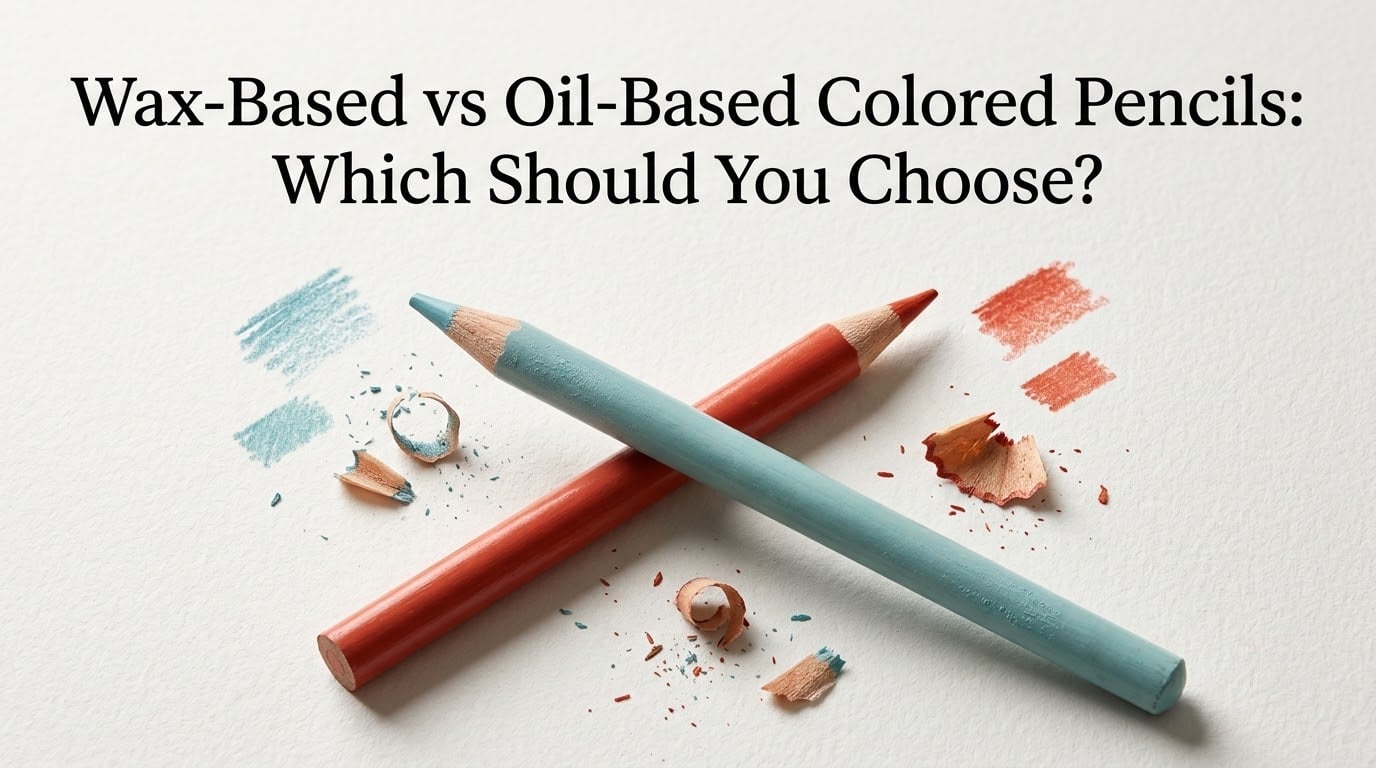
Pick a pencil up off your desk and run it across a scrap of paper. That smooth glide or stubborn scratch you feel comes down to one decision the manufacturer made: wax binder or oil binder. Get that decision right, and your whole colored pencil practice feels easier. Get it wrong, and you fight smudging, wax bloom, or cores that snap when you sharpen.
We have spent years testing both binder types on everything from coloring books to gallery portraits, and the choice between wax-based vs oil-based colored pencils shapes every layer you lay down. In this guide we will walk you through what each binder does, how the two pencil families feel in your hand, where each one shines, and the exact use cases that should drive your decision. By the end you will know which type belongs in your kit, which paper to pair it with, and how to handle the quirks each binder brings to the page.
Table of Contents
- Quick Answer: Wax-Based vs Oil-Based Colored Pencils
- What Are Wax-Based Colored Pencils?
- What Are Oil-Based Colored Pencils?
- Wax vs Oil Colored Pencils: Side-by-Side Comparison
- Blending, Layering, and Burnishing Differences
- Wax Bloom, Smudging, and Erasing: Troubleshooting Each Type
- Best Paper Pairings for Wax-Based vs Oil-Based Pencils
- Can You Mix Wax-Based and Oil-Based Pencils in One Artwork?
- Who Should Choose Wax-Based Pencils
- Who Should Choose Oil-Based Pencils
- Frequently Asked Questions
- Are wax or oil colored pencils better?
- Are Prismacolor colored pencils oil or wax-based?
- Can you use wax and oil-based colored pencils together?
- What are some good non-waxy colored pencils?
- Which is better, wax or oil based colored pencils?
- Are Crayola colored pencils oil-based or wax-based?
- How to stop colored pencils from smudging?
- Final Verdict: Picking the Right Pencil for Your Art
Quick Answer: Wax-Based vs Oil-Based Colored Pencils
Wax-based colored pencils use a soft wax binder that creates creamy, blendable cores ideal for smooth layering and forgiving coverage. Oil-based colored pencils use a vegetable-based oil binder that produces firmer cores, sharper points, and more stable pigment on the page.
Choose wax-based if you want the easiest blending, soft layered gradients, and beginner-friendly forgiveness. Choose oil-based if you need fine detail, archival stability, low smudging, and a sharp point that lasts through long sessions. Both work well; they simply favor different techniques. Most adult colorists end up owning at least one of each.
What Are Wax-Based Colored Pencils?
Wax-based colored pencils are made by suspending dry pigment in a soft wax binder, then pressing the mixture into a wooden shaft. The wax binder is what gives these pencils their famously smooth, buttery feel on paper.
Because the binder is soft, the core releases pigment with very little pressure. You can lay down a layer quickly, build up color in just a few strokes, and blend two colors together with little more than a light circular motion. That forgiving quality is exactly why beginners tend to gravitate toward wax-based pencils.
The trade-off is structural. A softer wax core breaks more easily inside the sharpener, loses its point faster during detail work, and can develop a chalky haze called wax bloom when pigment is pushed deep into the paper tooth. We will cover wax bloom and how to fix it later in this guide.
Common examples of wax-based pencils include Prismacolor Premier (the classic soft-core choice), Crayola colored pencils (the budget student staple), and artist lines like Caran d’Ache Pablo and Stabilo Carbothello. Prismacolor in particular is often the first wax-based pencil a new artist owns.
What Are Oil-Based Colored Pencils?
Oil-based colored pencils replace the wax binder with a vegetable oil or modified plant-oil binder, sometimes combined with small amounts of gum. The result is a firmer core that releases pigment only when you press down.
That firm core has real advantages. Oil-based pencils hold a sharp point far longer, so you can render fine lines, hair strands, and crisp edges without constantly resharpening. Their pigment also tends to be highly lightfast, which is why galleries and portrait artists favor oil-based lines for work that needs to last decades without fading.
The trade-off is effort. Oil-based cores do not glide the way wax-based ones do. You will need slightly more pressure for each stroke, your first layer will look thin, and building up saturated color takes longer. Many artists treat this as a feature rather than a flaw: oil-based pencils reward careful layering and let you build depth without losing detail underneath.
Common examples of oil-based pencils include Faber-Castell Polychromos (the most cited oil-based brand), Caran d’Ache Luminance, Derwent Lightfast, and Mitsubishi Uni Color. If you have ever picked up a Polychromos pencil and felt it was harder than a Prismacolor, that firmness is the oil binder at work.
Wax vs Oil Colored Pencils: Side-by-Side Comparison
Here is the at-a-glance comparison. Skim this first, then read the deeper sections below for the reasoning behind each row.
- Core softness: Wax-based feels soft and creamy. Oil-based feels firm and resistant.
- Blending ease: Wax-based blends with light pressure. Oil-based blends with more pressure or solvent.
- Point retention: Wax-based loses its point fast. Oil-based keeps a sharp tip through long detail sessions.
- Lead breakage: Wax-based cores snap more often in the sharpener. Oil-based cores are durable.
- Wax bloom risk: Wax-based can develop a milky haze. Oil-based does not produce wax bloom.
- Smudging: Wax-based smudges more easily. Oil-based lays down smudge-resistant pigment.
- Lightfastness: Wax-based varies by brand. Oil-based tends to be more archival.
- Layering speed: Wax-based lays down color quickly. Oil-based rewards slow, patient layering.
- Beginner friendly: Wax-based is more forgiving. Oil-based rewards practice.
- Detail work: Oil-based wins for fine lines. Wax-based needs constant resharpening.
- Paper pairing: Wax-based likes fine-grain or vellum paper. Oil-based handles toothier paper well.
- Best for: Wax-based suits coloring books and blending. Oil-based suits portraits and illustration.
Blending, Layering, and Burnishing Differences
Blending is where the wax vs oil difference becomes most visible. When you blend two colors, you are essentially pushing pigment deeper into the paper and forcing the colors to mix. The binder decides how easily that mixing happens.
Wax-based pencils blend with almost no effort. Place a yellow stroke next to an orange stroke and a few soft circles with a third color will pull the boundary line into a smooth gradient. The wax binder softens as it warms against the paper, and your pigment flows. Burnishing, which is the technique of pressing hard to push pigment into a polished, almost waxy sheen, is far easier with wax-based cores.
Oil-based pencils blend more slowly. The binder does not soften with friction in the same way, so you have to either apply more pressure, layer many light passes, or use a solvent like odorless mineral spirits to dissolve and move pigment around. Solvent blending is popular among oil-based users because it produces very smooth gradients, but it requires ventilation and a different workflow.
For layering, both pencil types support multi-pass work. Wax-based layers fill the paper tooth quickly, which means you can reach saturated color in fewer strokes. Oil-based layers stay distinct longer, so you can build up subtle hue shifts without muddying the layers below. Many portrait artists prefer oil-based for exactly this reason: they can adjust skin tones one thin layer at a time without disturbing what is underneath.
Wax Bloom, Smudging, and Erasing: Troubleshooting Each Type
Every binder brings a quirk. Knowing the quirk ahead of time saves hours of frustration.
Wax bloom is the milky haze that appears on dark areas of a wax-based drawing after a day or two. It happens because the wax binder migrates back to the surface as the pigment settles. The fix is simple: lightly buff the surface with a soft cloth or tissue, then spray the finished piece with a final fixative. Most artists plan for wax bloom as a normal step rather than a defect.
Smudging affects wax-based pencils more than oil-based because the soft binder stays mobile on the paper surface longer. The simple fix is to lay a sheet of glassine or tracing paper under your drawing hand. The deeper fix is to finish heavily layered areas before moving on, and to spray fixative between sessions if you need to rest your hand on the work.
Erasing is also binder-dependent. Wax-based pigment can be lifted with a soft kneaded eraser in the early layers, but once you have burnished pigment into the paper, it stays put. Oil-based pigment is harder to lift at any stage because the binder grips the paper more firmly. Plan your drawing accordingly: lay down light layers first, then commit to color as you build.
Lead breakage is mostly a wax-based issue. A soft core can snap inside the sharpener, especially if you twist the pencil while sharpening or use a cheap sharpener. The fix is a high-quality helical sharpener and a light, straight turning motion. Oil-based cores almost never break this way because of their firmer binder.
Best Paper Pairings for Wax-Based vs Oil-Based Pencils
The right paper changes how each pencil type behaves. Texture, weight, and finish all interact with the binder.
Wax-based pencils perform best on fine-grain or vellum paper. The smooth surface lets the soft wax binder glide and burnish without grabbing tooth. Hot press watercolor paper, Bristol board, and heavyweight vellum drawing paper are excellent choices. A rough or heavily textured paper will catch the wax and produce a grainy, uneven layer.
Oil-based pencils are more forgiving about paper texture. They handle slightly toothy paper well because the firm binder can push pigment into the small valleys without softening. Cold press watercolor paper, toned paper, and mixed-media sketchbooks are popular pairings. The tooth gives oil-based pigment something to grip, which deepens saturation on the first layer.
For both types, look for paper that is acid-free and at least 100 lb (160 gsm). Thin paper would buckle under the pressure needed for either binder type, and acidic paper would yellow and damage your finished piece over time. A bright white paper suits vibrant pigments, while a toned gray or cream paper softens highlights and gives a different mood.
If you are unsure, start with a 98 lb (160 gsm) Bristol vellum pad. It is forgiving enough for wax-based blending and firm enough to handle oil-based layering. Most artists we know keep a pad of this on their desk as a default.
Can You Mix Wax-Based and Oil-Based Pencils in One Artwork?
Yes, and many advanced artists do. The trick is knowing which type does which job in the piece.
A common workflow is to use oil-based pencils for the underdrawing and fine details, then switch to wax-based pencils for blending, fills, and burnished highlights. Oil-based pencils lay down a stable base layer that does not smudge under your hand. Wax-based pencils then build on top, blending smoothly without disturbing the detail work below.
The reverse also works: lay down a wax-based base for fast color coverage, then add oil-based detail on top. The harder oil core can sit on top of softer wax layers without picking them up, which is useful when you want a crisp edge over a soft gradient.
The one rule when mixing binders is to avoid lifting. Wax-based pigment already on the page can be picked up by an oil-based pencil if you press too hard, and oil-based pigment is hard to lift at all. Use light pressure, work in thin layers, and test your approach on a scrap sheet before committing to your finished piece.
Who Should Choose Wax-Based Pencils
Pick wax-based if any of the following sound like you.
- You are a beginner who wants forgiving, smooth color laydown.
- You mostly do adult coloring books and want quick coverage.
- You love soft, blendable gradients and burnished highlights.
- You are working on toned or white paper and want opaque coverage.
- You want a budget-friendly entry into artist-grade pencils.
Wax-based pencils also suit mixed media artists who like to layer colored pencil over watercolor or ink. The soft wax binder lays down quickly on top of other media without disturbing it, which makes Prismacolor and similar wax-based lines a popular second step after washes.
Be aware of the trade-offs: cores may snap, points will dull fast, and wax bloom needs to be buffed away before you spray fixative. If those quirks sound manageable, wax-based is probably your best starting point.
Who Should Choose Oil-Based Pencils
Pick oil-based if any of the following sound like you.
- You render fine detail like hair, fur, eyelashes, or architectural edges.
- You work on portraits or realistic illustration and need control.
- You care about archival stability and lightfastness for finished pieces.
- You often work in long sessions and want a sharp point to last.
- You live in a warm or humid climate where wax bloom is a constant issue.
Oil-based pencils also suit illustrators who need a consistent line weight across a full page. Because the firm core does not soften as much under friction, a Faber-Castell Polychromos or Caran d’Ache Luminance pencil will keep the same line width whether you are on stroke one or stroke fifty. That predictability is hard to find in any wax-based line.
The trade-off is patience: your first layers look thin, you will need more pressure for each stroke, and reaching saturated color takes longer. If you enjoy slow, deliberate layering, oil-based pencils will reward you. If you want fast coverage, they will feel frustrating.
Frequently Asked Questions
Are wax or oil colored pencils better?
Neither binder is universally better; the right choice depends on your technique. Wax-based pencils blend easily and forgive beginner mistakes, while oil-based pencils hold a sharp point, resist smudging, and stay archival over time. Pick wax-based for fast coverage and soft gradients, and oil-based for fine detail and long-lasting work.
Are Prismacolor colored pencils oil or wax-based?
Prismacolor Premier pencils are wax-based. The wax binder is what gives them their famously soft, creamy laydown and excellent blendability, and also what makes their cores more prone to snapping and their dark areas more prone to a milky wax bloom haze.
Can you use wax and oil-based colored pencils together?
Yes, many advanced artists mix both types in a single artwork. A common approach is to lay down an oil-based underdrawing and fine details first, then switch to wax-based pencils for blending, fills, and burnished highlights on top. Use light pressure when crossing binder types so you do not lift underlying pigment.
What are some good non-waxy colored pencils?
Popular non-waxy, oil-based colored pencils include Faber-Castell Polychromos, Caran d’Ache Luminance, Derwent Lightfast, and Mitsubishi Uni Color. These brands all use an oil or modified plant-oil binder that produces a firmer core, sharper point, and more archival pigment than wax-based lines.
Which is better, wax or oil based colored pencils?
Wax-based pencils are better for fast blending, soft gradients, beginner-friendly coverage, and budget-friendly entry into artist-grade work. Oil-based pencils are better for fine detail, archival stability, smudge resistance, and long sessions where a sharp point matters. Most artists we know end up owning both for different parts of their practice.
Are Crayola colored pencils oil-based or wax-based?
Crayola colored pencils are wax-based. They use a wax binder to keep their cores affordable and beginner-friendly, which is why Crayola pencils feel firmer and less creamy than artist-grade wax-based lines like Prismacolor Premier but still belong to the wax binder family.
How to stop colored pencils from smudging?
To reduce smudging, place a sheet of glassine or tracing paper under your drawing hand, finish heavily layered areas before moving on, and spray fixative between sessions if you must rest your hand on the work. Oil-based pencils smudge less than wax-based ones because the firmer binder grips the paper more securely.
Final Verdict: Picking the Right Pencil for Your Art
The wax-based vs oil-based colored pencils choice comes down to what you actually do at the desk. Wax-based pencils are your friend if you want fast coverage, easy blending, and forgiving feel; they are the default starting point for most beginners and adult colorists. Oil-based pencils are your friend if you want crisp detail, archival stability, and a sharp point that lasts; they are the working tool of most professional illustrators and portrait artists.
Our honest recommendation is to start with one artist-grade wax-based set like Prismacolor Premier to learn blending and burnishing, then add an oil-based set like Faber-Castell Polychromos when you are ready to render fine detail or build archival work. The two binders complement each other, and most experienced artists keep both on their desk for different jobs.
Whichever binder you choose for your next piece, pair it with acid-free heavyweight paper, sharpen with a quality helical sharpener, and finish with a final fixative spray. Those three habits will protect your work no matter which binder family you draw from. Updated for 2026, this guide will continue to reflect the best practices our team has tested across both binder types, and we will revisit it as new lightfast ratings and student-grade innovations reach the market.