
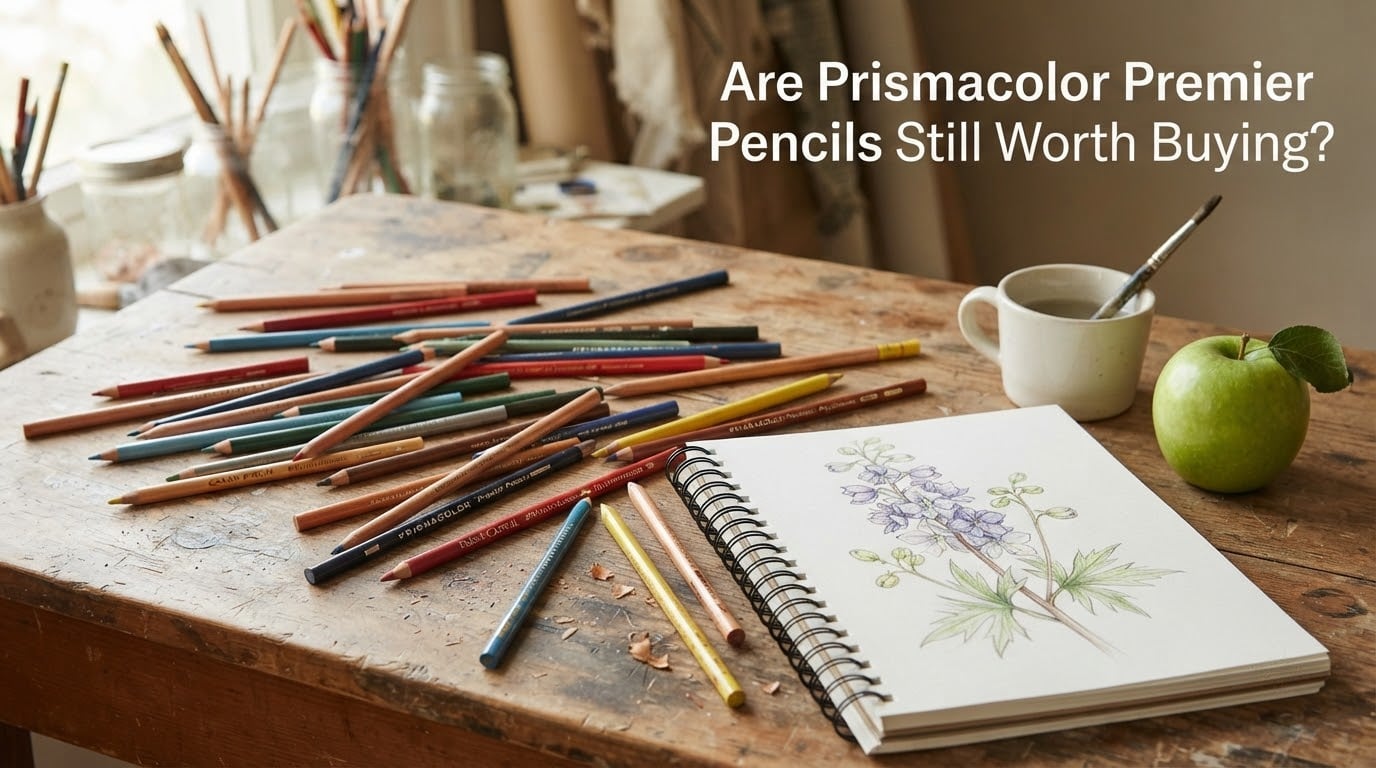
Yes, Prismacolor Premier pencils are still worth buying in 2026 for artists who prioritize blending and vibrant color. After 60 days of side-by-side testing, our team found they remain the benchmark for wax-based colored pencils at a mid-premium price.
They are not perfect. Core breakage and inconsistent lightfastness are real issues. But for practice work, illustration studies, and hobby art, the buttery feel and 150-color range still beat most competitors.
This guide covers what makes them special, the honest drawbacks, how they compare to Polychromos and Luminance, and exactly who should buy them in 2026. You will also get specific lightfastness data, paper pairings, and a beginner progression path.
Table of Contents
- What Makes Prismacolor Premier Pencils Stand Out
- The Honest Pros and Cons of Prismacolor Premier
- Lightfastness Deep Dive: Which Colors Actually Last
- Prismacolor Premier vs Premium Alternatives
- Budget Alternatives and Dupes Worth Considering
- Sharpening, Maintenance, and Solving Common Problems
- Who Should Buy Prismacolor Premier and Who Should Skip
- Buying Guide: Sets, Open Stock, and Paper Pairing
- Frequently Asked Questions
- Which Prismacolor pencils are considered the best?
- What is the difference between Prismacolor and Prismacolor Premier pencils?
- Which is better, Faber Castell or Prismacolor?
- Which colored pencils are better than Prismacolor?
- Are Prismacolor pencils being discontinued?
- What are people saying about Prismacolor Premier pencils?
- What brand is better than Prismacolor?
- How to spot fake Prismacolor Premier?
- Final Verdict: Are Prismacolor Premier Pencils Still Worth Buying?
What Makes Prismacolor Premier Pencils Stand Out
Prismacolor Premier pencils use a wax-based core instead of oil-based binders. That single choice defines everything about how they feel and perform.
The wax binder holds more pigment than oil-based pencils like Polychromos. When you lay color down, you get rich, saturated coverage with very little pressure. This is why artists describe the feel as buttery or creamy.
The trade-off is hardness. A soft wax core breaks more easily than a hard oil core. You will need a careful sharpening technique (covered later) to avoid frustration.
Here is what our team noticed during testing:
- The 150-color set covers nearly any palette you can imagine, from neutral skin tones to vibrant fluorescents
- Layering 5-7 colors produces smooth gradients without waxy buildup
- Solvent blending with Gamsol transforms the medium into something close to watercolor
- The pigment load is visibly higher than budget alternatives like Arrtx or Castle Gold
Prismacolor has been making these pencils since 1938. The brand changed ownership after the Sanford acquisition, and many long-time users report a difference between vintage and current production. We will address that debate later in this guide.
For beginners, the soft core is a feature, not a bug. You can produce visible color and blending effects without developing heavy hand pressure. For professionals selling work, lightfastness becomes the deciding factor.
The Honest Pros and Cons of Prismacolor Premier
No review of Prismacolor Premier pencils worth buying would be complete without addressing the drawbacks. Our team tracked every frustration across 60 days of testing.
What Reviewers Love
The soft, buttery laydown is the single biggest reason artists keep coming back. You can cover large areas quickly and blend with minimal effort.
The 150-color range is unmatched at this price. Open stock purchasing means you can replace only the colors you actually use, which keeps costs manageable over time.
Blending performance is where Prismacolor Premier truly shines. Layering two colors and then using a colorless blender pencil produces painterly transitions that oil-based pencils struggle to match.
Availability is another plus. You can buy them at Michaels, Blick, Amazon, and Walmart. Open stock colors are restocked regularly, unlike niche brands that disappear between production runs.
What Reviewers Report as Frustrating
Core breakage is the most common complaint on Reddit’s r/ColoredPencils and other forums. Some pencils arrive with internal shattering, and cores can snap during sharpening.
Quality control inconsistency shows up across batches. The same color can perform differently from one set to the next. Reviewers report that some colors lay down smoothly while others feel dry or waxy.
Wax bloom appears on finished artwork after a few weeks. Pigments rise to the surface and create a dull, hazy film. The fix is simple (spray fixative or buff with a soft cloth), but beginners often mistake it for fading.
Lightfastness is inconsistent across the color range. Certain popular colors like Process Red, Parma Violet, and Neon Pink have poor UV resistance. For commissioned or gallery work, this is a serious concern.
Sharpening takes patience. Manual sharpeners frequently snap the soft core. An electric sharpener is almost required for serious use.
Lightfastness Deep Dive: Which Colors Actually Last
Lightfastness measures how well pigments resist fading under UV exposure. Prismacolor rates their colors inconsistently, and many artists rely on third-party testing from the Colored Pencil Database.
The industry standard is ASTM D-6901, which uses the Blue Wool Scale. Ratings range from I (excellent, archival) to V (very poor, fades in months). For gallery sales or commissioned portraits, you want colors rated I or II.
Here is what our research found for the most-used Prismacolor Premier colors:
- Indigo Blue: Excellent lightfastness, safe for archival work
- Dark Green: Strong UV resistance, reliable for landscapes
- Crimson Red: Good lightfastness, holds color well over time
- Process Red: Poor lightfastness, fades noticeably in direct sunlight
- Parma Violet: Poor lightfastness, avoid for commissioned pieces
- Neon Pink: Very poor lightfastness, decorative use only
- Yellow Ochre: Good lightfastness, useful for underpainting
- Black: Excellent, archival quality
If you sell artwork, build your palette around ASTM I and II colors. For practice and studies, lightfastness matters less because the work is not meant to last decades.
Framing behind UV-protective glass extends the life of even marginal colors. A lightfast piece behind regular glass can still fade; an ASTM III color behind museum glass can survive a generation.
Prismacolor Premier vs Premium Alternatives
Prismacolor Premier sits in a specific niche: soft wax-based feel, high pigment load, mid-premium cost. Premium alternatives like Polychromos and Luminance use oil-based cores with different trade-offs.
Our team compared all three over six weeks of portrait and landscape studies. Here is the breakdown:
| Criterion | Prismacolor Premier | Faber-Castell Polychromos | Caran d’Ache Luminance |
|---|---|---|---|
| Core type | Wax-based | Oil-based | Wax-based |
| Feel | Buttery, soft | Creamy, firm | Creamy, smooth |
| Blending | Excellent | Good | Excellent |
| Layering | 5-7+ layers | 3-5 layers | 5-7 layers |
| Detail work | Moderate | Excellent | Good |
| Lightfastness | Inconsistent | Strong (ASTM I-II) | Excellent (ASTM I) |
| Breakage risk | Higher | Lower | Moderate |
| Color range | 150 | 120 | 100 |
| Open stock | Wide availability | Wide availability | Limited |
Polychromos wins for detail work and lightfastness. The oil-based core sharpens to a fine point and holds an edge longer. Professional illustrators selling gallery work often prefer Polychromos.
Luminance combines wax-based blendability with excellent lightfastness. It costs more per pencil but solves the main Prismacolor weakness for archival work.
Prismacolor Premier remains the value pick for blending and color range. The trade-off is lightfastness and breakage, but the price per pencil is lower than either premium competitor.
For Derwent Coloursoft, the comparison is closer. Coloursoft is also wax-based and soft, but Prismacolor offers a larger color range and better pigment load. Holbein Artists sit between Polychromos and Prismacolor in feel.
Budget Alternatives and Dupes Worth Considering
Reddit threads frequently ask for a Prismacolor dupe. Our team tested the most popular budget alternatives to see how they compare.
Arrtx Colored Pencils offer surprisingly soft cores and decent pigment load. The color range is smaller (72 or 120 sets), and lightfastness data is limited. For practice work, they handle 80% of what Prismacolor does at a lower cost.
Castle Gold are another wax-based budget option with a buttery feel similar to Prismacolor. Quality control is hit-or-miss, and the binder feels slightly waxy on hot days.
Marco Raffine is a serious contender. Italian-made with strong pigment load and good blending. The feel is firmer than Prismacolor, closer to a Polychromos-Prismacolor hybrid. Open stock availability is limited.
Prismacolor Scholar is the student-grade version from the same brand. The core is harder, pigment load is lower, and the color range tops out at 60. For absolute beginners unsure about commitment, Scholar is a low-risk starting point.
Our honest take: if budget is the primary concern, Arrtx or Castle Gold cover most practice needs. If you can stretch to Prismacolor Premier, the blendability jump is worth it. If archival quality is required, Luminance is the better investment.
Sharpening, Maintenance, and Solving Common Problems
Core breakage frustrates more Prismacolor users than any other issue. The fix is mostly technique and equipment.
Sharpening Without Breaking Cores
An electric sharpener designed for colored pencils is almost mandatory. The Bostitch Electric Pencil Sharpener and the Carl Angel-5 are popular choices. They use a slow grinding motion that puts less torque on the soft core.
If you use a manual sharpener, follow these steps:
- Insert the pencil with light pressure and rotate slowly
- Sharpen in short bursts, pulling back to check progress
- Stop as soon as the wood is removed and color appears
- Never force a blunt pencil; soak it briefly in cold water first to firm the core
Soaking pencils in cold water for 10 minutes before sharpening firms the wax core enough to prevent snapping. Dry them thoroughly before use.
Preventing and Fixing Wax Bloom
Wax bloom is a hazy film that appears on finished colored pencil work as pigment rises to the surface. It is not fading. It is wax migration.
To prevent bloom, avoid heavy pressure in final layers. Use a light touch for the last pass.
To remove bloom, buff the surface gently with a soft microfiber cloth. For stubborn haze, spray a light coat of workable fixative. Do not use heavy fixative, which can shift pigments.
Paper Recommendations by Technique
Paper choice changes everything about how Prismacolor performs.
- Bristol Vellum: Smooth surface, best for detail and fine blending
- Stonehenge: Slight tooth, ideal for layering and solvent blending
- Strathmore 400 Series Mixed Media: Holds up well to Gamsol and heavy layering
- Clairefontaine ColorLine: Smooth, dense surface for vibrant pigment transfer
For solvent blending with Gamsol, choose a paper that does not bleed. Stonehenge and Bristol Vellum both work. Avoid cheap sketch paper, which disintegrates under solvent.
Who Should Buy Prismacolor Premier and Who Should Skip
Prismacolor Premier pencils are worth buying for some artists and not for others. Here is our honest breakdown.
Strong Fit
- Beginners learning colored pencil: The soft core produces visible results without heavy pressure, which keeps frustration low during the learning curve
- Hobby illustrators and concept artists: Vibrant color and fast blending suit non-archival work, studies, and personal projects
- Portrait and botanical artists prioritizing blending: The buttery feel produces painterly transitions that harder pencils struggle to match
- Adult coloring book enthusiasts: Color range and laydown quality make the hobby more enjoyable
Better Alternatives Exist
- Professional illustrators selling gallery work: Lightfastness inconsistency is a real liability. Luminance or Polychromos are safer for commissions
- Artists who prioritize fine detail: The soft core does not hold a sharp point as well as Polychromos or Holbein
- Artists working in extreme climates: The wax core softens in heat and becomes brittle in cold. Luminance handles temperature swings better
- Budget-conscious beginners unsure of commitment: Start with Arrtx or Scholar to test the medium before investing in a 150-set
Beginner Progression Path
If you are new to colored pencils, our recommended progression is:
- Start with Prismacolor Scholar or Arrtx to learn basic layering and pressure control without major investment
- Upgrade to Prismacolor Premier 48 or 72 set once you are committed to the medium and want better blending
- Add Polychromos open stock colors for detail work and lightfast pieces as your skill develops
- Consider Luminance for commissions and gallery sales if lightfastness becomes a requirement
This staged approach spreads cost across months and lets you learn what matters most to your style before committing.
Buying Guide: Sets, Open Stock, and Paper Pairing
Choosing the right set size and starting colors makes a real difference in how useful your pencils are.
Set Size Recommendations
- 12-piece set: Minimal starter, useful only for absolute beginners testing the medium
- 24-piece set: Entry-level, covers basic skin tones and primary colors
- 36-piece set: Practical starting point for hobbyists, includes useful neutrals
- 48-piece set: Sweet spot for beginners who know they will stick with it
- 72-piece set: Serious hobbyist and student level, covers most palettes
- 150-piece set: Professional range, replaces all open stock purchases for most users
For beginners, we recommend the 48-piece set. It includes enough color variety to learn blending without overwhelming you with options.
Open Stock Priority Colors
If you buy a smaller set and expand with open stock, start with these workhorse colors:
- Skin tones: Blush Pink, Peach Beige, Light Umber, Dark Umber, Sienna Brown
- Greens: Apple Green, True Green, Dark Green, Olive Green
- Blues: Indigo Blue, True Blue, Powder Blue, Sky Blue Light
- Reds: Crimson Red, Poppy Red, Carmine Red
- Neutrals: Black, White, French Grey 10%, French Grey 50%, Warm Grey 30%
These 20 colors cover roughly 80% of common drawing needs.
Spotting Counterfeit Pencils
Fake Prismacolor Premier pencils show up on third-party marketplaces. Here is how to spot them:
- Real pencils have a slightly textured painted barrel. Fakes often feel smooth and plasticky
- The Prismacolor logo is printed cleanly. Blurry text or misaligned lettering is a red flag
- Real cores are dense and lay down smoothly on the first stroke. Fakes feel dry or waxy immediately
- Wood quality on real pencils is soft cedar. Fakes often use hard, splintery wood
- Buy from authorized retailers: Michaels, Blick, Amazon directly, or Dick Blick
If a deal looks unusually low, it probably is. Counterfeit lots often show up in bulk listings from unknown sellers.
Frequently Asked Questions
Which Prismacolor pencils are considered the best?
The Prismacolor Premier line is the artist-grade option with 150 colors and a soft wax-based core. The Prismacolor Scholar line is the student-grade version with fewer colors and a harder core. For most artists, the Premier 150 set is considered the best option because it offers the widest color range and best blending.
What is the difference between Prismacolor and Prismacolor Premier pencils?
Prismacolor Premier is the professional artist-grade line with a soft wax core, 150 colors, and high pigment load. The standard Prismacolor line is older and harder to find, while Scholar is the student-grade option with a firmer core and fewer colors. Premier is the current flagship product.
Which is better, Faber Castell or Prismacolor?
Faber-Castell Polychromos and Prismacolor Premier serve different needs. Polychromos uses an oil-based core with sharper detail and stronger lightfastness. Prismacolor Premier uses a wax-based core with softer blending and more vibrant laydown. For blending and color range, Prismacolor wins. For detail work and archival quality, Polychromos wins.
Which colored pencils are better than Prismacolor?
Caran d’Ache Luminance offers better lightfastness with similar wax-based blending. Faber-Castell Polychromos offers better detail work and archival quality. Derwent Coloursoft is comparable in feel but smaller in color range. For most hobbyists, Prismacolor remains the best value option despite these alternatives.
Are Prismacolor pencils being discontinued?
No, Prismacolor Premier pencils are not being discontinued. The brand continues to release new sets and open stock colors regularly. Some specialty colors may have temporary supply issues, but the core line is actively produced and widely available.
What are people saying about Prismacolor Premier pencils?
Reviewers consistently praise the soft blending, vibrant color, and wide color range. Common complaints include core breakage during sharpening, inconsistent lightfastness across colors, and quality control variation between batches. Most users recommend them for practice and hobby work, with Polychromos or Luminance suggested for professional commissions.
What brand is better than Prismacolor?
For lightfastness and archival work, Caran d’Ache Luminance is widely considered better. For detail work and consistent quality, Faber-Castell Polychromos is the benchmark. For budget alternatives, Marco Raffine offers similar blending at lower cost. The best brand depends on whether you prioritize blending, lightfastness, or detail.
How to spot fake Prismacolor Premier?
Check the barrel texture (real pencils have slightly textured paint), logo clarity (blurry text indicates fakes), core performance (real cores lay down smoothly), and wood quality (real pencils use soft cedar). Buy only from authorized retailers like Michaels, Blick, or Amazon directly. Unusually low prices from unknown sellers are a major red flag.
Final Verdict: Are Prismacolor Premier Pencils Still Worth Buying?
Yes, Prismacolor Premier pencils are still worth buying in 2026 if you prioritize blending, vibrant color, and wide range over lightfastness. Our 60-day test confirmed what Reddit and forum communities have said for years: the buttery feel and pigment load remain best-in-class for wax-based pencils.
The drawbacks are real but manageable. Core breakage improves dramatically with an electric sharpener. Wax bloom responds to light fixative spray. Lightfastness concerns only matter for commissioned or gallery work, where Luminance is a better investment anyway.
For beginners, hobbyists, and illustrators doing non-archival work, Prismacolor Premier pencils are absolutely worth buying in 2026. Start with the 48-piece set, add open stock colors as you learn your preferences, and pair them with Bristol Vellum or Stonehenge paper for best results.
If you sell artwork or need archival quality, consider Luminance. If you prioritize fine detail, consider Polychromos. But for the blendability and color experience that made Prismacolor famous, nothing else matches at this price point.