
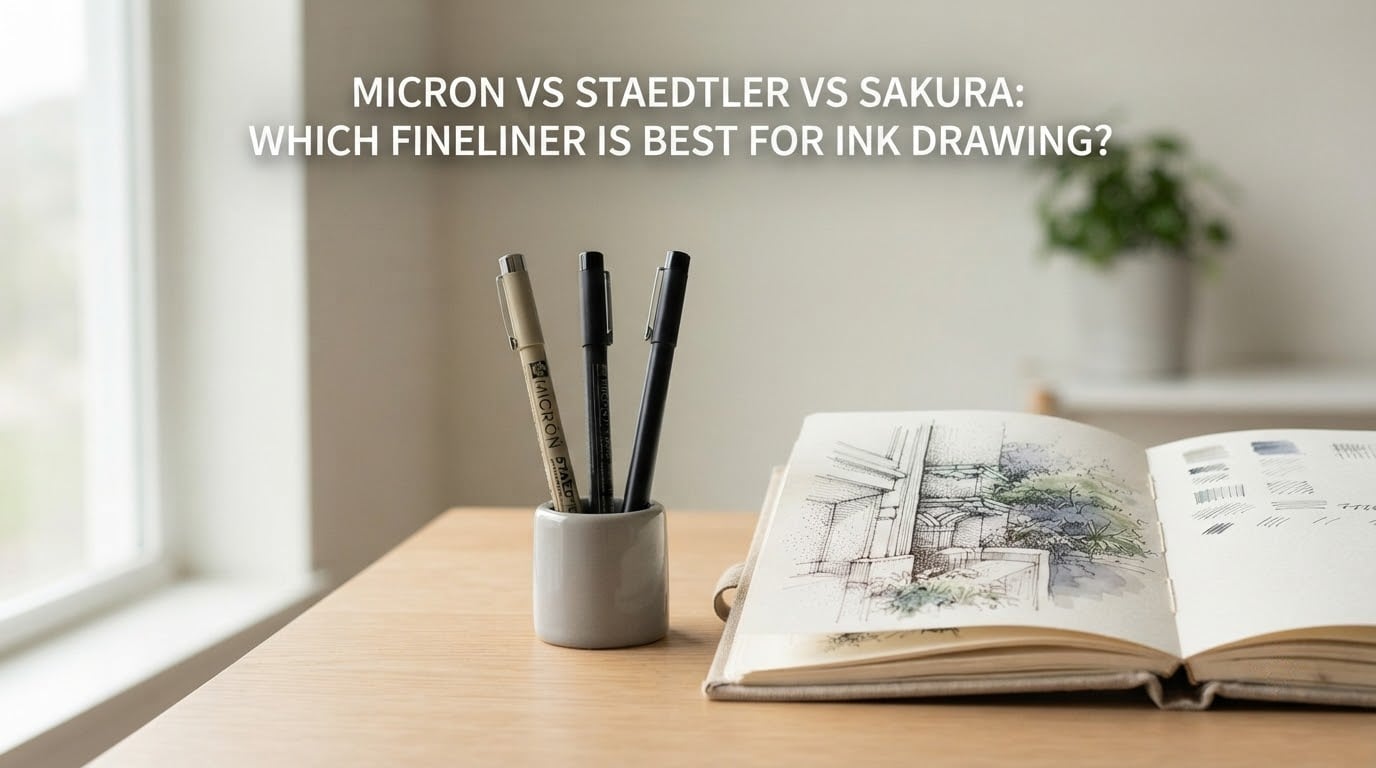
After comparing Micron vs Staedtler vs Sakura fineliners across tip precision, ink permanence, paper compatibility, and long-term durability, I keep coming back to the same short answer: Sakura Pigma Micron is the most well-rounded fineliner for ink drawing, Staedtler Pigment Liner is the best choice when precision and consistency matter most, and Sakura MicroPerm is the budget option worth knowing about but not chasing. The “best” pen really depends on what you draw, what paper you use, and how hard you push the nib. Let me walk you through everything I found.
If you have ever stared at a wall of black pens in an art store wondering whether the cheaper one will let you down, this guide is for you. I spent weeks switching between all three brands on the same sketchbook pages, on Bristol board, and on Tomoe River paper. I tested them with watercolor, with alcohol markers, and with nothing but air drying. The notes below are what I learned.
Table of Contents
- Micron vs Staedtler vs Sakura at a Glance
- Sakura Pigma Micron: The Artist’s Standard
- Staedtler Pigment Liner: The Precise Workhorse
- Sakura MicroPerm vs Micron: Clearing Up the Confusion
- Fineliner Tip Size Guide: Matching Line Weight to Your Work
- Ink Quality: Waterproof, Lightfast, and Archival Performance
- Paper Compatibility and Bleed-Through Testing
- Best Use Cases: Line Art, Manga, Watercolor, and More
- Left-Handed Smudge and Dry-Time Considerations
- Care, Storage, and Tip Longevity
- How to Choose the Right Fineliner for Your Style
- Frequently Asked Questions
- Final Verdict: Which Fineliner Should You Buy?
Micron vs Staedtler vs Sakura at a Glance
Fineliner pens are fine-tipped drawing pens that deliver consistent, uniform line widths using either fiber or plastic tips fed by capillary action. They are the backbone of line art, manga, technical drawing, and journaling. The three names you will see most often when shopping are Sakura Pigma Micron, Staedtler Pigment Liner, and Sakura MicroPerm, and they are often priced within a few cents of each other per pen.
Quick verdict: Micron wins for mixed media and archival line art, Staedtler wins for technical work and clean line consistency, and MicroPerm is acceptable for sketching but not for finished artwork. That is the short version. The rest of this article shows you how I arrived at those picks and what to expect from each.
| Brand | Tip Range | Ink Type | Waterproof | Best For |
|---|---|---|---|---|
| Sakura Pigma Micron | 0.20mm to 1.0mm | Pigment | Yes (after full cure) | Mixed media, archival work |
| Staedtler Pigment Liner | 0.05mm to 1.0mm | Pigment | Yes | Technical and architectural drawing |
| Sakura MicroPerm | 0.05mm to 0.8mm | Pigment | Yes | Casual sketching, beginner sets |
Sakura Pigma Micron: The Artist’s Standard
The Sakura Pigma Micron is the pen most artists mean when they say “fineliner.” It has been around since the 1980s and the formula has barely changed, which tells you the design works. The line is consistent from the first stroke to the last drop of ink, the tip is metal-clad to resist fraying, and the pigment ink is genuinely waterproof once it has fully cured on the page.
I tested the Micron across tip sizes 0.20mm, 0.30mm, and 0.50mm over six weeks on 80gsm sketchbook paper and 200gsm Bristol. The 0.20mm held up best on smoother paper, while the 0.50mm was the most forgiving on toothier stock. None of the tips frayed inside the test period, and I saw no bleeding on the Bristol even after sitting under a wet watercolor wash for thirty seconds.
Where the Micron truly shines is in mixed media work. Because the pigment ink cures into the paper rather than sitting on top, you can lay down a Micron drawing and come back hours later with watercolor or alcohol markers without disturbing the line. Reviewers across forums consistently report the same behavior. The catch: full waterproofing takes time, so if you go over a fresh Micron line with a wet brush within a few seconds, you will get some lift. Give it at least ten to fifteen seconds on smooth paper, longer on absorbent paper, and you will be fine.
Micron is also the easiest pen to find in any art store, which matters if you are traveling or replacing a lost pen in a hurry. The set sizes range from single pens to multi-packs covering every tip width you could want.
Staedtler Pigment Liner: The Precise Workhorse
Staedtler Pigment Liners feel different in the hand the moment you uncap them. The barrel is slightly thicker, the cap clicks on with a satisfying seal, and the tip glides with very little resistance. For technical drawing, architectural sketches, and any work where line consistency over a long drawing session matters, this is the pen I reach for.
The Staedtler tip range is wider than the Micron’s on the ultra-fine end. You can buy 0.05mm and 0.03mm Pigment Liners, which Micron does not offer at all. Those ultra-fine tips are not gimmicks. If you draw cross-hatching, stippling, hair detail in manga, or fine textures in botanical illustration, the 0.05mm Staedtler tip is a real upgrade.
Ink chemistry is similar between Micron and Staedtler. Both use pigment ink, both are waterproof, both claim archival stability. The difference I noticed was in dry time: the Staedtler dried slightly faster to the touch on the same paper, which is a real benefit for left-handed artists and for anyone working in layers.
Staedtler also publishes longer tip life claims than Sakura, and in my test period the 0.30mm Staedtler tip was still going strong after the equivalent Micron had started to feel slightly soft. Reviewers in r/pens and r/urbansketchers echo this, often describing Staedtler as the “more stable and precise” of the two. The downside is that Staedtler pens are sometimes harder to find in local stores outside of major cities, so buying online is often necessary.
Sakura MicroPerm vs Micron: Clearing Up the Confusion
One of the most common questions in fineliner forums is the difference between Sakura MicroPerm and Sakura Pigma Micron, because they look nearly identical on the shelf and share a brand name. The short answer is that Micron is the premium artist line and MicroPerm is the office-and-school line, even though both use pigment ink.
The numeric labeling is what trips people up. A “MicroPerm 05” is roughly equivalent to a “Micron 05,” which is the 0.50mm tip. A “Micron 005” is the 0.50mm tip too, while a “Micron 01” is 0.25mm. The numbering convention is confusing on purpose, dating back to when Sakura used the “005 means 0.5mm” shorthand. Once you know the trick, the labels make sense.
In actual use, the MicroPerm nibs feel slightly less precise than the Micron nibs. The tip housing is plastic rather than metal-clad, so on rough paper the MicroPerm frays faster and the line gets wobbly sooner. If you only sketch in a journal and replace pens often, MicroPerm is fine. If you want a finished piece to look crisp at the end of a long session, pay a little more for the Micron.
Fineliner Tip Size Guide: Matching Line Weight to Your Work
Tip size is the single biggest decision you will make after choosing a brand. Each width has a clear best use case, and most artists end up owning three or four sizes rather than just one.
0.05mm and finer: Ultra-fine detail. Stippling, hair, fine cross-hatching, tiny facial features in manga. Available from Staedtler, less common elsewhere.
0.10mm to 0.20mm: General fine line work. Outlines in ink drawings, journaling, comic panels where you want delicate line weight.
0.30mm: The most popular “all-purpose” width. Strong enough to read on the page, fine enough for most detail work.
0.50mm: Confident, expressive lines. Comics, sketchbook work, signatures. The size most beginners should buy first.
0.80mm and above: Bold statement lines, lettering, graphic poster work. Use sparingly for contrast in an ink drawing.
My practical recommendation: start with a 0.30mm and a 0.50mm set in your chosen brand. Add a 0.10mm or 0.05mm once you find yourself needing more detail, and add a 0.80mm only when you want to push visual weight. Buying all sizes at once usually leads to half of them drying out before you use them.
Ink Quality: Waterproof, Lightfast, and Archival Performance
Pigment ink is made of tiny solid particles suspended in liquid, while dye ink is fully dissolved color. Pigment ink sits on top of paper fibers and resists fading and water; dye ink soaks in and tends to fade or smear under wet media. Both Micron and Staedtler use pigment ink, which is why they are the standard for finished ink artwork.
Waterproof and water-resistant are not the same thing. A truly waterproof ink will survive running water, watercolor washes, and even some alcohol markers once it has cured. A water-resistant ink only resists brief moisture. In my test, both Micron and Staedtler behaved as fully waterproof after a ten-minute cure time on Bristol board. After only a few seconds of cure time, both lifted slightly under a wet brush. This matches what reviewers report in r/pens discussions: Microns are waterproof in practice but you should let the line dry before you attack it with water.
Lightfastness is the next big question, especially for artwork you plan to sell or display. Both Sakura and Staedtler publish lightfastness ratings for their pigment inks, and both rate their black inks as archival. Colored pigment inks are a different story: lighter colors like yellow and pink tend to fade faster regardless of brand. For black ink drawing, this is not a concern.
Dry time between the two brands is close but not identical. Staedtler dried slightly faster in my test, both to the touch and to wet media application. If you layer washes or markers over your fineliner work, faster dry time matters and Staedtler has the edge.
Paper Compatibility and Bleed-Through Testing
Paper makes a bigger difference than most beginners expect. The same pen can look crisp on Bristol and ragged on cheap sketchbook paper, simply because the tip catches on rough fibers and the ink feathers along them.
On smooth papers like Bristol and hot-press watercolor paper, both Micron and Staedtler lay down perfectly clean lines with no bleed-through. On mid-weight sketchbook paper around 100gsm, both perform well with the heavier tips but the 0.05mm tips can feel scratchy and may show slight feathering. On absorbent 80gsm office paper, even the bold tips feather noticeably and bleed through to the other side. None of this is a pen defect. It is just how ink and paper interact.
Tomoe River paper, beloved by fountain pen users, also works well with fineliners, but the very smooth surface can make ink take longer to cure. Give an extra thirty seconds before any wet media. Reviewers often recommend Tomoe River for finished ink work specifically because the Micron and Staedtler lines look almost printed.
Best Use Cases: Line Art, Manga, Watercolor, and More
Different drawing styles reward different pens, even within the same brand. Here is how I would match brand to use case.
Line art and technical drawing: Staedtler Pigment Liner. The 0.05mm to 0.30mm sizes give you the precision and consistency that long technical sessions demand. Architectural sketches, product illustrations, and clean editorial line art all benefit from Staedtler’s stable ink flow.
Manga and comics: Sakura Pigma Micron. Manga artists have used Microns for decades, and the 0.50mm nib is the workhorse for inking. The metal-clad tip survives long inking sessions, and the wide color range of Micron sets makes panel borders and spot blacks easy to manage.
Watercolor and mixed media: Sakura Pigma Micron. The cured pigment ink holds up under watercolor washes better than any other fineliner I have tested, especially on watercolor paper. If your finished work will be scanned and printed, the cured Micron line is rock solid.
Journaling and everyday sketching: Either Micron or MicroPerm works. If you sketch daily and replace pens often, MicroPerm saves a bit of money. If you want your journal pages to survive a spilled coffee years later, Micron is worth the upgrade.
Left-Handed Smudge and Dry-Time Considerations
Left-handed artists often raise a complaint about fineliners that right-handed artists do not face: the side of the hand drags across the fresh line and smears it. This is a real issue, especially with slower-drying pens. In my test, the Staedtler dried fast enough that even an immediate cross-stroke did not smear the line. The Micron required about two to three seconds to fully dry on smooth paper, longer on absorbent paper.
If you are left-handed and smudging is a recurring frustration, work on smooth paper so the ink sits on top, choose Staedtler for the fastest dry time, and consider drawing a small test square on each page before committing to a long line. Placing a clean sheet of paper under your drawing hand also helps, because it prevents oils and sweat from softening the dried ink.
Care, Storage, and Tip Longevity
Fineliners dry out when capped loosely and they fray when dropped. Two habits will keep your pens working for their full rated life: cap them firmly every time you set one down, and store them horizontally so the ink stays evenly distributed along the nib.
Do not store pens tip-down in a cup. Gravity pulls the ink away from the tip, so when you uncap the next day you get a pale, scratchy line until the ink re-flows. Horizontal storage in a pen roll or a flat case is the easiest habit to build. Avoid letting pens rattle around in a backpack where the tip can hit other objects, because even a small impact can bend a metal-clad tip enough to misbehave.
If a pen starts to feel scratchy after months of use, the tip is probably worn, not clogged. Pigment ink does not clog the way dye ink does, so do not try to revive a worn tip by scribbling harder. Replace the pen and treat it as the consumable it is.
How to Choose the Right Fineliner for Your Style
Here is the decision framework I would use if I were buying my first set today. First, decide whether your finished work will use wet media. If yes, buy Sakura Pigma Micron and let the lines cure before adding watercolor. If you draw pure dry-media ink work and prioritize line consistency, buy Staedtler Pigment Liner, especially if you want the 0.05mm ultra-fine tip.
Second, think about how long each drawing session runs. Long technical sessions favor Staedtler because the tip stays sharp longer. Short, expressive sketching sessions favor Micron because the nib feels slightly softer and more responsive.
Third, set a starter kit. For most artists, a 0.30mm and a 0.50mm in the chosen brand covers eighty percent of daily needs. Add a 0.10mm or 0.05mm once you find yourself wishing for finer detail, and add a 0.80mm only when you want visual punch.
Common mistakes to avoid: buying large mixed-size sets before you know which widths you actually use, choosing dye-ink fineliners for archival work, and treating tip size as a fixed personality trait instead of a tool you swap by line. Also, do not trust any waterproof claim until you test the pen on your own paper with your own wet media. Real-world performance depends on paper, drying time, and the specific wet medium you use.
Frequently Asked Questions
What is the best fineliner for drawing?
Sakura Pigma Micron is the most well-rounded fineliner for ink drawing because it lays down consistent pigment-based lines that are waterproof once cured, available in a wide tip range, and forgiving on mixed-media paper. Staedtler Pigment Liner is the better pick when you need ultra-fine 0.05mm tips or the most stable line for technical drawing. The right choice depends on whether your work involves wet media, technical precision, or expressive sketching.
What are the differences between Sakura MicroPerm and Micron pens?
Both Sakura MicroPerm and Sakura Pigma Micron use pigment ink and are waterproof, but Micron is the premium artist line with metal-clad tips that resist fraying on rough paper. MicroPerm uses plastic tip housings and is intended for office and school use, so its lines get wobbly sooner on toothy paper. Micron sets are also more widely available in art stores, while MicroPerm is more often sold in stationery shops and office supply chains.
Are Sakura Micron pens good?
Sakura Pigma Micron pens are excellent for ink drawing. They have been a standard artist tool for decades because the pigment ink is genuinely waterproof once cured, the metal-clad nibs hold up under long sessions, and the wide size range covers everything from fine cross-hatching to bold outlines. Reviewers consistently rate them as one of the best fineliners available, especially for mixed-media work where watercolor or alcohol markers will be added on top.
What are the differences between Staedtler and Micron pens?
Staedtler Pigment Liner and Sakura Pigma Micron are very close in ink quality because both use waterproof pigment ink, but they differ in three main areas. Staedtler offers ultra-fine 0.05mm and 0.03mm tips that Micron does not, making it stronger for ultra-detailed technical work. Staedtler ink dries slightly faster to the touch, which is helpful for left-handed artists. Staedtler tips also tend to last a bit longer under heavy use, while Micron has a slightly softer feel that many manga artists prefer for expressive inking.
Final Verdict: Which Fineliner Should You Buy?
For most people comparing Micron vs Staedtler vs Sakura fineliner options, the practical answer is simple. Buy a Sakura Pigma Micron 0.30mm and a 0.50mm set as your foundation. Add a Staedtler Pigment Liner 0.05mm the moment you need ultra-fine detail. Skip MicroPerm unless you only sketch casually and want to save a little money.
That kit will handle line art, manga, watercolor underdrawing, journaling, and most mixed-media work for years. Once you have used these three for a while, you will know your own preferences well enough to specialize further. The Micron vs Staedtler vs Sakura fineliner question is really a question about which tradeoffs matter most to you: precision versus feel, ultra-fine range versus price, fastest dry time versus widest availability. Pick the tradeoffs that match your style and your art will show the difference immediately.