
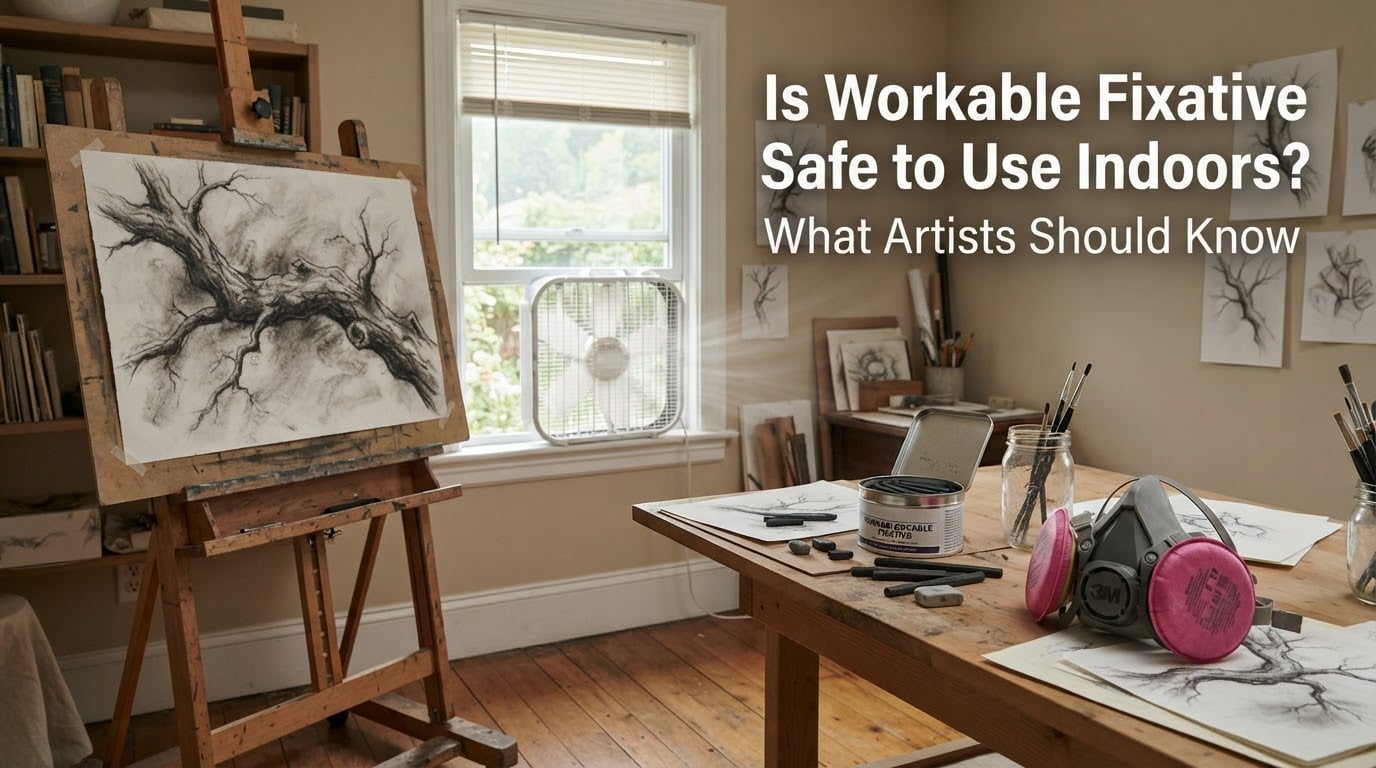
Yes, workable fixative can be safe to use indoors, but only when you treat it like the solvent-based aerosol it actually is. Open a window, run an extraction fan, wear a respirator, and keep pets and kids out of the room. Skip any of those steps and you trade a smudge-proof drawing for a headache, dizzy spells, or a longer-term respiratory risk that is genuinely avoidable.
I have sprayed fixative in studio apartments, college dorms, and shared houses over the last decade, and I have learned the hard way that the word “workable” describes the artistic finish, not the safety profile. This guide walks through exactly what workable fixative is, what the fumes do to indoor air, and how to set up a small space so you can use it without making yourself sick. Whether you draw charcoal in your bedroom, teach pastel classes from a home studio, or simply want to lock a finished sketch before framing, the rules below apply.
Table of Contents
- Quick Answer: Is Workable Fixative Safe to Use Indoors?
- What Is Workable Fixative and How Does It Work?
- Indoor Safety: Why Fumes Matter
- Ventilation Setup for Indoor Fixative Use
- Safety Precautions Beyond Ventilation
- Non-Toxic and Lower-Toxicity Alternatives
- How Long to Leave Fixative Spray Before Framing or Stacking
- Workable Fixative Safety Standards: What ASTM D-4236 Means
- Frequently Asked Questions
- Final Thoughts on Using Workable Fixative Indoors
Quick Answer: Is Workable Fixative Safe to Use Indoors?
Workable fixative is safe to use indoors only when you control three things: airflow, exposure distance, and respiratory protection. The fixative itself is an aerosol of resin or casein particles carried by fast-evaporating solvents, and those solvents are volatile organic compounds (VOCs) that off-gas into the room the moment you press the nozzle. In a sealed space, VOCs accumulate within minutes and can irritate your eyes, throat, and lungs.
For a quick safety baseline, our team treats every indoor fixative session with this minimum protocol:
- Two open windows on opposite walls (cross-ventilation)
- One box fan pulling air out of the room, or an open window with a fan facing outward
- A NIOSH-approved organic vapor respirator (not a dust mask or cloth mask)
- 30 cm distance between can and artwork
- No people, pets, or food in the room for at least 30 minutes after spraying
If you cannot meet those five conditions, spray outdoors or postpone the session. There is no shortcut that makes solvent-based fixative safe in a closed bedroom.
What Is Workable Fixative and How Does It Work?
Workable fixative is a clear aerosol spray made from resin or casein dissolved in a fast-evaporating solvent, typically a petroleum distillate or alcohol. When you spray it onto a charcoal, pastel, or graphite drawing, the solvent carries the binder onto the paper and then flashes off within seconds. What remains is a thin, transparent film that holds pigment in place without sealing the paper permanently.
The “workable” part matters. Unlike final fixative, workable fixative is designed so you can keep drawing on top of the dried layer. The film creates fresh “tooth” (tiny ridges that grab dry media) without locking the surface completely. That is why charcoal artists reach for it between sessions and why pastel painters use it to fix underlayers before adding highlights.
Common workable fixatives include Krylon Workable Fixatif, Winsor & Newton Professional Fixative, Sennelier Fixative, Lascaux Archival Fixative, and Daler Rowney Perfix. Each one relies on the same basic chemistry: a binder (resin or casein) plus a solvent carrier plus a propellant for the aerosol can.
Workable Fixative vs Final Fixative
The difference between workable and final fixative comes down to how permanent the film is. Workable fixative leaves a soft, slightly tacky layer that accepts more media. Final fixative creates a harder, more permanent seal that resists further layering.
Use workable fixative when you are still building layers or want to rework an area. Use final fixative when the artwork is finished and you want maximum smudge protection for framing, transport, or display. Both contain solvents, so both require the same ventilation discipline indoors.
Indoor Safety: Why Fumes Matter
The safety question around workable fixative is really a question about the solvent carrier, not the resin. The binder is inert once dry. The solvent is what gives workable fixative its strong odor and its indoor air risk.
Most workable fixatives use one of three solvent systems: petroleum distillates (like naphtha or mineral spirits), denatured alcohol, or a blend. All three are volatile organic compounds, meaning they evaporate at room temperature and become part of the air you breathe. In a well-ventilated studio, those VOCs disperse quickly. In a closed room, they accumulate.
What VOCs Do to Indoor Air
Volatile organic compounds (VOCs) are carbon-based chemicals that off-gas from solvents, paints, adhesives, and aerosols. Short-term exposure to high concentrations causes eye and throat irritation, headaches, dizziness, and nausea. Long-term exposure has been linked to chronic respiratory issues and, with certain solvents, organ damage.
Workable fixative in a closed 12-by-12 room can push VOC concentrations well above what most air quality guidelines consider safe, especially during repeated sessions. The odor you smell is your body registering the irritant. “I can still smell it” means the concentration is still high enough to matter.
Symptoms of Fixative Overexposure
Reviewers in artist communities describe a consistent pattern when fixative is used in poor ventilation. Watch for these signs during and after spraying:
- Burning or watery eyes
- Sore throat or dry cough
- Headache, particularly behind the forehead
- Dizziness or lightheadedness
- Nausea or upset stomach
- Fatigue that lingers for hours after spraying
If you feel any of these, leave the room immediately, open more windows, and step outside for fresh air. Artists in Reddit’s r/ArtistLounge have reported dizziness that lasted days after a single indoor session without ventilation, and several have mentioned being unable to fully air the smell out of sketchbook pages sealed with fixative in a closed room.
Ventilation Setup for Indoor Fixative Use
Ventilation is the single most important factor in indoor fixative safety. The goal is to move contaminated air out of the room faster than it accumulates, so VOCs never reach irritating concentrations. Open a window, and you get passive ventilation. Add a fan, and you get active ventilation that works even on still days.
5-Step Indoor Ventilation Protocol
- Open two windows on opposite walls to create cross-ventilation. Single-window setups leave stale air pockets.
- Place a box fan in the window facing outward to pull air out of the room. Position the fan as close to the opening as the window frame allows.
- Set up your artwork and spray area on the side of the room opposite the exhaust fan, so fumes travel away from your face before exiting.
- Keep the fan running for at least 30 minutes after you finish spraying. VOCs continue off-gassing from the wet film.
- Close and seal the fixative can, then leave the room. Return only when the odor has faded.
Apartment-Friendly Ventilation Options
Apartment and rental restrictions can make outdoor spraying difficult. Some buildings prohibit aerosol use on balconies, and many renters cannot drill holes for extraction fans. For those situations, a few workarounds help:
- Bathroom with an exhaust fan: Spray during a 20-minute hot shower so the steam carries fumes into the exhaust vent, then leave the bathroom door open to clear residual odor.
- HEPA air purifier with carbon pre-filter: Place it next to your spray area to capture airborne particles and reduce but not eliminate VOCs.
- Portable spray tent: A pop-up tent with a charcoal-filter exhaust port, designed for airbrush work, also works for fixative.
- Hallway or stairwell with open windows: When local rules allow, a well-ventilated stairwell is often safer than a sealed apartment room.
Safety Precautions Beyond Ventilation
Ventilation handles the room. Personal protective equipment handles what still reaches your face. The two together make indoor fixative use manageable; either one alone is not enough.
Masks vs Respirators: What Actually Works
A cloth mask or surgical mask will not protect you from fixative fumes. Those masks filter particles, not vapors. To block VOCs, you need a respirator rated for organic vapors, typically with black cartridges labeled “OV.”
Look for a NIOSH-approved respirator with organic vapor cartridges. Fit matters as much as the cartridge. A respirator with a poor seal leaks unfiltered air around the edges, so follow the manufacturer’s fit-test instructions. Artists with beards should know that facial hair breaks the seal on most half-face respirators; a full-face respirator or a powered air-purifying respirator (PAPR) is the safer option.
For occasional use, a reusable half-face respirator with replaceable OV cartridges costs less than a few cans of premium fixative and lasts for years.
Distance, Coats, and Timing
How you spray matters as much as where. Hold the can at least 30 cm from the artwork and use smooth, side-to-side passes. Closer than 30 cm saturates the paper, causes color shift, and bounces more aerosol back toward your face.
Apply two to three light coats rather than one heavy coat. Allow 5 to 10 minutes of drying time between coats. Heavy coats trap solvent under the surface, slow curing, and release VOCs over a longer window. Light coats flash off cleanly and reduce total exposure.
Keep Pets, Kids, and Food Away
Pets and children are more sensitive to VOCs than adults because of their smaller body mass and faster breathing rates. Birds are particularly vulnerable; their respiratory systems react to aerosolized particles at concentrations that may not bother humans at all.
Spray only when the room is empty of pets, kids, and uncovered food. Wait at least 30 minutes after spraying before re-entering, and ventilate longer if the odor is still strong.
Non-Toxic and Lower-Toxicity Alternatives
If indoor safety is a hard constraint (asthma, shared apartment, respiratory sensitivity, young children at home), several alternatives reduce or eliminate the VOC exposure that makes solvent-based fixatives risky indoors.
Casein-Based Fixatives
Casein-based fixative is a milk-derived binder (casein protein) carried in water rather than petroleum solvents. SpectraFix is the most widely available casein fixative, and reviewers in artist communities consistently describe it as the safest workable fixative for indoor use.
SpectraFix has minimal odor, contains no petroleum distillates, and is non-flammable. Artists with chemical sensitivities report using it in bedrooms and small home studios without symptoms. The trade-off is a slightly different finish than solvent-based fixatives and a longer drying time.
Workable Fixative vs Hairspray
Hairspray is not a safe fixative substitute. Most hairsprays contain similar solvents to fixative, plus added fragrances and propellants that do nothing for archival quality. They yellow over time, can damage paper, and offer inconsistent pigment binding. The “hairspray as fixative” trick is a budget shortcut that ages badly on the artwork.
DIY and Low-Tech Alternatives
For artists who want to avoid aerosols entirely, a few low-tech options help reduce smudging without spraying:
- Spray fixative with a pump-action plant mister: Decanting workable fixative into a hand pump mister gives finer droplet control and slower release, though it voids manufacturer warranties.
- Interleaf tissue: Placing a sheet of glassine between sketchbook pages prevents smudging during transport.
- Spray starch diluted with water: Some artists use diluted starch for very light fixing of pastel underlayers, though it is not archival.
- Drawing carefully and not over-handling the page: The oldest fixative is a steady hand.
How Long to Leave Fixative Spray Before Framing or Stacking
Drying and curing are different. Workable fixative feels dry to the touch within 5 to 15 minutes, but the solvent continues to off-gas from the film for 24 to 48 hours. Stacking drawings before the solvent has fully evaporated traps fumes between pages, which is the cause of the lingering “fixative smell” that artists report in closed sketchbooks.
For best results, leave sprayed drawings on a flat surface in a ventilated area for at least 24 hours before closing them in a sketchbook, framing them under glass, or stacking them in a portfolio. If you need to move them sooner, separate pages with glassine sheets and keep them fanned out, not pressed together.
Workable Fixative Safety Standards: What ASTM D-4236 Means
Art supplies sold in the United States are required to conform to ASTM D-4236, the standard for labeling art materials for chronic health hazards. A fixative that meets ASTM D-4236 has been evaluated for long-term health risks and carries a label that states the product has been reviewed by a toxicologist.
ASTM D-4236 does not mean a product is non-toxic. It means the product has been assessed and labeled according to its actual hazards. Read the label. Look for warnings about ventilation, flammability, and VOC content. If a fixative carries a “Danger” signal word, treat it accordingly, even if the brand is familiar.
Frequently Asked Questions
Is fixative spray safe?
Fixative spray is safe when used with proper ventilation and respiratory protection. The aerosol solvents release volatile organic compounds (VOCs) that can irritate eyes, throat, and lungs in enclosed spaces. Spray only in a well-ventilated room with an exhaust fan, wear a NIOSH-approved organic vapor respirator, and keep the area clear of pets, children, and food for at least 30 minutes after use.
How long to leave fixative spray?
Leave fixative spray for at least 5 to 10 minutes between light coats and 24 to 48 hours before stacking, closing in a sketchbook, or framing under glass. The surface feels dry quickly, but the solvent continues to off-gas from the film for up to two days. Trapping undried pages in a closed book or frame is the most common cause of lingering fixative odor.
Is spray fixative flammable?
Yes, spray fixative is flammable. Both the solvent carrier and the aerosol propellant are combustible, and spraying near an open flame, pilot light, hot surface, or while smoking creates a serious fire risk. Store cans away from heat sources, never puncture or incinerate them, and spray only in well-ventilated areas clear of ignition sources.
What can I use instead of fixative spray?
Use casein-based fixative such as SpectraFix for a non-toxic, low-odor workable fixative that is safe in small indoor spaces. Glassine interleaf sheets prevent smudging in sketchbooks during transport. For finished work that does not need reworking, final fixative gives stronger smudge protection than workable fixative, though it still requires ventilation. Hairspray is not a reliable archival substitute and tends to yellow over time.
Final Thoughts on Using Workable Fixative Indoors
So, is workable fixative safe to use indoors? Yes, when you treat it as a solvent-based aerosol and respect the ventilation rules. Cross-ventilate the room, run an exhaust fan, wear an organic vapor respirator, and give the film 24 hours to off-gas before closing or framing the work. If those steps feel like too much overhead for a single sketch, switch to a casein-based fixative such as SpectraFix or take the session outside.
For home artists in apartments, dorms, or shared spaces, the smart move in 2026 is to invest once in a half-face respirator with organic vapor cartridges and a small box fan. That setup turns workable fixative from a health gamble into a controlled tool, and it lets you keep drawing on your own schedule instead of waiting for good outdoor weather.