
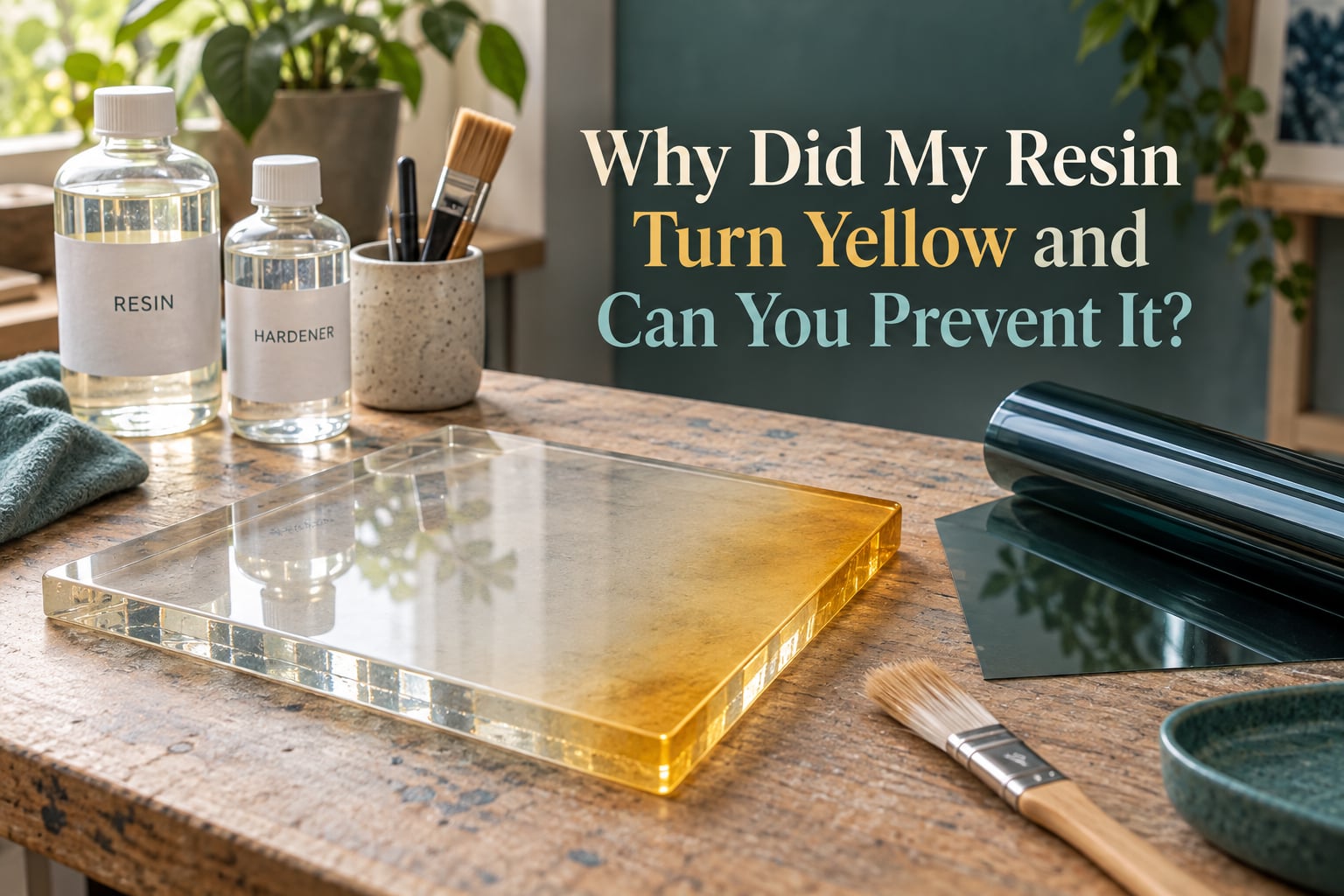
Anyone searching why did my resin turn yellow gets the same short answer: ultraviolet light broke bonds in the cured polymer and created structures that absorb blue light, so the surface now looks warm and dull instead of clear. That change is chemical, permanent, and cumulative. You cannot fully reverse it. You can slow it down with the right resin, a complete cure, limited sun exposure, and a renewable top coat.
I have poured more clear pieces than I can count, and the honest answer is the one the craft forums keep arriving at. One of the most-upvoted posts on r/polymerclay put it plainly: there is no amount of UV stabilizers that stop this, and no brand or type is immune. Every clear resin eventually turns yellow.
So the useful question is not whether it will happen. It is how long you can push it back, and what to do about a piece that is already on that road. This guide covers the chemistry in plain language, the ranked list of causes, the honest timeline, and a seven-step prevention protocol you can apply today.
Table of Contents
- Quick Answers to the Questions You Asked Most
- Why Did My Resin Turn Yellow? The Chemistry
- The 5 Reasons Resin Turns Yellow, Ranked
- Two Different Kinds of Yellowing
- Aromatic vs Aliphatic Resin
- Is Yellowed Resin Still Good?
- Can You Fix Resin That Has Already Turned Yellow?
- How to Prevent Resin Yellowing: A 7-Step Protocol
- Top Coat Options Compared
- How Long Before Resin Turns Yellow?
- Is It Yellowing or Just Cloudy?
- Choosing a Non-Yellowing Resin
- Frequently Asked Questions
- Two Levers: Slow It Down, or Plan for It
Quick Answers to the Questions You Asked Most
Can yellowed epoxy be fixed? Sometimes. Light yellowing on the surface can often be sanded back and recoated. Deep yellowing soaked through the whole cast cannot be reversed, and that piece needs a recast or a redesign.
Is resin still good if it turns yellow? Usually yes, structurally. Yellowing is a surface-level optical change from UV exposure, not a sign that the piece has weakened. The exceptions are food contact and skin contact surfaces, where you should replace rather than reuse.
Does resin yellow indoors without sunlight? Yes, more slowly. Window glass blocks most UVB but passes a meaningful share of UVA, and some indoor lighting adds a small amount too. A piece on an interior wall with no window exposure at all will stay clear far longer.
Is there a resin that never yellows? No. Aliphatic and cycloaliphatic chemistry yellows far more slowly than aromatic, which is a real improvement, but slower is not the same as immune.
Why did my resin turn yellow before it cured? Usually an over-rich mix, an off-ratio mix, excess heat during the cure, or a photoinitiator-heavy UV resin left under the lamp too long. That yellow-on-pour is a different problem from yellowing years later.
My hardener bottle looks yellow and cloudy. Is it ruined? Most of the time no. Hardener that has absorbed moisture can crystallise, and gentle warmth often brings it back. Filter it and test a small mix before committing to a full pour.
Will a top coat stop yellowing entirely? No. A sacrificial top coat takes the UV hit instead of the resin underneath, which protects the piece underneath for years. The top coat itself will yellow, and that is the trade you accept.
Can I use yellowed resin in a new pour? For non-structural craft pieces, warmed and filtered liquid resin usually still cures. Do not reuse it for anything load-bearing, electrical, or food safe, and never reuse a hardener that has crystallised back into a solid.
Why Did My Resin Turn Yellow? The Chemistry
Clear resin is a cured polymer network, a web of linked molecules that has locked into a rigid solid. That rigidity is what makes it durable, and it is also what makes the material vulnerable to light.
When ultraviolet photons hit that network, they carry enough energy to snap carbon-carbon bonds. That break is called chain scission, and the loose fragments left behind react with oxygen in the air, which is oxidation. Both reactions create new molecular structures called chromophores.
What a chromophore is: a molecular structure that absorbs specific wavelengths of light. Chromophores produced by UV degradation tend to absorb the blue end of the visible spectrum, so your eye reads the missing blue as a warm yellow cast.
This is why yellowing shows up as a colour change rather than as a texture change. The surface is still smooth, still hard, still glossy. It is just filtering light differently.
The three properties that matter are that the reaction is cumulative, that it is permanent, and that it is mostly driven by light and heat. Cumulative means every additional week of exposure adds a small amount that never comes back out. That is why a ten-year-old piece in a dim hallway and a two-year-old piece in a sunny window can look completely different even if they started identical.
One r/crafts commenter made the point that manufacturer claims do not survive contact with real exposure, noting that clear polyurethane advertised as UV stable still yellows over time. That matches what I have seen on my own pieces. Any product that promises permanent clarity is overselling.
The 5 Reasons Resin Turns Yellow, Ranked
1. UV exposure. By far the largest driver. Direct sun is the worst case, but a window seat delivers enough UVA over months to produce visible change, and interior lighting contributes a smaller ongoing dose.
2. Heat. Elevated temperature accelerates both scission and oxidation, and heat also pushes the cure reaction itself too far. Display cases, sunny shelves, drying racks near a radiator, a conservatory, and a car in summer sunlight are all heat sources people forget.
3. Incomplete or off-ratio cure. Under-mixed resin leaves unreacted components trapped in the network. That leftover chemistry is a common cause of yellowing that shows up within days, not years, and it also leaves you with a softer, less chemical-resistant piece. Accurate ratio measurement matters more than any additive.
4. Resin and hardener chemistry. Aromatic backbones, which includes most bisphenol-A craft epoxies, form yellowing chromophores far more readily than aliphatic systems. The hardener matters independently too, and a cycloaliphatic amine hardener paired with an aromatic resin will yellow faster than an aliphatic hardener on the same resin.
5. Oxidation over time. Oxygen in air slowly attacks the surface of any uncapped polymer. This is a background process that runs regardless of UV, and it is one more reason a piece stored in a closed box ages differently from one sitting open on a shelf.
Overcuring a UV resin falls under the same chemistry as heat. Dwell too long under the lamp, or rest a cured layer under the UV source while you build the next one, and the photoinitiator chemistry pushes the piece toward yellow while it is still soft enough to trap it.
Two Different Kinds of Yellowing
Almost all of the confusion in this topic comes from lumping two unrelated problems under one word. They have different causes, different timelines, and completely different answers.
| What you are seeing | What caused it | Can you fix it? |
|---|---|---|
| Hardener is yellow or crystallised in the bottle | Moisture absorbed into the amine hardener, sometimes with partial crystallisation | Often yes. Warm it in a water bath, filter it, test a small mix |
| Piece yellowed during or right after the pour | Over-rich mix, off-ratio mix, excess heat, or overcuring under a UV lamp | Sometimes. Sand and recoat if it is surface level |
| Piece slowly yellowing over months or years | UV exposure and oxidation, amplified by heat | Not really. Sand and recoat at best, recast at worst |
The bottle version is the one where people waste money. A hardener that has turned cloudy and pale yellow from moisture can often be brought back with gentle warmth, because the crystallised material dissolves again. Just put the sealed bottle in warm water, never a hot plate or an open flame, and let it sit until it clears.
A r/ResinCasting user reported that their concern was a birthday gift they did not want to yellow later, which is the emotional heart of most of these questions. Nobody pours a keepsake expecting it to be disposable. Once you know which of the two problems you have, the appropriate response is very different.
Aromatic vs Aliphatic Resin
Most published explanations of this stop at jargon. Here is the version that matters if you are choosing a jug at the shop.
Aromatic epoxy has ring-shaped carbon structures in its backbone. Those rings are stable, which is why the material is tough and dimensionally stable, but they are also exactly the structures that turn into yellow chromophores when light hits them. Most budget craft epoxies and nearly all bisphenol-A epoxies are aromatic.
Aliphatic epoxy replaces those rings with plain carbon chains. The result is a resin that stays noticeably clearer for longer. Cycloaliphatic sits between the two, using ring structures that are less prone to forming chromophores.
| Chemistry | Yellowing resistance | Where you will meet it |
|---|---|---|
| Aromatic | Lowest. Visible yellowing in months to a couple of years under typical exposure | Most general craft epoxies, art resin, clear-coat epoxies |
| Cycloaliphatic | Good. A large step up on aromatic | Higher-end castings, some furniture and marine coatings |
| Aliphatic | Highest of the epoxies, still not immune | Premium clear castings, jewellery, display pieces |
| Water-based polyurethane | Good initially, degrades outdoors faster than expected | Coatings and some craft clear coats |
If a project has to stay clear for a decade, think of chemistry choice as buying time rather than buying immunity. A premium aliphatic resin buys you more time than a budget aromatic one, and it costs more per litre, which is worth it for a wedding present and questionable for a practice coaster.
Is Yellowed Resin Still Good?
Yes, in most cases. Yellowing is a cosmetic and optical change at and near the surface. It is not evidence that the piece has lost strength, gone brittle, or become dangerous.
A user posting a two-year update on their own piece reported mild yellowing with no rot and no structural deterioration, which matches what I see on my own test tiles. The polymer network is still doing its job. It just filters blue light a little differently now.
There are three exceptions worth caring about:
- Food contact. If the piece is a coaster, a board, a bowl liner, or anything that touches food, replace it. A degraded surface layer is not something you want against food, and abrading it for a new pour reintroduces the question.
- Skin contact. A ring, pendant, or bracelet worn daily will pick up oils and abrade faster. A piece already turning yellow will not stay presentable.
- Load-bearing or electrical work. A yellowed surface is not proof of a bad cure, but if the piece is structural or insulating, do not assume the rest of the properties are intact.
For a purely decorative piece, a yellowed surface is a finish you can live with or sand back. For anything that touches people or food, it is a replacement signal.
Can You Fix Resin That Has Already Turned Yellow?
There is an honest three-tier answer, and the tier matters more than the technique.
Tier 1: Light surface yellowing. Sand it back and recoat. Yellowing concentrates near the surface, so if you take off 100 to 200 microns with wet sanding and progress up through grits, you often reach material that is still close to colourless. Clear coat over it and the piece looks new again. This works best on flat, generously thick pours.
Tier 2: Moderate yellowing. Sanding alone will get you part of the way, and the surface will still read warm under a bare lamp. Here you want a pigmented or tinted recoat that deliberately hides the warmth rather than a clear one that reveals it. A warm amber tone applied on purpose often looks better than fighting for a clear finish that will not happen.
Tier 3: Deep yellowing. Once the colour is soaked through the whole cast, no amount of surface work touches it. Your options are to accept it, bury it under an opaque finish, or recast the piece. Polishing a deep-yellowed piece is the trap here, because you spend a long time making it glossy and no less yellow.
Whichever tier you are in, work wet and go up in grit steps. A polished finish is a sequence, not a single pass, and skipping grits on a piece you already care about is how you find new scratches to worry about.
How to Prevent Resin Yellowing: A 7-Step Protocol
Myth busted: UV stabilizers and hindered-amine light stabilizers slow yellowing. They do not prevent it. A product labelled non-yellowing is describing a rate, not a guarantee, and the difference is the entire reason this article exists.
Step 1. Choose the least yellowing chemistry you can justify. Aliphatic or cycloaliphatic for anything long term. Aromatic is fine for pieces that will be used, handled, or kept in a drawer.
Step 2. Measure the ratio properly. Volume or weight, with a real scale or a proper pump, and mix the full recommended time. Under-mixing causes yellowing that looks like a lighting problem and is actually a chemistry problem.
Step 3. Give it the full cure. Most two-part epoxies need 24 to 72 hours at room temperature to reach full properties, and UV resin needs the full recommended exposure on every face. Pulling a piece early leaves a network that never finished forming.
Step 4. Control the temperature during the cure. Warm rooms accelerate the reaction past the point you want. Cool, steady, and out of direct sun is the target. A mild post-cure is useful for industrial work but is not a trick for craft pieces.
Step 5. Plan the placement before you pour. This is the step people skip and then regret. Ask where the piece will actually live in five years, and rule out windowsills, south-facing walls, lit display cabinets, radiators, and mantelpieces with a fire underneath.
Step 6. Apply a top coat. Treat the clear coat as sacrificial. It is the layer that yellows instead of the resin, and because it is a thin film you can renew it. The comparison table below covers the options.
Step 7. Maintain it on a schedule. Inspect annually for a gloss change or a warm cast, and renew the top coat before it turns chalky and holds dirt. The community consensus on outdoor pieces, repeated across the composite and automotive forums, is that a top clear coat is not optional, and the same applies to a sunny indoor shelf.
One cheap addition that is genuinely overlooked: UV-filtering window film on the glazing nearest the piece. It does nothing for the resin, but it lowers the dose reaching it every single day, and daily dose is what determines the timeline.
Top Coat Options Compared
| Option | UV protection | Application | Renews every |
|---|---|---|---|
| UV-resistant varnish | Good | Brush or spray, several thin coats | 1 to 2 years indoors |
| Marine varnish | Good, built for exposure | Brush, more coats, longer cure between | 1 year outdoors |
| Automotive clear coat | Very good, self-leveling | Spray, needs ventilation and a mask | 1 to 2 years |
| Sacrificial epoxy top layer | Good barrier, not UV-stable itself | Brush or pour, thick | Hard to renew in place |
| UV-filtering window film | Reduces the dose reaching the piece | Peel and stick to the glass | 5 to 10 years |
One r/ResinCasting user reported spraying a protective UV-blocking lacquer as a working mitigation on a finished piece, which is the same idea as the automotive clear coat row above. Another community view worth repeating is blunt about outdoor work: all outdoor epoxy use must have a top clear coat, because otherwise it will turn yellow, regardless of brand.
Window film is the only row that helps before a coat is ever applied, which is why it belongs on the list even though it is not a finish.
How Long Before Resin Turns Yellow?
Nobody publishes these numbers, so treat the ranges below as community-reported experience rather than lab measurement. They are honest ballpark figures, and they vary enormously with thickness, chemistry, and how hot the piece gets.
| Exposure condition | When you will see colour | Protection needed |
|---|---|---|
| Indoors, no window, moderate light | Several years, often well beyond 5 | Top coat optional, dust cover helps |
| Indoors, near a window | 1 to 3 years | UV top coat plus window film |
| Direct sun through glass | 6 to 18 months | Top coat plus move it out of the sun |
| Uncovered outdoor exposure | Weeks to a few months | Not recommended without a marine varnish system |
| Outdoor with a maintained top coat | Years, with annual renewal | Annual re-varnish, non-negotiable |
Multiple independent users report yellowing emerging over one to three years, often on pieces near windows or outdoors. That is the range most people meet, and it is the one to plan around when the piece is a gift or a keepsake.
The single biggest predictor is not the brand name. It is total dose, meaning direct sun multiplied by hours multiplied by years.
Is It Yellowing or Just Cloudy?
Mistaking cloudiness for yellowing leads to the wrong fix, so diagnose before you sand anything.
| Defect | What it looks like | When it appears | What causes it | Can you fix it? |
|---|---|---|---|---|
| Yellowing | Warm honey or amber cast, still glossy | Months to years later | UV exposure and oxidation | Partly, by sanding and recoating |
| Cloudiness | Milky white haze through the whole piece | During or right after the pour | Moisture, mixing, incomplete cure | Often, by re-pouring correctly |
| Amine blush | Greasy-looking dull film on the surface | At or after cure, in cool damp conditions | Amine and moisture reacting at the surface | Yes, wash or sand the surface |
| Bubbles | Discrete round voids | At the pour | Air from mixing or pouring | Yes, torch or heat gun, or a pressure pot |
A quick field test: hold the piece against a white sheet of paper in daylight. A haze that is milky white is cloudiness. A cast that reads warm against white paper is yellowing. Under a warm indoor lamp everything looks yellower than it is, so check in daylight before you decide.
Degassing and warm-room pouring solve most cloudiness, and a torch or heat gun solves most bubbles. Neither touches yellowing, because yellowing is not a defect in the pour.
Choosing a Non-Yellowing Resin
When you are standing in front of a shelf, read the product page for these five things rather than the word non-yellowing on the front:
- The chemistry. Does it say aliphatic, cycloaliphatic, or just epoxy? If it says nothing, assume aromatic.
- What the UV claim actually says. A stated test method or a stated exposure period is a real claim. A vague promise of UV resistance is not.
- The full cure time. A manufacturer confident in its chemistry will tell you the 72-hour figure. If the label says cure in 4 hours, the network is not finished.
- Mix ratio tolerance. Products tolerant of a small ratio error are safer for beginners, because that is where yellowing from bad mixing usually starts.
- Whether a top coat is expected. Any manufacturer selling you an outdoor or display piece will mention a top coat. If yours does not, ask them why.
The same UV degradation logic applies far outside craft work. Carbon fibre and composite panels, automotive parts, and boat components yellow for identical reasons, which is why those communities reach the same conclusion: a top clear coat, renewed on a schedule. If your interest is composite work rather than jewellery, the chemistry section above is the part that transfers.
One more honest point. Pigmented and painted pours barely yellow in any meaningful sense, because the colour masks the shift. If a piece is destined for a bright, warm, or heavily pigmented look, that is the plan-for-it option: the yellowing still happens, you just never see it.
Frequently Asked Questions
Will epoxy turn yellow in the sun?
Yes. Direct sunlight is the fastest route to visible yellowing because ultraviolet photons break bonds in the cured polymer and create chromophores that absorb blue light. Through a window it is slower, because glass blocks much of UVB while passing a meaningful share of UVA, but a piece on a sunny sill will still show colour within one to three years. Outdoors with no protection, expect weeks to a few months. A maintained top coat is the single most effective mitigation.
Why did my UV resin turn yellow?
Usually one of two things. If it yellowed during or shortly after the pour, the cause is overcuring under the lamp, too many passes under the UV source, or excess heat, and the photoinitiator chemistry pushed the piece yellow while it was still soft. If it yellowed gradually over months, the cause is ordinary UV degradation and oxidation from ambient light exposure. The second case is the one no resin is immune to, and prevention means slower exposure rather than zero exposure.
Can yellowed epoxy be fixed?
It depends how deep the colour goes. Light surface yellowing can often be sanded back through wet grits and recoated clear. Moderate yellowing usually needs a tinted or pigmented top coat, because a clear one will still read warm. Deep yellowing soaked through the whole cast cannot be reversed at all, and that piece needs a recast, an opaque finish, or acceptance. Polishing a deep-yellowed piece is the most common wasted afternoon in this craft.
Is resin still good if it turns yellow?
Structurally, usually yes. Yellowing is a cosmetic and optical change near the surface, not a sign the piece weakened or went brittle. Replace any yellowed piece that touches food, since a degraded surface layer is not something you want against food, and replace jewellery worn daily, since abrasion and oils make it look worse. For load-bearing or electrical applications, do not assume the rest of the properties are intact. Decorative pieces can be sanded and recoated or simply lived with.
Why is my clear resin turning yellow after a few months?
A few months points to exposure rather than a bad mix, so look at where the piece lives. Windowsills, conservatories, display cabinets with lighting, and shelves above radiators are the usual suspects. Interior lighting on its own contributes a small dose, and a room with no window exposure at all will keep a piece clear far longer. If the piece never saw any of those, suspect the mix instead: an off-ratio or under-mixed pour, or an early pull from the heat or the UV lamp.
What is the best UV resin that does not yellow?
There is no resin that does not yellow, so judge on rate rather than on the word non-yellowing. Look for aliphatic or cycloaliphatic chemistry, a stated full cure time of 24 to 72 hours, and a mix ratio tolerance rather than a precise fixed ratio. Then finish the piece: a UV-resistant varnish or automotive clear coat renewed every one to two years does more for long-term clarity than any additive in the resin itself. Aliphatic buys you years over aromatic, not immunity.
Two Levers: Slow It Down, or Plan for It
Why did my resin turn yellow? Because light and heat chemically altered the cured polymer, the change is permanent, and no product on the shelf will stop it. That is the part worth accepting early rather than discovering after a gift has sat by a window for two years.
The first lever is slowing it down: aliphatic chemistry, an accurate mix, a full cure, a placement away from windows and heat, and a top coat you renew on schedule. Done properly, that buys years.
The second lever is planning for it: pigmented pours, warm-toned palettes, opaque finishes, and pieces built for handling rather than display. Nothing yellows in a drawer, and a resin piece that gets used stays out of the light.
Run the seven-step protocol before your next pour, and run a small coupon test first if a big piece is riding on it. Pour a few test tiles, put one in the sun, one by a window, and one on an interior shelf, and write the dates on the back. You will have your own timeline in six months, and it will be more accurate than anything printed on a bottle.