
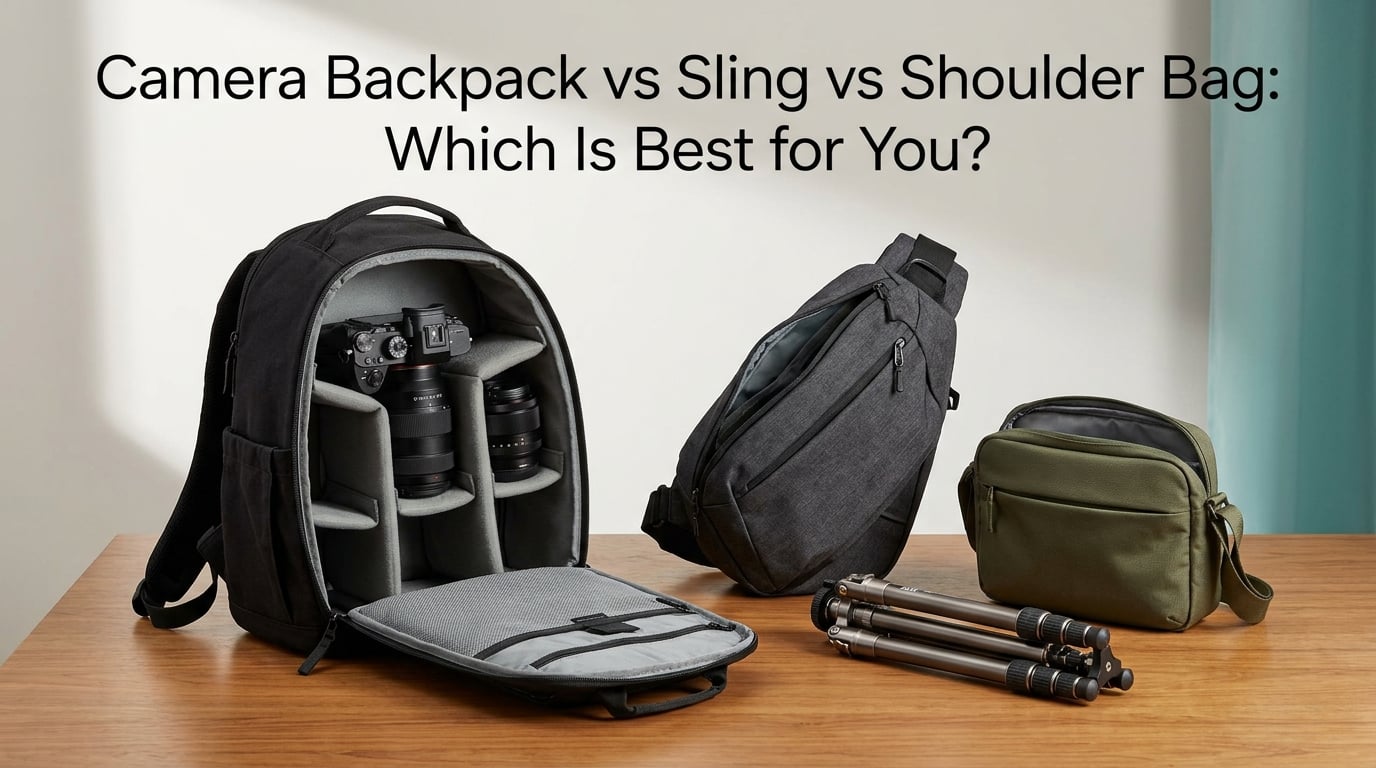
If you have ever hauled a camera kit up a hill and wondered why your shoulder hurt more than your legs, you already know that bag choice is not a style preference. It is a load-bearing engineering decision. This guide breaks down the camera backpack vs sling vs shoulder bag question the way photographers actually argue it: by weight, access speed, and how long you plan to wear the thing on your body.
Most buying guides answer this question with a list of bags. That is not what you need, because the answer is a framework rather than a product. By the end of this guide you will know which of the three bag types fits your gear, your shooting style, and your tolerance for shoulder pain, and you will know which trade-off you are making when you pick it.
Table of Contents
- Camera Backpack vs Sling vs Shoulder Bag: The Quick Answer
- What Each Camera Bag Type Actually Is
- Camera Backpack: When It Wins and When It Loses
- Camera Sling: When It Wins and When It Loses
- Shoulder and Crossbody Camera Bags: When They Win and When They Do Not
- Hybrid and Convertible Camera Bags
- Weight and Ergonomics: The Number That Decides Your Bag
- Security, Bag Snatching, and Stealth Carry
- Capacity in Litres: How Big Should Your Bag Be?
- How to Choose a Camera Bag: A Six-Step Checklist
- Frequently Asked Questions
- Conclusion: Which Camera Bag Is Right for You
Camera Backpack vs Sling vs Shoulder Bag: The Quick Answer
Three variables decide it, and they are all knowable before you spend anything. Here is the short version:
- Pick a camera backpack if you carry more than about 2 kg of gear, if you hike or stand for full days, or if you need to carry a tripod, a jacket, and a laptop alongside the camera.
- Pick a camera sling if you carry one body and one or two lenses, and if you need the camera in your hands within a couple of seconds without looking.
- Pick a shoulder or crossbody bag if you want the lowest profile option, carry a fixed-lens or rangefinder kit, and mostly need somewhere to park the camera between shots.
Here is the same thing laid out side by side:
| Criterion | Camera Backpack | Camera Sling | Shoulder / Crossbody |
|---|---|---|---|
| Typical capacity | 14 to 30 litres | 6 to 12 litres | 4 to 10 litres |
| Typical gear load | 3 kg and up, full kit plus accessories | 1.5 to 2.5 kg, one body plus one or two lenses | Under 1.5 kg, compact kit |
| Access speed | Slow, 5 to 10 seconds typical | Fastest, roughly 2 to 4 seconds with whip access | Moderate, 5 to 8 seconds |
| Comfort over 3+ hours | Best, with a load-bearing hip belt | Fair, degrades sharply past 2.5 kg | Poor, worst load distribution of the three |
| Straps | Two padded shoulder straps plus waist strap | One strap, usually with a stabilising buckle | One thin strap, often unpadded |
| Security in crowds | Highest, sits flat against your back | Medium, rotates to the front when worn across the body | Lowest, sits away from your torso |
| Weather protection | Usually best, covered zippers and base panels | Good, but the panel shape traps water at seams | Varies, least padding means least protection |
| Best for | Hiking, travel, weddings, full-frame kits | Street, events, vlogging, quick pull-over shoots | Everyday carry, fixed-lens kits, minimalists |
| Main trade-off | Bulk and swing while moving | One-sided load on your shoulder | Lowest capacity and protection |
What Each Camera Bag Type Actually Is
The vocabulary is muddled online, so it is worth being precise. Two of these names are frequently used interchangeably when they describe physically different bags.
Camera backpack
A camera backpack is a structured bag with two padded shoulder straps, usually a padded hip belt or waist strap, and internal dividers you can rearrange. The body of the bag hangs on your back between your shoulder blades, and the load transfers through both shoulders and, if the belt is properly adjusted, onto your hips.
Camera sling
A camera sling has a single strap that runs across your torso. Worn on one side, the bag rests against your hip with the camera rotated toward the front. That rotation is the whole point: you can swing the bag forward, flip the panel open, and pull the camera out without taking it off. Many slings add a stabilising strap or buckle that clips around your waist or chest so the bag stops bouncing.
Shoulder and crossbody bags
A shoulder bag, sometimes called a crossbody, also uses a single strap, but the bag hangs lower and further from your spine, and the strap is typically thinner and less structured. This is the least protective of the three categories and usually the smallest. The distinction matters: a sling is designed around gear access, a shoulder bag is designed around convenience.
Hybrid convertible bags
A hybrid combines both strap systems. You wear it as a two-strap backpack and then tuck one strap away and swing it to a single-strap carry without removing the bag from your body. More on these below, because they solve a problem that pure category thinking does not.
Camera Backpack: When It Wins and When It Loses
A backpack wins decisively when the gear is heavy and the day is long. Two straps spread the load across both shoulders, and a properly fitted hip belt takes a meaningful share of the weight off your upper body entirely. For anyone carrying a full-frame body, three or four lenses, a tripod, and layers, this is not a marginal improvement. It is the difference between finishing a day shoot able to move your neck and not.
Backpacks also win on capacity and organisation. Dividers, clamshell openings, and dedicated accessory pockets let you rebuild the interior between a hiking trip and a wedding day. They handle a laptop, water bottles, and rain gear without turning into a shapeless mass. For airline travel, larger models with luggage pass-through straps and a stowable top strap are simply easier to manage.
Where backpacks lose is bulk and movement. A rigid camera backpack is a boxy object that swings when you walk, snags on branches when you climb, and refuses to sit flat against your back when you are low or moving fast. Forum photographers describe small two-strap packs as bulky and boxy, and that complaint comes up constantly from people who otherwise like them.
The fix for swing is not a smaller bag, it is a waist strap. A waist strap on a small pack often only stops the bag from rotating; it does not transfer weight to your hips unless it is padded, wide, and positioned to rest on the actual bony part of your pelvis rather than your waist. Test this in a shop with your own kit in the bag.
Camera Sling: When It Wins and When It Loses
A sling wins on access speed and nothing else comes close. Because the bag already sits against your torso with the lens pointing outward, getting the camera out is a rotation and a pull rather than a rummage. That is the entire argument for slings, and it is a strong one for street photography, events, vlogging, and any situation where the shot appears and disappears in a few seconds.
Slings also travel well in a way backpacks do not. They are almost never mistaken for a camera bag by a bag snatcher, they slide under a table or a seat without you taking them off, and a sling with a rear laptop dock handles a long day of shooting plus a computer without a second bag.
The failure mode is load. A single strap puts the entire weight of your kit on one side of your body, and there is a threshold where that stops being manageable. In a long-running DPReview discussion, a two-lens micro four thirds kit was weighed at 1160 g, or 2.55 lb, and the consensus was that carrying that on one strap is uncomfortable and that two straps are meaningfully more balanced. A full-frame body with two fast primes will be roughly twice that.
Longer-term wear is the other issue. Sustained one-strap carrying shows up in the neck, the trapezius, and the rotator cuff, particularly if the bag sits low on your hip and pulls forward. If you know you will wear a bag for six hours at a time, solve it with a sling that has a proper padded strap and a stabilising buckle, or move to a hybrid.
Shoulder and Crossbody Camera Bags: When They Win and When They Do Not
Shoulder bags are underrated for a specific and fairly narrow set of users. If you carry a fixed-lens compact or a rangefinder-style body, if you want something that disappears under a jacket or a coat, and if the camera spends most of its life on a table rather than in your hands, a well-padded shoulder bag is genuinely the right answer.
They are also the easiest bag type to live with. Nothing swings, nothing digs in, and you can get in and out of a car or a train without a fuss. For commuting and everyday carry, that low friction has real value.
What you give up is protection and capacity. These bags carry the least padding, the fewest dividers, and the least weather sealing, and they are the easiest target in a crowd because they sit away from your body. If your gear is a full-frame body with a 1.4x prime in it, a sling or a small backpack is a better home.
Hybrid and Convertible Camera Bags
Hybrids are the most practical answer for a lot of people and almost never get explained properly. The design is simple: two padded shoulder straps that stow into the bag, plus a single diagonal strap that you pull out and use instead. You switch between them without taking the bag off your body and without setting anything down.
Photographers recommend this category for exactly the reasons the framework predicts. The two-strap mode handles the climb to the overlook with a heavy kit, and the single-strap mode handles the two hours of walking around a market where you want the camera in your hands. Convertible models with removable hip belts are frequently named as the most balanced option for anyone who cannot commit to one carry style.
The trade-off is that you give up some specialisation. A hybrid is rarely the lightest bag in its class or the fastest to open, and the extra strap hardware adds bulk. If you shoot in one environment and your gear list never changes, a purpose-built bag will serve you better. If your environment changes weekly, a hybrid will save you owning two bags.
Weight and Ergonomics: The Number That Decides Your Bag
Weigh your actual kit. Put it on a scale with the body, the lenses you genuinely use, and the accessories you genuinely carry, then add the weight of the bag itself. That number is the most important input to this entire decision, and it is the one most people never bother to measure.
- Under 1.5 kg total is a shoulder bag or small sling range. Comfort is not the deciding factor here, so choose on access and profile.
- 1.5 to 2.5 kg is sling territory if you shoot standing and short bursts, and backpack territory if the day is long and the terrain is uneven.
- Over 2.5 kg wants two straps. A single strap at that weight is a health problem, not a preference.
Two fit details matter more than brand. First, torso length: a backpack harness only works if the hip belt lands on your iliac crest, and that is a function of torso length, not strap adjustment. Second, strap padding width: a wide, stiff strap spreads load, a narrow one concentrates it. Both are cheap to check in person and impossible to check from a photograph.
Security, Bag Snatching, and Stealth Carry
Risk differs by bag type, and the ordering is straightforward. A backpack worn normally sits flat against your back, zipped and out of sight, which makes it the least attractive target of the three. A sling worn across the body keeps the camera facing inward and is a reasonable middle ground, though the bag itself is more visible. A shoulder bag hanging away from your torso is the easiest to reach and the easiest to run off with.
Note the cost of stealth. A tightly closed, low-profile bag that hides a camera also makes that camera slow to reach, and slow is a real price when the shot is already gone. Whether that trade is worth it depends on where you shoot. In dense tourist crowds and on public transport, low profile helps. On a street where you work alone, access speed usually matters more.
Simple mitigations cost nothing: put the camera body in the compartment closest to your back rather than the closest to the front panel, keep zippers closed and facing your body, and use a stabilising strap in crowded spaces. None of these slow you down.
Capacity in Litres: How Big Should Your Bag Be?
Capacity is where most sizing errors happen, because people buy for the kit they own rather than the kit they carry. A body plus one or two lenses plus a couple of small accessories is a 6 to 10 litre problem. Add a third and fourth lens, a tripod, and a layer and you are at 14 to 20 litres. A full kit with flash triggers, a laptop, and water bottles belongs in the 20 to 30 litre range.
There is also a gap in the market that explains a lot of forum confusion: below about 10 litres there are few true two-strap backpacks, because a bag that small barely differs from a sling. If you carry a compact kit and want two straps, your realistic options are a hiking daypack with a removable camera insert or a small rigid pack in the 10 to 14 litre range.
Buy dividers you can reconfigure rather than a fixed layout. The same bag should be a one-lens street setup in the morning and a two-lens travel setup at the weekend, and removable dividers are what make that possible.
How to Choose a Camera Bag: A Six-Step Checklist
Work through these in order and the decision makes itself.
- Weigh your real kit. Body, the lenses you will actually mount, and the accessories you will actually use. Add the bag weight later.
- Count the hours you will wear it. Under two hours of walking, comfort barely matters. Six hours of standing, comfort is the whole decision.
- Decide how fast you need the camera. Seconds matter for street and events, minutes are fine for landscape and travel.
- Check the strap system. Two straps for anything above 2.5 kg, a padded stabilised strap for single-strap carry, and a hip belt that actually rests on your hips.
- Match the bag to the environment. Crowds and transit favour low profile and security, open terrain favours access speed, weather favours sealed zippers and covered seams.
- Decide on the secondary cargo. Laptop, tripod, water, and layers change the answer, because they are what push you from a sling into a backpack.
Mapped to niches, the same framework gives:
| What you shoot | Best bag type | Why |
|---|---|---|
| Street photography | Sling, or convertible hybrid | Speed of access outweighs capacity |
| Travel and airline-heavy itineraries | Backpack with pass-through strap | Capacity for layers, laptop, and personal items |
| Hiking and outdoor shooting | Small backpack with hip belt, or hybrid | Load transfer and swing control on uneven ground |
| Weddings and events | Backpack, staged close to a base bag | Long days, heavy kits, fast recovery from a base |
| Vlogging and video | Sling or hybrid | Constant access, compact rig, stable during movement |
| Everyday carry and commuting | Shoulder or sling | Low profile, low bulk, quick on and off |
| Fixed-lens or rangefinder kits | Shoulder bag | Small, light, needs almost no protection |
Frequently Asked Questions
Are backpacks better than sling bags?
Backpacks are better when the kit is heavy or the day is long, because two straps and a hip belt spread the load across your back and hips. Slings are better when access speed matters most, because the camera rotates toward your chest and comes out in seconds. Most photographers end up owning one of each, or a convertible bag that does both.
Is a backpack better than a shoulder bag?
Yes, for almost any kit with real weight behind it. A backpack protects the gear better, carries more, and distributes load in a way a single thin shoulder strap cannot. A shoulder bag only wins when your kit is genuinely small and light, such as a fixed-lens or rangefinder body, and you care more about low profile than protection.
What is the best backpack for carrying a camera?
The best camera backpack is the one whose padded hip belt rests on your hips, whose harness fits your torso length, and whose interior dividers you can reconfigure. Fit comes before brand and feature count. Match capacity to your real kit, confirm the total loaded weight feels comfortable, and check that the waist strap is load-bearing rather than decorative.
Are sling bags out of style?
No. Fashion cycles are irrelevant to how a sling functions, and the design is one of the most practical answers to camera access. What has changed is that convertible designs let one bag serve both single-strap and two-strap carry, so a sling is increasingly a mode rather than a separate purchase.
How much weight can a sling camera bag carry comfortably?
Comfortable carrying is realistically capped around 2 kg of gear including the bag, and comfort degrades noticeably past 2.5 kg. Forum measurements of a two-lens micro four thirds kit came to 1160 g, or 2.55 lb, and users agreed that weight is uncomfortable on one strap. Full-frame kits with fast primes should go on two straps.
Do I need a hip belt on a camera backpack?
If the loaded bag weighs more than about 2.5 kg or you will wear it for more than a couple of hours, yes. A padded hip belt that rests on your pelvis transfers a real share of the load off your shoulders. A thin waist strap on a small pack mostly stops the bag from rotating and will not prevent shoulder pain on its own.
What size camera bag do I need?
A body with one or two lenses needs 6 to 10 litres. Add a third and fourth lens, a tripod, and a layer and you need 14 to 20 litres. A full kit with a laptop and personal items belongs in a 20 to 30 litre pack. Buy adjustable dividers so the same bag can be reconfigured between a street setup and a travel setup.
Conclusion: Which Camera Bag Is Right for You
There is no universal winner in the camera backpack vs sling vs shoulder bag debate, and anyone who tells you otherwise is selling something. Weigh your kit first. Above roughly 2.5 kg or below a couple of hours of carry, a two-strap backpack wins on comfort and capacity, and a convertible hybrid is the most flexible version of that answer. Under that weight, a sling wins if you shoot standing and need speed, and a shoulder bag wins if you want the smallest possible footprint.
Buy the bag that matches the way you actually shoot, not the way you shoot once a year. Put your real kit in the candidate bag, wear it for half an hour, and check where the hip belt lands and how fast you can get the camera out. That test answers every question this guide raised.