
Most people only think about ink type when a print has already started to look tired on the wall. By then the decision is made, and the print is a fixed cost you either keep or reprint. Getting it right before the run matters more than any other single choice in printing art.
Our team has spent years comparing giclee output, reading permanence data, and talking with printmakers who sell limited editions and photographers who have watched their own work fade. This guide covers the chemistry, the lifespan numbers, the paper interactions, and the places where the honest answer is more nuanced than the usual pigment advocacy.
Table of Contents
- The Short Answer
- What Dye Ink Is and What Pigment Ink Is
- How Long Does Each Ink Type Actually Last?
- Dye vs Pigment Ink Head to Head
- Where Dye Ink Wins (and Why That Matters for Art)
- The Modern Dye Ink Exception: When the Gap Narrows
- Paper Changes Everything: Matte vs Glossy Substrates
- What Archival Actually Means (and How to Verify It)
- How to Make Any Print Last Longer
- How to Choose for Your Situation
- Cost Over Time: Ink Price vs Rework
- Frequently Asked Questions
- Final Verdict
The Short Answer
Pigment ink lasts far longer for art prints. Independent testing houses such as Wilhelm Imaging Research rate quality pigment prints at 100 years or more for colour, while dye-based prints on comparable paper can show visible fading within a few years under the same display conditions. The one qualifier worth holding onto is that paper choice and UV exposure can shorten the rated life of either ink type dramatically.
That headline answer is only the summary, and the margin between the two is not a straight line. It narrows on certain matte papers, it widens on glossy and baryta, and modern dye formulations have closed part of the gap that older buyer guides describe. The rest of this article explains exactly where the lines fall.
What Dye Ink Is and What Pigment Ink Is
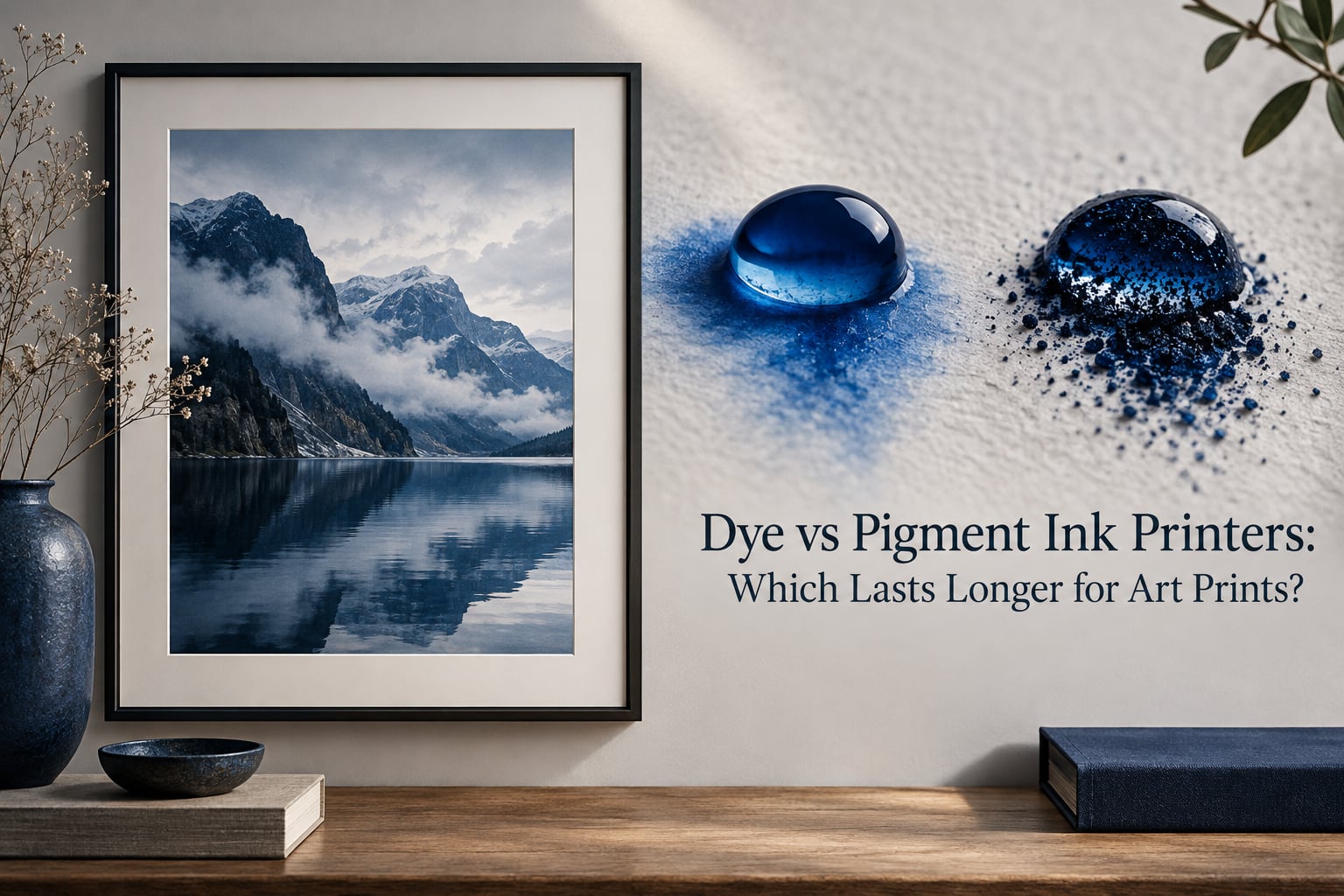
The entire longevity question comes down to one physical difference: whether the colour is dissolved into the liquid or suspended in it. Everything else, from fade resistance to water behaviour to how the print handles humidity, follows from that single fact.
Dye ink: colorant dissolved in a carrier
Dye ink is water-soluble. The colorant molecules are fully dissolved in the liquid carrier, which is why dye spreads smoothly and produces very clean gradients in skies, skin tones, and smooth tonal transitions. When the ink meets the paper, the carrier carries the colour into the fibre and the dye molecules settle there.
Because the colour is now inside the paper rather than sitting on top of it, light and oxygen can reach it directly. The dye molecules break down over time and the print shifts colour as different components fade at different rates. This is a chemical process, and it happens even on a dark, indoor wall.
Pigment ink: solid particles suspended in a carrier
Pigment ink is not dissolved. It contains finely ground solid colour particles, held in suspension by dispersants until they land on the substrate, where they are fixed at or just below the surface. The particles are chemically inert, which is the entire reason pigment prints hold their colour.
Modern pigment inks use particle sizes in the nano range to avoid the graininess that gave pigment inks a bad reputation years ago. When the printer and paper are well matched, a pigment print is not obviously coarser than a dye print at normal viewing distance. It can look slightly flatter on some deep blacks, and that is the trade.
Why that difference decides longevity
Pigment colorant is solid, stable material. Dye colorant is a molecule that can be broken by photons and oxygen. Everything printed after that statement, including lightfastness ratings and archival claims, is downstream of this chemistry.
One-line version: dye ink soaks in and spreads beautifully, pigment ink sits on top and refuses to break down. For art prints, refusing to break down wins.
How Long Does Each Ink Type Actually Last?
On quality fine art paper under museum conditions, pigment prints carry lightfastness ratings that translate to well over a century of display. Wilhelm Imaging Research figures cited across the fine art printing industry put quality pigment colour prints at 100 years or more, and some pigment formulations test into the 200-year range on the same substrates. Aardenburg Research has published similar ranges for pigment systems on cotton rag and alpha-cellulose papers.
Dye prints are a different story. Under gallery conditions with moderate light, a good dye print can hold up for years, which is why a decade-old dye print hanging on a wall is not a horror story. Push that into a bright room, a south-facing window, or a humid climate, and the measured difference between the two becomes obvious in a few short years.
The comparison that circulates in print forums is that pigment-based prints last two to three times longer than dye-based prints. That is a reasonable shorthand rather than a laboratory constant, because the true figure depends on the light level, the ink load, the paper, and how the print is framed.
| Ink type | Typical lifespan on fine art paper | Under bright or direct light | What ages first |
|---|---|---|---|
| Pigment ink | 100 years or more for colour under museum conditions | Noticeable change takes considerably longer than dye | The paper itself, and any optical brightening agents in it |
| Dye ink | Several years to a decade indoors, depending on light | Visible fading within a few years is common | The dye molecules, with colour shift as components break down |
| Pigment ink on B&W | Often the longest-lived category of all | Holds density longer than colour pigment | Paper tone, and yellowing in optical brighteners |
| Dye sublimation | Strong fade resistance, but vulnerable to heat | Holds colour well under light | Nothing visible except under direct heat or abrasion |
Read those numbers as a range under stated conditions, not a warranty. A pigment print stored in a humid, sunlit room will not reach 100 years, and the ISO standards that formalise these figures all describe display conditions that are better than most homes.
Dye vs Pigment Ink Head to Head
Here is the side-by-side comparison we come back to. Read the longevity row first, then look at the rows where dye genuinely wins, because those are the reasons people still choose it.
| Factor | Dye ink | Pigment ink |
|---|---|---|
| Longevity | Years indoors, shorter under strong light | 100 years or more under museum conditions |
| UV resistance | Molecules break down under light exposure | Solid particles are largely unaffected by UV |
| Water and smudge resistance | Water-soluble unless fully sealed by a suitable overcoat | Holds together well once cured on the surface |
| Colour gamut and vibrancy | Wider, punchier, better for saturated colour | Slightly narrower, more restrained tone |
| Apparent sharpness at close range | Finer apparent detail, smoother gradients | Matches at normal viewing distance with modern inks |
| Black density | Deeper, glossy blacks on gloss papers | Good, occasionally slightly flatter |
| Matte paper behaviour | Renders smoothly on many matte stocks | Can show subtle grain or bronzing on some papers |
| Cost per print | Lower ink and hardware cost | Higher ink cost, especially for matte pigment |
| Maintenance | Less prone to head clogging | Matte pigment settles and needs cleaning cycles |
| Best suited to | Draft proofs, high-saturation colour work, disposable prints | Limited editions, gallery sales, anything you keep for decades |
Where Dye Ink Wins (and Why That Matters for Art)
Dye ink is not the wrong answer, and pretending otherwise is how you end up with a print you quietly resent. Dye wins in four areas that matter to artists.
- Gamut and vibrancy. Dye inks deposit a deeper, glossier layer, which produces more saturated blues, greens, and skin tones. On a saturated landscape or a vivid abstract, that difference is visible to anyone standing in the room.
- Fine apparent detail at close viewing distance. In the fredmiranda photography forum, a common view is that dye produces a finer-looking print than pigment, while accepting that pigment has the longevity. If your art is being examined at arm’s length, that gap is worth weighing.
- Gradients and skin tones. Dissolved dye spreads evenly, so smooth transitions come out clean with less visible banding. Pigment can be tuned for this too, but it takes more work.
- Lower running cost. Dye hardware is usually cheaper and the ink costs less per print, which matters for editions where you are not sure they will sell.
Pigment has a real drawback too, and it is not the colour. Matte pigment ink is heavier and particle-rich, so it settles in the print head and clogs nozzles more quickly than dye. Printmakers report faint or missing black text and shorter intervals between cleaning cycles on pigment machines. The durability advantage is real, but it comes with maintenance you have to budget for in time rather than money.
The Modern Dye Ink Exception: When the Gap Narrows
Here is the part most dye-versus-pigment guides leave out. Saying all dye inks fade within a few years is wrong, and repeating it does a disservice to people who print with them daily.
Canon’s ChromaLife100+ dye inks are marketed with a 100-plus-year lifespan claim on supported Canon papers. That claim is about the ink and paper pairing, not the ink alone, and it assumes the print is displayed under controlled conditions. Still, it changed the conversation. Printmakers on the Luminous Landscape forum push back on blanket dye-bashing, noting that a Canon Pro 100 on select Canon papers achieves reasonably good life per Aardenburg testing, which is independent rather than manufacturer data.
What this changes, and what it does not:
- On supported paper, with clean handling and controlled display, a good dye print is not a short-lived object.
- The gap widens again the moment the print sits near a window, or the environment is warm and humid.
- Users on r/photography make the same point from the buyer side: dye ink may fade faster when the ink is not high end, or when it is exposed to sunlight. The variable is the combination, not the cartridge name.
So the honest reconciliation of the two claims you will read online, pigment for 100 to 200 years and modern dye for 100-plus years, is that both are defensible. They describe different experiments, different papers, and different definitions of last. When you compare them, compare the same paper under the same light.
Paper Changes Everything: Matte vs Glossy Substrates
Ink type is the biggest factor, but paper can shift the result by a surprising amount. On dpreview forums, the consensus observation is that pigment inks perform better than dye on many matte papers, and that on a few matte papers the two perform similarly.
That is the exception worth knowing about, because it is the closest dye ever gets to parity. Matte papers have a porous, textured surface that diffuses reflection. Dye sits well into that texture, and pigment spreads across it, so the two inks converge. Glossy and baryta papers are nonporous and highly reflective, which amplifies every difference: dye produces deeper contrast and glossier blacks, and pigment appears slightly flatter by comparison. On those papers the longevity gap matters most, and the visual gap is widest too.
Two substrate details affect both ink types. Optical brightening agents are synthetic whiteners added to many papers, and they yellow over time regardless of ink, which is why lignin-free cotton rag is the substrate of choice for archival work. A print on cheaper alpha-cellulose paper may fade less than expected and still look tired, because the paper gave up first.
What Archival Actually Means (and How to Verify It)
Archival is a system, not an ink category. That single sentence resolves most of the confusion around the word, including the belief that archival and pigment are the same thing. They are not.
An archival print is archival because of four things working together: a stable pigment or dye ink, a lignin-free and acid-free substrate, correct colour management through an ICC profile, and a display environment that keeps UV, humidity, and physical damage in check. Remove any one of them and the rated lifespan no longer applies. That is also why a print made on a good paper with third-party dye ink is not archival by default, and why a pigment print on an unbuffered sheet fails the same test.
Two standards are worth knowing:
- ISO 9706 covers the permanence of the paper itself, which is why it is quoted in paper specifications rather than ink specifications.
- ISO 18902 covers image permanence for processed photographic prints, and it is the standard image permanence ratings are measured against.
Wilhelm Imaging Research and Aardenburg Research publish independent lightfastness and permanence ratings for specific printer, ink, and paper combinations. Forum users treat these as far more credible than manufacturer longevity claims, and they are right to. Before you commit to a large run, ask the print provider for the named permanence rating for the exact ink and paper they intend to use. If they cannot name it, you are paying for a marketing word instead of a measurement.
One more piece of terminology to clear up. Giclee describes the process, an inkjet print made with water-based inks on a suitable substrate, not the ink itself. Giclee and pigment are frequently used as synonyms in print marketing, and that conflation is the single biggest source of confusion in this topic.
How to Make Any Print Last Longer
Framing and placement can cut the life of a print more than the ink choice ever will. Follow these steps for either ink type, and they add years rather than months.
- Glaze it. Use UV-filtering glazing rather than standard glass. It slows the light-driven component of fading, which is the dominant one for dye prints.
- Keep it out of direct sun. Even a short distance from a window, a reflecting surface, or a halogen spotlight makes a large difference over decades.
- Use acid-free, buffered mounts and matting. Wood-pulp matting board can discolour and wick acids into the sheet edge, and the damage shows up at the border first.
- Hold humidity between 30 and 50 percent. Stable is better than low. Rapid swings cause cockling and stress the paper more than steady mid-range humidity.
- Let the print dry fully before framing. Prints stacked or framed while still releasing moisture can pick up mould and stick together at the edges.
- Document the run. Record the printer, ink, paper, and profile used for a limited edition. If a reprint is ever needed, matching the original is close to impossible without that note.
How to Choose for Your Situation
The longest-lasting ink available is pigment, in a machine built for it, on a stable paper. The question is whether your situation is one where that matters enough to accept the trade-offs. Use this decision matrix to work it out.
| Your situation | Recommended approach | Why |
|---|---|---|
| Selling a limited edition in a gallery | Pigment, cotton rag or baryta, UV glazing | Colours must match across the edition for years |
| One-off print for your own wall | Pigment, matte cotton rag | Cheapest path to a print that outlives the room |
| Bright, sunlit room or hallway | Pigment, plus UV glazing and no direct light | Light exposure is the single biggest fading driver |
| Draft proofs you will throw away | Dye | Nothing to protect, and dye is cheaper per sheet |
| Highly saturated colour work, no long-term goal | Dye | Wider gamut and stronger vibrancy, and it matters more to you than decades |
| A large desktop print run | Four-ink pigment, matte or satin | Balanced cost, black density, and permanence |
| A gallery or edition release | Eight to twelve colour pigment wide-format | Wider gamut, smoother gradients, and better ink coverage |
| Uncertain whether the edition will sell | Test with dye, commit in pigment | Order small first, then reprint the survivors in pigment |
On the question of printer class: desktop four-colour pigment machines produce prints that hold up well for the money and cover most needs, while eight and twelve colour wide-format systems add inks that widen the gamut and smooth out gradients in skies and skin. The class matters for colour fidelity and cost. It does not change the pigment-versus-dye longevity ranking, which is a chemistry result, not a hardware result.
Cost Over Time: Ink Price vs Rework
Dye ink is cheaper per print. The honest question is what happens in year five when the print has to be redone, including the framing, the labour, and the fact that the original edition is now split.
Run it as cost of ownership rather than cost per sheet. A dye print is the cheaper object on day one, and it becomes the more expensive object once it fails, because reprinting is a full cost rather than a topping-up. The same logic applies to a limited edition: a re-run to replace a faded piece changes the edition size, which is a problem that does not have a clean fix.
For short-run or experimental printing where you may discard the work anyway, dye remains the sensible choice and the maths favours it. For anything you sell, sign, or intend to keep for a decade, the pigment premium is small compared to the cost of a reprint you do not want to make.
Frequently Asked Questions
What type of printer has the longest lasting ink?
A printer using pigment-based ink produces the longest-lasting prints, with independent testing houses such as Wilhelm Imaging Research rating quality pigment colour prints at 100 years or more under museum conditions. The printer class matters less than the ink chemistry, though eight to twelve colour wide-format pigment systems also give you a wider gamut and better ink coverage than a four-colour desktop machine.
How long do dye inks typically last?
Dye prints last several years to a decade indoors under moderate light, and they can show visible fading within a few years in a bright or sunlit room. On supported papers with controlled display, modern dye formulations such as ChromaLife100+ are marketed with lifespan claims far longer than that, and independent Aardenburg testing of a Canon Pro 100 on select Canon papers showed reasonably good results.
How long do archival prints last?
A properly made archival print carries a rated lifespan of 100 years or more for pigment colour, with some pigment formulations testing into the 200-year range. That figure assumes an acid-free, lignin-free substrate, correct colour management, and display conditions without direct sunlight and with humidity held between 30 and 50 percent. Change any of those and the rating no longer applies.
Are pigment-based inks archival?
Pigment ink is the most common choice for archival printing because solid colour particles are chemically inert, but pigment alone does not make a print archival. Archival status depends on the ink, an acid-free and lignin-free substrate, proper colour management with an ICC profile, and a display environment that controls light and humidity.
Is archival ink the same as pigment ink?
No, the two terms are not interchangeable. Archival describes a complete system combining ink, substrate, colour management, and display conditions, while pigment describes one ink chemistry. Archival dye inks exist, and a pigment print on an unbuffered sheet is not archival, so the words answer different questions.
What are the disadvantages of pigment ink?
The main practical drawbacks are running cost and maintenance. Matte pigment inks are heavier and particle-rich, so they settle in the print head and clog nozzles more quickly than dye, leading to missing blacks and more frequent cleaning cycles. On some papers pigment also shows a slightly flatter appearance, subtle grain, or bronzing, and matte pigment is among the most expensive inks to run.
How long does dye ink last on photo paper?
On glossy photo paper, dye ink produces deeper contrast and glossier blacks, and it also fades faster there than on matte stocks, because glossy surfaces have no porous surface to hold the colour away from the light. Expect several years indoors and noticeably less in a bright room. Matte and cotton rag papers narrow this gap considerably, and on a few matte papers the two inks perform similarly.
Final Verdict
For dye vs pigment ink printers, the answer to the longevity question is not close. Pigment ink outlasts dye by a wide margin on art prints, holds its colour in bright rooms where dye does not, and is the only sensible choice for editions you intend to sell. Dye ink still wins on vibrancy, fine apparent detail, and cost per sheet, and on a few matte papers the performance gap nearly disappears.
What to do next is simple. Decide whether the print is a keeper or a proof, pick the ink to match, choose a lignin-free cotton rag or alpha-cellulose paper, and ask for the named permanence rating for that exact combination. Then glaze it, keep it out of direct sun, and hold the humidity steady. On this topic in 2026, the chemistry still decides the outcome, and everything you do afterwards protects it.