
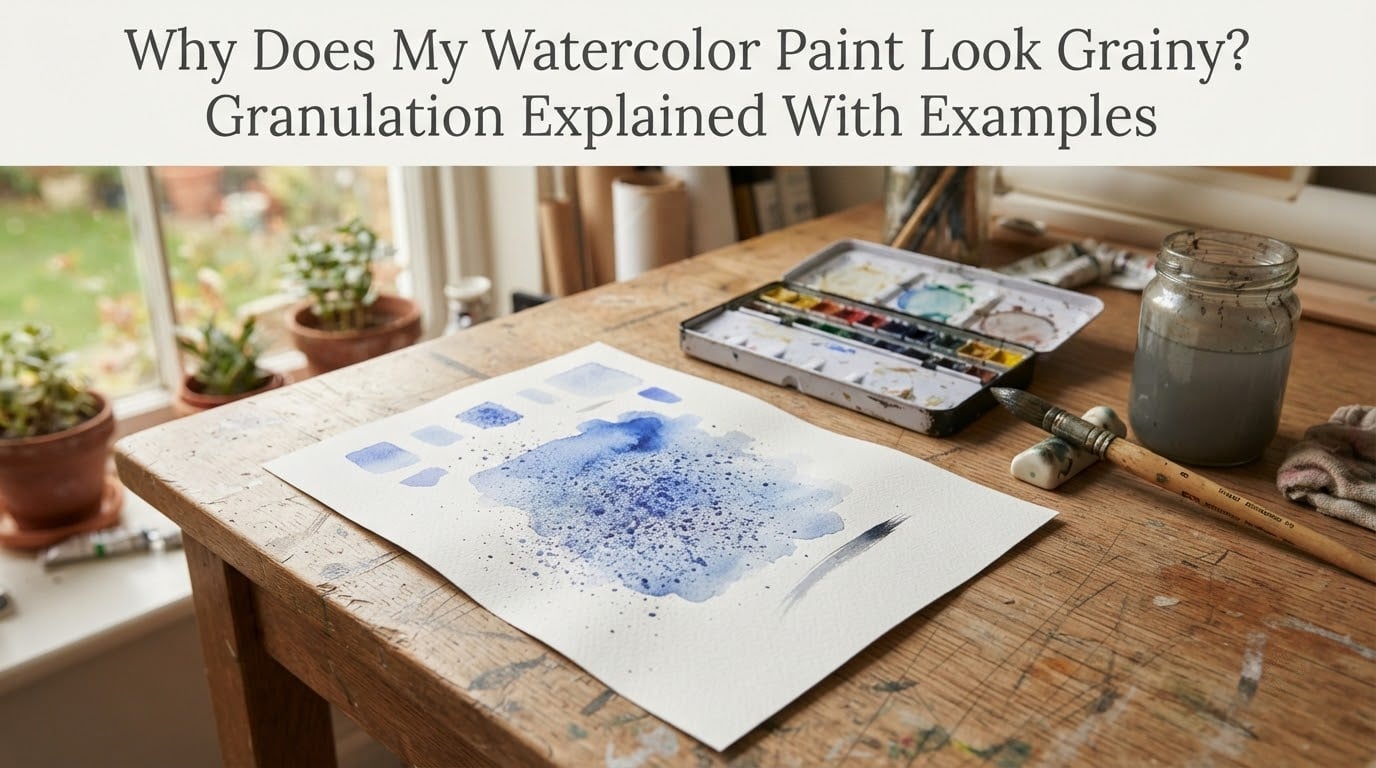
If you have ever asked yourself why does my watercolor paint look grainy, you are not alone. Most beginners spot speckled, sandy patches in their washes and assume the paint or paper is faulty. In our studio, we see this question every week, and the answer is usually simpler and more interesting than people expect: that graininess is most often a feature called granulation, and once you understand it, you can control it on purpose.
This guide walks through what granulation is, why some pigments do it and others do not, how your paper changes everything, and how to troubleshoot real problems versus intentional texture. By the end, you will know exactly why your watercolor paint look grainy in some paintings and buttery smooth in others.
Table of Contents
- Quick Answer: Why Does My Watercolor Paint Look Grainy?
- What Is Granulation in Watercolor?
- Why Granulation Happens: Pigment Particles and Binder
- Common Granulating Pigments (With Examples)
- Non-Granulating and Staining Pigments
- How Paper Choice Affects Granulation
- How to Control Granulation in Your Paintings
- Troubleshooting: Is Your Watercolor Grainy or Granulating?
- Frequently Asked Questions
- The Takeaway
Quick Answer: Why Does My Watercolor Paint Look Grainy?
Your watercolor paint looks grainy because heavier pigment particles are settling into the texture of the paper instead of spreading evenly. This effect is called granulation, and it is a normal behavior of certain earth and mineral pigments, especially on cold press or rough paper, when you use enough water to let the particles move.
Granulation is not a defect. It is what happens when larger, denser pigment grains drop down and clump together as the water dries, leaving speckled patches where the color is concentrated. The same paint brushed onto hot press paper with less water will look smooth, because the pigment cannot travel, separate, or settle.
If your goal is to know whether the graininess is intentional texture or a real problem, the key is to check the pigment and the paper. We cover both in detail below, with examples you can test today.
What Is Granulation in Watercolor?
Granulation is the speckled, textured appearance you see when pigment particles do not spread evenly across the paper. Rather than forming a flat wash, the heavier grains drift to the valleys of the paper surface and gather in small clusters, leaving lighter rings and darker dots that look like fine sand.
We think of granulation as the natural behavior of certain pigment families, mainly earth colors and a few mineral pigments like ultramarine and cobalt. The clumping is visible because the pigment load is heavy and the binder cannot keep every grain suspended in the water.
When reviewers describe a watercolor as looking “grainy” or “speckled,” this is the effect they mean. It is one of the most loved watercolor techniques for adding texture to rocks, tree bark, weathered stone, and skies, and it is fully under your control once you know how it works.
Granulation vs Sedimentation vs Flocculation
Three terms get confused in beginner forums, so let us clear them up. Granulation is the visible speckled result on your paper. Sedimentation is the physical settling of heavier pigment particles at the bottom of your mixing well or wash. Flocculation is when those particles clump together in suspension, forming soft aggregates before they ever touch the paper.
All three are connected, but only granulation is what you see on the page. Sedimentation and flocculation are the mechanics that cause it. If your paint is settling hard in the palette, it will also granulate more strongly on the paper.
Why Granulation Happens: Pigment Particles and Binder
Granulation happens because watercolors are made of pigment particles suspended in a water-soluble binder, typically gum arabic. Larger, heavier particles such as earth oxides, raw sienna, and ultramarine do not stay perfectly suspended. As the wash dries, the binder loses its grip and the heavy grains migrate, settle, and cluster.
Three conditions make granulation more visible. First, larger particle size: coarse-ground pigments granulate more than finely milled ones. Second, higher pigment load: a pan loaded with pigment-rich paint will speckle more than a thin tube color. Third, more water: dilution lets particles move freely, travel across the paper, and settle into valleys.
Reviewers in watercolor forums regularly point out that switching from a hard, smooth paper to a cold press or rough paper makes the same paint suddenly look grainy. The paper is acting like a relief map, and the heavy grains fall into its dips.
Synthetic organic pigments, called “stainers,” are milled very fine and behave differently. They stay suspended, soak into the paper fibers evenly, and tend to produce flat, even washes. That is why your quinacridone rose looks smooth while raw umber looks sandy.
Common Granulating Pigments (With Examples)
If you want grainy, painterly texture, start with this shortlist. These pigments consistently granulate across brands and paper types, and they are the colors most landscape painters reach for.
- Ultramarine Blue (PB29) – the classic granulating blue, loved for skies and shadows
- Cobalt Blue (PB28) – softer granulation, beautiful for water and distance
- Burnt Sienna (PBr7) – the quintessential earth pigment for bark, wood, and warm rocks
- Raw Umber (PBr7) – strong granulation, perfect for ancient stone and weathered walls
- Burnt Umber (PBr7) – deeper version of raw umber, dramatic separation
- Yellow Ochre (PY43) – gentle speckle, ideal for old plaster and sunlit landscapes
- Quinacridone Gold (PO49) – subtle granulation in the warm yellow-orange range
- Viridian (PG18) – cool green that granulates into moss and foliage textures
Try this quick test. Paint a single stripe of each color on a piece of cold press paper, leave it to dry untouched, and look at the wash. You will see the heaviest granulation in ultramarine, raw umber, and burnt sienna, and the smoothest in quinacridone and phthalo pigments.
Non-Granulating and Staining Pigments
Non-granulating pigments, often called “stainers,” behave like dye: they soak evenly into the paper and leave flat washes. They are perfect for skies, smooth gradients, and underpainting where you do not want the texture to compete with the subject.
- Phthalo Blue (PB15) – extremely fine particles, very even washes
- Phthalo Green (PG7) – smooth and intense, ideal for foliage flats
- Quinacridone Magenta (PR122) – staining, transparent, great for floral shadows
- Permanent Alizarin Crimson (PR170) – smooth, soft edge painting
- Winsor Violet (PV23) – staining, beautiful in glazes
- Aureolin (PY40) – light, staining yellow that does not speckle
In our painting sessions, we keep one stainer on the palette specifically because we know that when we want a sky to be perfectly flat, granulation would betray us. Reach for phthalo or quinacridone when you want control.
How Paper Choice Affects Granulation
Paper is the second half of the granulation story. Cold press and rough papers have visible tooth and surface valleys that catch heavier pigment particles. Hot press paper is pressed smooth, so particles cannot drop into dips and granulation is minimal or invisible.
If your watercolor paint look grainy on cold press and behaves perfectly on hot press, the paper is the cause, not the paint. Switching papers is the cleanest way to dial granulation up or down.
- Hot press – smooth, minimal granulation, ideal for illustration and detailed work
- Cold press – classic watercolour paper, moderate tooth, granulation is visible but controlled
- Rough – heavy texture, dramatic granulation, statement-making washes
Paper weight matters too. Lighter papers (190 lb / 300 gsm) buckle more, which slows drying and increases granulation. Heavier papers (300 lb / 640 gsm) stay flatter and dry faster, producing subtler texture. Reviewers note that 100 percent cotton papers granulate more predictably than wood pulp papers, where fillers can muddle the effect.
How to Control Granulation in Your Paintings
Granulation is a tool, not a problem. Use these steps to push the effect in either direction.
To Increase Granulation
- Pick a granulating pigment from the list above, especially ultramarine, burnt sienna, or raw umber.
- Use rough or cold press cotton paper with visible tooth.
- Dilute your wash with plenty of clean water so pigment particles can move freely.
- Tilt the paper at a slight angle so the wash flows slowly across the surface.
- Do not overwork the wash mid-drying. Each brushstroke redistributes the pigment.
To Reduce or Avoid Granulation
- Choose a staining pigment such as phthalo blue or quinacridone.
- Switch to hot press paper or pre-wet and blot the surface flat.
- Use thicker, more pigment-loaded paint with less water.
- Work quickly and dry the area with a hairdryer to lock the wash in place.
- Use a size or watercolor ground on the paper to fill the valleys.
Our team keeps two palettes: one full of granulators for landscape texture, one with stainers for clean skies and modern botanicals. Knowing which paint goes on which paper saves time and frustration.
Troubleshooting: Is Your Watercolor Grainy or Granulating?
True granulation follows the patterns above: speckles concentrated in the valleys of cold press or rough paper, strongest from earth pigments and ultramarine, and controlled by water amount. If your wash looks chalky, dusty, or uneven in a way that does not match the pigment, the issue is something else.
Common look-alikes include paint that has dried out in the pan (re-wet fully before judging), pigment flaking off because the paper is too dry or sized poorly, and “tide lines” where water dried unevenly. Poor adhesion shows as patches that lift when you scrub or restroke, while true granulation stays put and looks decorative.
If reviewers on watercolor forums report “grainy paint that does not stick,” they are almost always describing adhesion issues, not granulation. The test is simple: rest a clean brush on the dried wash. If color lifts onto the brush, your paper is the problem, not the pigment.
When in doubt, swatch the color on a test strip of the same paper and let it dry untouched. Granulation settles predictably; adhesion problems show as flaking or beading.
Frequently Asked Questions
Why does my watercolor paint look grainy?
Your watercolor paint looks grainy because heavier pigment particles settle into the texture of the paper. This effect, called granulation, is most visible with earth pigments and ultramarine on cold press or rough paper, especially when you use plenty of water.
How to achieve granulation in watercolor?
To achieve granulation, use a granulating pigment such as ultramarine, burnt sienna, or raw umber on cold press or rough cotton paper. Dilute the paint with plenty of water, tilt the paper slightly, and avoid overworking the wash as it dries.
Why is my paint grainy?
Your paint is grainy because the pigment particles in certain colors are larger and heavier than the binder can hold in suspension. As the water dries, those particles migrate and cluster in the low points of the paper surface, creating speckles and soft rings.
What does poor paint adhesion look like?
Poor paint adhesion looks like chalky patches or color that lifts when you pass a clean brush over a dried wash. True granulation, by contrast, stays put and forms decorative speckles rather than flaky or beaded areas.
How do I avoid the grainy paper look?
To avoid the grainy paper look, switch to hot press paper, use staining pigments like phthalo or quinacridone, and reduce the water in your wash. You can also dry the wash quickly with a hairdryer to lock the pigment in place before granulation sets in.
The Takeaway
If you have wondered why does my watercolor paint look grainy, the simple truth is that the texture you see is most likely intentional granulation from heavier pigment particles settling into your paper. It is a feature, not a flaw, and once you learn to read it, granulation becomes one of the most expressive watercolor techniques in your kit.
Pick up a granulating color like ultramarine or burnt sienna, swatch it on cold press paper, and try the steps above. You will soon know when the graininess is something to embrace and when it is a sign to reach for a smoother paper or a staining pigment. Both choices are valid, and now you have the tools to make them confidently.